The short answer
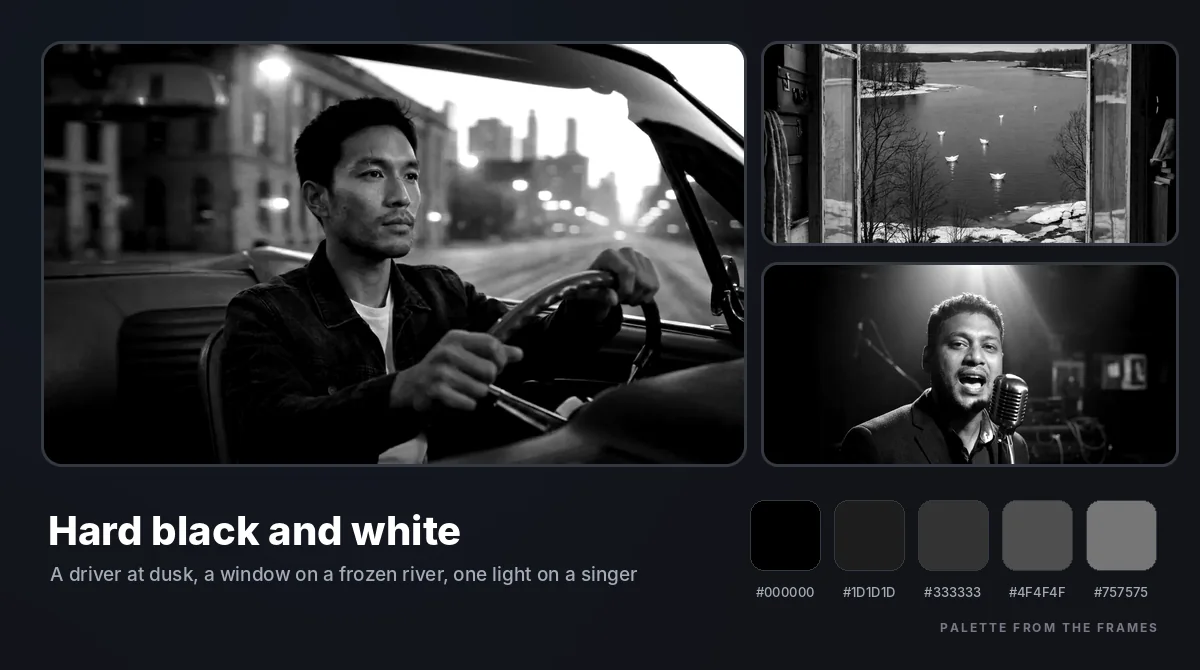
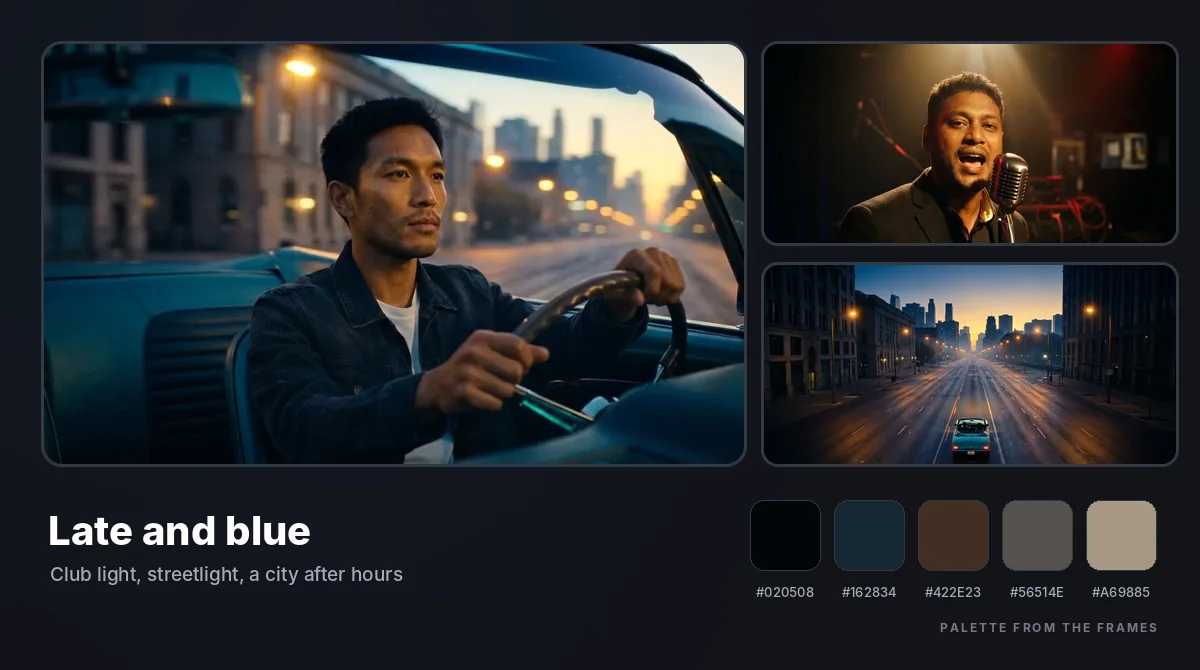
Good jazz music video ideas are rooms with a past, lit by lamps: a hotel lounge at 1 a.m., a 1950s radio studio, a glassblower's furnace through one night. Let the camera listen with slow moves and long holds, use the tune's head as bookends and the solos for wandering, and skip lip sync on instrumentals, which the Abstract and Story styles carry without a singer.
- Set jazz in rooms with a past, lit by lamps, a single spotlight or a streetlight.
- Use the head as the video's bookends and let the picture wander during the solos.
- Instrumentals need no singer: the Abstract and Story styles carry them without lip sync.
- Cuts land on the downbeats Muvora finds; rubato passages hold longer, and odd meters are worth a check.
- Jazz has no genre look of its own: pick lo-fi for ballads and jazz-hop, and describe the rest in the idea box.
On this page (6 sections)ShowHide
What makes a jazz music video work
A jazz video that works feels like being let into a room where something good is happening. It doesn't need many people or many places; it needs atmosphere you can name, a camera that seems to be listening, and a shape that follows the tune. Five choices carry most of it.
- Rooms with a past. A low-ceilinged basement club, a hotel lounge with a curved bar, a radio studio paneled in wood, a rehearsal room over a shop. Places that look as if music has been played in them for decades.
- Light from lamps, not rigs. Table lamps with fabric shades, one spotlight on a singer, sodium streetlights through a window, the red light over a studio door. Amber and near-black, with one cool blue from outside to give the frame depth.
- A camera that listens. Slow push-ins, long holds and a slow pan that keeps the players in frame. A jazz audience sits still and leans in; the camera should too, saving its rare moves for a solo's peak.
- The form as the structure. Most tunes state the melody (the head), give each player a solo over the same chords, then play the head again. Make the head the video's opening and closing, and let the solos wander to other places, other hours or other colors.
- One piece of wardrobe. A camel overcoat, a silk scarf, a worn cardigan, a pair of round glasses: name it in the idea box in the same words every time, and it becomes the lead's signature across every shot.

How cuts land on swing, rubato and odd meters
Swing lives between the beats: the long-short eighth notes, the ride cymbal's lilt, the bass walking quarter notes. Cuts don't need to chase any of that. Muvora's shot planner cuts on downbeats, the first beat of a bar, so every change of picture lands on the one and the swing plays out inside each shot. Tempo decides how long those shots can be. A ballad around 60 BPM has four-second bars; a medium swing tune often sits somewhere around 120 to 160; bebop heads often fly past 200. Once a 4/4 bar lasts under about 1.6 seconds (faster than 150 BPM), the planner counts bars in twos, so a 240 BPM burner cuts at the pace of a 120 BPM tune rather than flickering. Find your tempo with the tap tempo tool before you plan.
Free time is the other half of jazz. Muvora cuts on the downbeats it finds, and on loose, rubato passages (an unaccompanied piano intro, a singer stretching a phrase over a held chord, a final cadenza) it finds fewer firm ones, so the planner holds longer shots there, which suits the music. Waltzes in 3/4 are read like any other song, with cuts on the first beat of each bar. In 5/4 or 7/4 the downbeats found may not match the count you feel, so play the storyboard against the music and drag any cut that lands mid-phrase; it snaps to the nearest beat.
| Part of the tune | What happens | Shot ideas | Pace |
|---|---|---|---|
| Intro or count-in | A piano alone, a bass pedal or a drum fill sets the room | The room before anyone arrives: chairs on tables, a lamp, rain on the window | One or two long holds |
| The head | The melody, stated plainly, sometimes sung | The lead in their place: the singer at the microphone, the guard on his rounds, the glassblower at the furnace | Steady, about one shot every two bars |
| Solos | Each player improvises over the chords | Wander: a new color, place or memory for each soloist, or details of the room | Freer; longer holds in quiet choruses, shorter as a solo builds |
| Trading fours or a drum break | Short phrases passed between players | Quick back-and-forth between two or three images | The fastest cuts of the tune |
| Head out | The melody returns | Back to the opening place, changed: the room full, the dawn up, the piece finished | Steady again |
| Tag or coda | The last phrase repeated, a held final chord | One image that lets go: the lights going down, the bulb swinging, the last reflection still | One long shot to the end |
Skip the blank page
Upload your song and Muvora's AI director plans a shot-by-shot storyboard on the beat. Edit every shot for free, and pay only if you render.
Vocal jazz ideas
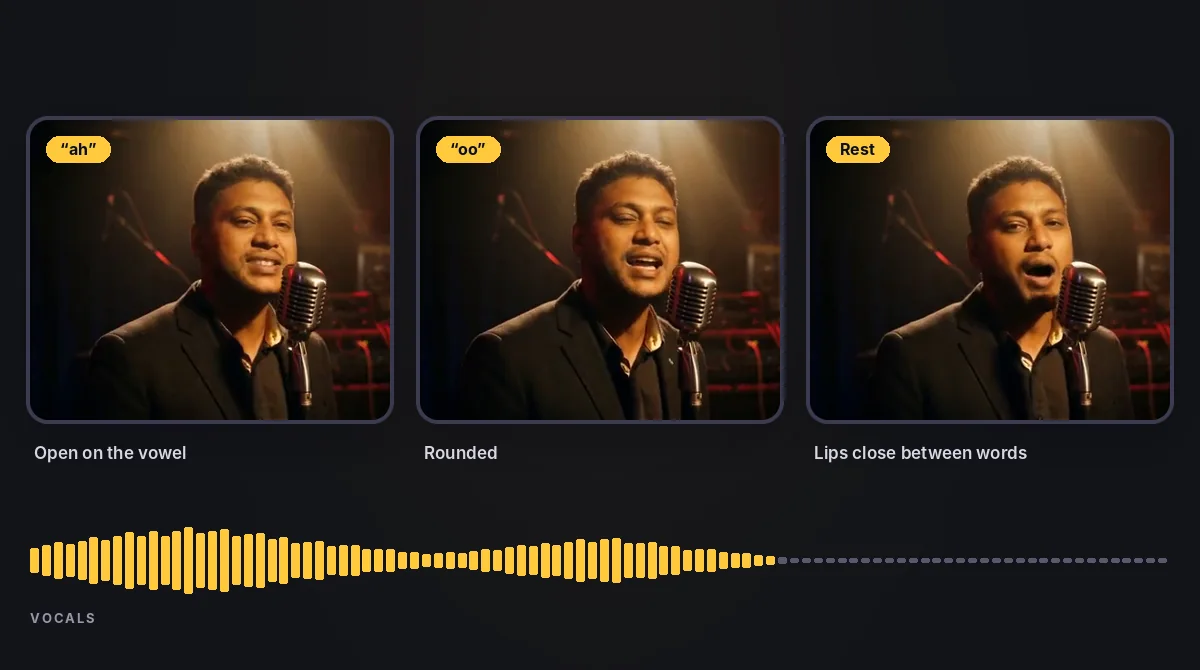
A jazz singer's video lives on the face and the room around it. With the Performance style you upload one clear, front-facing photo of the singer (yourself, or someone who has given permission, confirmed with a consent box), and Muvora lip-syncs the shots where the song is sung; the piano or horn solos get other shots. These four concepts give a singer a room worth being in.
- Performance · 1950s radio
Live on the wireless
A singer at a ribbon microphone in a wood-paneled radio studio around 1958, a small band behind her, the engineer watching through glass, a red light glowing over the door. Verses stay in the studio in warm tungsten light. Each chorus cuts to the people listening: a cab driver at a red light, a couple in a kitchen, a night watchman with a radio, all leaning in.
Use this idea on my songUse this idea on my song - Performance · backstage
Ten minutes to the downbeat
Ten minutes before the first set in the narrow corridor behind a basement club. Verses follow the singer from a mirror ringed with bulbs, past the drummer tapping brushes on a road case, to the edge of the curtain. Each chorus she's a step closer to the light; the last chorus is the stage itself, one spotlight, the trio behind her, the room gone quiet.
Use this idea on my songUse this idea on my song - Performance · blue hour
Balcony call and response
Two balconies across a narrow courtyard at blue hour. The singer sings from one; on the other, an old man answers her phrases on a muted trumpet. Verses are the two of them trading lines while the neighbors' windows stay dark. Each chorus another window opens and lights up, a head leans out, a plant gets watered; by the last chorus the whole courtyard is lit and listening.
Use this idea on my songUse this idea on my song - Performance · late night
Hotel lounge, last set
A hotel lounge at one in the morning: a curved bar, a piano under a pink-shaded lamp, two guests left. The singer leans on the piano while the pianist plays. Verses hold close on her in the lamp's warm pool; each chorus the barman stacks another chair or polishes another glass. On the last chorus the overhead lights come up and she keeps singing to the empty room.
Use this idea on my songUse this idea on my song
Hear your tune as a storyboard
Upload the track, press “Use this idea on my song” on a concept and read the storyboard Muvora writes for it, every cut on your downbeats and the head bookending the video. Editing is free, and the free plan gives you 5 new storyboards a month to compare ideas.
Instrumental jazz ideas, no lip sync needed
Most jazz has no vocal at all, and that frees the picture. No singer means no lip sync and no photo: the Abstract style turns the music into color and texture, and the Story style follows characters through a night while the band plays on the soundtrack. Let the head bookend the story and give each solo its own image or color. A drawn look suits jazz well too; see the animated music video maker for how a drawn medium carries through every shot.
- Abstract · instrumental
Smoke and brass
No people: warm amber smoke curling through black space, catching light like polished brass. Each saxophone phrase pulls a ribbon of it into a new shape; the ride cymbal is a slow shimmer of gold dust; the walking bass is a pulse of light along the bottom of the frame. Every solo takes a color of its own, and when the head returns they all come back at once.
Use this idea on my songUse this idea on my song - Story · instrumental
The planetarium after closing
A night guard at a city planetarium finishes his rounds and switches the star projector on just for himself. The opening theme is the empty dome under work lights and his flashlight along the seats. Each solo is a different sky turning overhead: a winter field of stars, a slow eclipse, a comet's tail. When the theme returns the dome fills with stars and he lies back in a seat.
Use this idea on my songUse this idea on my song - Story · craft
The glassblower's night
A glassblower works alone through one long night, the furnace mouth glowing orange. The opening theme is the routine: gathering molten glass, turning the pipe, a puff of breath. Each solo is a new piece taking shape, a bowl, a vase, a twisted stem, in close-ups of tools, sparks and heat. When the theme returns at dawn, the finished pieces catch the first light on a shelf by the window.
Use this idea on my songUse this idea on my song - Story · cut-paper animation
Paper quartet
A jazz quartet made of cut paper on a flat stage of mid-century colors: a pianist of black rectangles, a bassist all curves, a drummer of circles, a saxophonist shaped like a bent leaf. On each solo the soloist's shapes grow, change color and spill across the stage while the others shrink to the edges. When the theme returns, all four snap back into one bold composition.
Use this idea on my songUse this idea on my song - Abstract · ballad
Rain on the boulevard
For a slow ballad: a wet city boulevard at night, seen only in its reflections. Puddles hold the colors of lit windows and passing headlights, each piano note a ripple spreading across them. Long holds through the theme; the solo brings a light rain that breaks every reflection into points of color. At the end the rain stops and one red reflection settles and goes still.
Use this idea on my songUse this idea on my song

A long instrumental, a live recording or a whole set can run eight minutes, which is where cost starts to matter. A music visualizer in Muvora is the Abstract style at the Visualizer quality: AI video on every shot, cut on the beat, at the lowest credit rate, so a long tune gets moving pictures from start to finish without a cinematic budget.
Neo-soul, jazz-hop and lyric ideas
Neo-soul borrows jazz chords and puts them under a soul vocal; jazz-hop loops jazz samples over relaxed hip-hop drums. Both sit close to R&B and lo-fi, so the R&B music video ideas and the lo-fi music video generator are good neighbors to this list. In Muvora the lo-fi look suits both: warm, unhurried and cut slowly. These five keep the room warm and the pace easy.
- Performance · neo-soul
Rhodes in the sunroom
A sunroom full of plants on a slow Sunday afternoon, an electric piano by the glass, light moving across the tiled floor. The singer sits beside the keys, barefoot, a cup of tea going cold. Verses hold close on her face in green-filtered light; each chorus the sun reaches a new corner of the room, and the last chorus is golden hour, friends arriving at the screen door.
Use this idea on my songUse this idea on my song - Performance · neo-soul
Barbershop after closing
A barbershop after closing on a summer night: chairs swept, clippers hung, a radio on the shelf. The barber, who is the singer, sweeps up and sings to the mirrors under the fluorescent tubes. Each chorus a regular drifts back in from the street, one to sit, one carrying a bass guitar, one with brushes and a snare. The last chorus is a jam session among the chairs.
Use this idea on my songUse this idea on my song - Story · jazz-hop
Crate-digging at dawn
A producer at a flea market at dawn, flipping through crates of records in plain paper sleeves while the stalls set up around her. Verses follow the hunt in cool early light: a vendor's dog, a pile of old radios. Each chorus a record drops onto her turntable at home, the needle settling into the groove; the last chorus plays out of her open window to the street.
Use this idea on my songUse this idea on my song - Lyric · rain
Through the steamed window
Karaoke-style captions over the view from the street into a small jazz bar on a rainy night. Through the steamed-up window the band is a warm blur; outside, umbrellas pass and a couple shelters under the awning. Each chorus someone pushes the door open and a little more light spills onto the wet sidewalk; on the last chorus the couple goes in.
Use this idea on my songUse this idea on my song - Lyric · jazz-hop
Rooftop record at dusk
Captions over a rooftop at dusk where a turntable sits on a milk crate beside a string of bulbs and some potted tomatoes. Pigeons circle, the city lights come on block by block, a train crosses a bridge in the distance. Each chorus the camera rises a floor higher above the roofs; the last chorus is full night, the bulbs and the turning record the only things moving.
Use this idea on my songUse this idea on my song

From a jazz idea to a storyboard
- 01
Find the tempo and mark the form
Tap out the tempo, then note where the head ends, where each solo starts and where the head comes back. Those are the moments to check once the storyboard arrives.
- 02
Upload the master
Upload the mix you'll release (MP3, WAV, M4A, AAC or FLAC, up to 8 minutes) and confirm you own it or have the rights. For a vocal tune, paste the lyrics: they're aligned to the singer for captions, and the AI director reads them for meaning.
- 03
Pick the style
Performance for a singer on screen from one photo, Story for characters through a night, Abstract for an instrumental made of color and texture, Lyric for captions over the scenes.
- 04
Choose a look and write the room
Jazz has no genre look of its own: pick lo-fi for ballads, neo-soul and jazz-hop, or leave it empty. Then use the idea box's 600 characters for the room, the hour, the lamps, the lead's one piece of wardrobe and what changes when the head returns.
- 05
Read the storyboard against the music
Play it through and check the head bookends the video, the solos wander, no close-up shows hands on keys or valves, and every cut in a rubato or odd-meter passage sits where you feel the phrase turn. Drag any that don't; they snap to the nearest beat.
- 06
Render and share it
Choose a quality, check the exact price and generate. Re-roll any shot that misses, then download the 16:9 video, the vertical and square versions and an 8-second Canvas loop.
For a long instrumental, Visualizer at 38 credits a second covers the whole tune most affordably; Standard at 60 keeps a recurring character, like the night guard or the barber, steadier from shot to shot; Cinematic at 110 is made at 1080p. Lip-synced shots in a Performance video are 75 credits a second, and the exact price shows before you generate. For more concepts across genres, browse the music video ideas hub, and for quieter songs with a single voice, the acoustic music video ideas.
Chord transposerMoving a standard into a singer's key for a new recording? Paste the chord chart and transpose it, slash chords and extensions included, spelled with the sharps or flats of the new key.Give the tune its room
Upload the track, paste a concept into the idea box and get a storyboard cut on your downbeats, slow where the music breathes. Change every shot for free, then render when the head looks right.
Written by the Muvora team. Last updated November 14, 2026. Spotted something out of date? Tell us at [email protected].