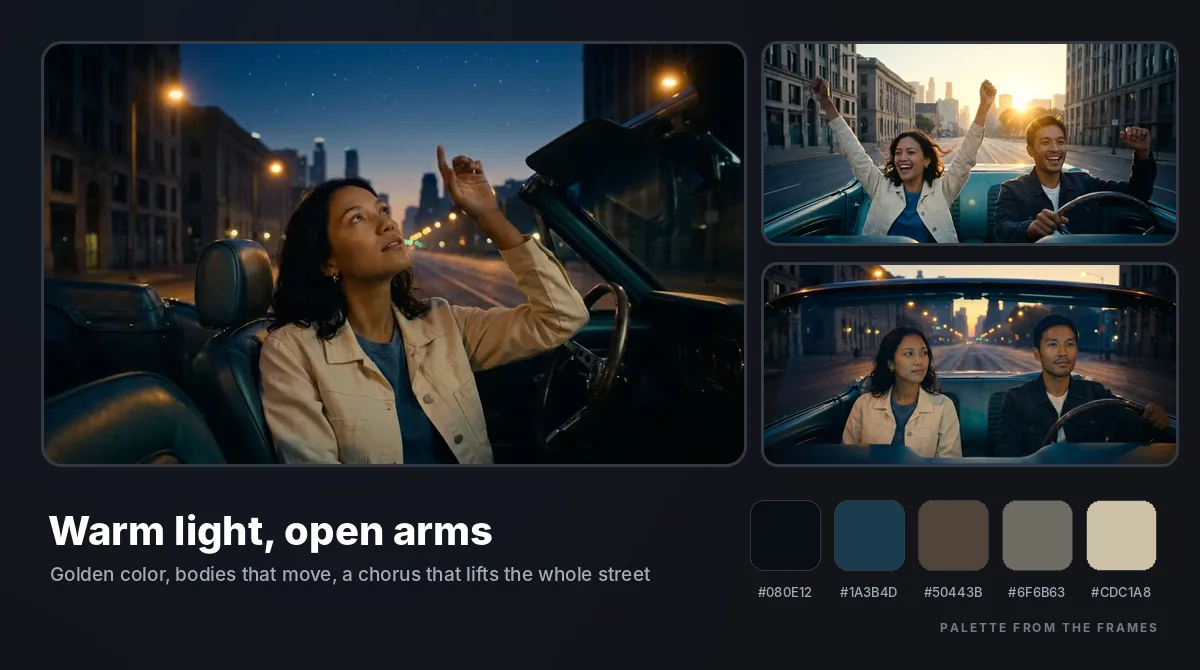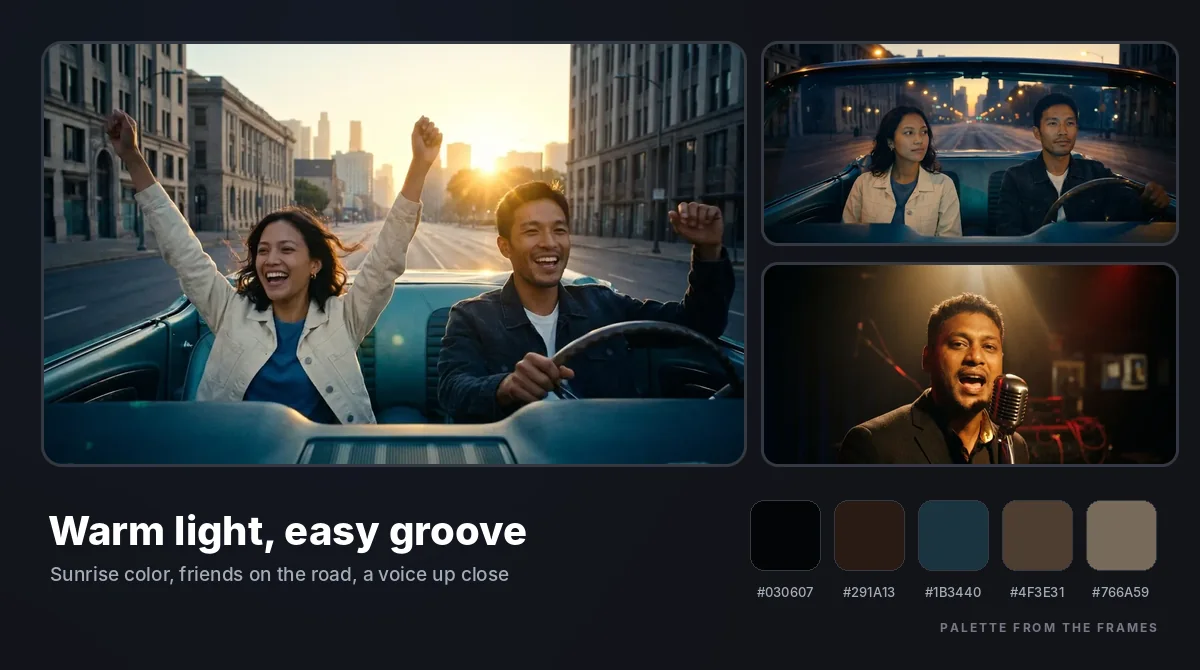
The short answer
Good reggae music video ideas start from a real place and the people in it: a hillside farm at first light for roots, a sound clash in a schoolyard for dancehall, a front-room party for lovers rock. Hold shots longer than pop does, check that the cuts sit with the one drop's accent on beat three, and skip the beach-and-flag postcard.
- Start from a real place with work and weather in it, not a beach at sunset.
- Pick the idea by sound: roots, dancehall, lovers rock and fusion each want a different world.
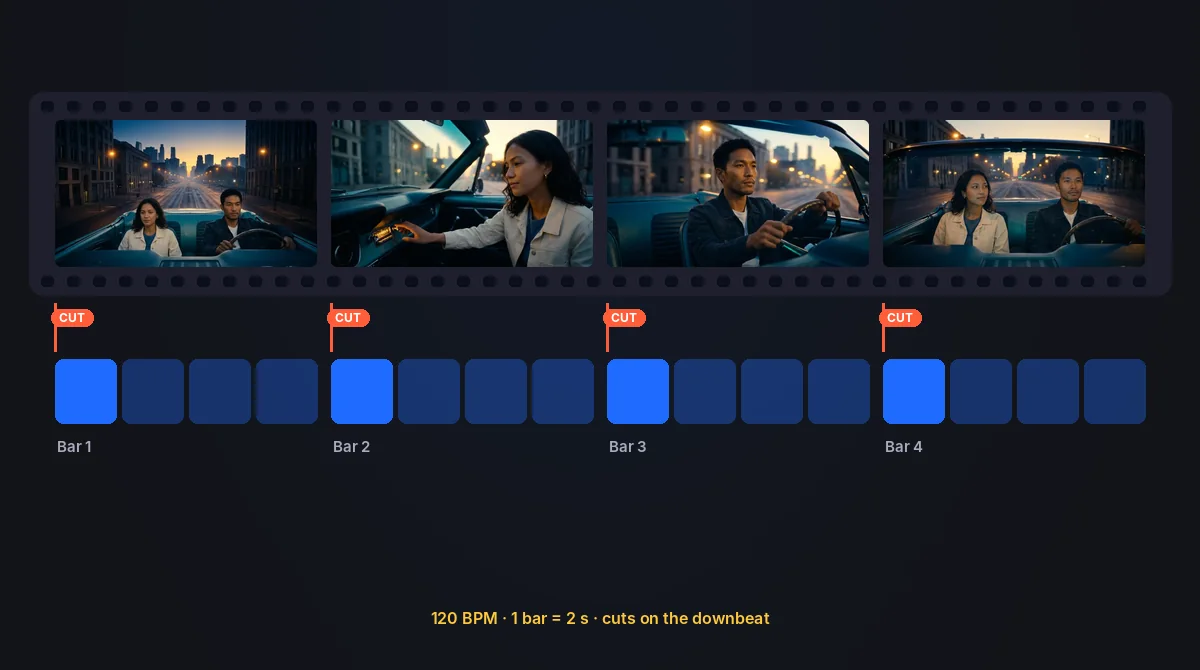
- The one drop leaves beat one empty and lands on three: check the cuts against it and drag any that feel off.
- Reggae has no genre look of its own: lo-fi suits roots and lovers rock, hip-hop suits dancehall, pop suits most fusion.
- Paste your lyrics so patois and slang reach the captions exactly as you wrote them.
On this page (7 sections)ShowHide
What makes a reggae music video work
A reggae video works when it feels like the song's own corner of the world on an ordinary day that turns into a good one. The riddim is patient, so the picture can be too: fewer cuts than pop, more time on faces, hands and the street around them, and a chorus that brings people together. Five choices carry most of it.
- A place with work and weather in it. A hillside plot in morning mist, a fishing beach where the boats come in at dawn, a yard with a sound system half built, a minibus climbing a mountain road, a front room with the furniture pushed back. Places where people live, not where tourists pose.
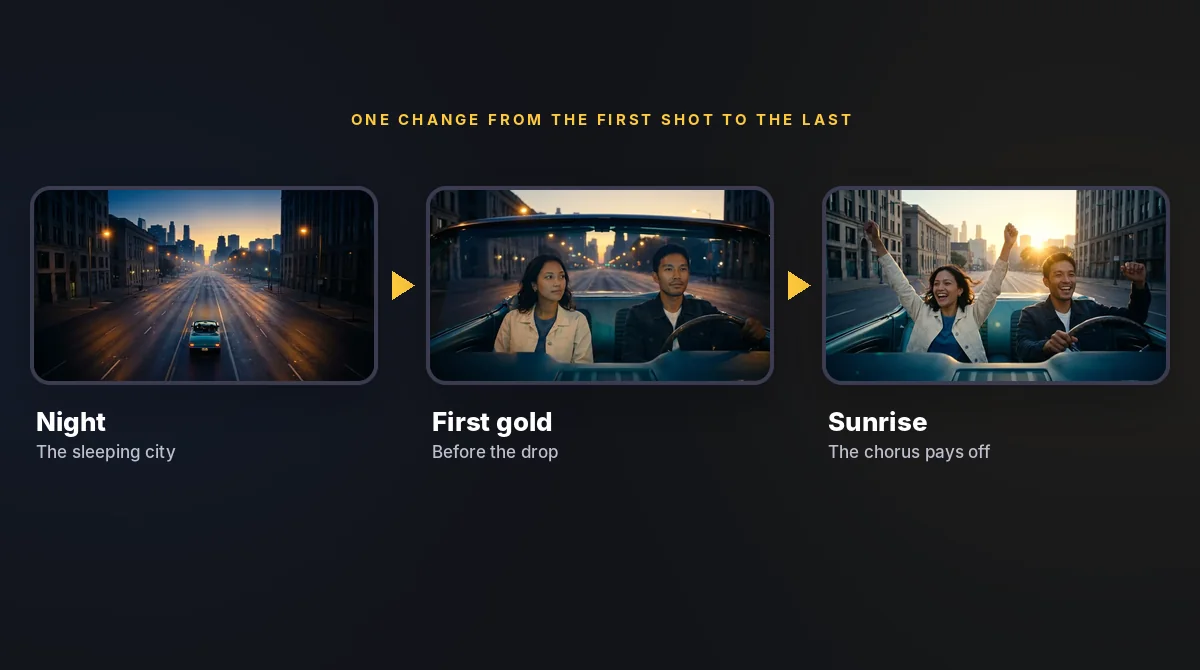
- Light from the sun and from bulbs. Low early sun through dust, the hard white of noon on a zinc roof, bare bulbs strung across a yard at night, a single red bulb in a front room. Name the source in the idea box and the director lights each shot from it.
- A camera that sits back. Planted wide shots that let people walk through the frame, slow push-ins on a singer, a high angle over a yard filling up. Reggae's biggest moments are often a crowd moving as one, and that needs room in the frame.
- Wardrobe with a story. A pressed short-sleeved shirt for church, a straw hat with a black band, a market vendor's apron, an outfit planned all week for Saturday's dance. Give the lead one signature piece and name it in the same words every time.
- Community in the chorus. A reggae chorus is sung by a crowd as much as by the singer. Let the verses follow one person and let each chorus bring in more of the neighborhood: a vendor, a grandmother, the children from next door.
How the cuts sit on a one-drop riddim
Most music puts its weight on the first beat of the bar. The one drop doesn't: in each 4/4 bar the kick drum and a rim shot land together on beat three, beat one is left empty, and the guitar and keys chop short chords on the offbeats (the skank). Rockers puts the kick on beats one and three, and steppers puts it on all four, which is why a steppers tune feels like it's marching forward while a one drop seems to lean back.
Muvora's shot planner cuts on the downbeats its analysis finds, always cuts at a section change, and holds shots longer in quiet parts. With a one drop, the empty beat one gives the analysis less to hear, so it may count the bar from the drum hit on three instead. Cuts then land with the drop, which often suits the music; if one feels half a bar early or late, drag it in the editor and it snaps to the nearest beat. Check the tempo too: a tune that feels like 72 BPM can also be counted at 144, by people and by software. If the storyboard changes shots twice as often as the song feels, merge them in pairs. Tap along with the tap tempo tool or play against the metronome to know which count you're in.
Slow tempos make long bars: at 75 BPM one bar lasts 3.2 seconds, so a verse can hold a shot for a bar or two, and in a loud chorus the planner may cut on a beat inside the bar rather than wait that long. Dancehall's faster riddims give bars nearer two and a half seconds and a shot about every bar in the chorus.
| Sound | Often around | What the drums and bass do | Cut pacing | Nearest look |
|---|---|---|---|---|
| Roots reggae | 60 to 90 BPM | One drop or rockers, a heavy bass line carrying its own melody | A bar or two a shot, longest in the verses | Lo-fi |
| Lovers rock | Slow and smooth, like roots | A soft one drop under a sweet, close vocal | Long holds, close on faces | Lo-fi |
| Dancehall | 90 to 110 BPM | A digital riddim with a deejay chanting over it | About a bar a shot in the chorus | Hip-hop |
| Steppers and dub | Varies | A kick on every beat, or the band dropping out under echo and reverb | Steady cuts, long holds in the breaks | Hip-hop for steppers, lo-fi for dub |
| Reggae fusion | Whatever its other half uses | A reggae lilt under pop, hip-hop or R&B production | Like its other half | Pop or hip-hop |
Skip the blank page
Upload your song and Muvora's AI director plans a shot-by-shot storyboard on the beat. Edit every shot for free, and pay only if you render.
Roots and lovers rock ideas
Roots reggae sings about faith, home, work and justice. Lovers rock, the romantic reggae that came out of South London in the mid-1970s and filled its house parties, sings about love in a soft, close voice. Both want warm light, patient shots and people you'd believe live where the camera finds them. The lo-fi look holds every shot about a third longer, which suits them, and the Performance style puts the singer on screen from one photo.
- Story · roots · dawn
Morning on the hill
A farmer and her teenage son climb a misty hillside at first light to work a small plot of yams and callaloo, a radio hanging from a branch. Verses follow the work: water carried from a spring, weeds cleared, breakfast eaten on a stone wall. Each chorus the sun climbs higher and neighbors appear on the next terraces; the last chorus is noon, everyone eating together under a breadfruit tree.
Use this idea on my songUse this idea on my song - Story · roots · craft
Speaker boxes
A carpenter builds a sound system in his yard over one week: plywood sheets, a hand saw, speaker cones laid on a table, his daughter painting the cabinets deep green. Verses are the work in close-ups of sawdust and screws; each chorus another finished box joins the stack. The last chorus is Saturday night, the stack complete, the yard full and the first bass note shaking the mango leaves.
Use this idea on my songUse this idea on my song - Story · roots · journey
Last bus over the mountain
A minibus climbs a mountain road at dusk, packed with market women and their baskets, a schoolboy, a man holding a rooster and a driver tapping time on the wheel. Verses ride the bends inside the bus, window light sliding over tired faces. Each chorus the passengers sing a little louder with the radio; on the last chorus the bus reaches the village and porch bulbs light the road.
Use this idea on my songUse this idea on my song - Performance · lovers rock · night
Front-room dance, 1979
A front room in a terraced house on a Saturday night in 1979: furniture pushed against the walls, a wooden radiogram in the corner, a red bulb in the ceiling and condensation on the window. I sing by the radiogram while couples dance close. Each chorus the room gets fuller and warmer; the last chorus is the final record, two dancers left and the window turning grey with dawn.
Use this idea on my songUse this idea on my song - Performance · lovers rock · daytime
Sheets on the line
I hang washing across a sunny backyard, white sheets lifting in the breeze, a kettle whistling through the kitchen window. Verses stay close on my face between the sheets. Each chorus a gust blows one aside to show a memory of the person I'm singing to, at the same line years earlier; on the last chorus he's there again, holding the other end of a sheet.
Use this idea on my songUse this idea on my song
See a reggae idea on your own riddim
Upload the track, press “Use this idea on my song” on a concept and read the storyboard Muvora writes for it, with every cut timed to your song and the chorus growing each time it returns. Editing is free, and the free plan makes 5 new storyboards a month, so you can try two ideas side by side.
Dancehall ideas
Dancehall moves faster and dresses louder: digital riddims, a deejay chanting over them, crews of dancers and outfits planned all week. Its videos work when they feel like a night out in a real neighborhood rather than an ad for a club. The hip-hop look cuts about a fifth faster, which suits a busy riddim. Describe dancing as movement in the scene (a crew dropping low together, a spin at the end of a line), because AI video draws motion but won't follow counted steps.
- Performance · dancehall · sound clash
Clash in the rain
Two sound systems face each other across a schoolyard in heavy rain, each with its own stack of boxes and its own crowd. I chant at the mic on one side while the selector across the yard waits his turn. Verses swap between the camps under colored bulbs; each chorus the crowds edge closer, and on the last chorus they're one crowd dancing in the puddles.
Use this idea on my songUse this idea on my song - Story · dancehall · getting ready
Saturday is the outfit
A week of getting ready for one dance: fabric chosen at the market on Monday, a fitting at the tailor's on Wednesday, nails on Friday, hair on Saturday afternoon. Verses are each errand in bright daylight with two best friends. Each chorus flashes forward to the dance itself, the outfit finished and turning under colored bulbs, and the last chorus stays at the dance until the sky gets light.
Use this idea on my songUse this idea on my song - Story · dancehall · dusk
Sound truck through the market
A small sound system strapped to a flatbed truck rolls slowly through a busy market at dusk, a selector riding beside the speakers. Verses follow the truck past fruit stalls, a barber's chair on the pavement and children running alongside. Each chorus the truck stops and the street around it dances; on the last chorus it parks at the crossroads and the whole market follows it there.
Use this idea on my songUse this idea on my song - Story · dancehall · road
Bike crew at sundown
A crew of friends on small motorbikes cruises a coast road at sundown, a cargo ship far out on a flat orange sea. Verses ride with them in pairs: wheels, wind and laughter. Each chorus they stop at a roadside cookshop where a speaker is already playing and more riders pull in; on the last chorus they ride off in a long line as their headlights come on.
Use this idea on my songUse this idea on my song - Story · dancehall · one location
Tire shop to dance floor
A roadside tire shop: by day the owner patches inner tubes and stacks tires in hard sun while a radio plays. At dusk the tires become seats, a speaker comes out of the back room and a string of bulbs goes up over the forecourt. Each chorus the camera sits a little wider as the space fills, and the last chorus is the whole street dancing between the tire stacks.
Use this idea on my songUse this idea on my song
Reggae fusion, dub and lyric ideas
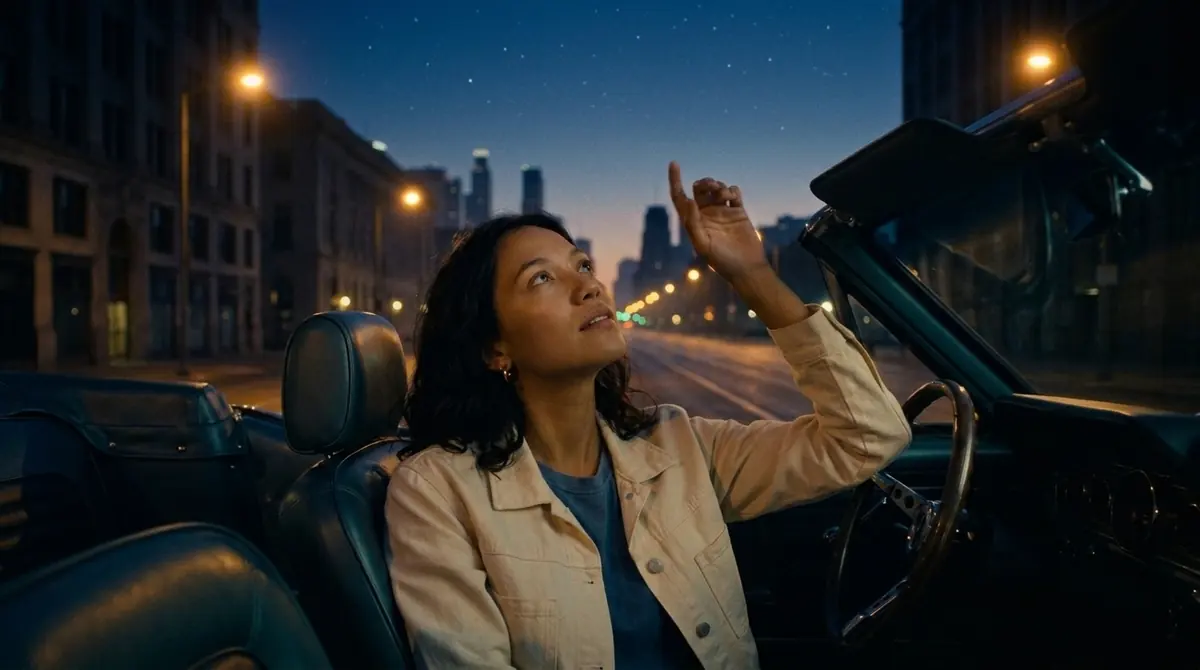
Reggae fusion puts the lilt under pop, hip-hop or R&B production, so its video can borrow that genre's polish: pick pop for a radio single, hip-hop when a rapper features. Dub strips a riddim to drums, bass and echo, and suits the Abstract style, where the picture moves because the sound does. Lyric videos work for any of them. Reggaeton, which grew partly out of dancehall, has concepts of its own in the Latin music video ideas.
- Story · fusion · daytime
Ferry between two towns
A small passenger ferry crosses a bright bay between two towns. On the upper deck a young man in a white linen shirt and a woman with a yellow headwrap keep catching each other's eye. Verses are the crossing: ropes, gulls, spray on the rail. Each chorus the boat passes the ferry going the other way and both decks wave; on the last chorus the two step off together.
Use this idea on my songUse this idea on my song - Story · fusion · city
Rooftop water tanks
Flat rooftops in a hot city, each with a black water tank, a satellite dish and a washing line. Two neighbors on facing roofs start talking across the gap, a radio beside each. Verses are the afternoon heat and small gestures; each chorus another rooftop joins with its own radio until the skyline is a party, and the last chorus is sunset with a plank laid across the gap.
Use this idea on my songUse this idea on my song - Abstract · dub
Echo pool
No people: a single drop of water falls into a dark pool, its ripples repeating and fading like a tape echo. The snare sends rings of warm amber light across the surface; the bass is a slow swell beneath it. In the dub breaks the picture empties to one ripple and a long trail of light, and when the riddim returns the whole pool shimmers amber and deep green.
Use this idea on my songUse this idea on my song - Story · dub · one room
Cutting the dubplate
An engineer cuts a one-off record at night on a lathe in a small studio, the stylus carving a spiral into black lacquer under a desk lamp. Verses are close-ups of the cut: the thread of lacquer curling away, the reels, the engineer's hands at a distance. Each chorus the finished plate plays on a big system across town; on the last chorus the engineer arrives to hear it.
Use this idea on my songUse this idea on my song - Lyric · daytime
Dominoes under the mango tree
Karaoke-style captions over a domino game under a mango tree: four old friends slapping tiles onto a wooden table, a radio on a crate, children watching from a low wall. Verses hold on hands, tiles and faces in dappled shade. Each chorus a winning tile slams down and the table erupts in laughter; the last chorus is dusk, the game over and the radio still playing.
Use this idea on my songUse this idea on my song
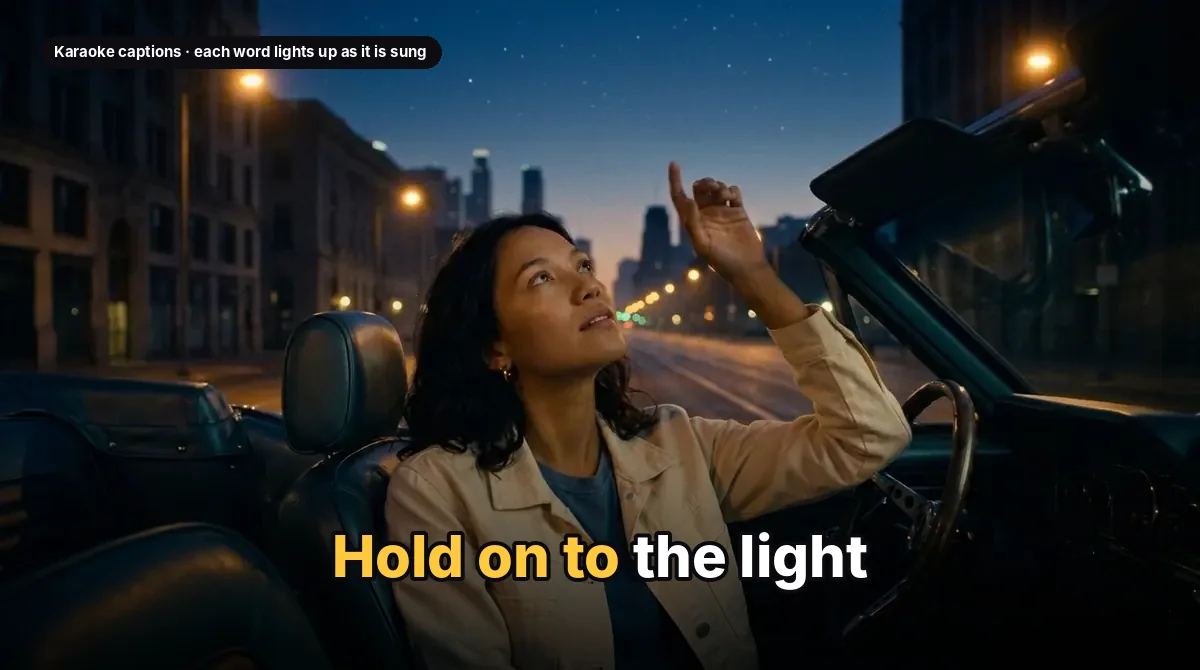
Patois and slang are where automatic transcription struggles most, so paste the lyrics with the upload: the captions then use your text, aligned to the vocal word by word, and the AI director reads them for meaning rather than guessing. A deejay's chanted verse is vocal too, so in a Performance video the shots over it can be lip-synced like the sung ones.
A reggae video, section by section
Many reggae songs let the riddim play alone before the voice comes in, give the singer long verses, bring a crowd into the chorus and drop the band out for a dub break near the end. Muvora's analysis names the parts it hears with ordinary song-form labels (intro, verse, chorus, bridge, outro), so match them to your arrangement by ear and use this as a starting map.
| Part of the song | What happens | Shot ideas | Pace |
|---|---|---|---|
| Intro or riddim alone | Drums and bass set the groove before the voice | The place waking up: a yard swept, shutters rolled up, speaker boxes carried out | One or two long holds |
| Verse | The story or the message | The lead at work or on the move, one action a shot: carrying, cooking, fixing, walking the road | A bar or two a shot |
| Chorus | The line everyone sings | The community arriving: neighbors, the crowd at the sound system, one image that returns each time | Shorter, about a bar |
| Deejay or toasting verse | A second voice chants over the riddim | Another angle on the same scene: the mic, the selector's hands, the crowd closer | Quick |
| Dub break | The band drops out, echo and reverb take over | One image held and left to breathe: smoke in a beam, a ripple, an empty street | The longest holds |
| Outro | The riddim rides out | The place winding down: the last bus, chairs stacked, first light | One long shot to the end |
From a reggae idea to a storyboard
- 01
Find the count and mark the moments
Tap the tempo and decide whether the song feels like 70-something or 140-something, then note where the riddim starts, where the deejay comes in and where the dub break drops the band out.
- 02
Upload the master and paste the lyrics
Upload the mix you'll release (MP3, WAV, M4A, AAC or FLAC, up to 8 minutes), confirm you own it or have the rights, and paste the lyrics so patois is captioned as written and the director reads the words for meaning.
- 03
Pick the style and the nearest look
Story for a place and its people, Performance for the singer on screen from one photo, Abstract for a dub version, Lyric for captions over the scenes. Then pick lo-fi for roots and lovers rock, hip-hop for dancehall and pop for most fusion.
- 04
Write the place into the idea box
Use the 600 characters for the place, the hour, the light sources, two or three colors that are really there and the lead's one signature piece of wardrobe, and say how each chorus brings more people in.
- 05
Check the cuts against the drop
Play the storyboard with the song. If a cut feels half a bar off the drum hit, drag it (it snaps to the beat); if shots change twice as fast as the song feels, merge them in pairs. Rewrite any shot that drifted toward the postcard.
- 06
Render and release it
Choose a quality, check the exact price and generate. Re-roll any shot that misses, then download the 16:9 video, the vertical and square versions and an 8-second Canvas loop for streaming.
Visualizer at 38 credits a second covers a long roots tune or a dub version most affordably; Standard at 60 keeps a recurring lead, like the carpenter or the ferry passengers, steadier from shot to shot; Cinematic at 110 is made at 1080p. Lip-synced seconds are 75 credits a second, and the exact price shows before you generate. The reggae music video maker page puts the settings in one place, the music video ideas hub has concepts for every genre, and the Afrobeats music video ideas suit a song that sits between the two.
Music video idea generatorNot sold on any of these? The idea generator suggests concepts by genre and mood, each with places, light, a motif and a chorus moment, ready to adapt for a reggae song.Give your riddim its place
Upload the song, write the place and its people into the idea box and get a storyboard cut to your track, patient where the bass breathes. Change every shot for free, then render when it looks like home.
Written by the Muvora team. Last updated November 14, 2026. Spotted something out of date? Tell us at [email protected].