The short answer
A filmed music video for an independent artist usually costs from a few hundred dollars for a simple one-day shoot to several thousand for an experienced crew, and label videos cost far more. An AI music video is priced by the finished second instead: in Muvora the storyboard is free and a 3-minute video renders for 6,840 to 19,800 credits, depending on quality.
- A shoot's cost is mostly days, crew and locations, spent before you see a single frame.
- Independent budgets commonly run from the hundreds into the low thousands of dollars, and they tend to grow during the shoot.
- AI video is priced per finished second, so length and quality set the cost, not the number of locations.
- In Muvora you plan and edit for free, see the exact price, then pay only for the seconds that render.
On this page (6 sections)ShowHide
What you are paying for on a filmed shoot
A music video budget is a list of people and days. Before anyone presses record there is pre-production: the treatment, location scouting, casting, a shot list and a schedule. Then comes the shoot day itself, which pays a director, a camera operator, someone on lighting, often a producer and a few assistants. The gear (camera body, lenses, lights, a gimbal or dolly) is rented by the day. Locations may charge a fee and need permits. After the shoot, an editor cuts the footage and a colorist grades it, and both bill by the day or the project.
Most of it is spent before you see a frame, and a reshoot means paying again.
You plan for free, see the price, then pay for finished seconds. A weak shot is redone on its own.
Every one of those lines scales with ambition. A second location means a company move and lost hours. A dancer, an actor or an extra needs a fee, wardrobe and time on set. Night exteriors need more light. Visual effects add post-production days. None of it is waste, but most of it is committed before you see whether the idea works on camera.
What independent artists typically spend
Published estimates vary widely because every source draws its tiers differently, but they cluster. Violet Recording, a recording studio, estimates that most independent artists spend $500 to $5,000 on a professional-looking music video. Writing about independent rappers in 2026, The Source puts indie music videos at roughly $1,500 to $10,000, with location rentals alone running $200 to $1,000, and warns that the total can run higher than expected.
| Tier | Who makes it | What it usually looks like | Where the money goes |
|---|---|---|---|
| DIY | You, a friend and a phone or a borrowed camera | One location, natural light, a performance and a few cutaways | Your time, a lens or light rental, a few props |
| Small crew | A local videographer, maybe one assistant | One day, one or two locations, a basic grade | The shooter's day rate, the edit, a location fee |
| Experienced crew | A director, camera, lighting, producer | A planned concept, several setups, a proper color grade | Crew days, gear package, locations, talent, post |
| Label video | A production company | Multiple days, sets, effects, choreography | Everything above, at scale |
Skip the blank page
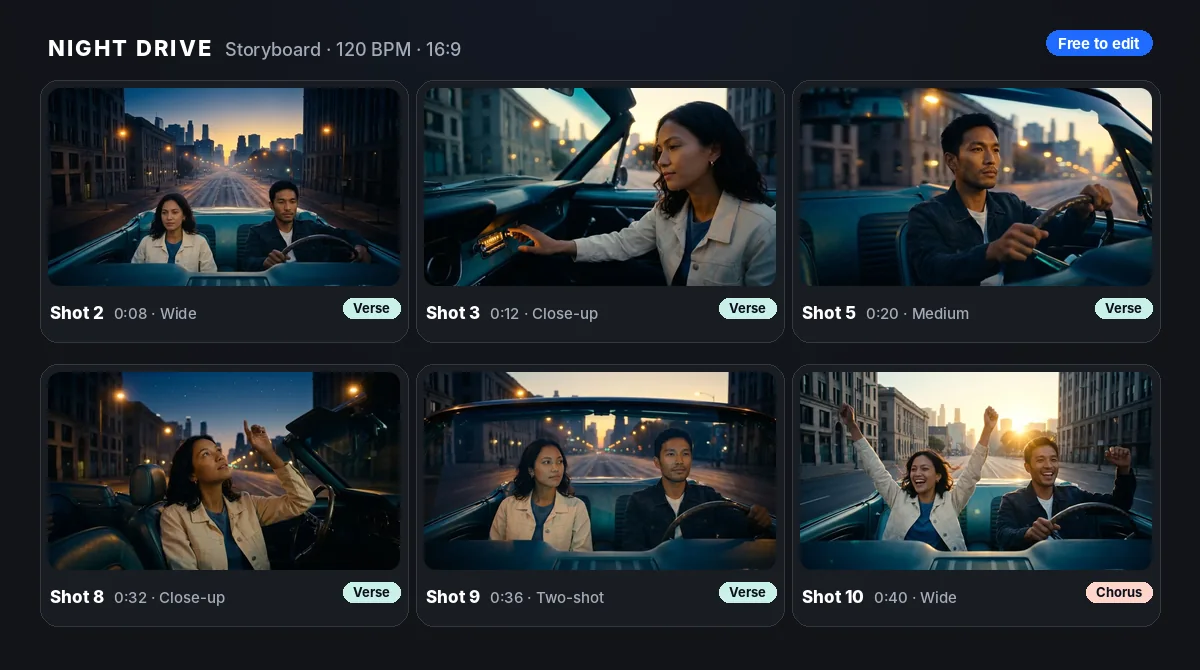
Upload your song and Muvora's AI director plans a shot-by-shot storyboard on the beat. Edit every shot for free, and pay only if you render.
What pushes the price up (or down)
- Shoot days. The biggest lever. One tightly planned day costs far less than two loose ones.
- Locations. Each new place costs travel, set-up time and sometimes a fee or a permit. One great location beats three average ones.
- People on camera. Actors, dancers and extras need fees, wardrobe, make-up and waiting time.
- Light. Daylight is free; night exteriors and big interiors need lighting gear and crew.
- Effects and post. Compositing, motion graphics and heavy color work add days after the shoot.
- Reshoots. If a key shot doesn't work, getting it again often means paying for another day.
Notice what's missing from that list: the length of the song. A filmed video costs roughly the same for a 2-minute and a 4-minute track if it's shot in the same day. Generated video works the other way round, which is why the two are budgeted so differently.
What an AI music video costs
With AI, there's no crew day or location to pay for. The cost is the compute that draws the frames and generates the motion, so it's charged per second of finished video. In Muvora, the song analysis and the full storyboard are free: you can make 5 new storyboards a month on the free plan and edit every shot before you spend anything. When you press Generate, the price is shown first, in credits per finished second at the quality you choose.
| Quality | Credits per finished second | A 3-minute video | Good for |
|---|---|---|---|
| Visualizer | 38 | 6,840 credits | Long tracks, lo-fi, covering a whole album |
| Standard | 60 | 10,800 credits | Singles and social cuts with a consistent lead |
| Cinematic | 110 | 19,800 credits | The main video of a release, up to 1080p |
Credits come with a monthly plan, starting at US$39 a month (US$27 a month billed yearly), or as one-time packs from US$12 that never expire. Three details keep the bill honest: shots that fail to render cost nothing, re-rolling a single shot is free up to 10% of the video's length, and one render gives you every export (16:9, 9:16, 1:1 and an 8-second Canvas loop), so a vertical cut doesn't cost a second video.
Music video cost calculatorEnter your song's length and the quality you want to see the credits and which plan covers it.Budgeting a whole release
Most releases need more than one video. A single typically wants a main video for YouTube, vertical clips for Shorts, Reels and TikTok, a Spotify Canvas loop and often a lyric video. With a shoot, each of those is extra editing time at the very least. With an AI render they come from the same storyboard, so the plan is simpler:
- 01
Decide which song carries the release
Spend on the lead single. Give it the strongest concept and, if the budget allows, Cinematic quality.
- 02
Cover the rest affordably
Album tracks, B-sides and long instrumentals work well as a Visualizer-quality render or an abstract visualizer, which keeps a whole project consistent without a big bill.
- 03
Lock the storyboard before you render
Edits to the storyboard are free; changes after rendering cost re-rolls. Read it through once against the song, fix prompts and cuts, then generate.
- 04
Export everything from one render
Take the 16:9 main video, the 9:16 and 1:1 cuts and the Canvas loop from the same job, instead of paying for each format separately.
Ways to spend less on any music video
- Plan on paper first. A storyboard and shot list catch problems while they're free to fix, whether you shoot or generate.
- One location, one lead. Small, specific ideas look more expensive than big, vague ones.
- Cut to the music. An edit that lands on the beat hides a modest budget. Check your timing with the shot list generator.
- Fix shots, not videos. Re-shoot or re-roll the one shot that misses, not the whole thing.
- Match quality to the song's job. Cinematic for the single that leads the campaign, Visualizer for the deep cuts.
- Use the billing to your advantage. In Muvora, yearly billing saves 30% or more, unused subscription credits roll over up to 2 months' worth, and pack credits never expire.
If you're weighing a shoot against generated footage, our honest comparison of AI music videos and hiring a videographer covers what each does best. Many artists do both: a filmed performance for the single, AI visuals for everything around it.
Know your price before you spend a cent
Upload your song, get the storyboard free, and see the exact credits for your video in each quality before you decide.
Written by the Muvora team. Last updated November 13, 2026. Spotted something out of date? Tell us at [email protected].