Generate chord progressions in any key, by mood, and hear them
Pick a key, major or minor, and a mood: happy pop, sad ballad, epic, dreamy, dark, jazzy, bluesy, gospel, lo-fi, rock, EDM or R&B. The generator shows four common progressions for it, each as Roman numerals and as chord names spelled for your key, voiced as written, as plain triads, with sevenths or with ninths. Play one on a loop at your tempo, shuffle for others, copy the chart or download a MIDI file. It all runs in your browser.
Free, no sign-up. Runs in your browser: nothing is uploaded.
Bright loops that sit under a sing-along chorus.
Happy pop in C major
4 of 8 happy pop progressions in C major.
The four-chord loop
- IC
- VG
- viAm
- IVF
Home, a lift to V, a moment of doubt on vi, then IV opens back up: a loop heard all over pop and rock.
The loop from its minor chord
- viAm
- IVF
- IC
- VG
The same four chords started on vi, so the loop leans bittersweet before it reaches home.
The doo-wop turnaround
- IC
- viAm
- IVF
- VG
Fifties ballad changes: home, the relative minor, IV, then V pulling back to the start.
The bright climb
- IC
- IVF
- viAm
- VG
IV straight after home keeps it open and sunny; vi to V builds into the next bar.
Common patterns, not anyone's song. Each chord lasts one bar of 4/4; the sound is made in your browser and nothing is recorded or sent anywhere. The text this tool writes is in English.
Song finished? Upload it and Muvora plans the whole video on its beats. The storyboard is free.
Make the videoUpload a new songHow to use the chord progression generator
- 01
Choose the key
Pick any of the twelve notes, major or minor. Chord names are spelled the way that key is written, so B♭ major gets E♭ and F, never D♯ and A♯.
- 02
Pick a mood and a length
Each mood has its own set of four-chord and eight-chord progressions, and the bluesy and rock sets also hold the 12-bar blues. Shuffle to see others from the same set.
- 03
Set the voicing and listen
Keep the chords as written, strip them to triads, or add sevenths or ninths, then press Play: each chord lasts a bar of 4/4 at the tempo you set, looping until you stop it.
- 04
Take it with you
Copy the chart, numerals over chords and four bars to a line, into your notes, or download a MIDI file that opens in any DAW with the chords and the tempo in place.
Roman numerals: one progression, every key
A Roman numeral names a chord by its place in the key rather than by its letter. Upper case is a major chord, lower case a minor one and ° marks a diminished chord, so in C major I is C, ii is Dm, IV is F, V is G and vi is Am. Write a progression as I–V–vi–IV and it works in any key: C, G, Am and F in C; G, D, Em and C in G; E♭, B♭, Cm and A♭ in E♭. That is why the generator prints the numerals above the chords. A ♭ or ♯ before a numeral marks a chord borrowed from outside the key, such as ♭VII, which is B♭ in C major.
- Upper case major, lower case minor
- The numerals stay, the letters move with the key
- ♭VII, ♭VI and iv are borrowed chords
Why some chords sound happy, sad or epic
Most of a progression's mood comes from where it lands and how hard it pulls. A major home chord sounds settled and bright, a minor one heavier. V pulls back to I because its third sits a half step below home, which is why minor keys often raise that note to make a major V. Chords borrowed from the parallel minor (♭VI, ♭VII and minor iv in a major key) bring the swell of a film score or the ache of a ballad, and sevenths and ninths soften the edges, which is most of what makes lo-fi and R&B progressions sound the way they do.
- V leads home through its third
- Borrowed chords bring the drama
- Sevenths and ninths blur the edges
From a loop to a song
A progression is a starting point, not a song: thousands of songs share I–V–vi–IV, and what makes one yours is the melody, the words and the way it is played. Try the same four chords with a slow, open rhythm in the verse and a driving one in the chorus, or keep the verse's chords and change only the last one before the chorus lands. A four-chord loop usually carries one or two lines of lyric; an eight-chord progression often holds a whole verse with an ending of its own. Loop one at the song's tempo and hum over it before you write a word.
- Same chords, a new rhythm per section
- Change one chord for a lift
- Hum the melody before the words

Finished the song? Make the video
Upload the recorded song and Muvora maps its tempo, key and sections, then writes a storyboard with every cut on a downbeat: longer shots in the verses, quicker ones in the chorus. Rewrite any shot for free, see the look in the style frames, and render when the price, shown before you press Generate, suits you.
Questions, answered
Can't find what you need? Start a free storyboard and see for yourself.
What is the most common chord progression?
I–V–vi–IV (C, G, Am and F in C major) is among the most used in pop and rock, along with its rotation vi–IV–I–V and the doo-wop I–vi–IV–V. In a minor key, i–VI–III–VII (Am, F, C and G) is the same four chords started from the minor one.
Are these progressions taken from real songs?
No. Each one is a common pattern that many songs share, written out by its numerals, and none is copied from a named song. What makes a song yours is the melody, the words and the arrangement you put over the chords.
How do I open the MIDI file?
Drag it into a DAW such as GarageBand, Logic, Ableton Live, FL Studio or Reaper, or open it in any MIDI player. It is a Standard MIDI File with one track: each chord held for a bar with its root in the bass, at the tempo you set, on a piano sound you can change.
What do 7, maj7 and 9 mean after a chord?
They add notes above the three-note chord. A 7 adds the note a whole step below the root (G7 adds F), maj7 the note a half step below it (Cmaj7 adds B), and 9 the note a whole step above the root, an octave up. m7b5 is a minor chord with a lowered fifth and a seventh, the half-diminished chord of minor-key jazz.
Why does a minor key use a major V chord?
In A minor the natural fifth chord is Em, which pulls home only weakly. Raising its third from G to G sharp makes E major, and that G sharp sits a half step below A and leads straight to it. Progressions written with V in a minor key are spelled that way here; ones written with v keep the minor chord.
What is a 12-bar blues?
A twelve-bar form built on three dominant seventh chords: four bars of I, two of IV, two of I, then V, IV, I and a V to turn around. Choose the bluesy or rock mood with 8 chords to see it, along with the quick-change version that moves to IV in bar 2.
Keep exploring
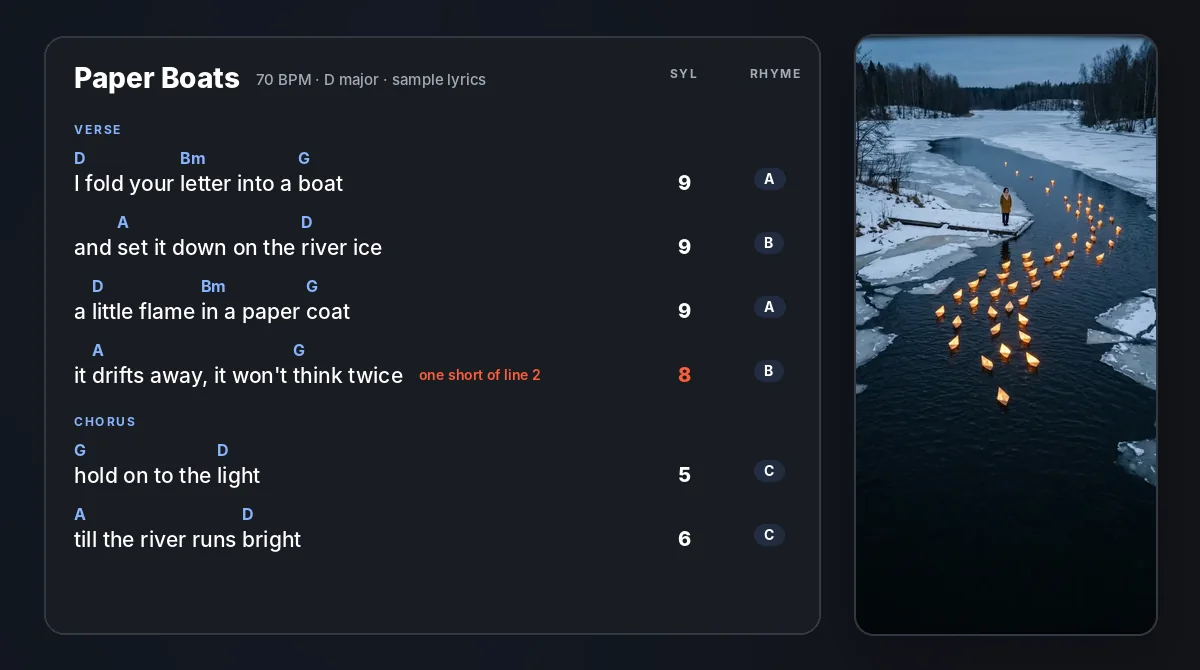
How to write a song
From a title or hook to a finished demo: the form, the chorus, chords, melody, lyrics that fit, rhyme, the bridge and splitting it with co-writers.
Read the guideChord transposer
Paste a chord sheet and move it to any key, spelled for that key, with chords kept over the lyrics and the capo shapes to play.
Open the toolSyllable counter
Paste lyrics to count the syllables in every line, see the rhyme scheme and find the lines that don't match the line they pair with.
Open the toolMetronome
A steady click from 20 to 300 BPM in seven time signatures, with accents, subdivisions, tap tempo and a tempo trainer.
Open the toolCamelot wheel
Pick a key to see its Camelot code and the keys that mix harmonically with it, on an interactive wheel.
Open the tool
Song structure explained
Intro, verse, chorus, bridge and drop: what each section does, how long it runs and how to hear it.
Read the guideChord finder
Click notes on a piano or type them to name the chord, with its inversion and other names, or type a chord to see its notes.
Open the toolDrum machine
A 16-step drum sequencer in your browser: eight synthesized drums, grooves by genre, swing, accents and rolls, saved as a WAV loop or a MIDI file.
Open the toolSong structure builder
Lay out a song's sections in bars at your tempo and see every start time, the length and a colored timeline. Export text, CSV or YouTube chapters.
Open the toolCircle of fifths
An interactive circle of fifths: each key's signature and relative minor, the chords in the key with Roman numerals, and how to move to a neighboring key.
Open the toolOnline piano
Play a piano in your browser with the mouse, touch or your computer keys, with a sustain pedal, octave shift and chords and scales lit on the keys.
Open the toolGuitar chord chart
Any guitar chord's shapes as diagrams, open and barre, with fingers and a plucked sound, plus a printable sheet of a song's chords.
Open the toolScale finder
Any scale in any key on a keyboard and a guitar neck, played up and down, with its chords and related keys; or tick notes to find the scales that hold them.
Open the tool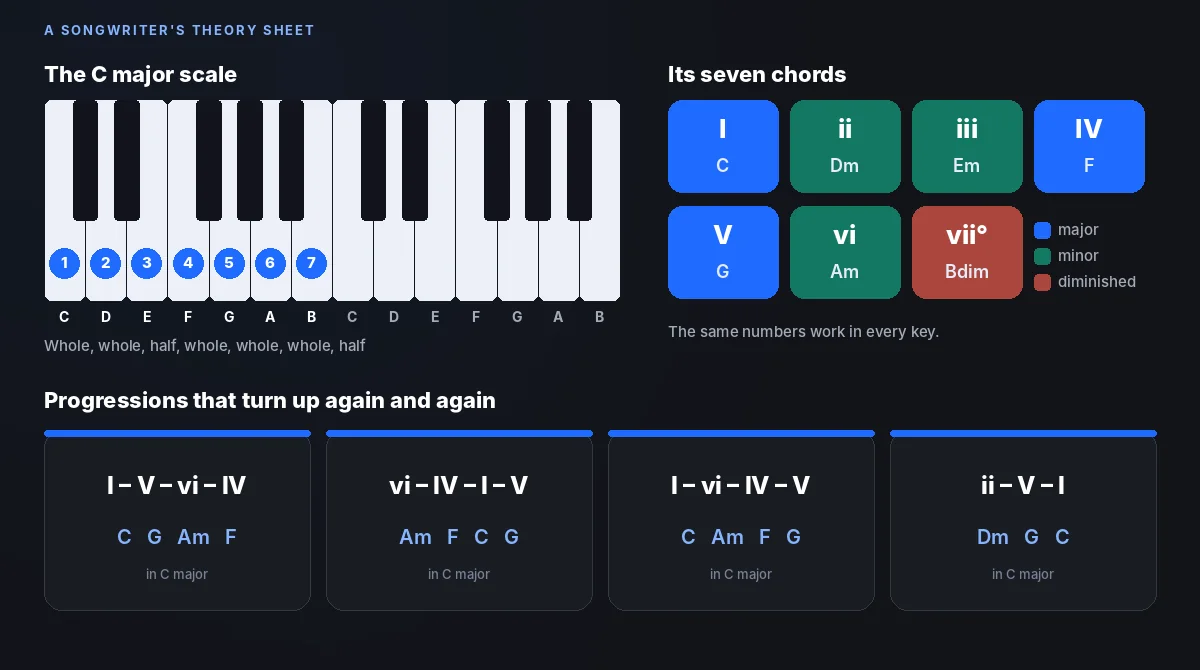
Music theory for songwriters
Notes, steps and intervals, scales and keys, chords and sevenths, Roman numerals, progressions, cadences, borrowed chords, modes and meter, in C and G.
Read the guidePiano chord chart
Any chord on a piano keyboard: its notes, root position and every inversion with fingerings, a two-hand voicing, and a printable chart of a key's chords.
Open the tool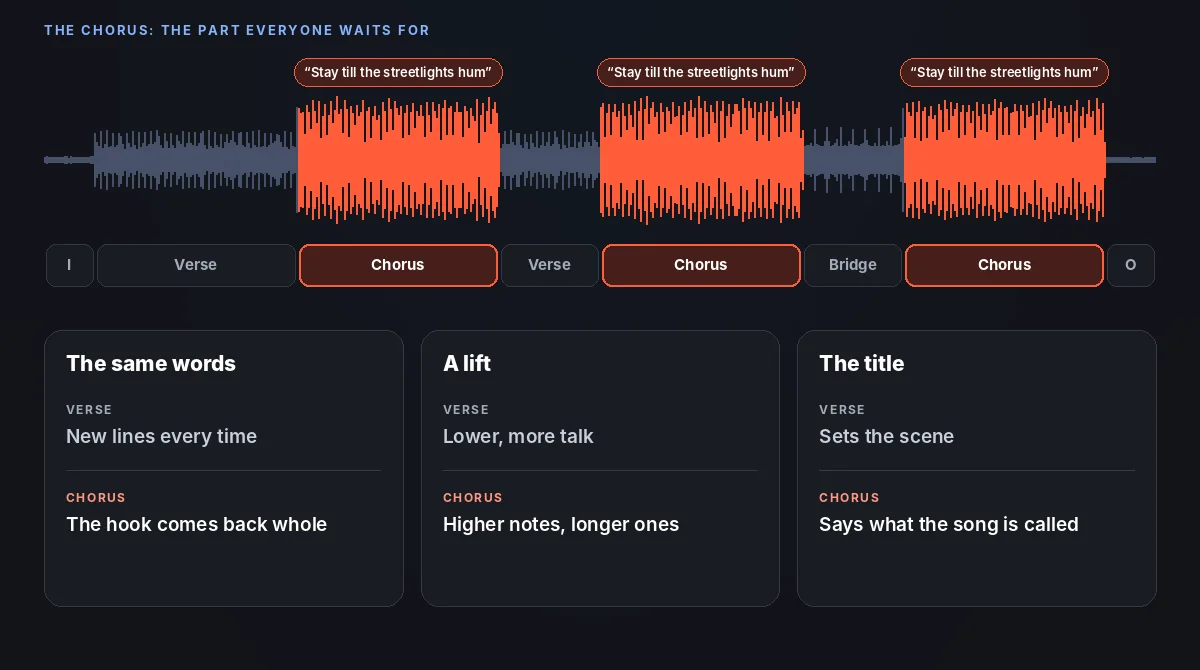
How to write a chorus
What a chorus does, where the title line goes, how it contrasts with the verse, how the pre-chorus builds to it, the lyric, the last pass and the fixes.
Read the guide
More free tools: beats, chords and voice
Play a piano, program a beat, name a chord, find a key on the circle of fifths, build a progression, change key, tune up and find your vocal range.
Your song deserves a music video
Upload a track and get a free beat-synced storyboard in minutes. Render it when you are ready.
No card needed to start.




