The short answer
Good black and white music video ideas are built on light and shape: a press photographer's flashbulb freezing a city at night, a singer in backlit rain against black, a sculptor's marble under one skylight, a charcoal-drawn fox crossing a town. Pick hard light for drama or soft window light for intimacy, dress people in clear lights and darks, and ask for black and white from the start.
- Black and white is built from light and shape, so plan the light first.
- Think in tones, not colors: two colors of the same brightness turn into the same gray.
- Ask for it at the start of the idea box, so the style frames and every shot are made in it.
- Hard light gives drama and silhouettes; soft window light gives faces and intimacy.
- In the Lyric style the sung words stay yellow, the one color in a gray frame.
On this page (8 sections)ShowHide
- 1.What black and white does for a music video
- 2.How to make a Muvora video black and white
- 3.Think in tones, not colors
- 4.Hard light and contrast
- 5.Soft light, faces and real places
- 6.Drawn, silent-era, lyric and abstract ideas
- 7.A black and white video, section by section
- 8.From a black and white idea to a storyboard
- Questions
What black and white does for a music video
Color tells the viewer a lot without asking: the time of day, the mood, how new a jacket is. Remove it and the eye goes to what's left, which is light, shape, texture and faces. A black and white video looks deliberate from its first frame, and it ages slowly, because nothing in it dates the way a fashionable color grade does.
- Light becomes the subject. A single bulb, a window, a flashbulb or a strobe draws the frame. Every shot needs a light you could point to and a clear place where it falls off into dark.
- Texture shows. Rain, steam, smoke, film grain, wet asphalt, wool, skin. In color they sit in the background; in black and white they carry the picture.
- Faces get closer. With no color to look at, a close-up holds attention longer, which suits ballads, confessional lyrics and anything sung straight down the lens.
- It carries an era. Silent comedy, 1950s press photography, early television, documentary photography and fashion portraits each have a black and white look a viewer recognizes at once.
- It holds a long video together. With no colors to match, shots from different places and hours sit together easily, so a story can travel a long way and still feel like one film.
How to make a Muvora video black and white
Muvora has no black and white switch and applies no color grade afterwards. The pictures are made in black and white because the brief asks for it, so write it at the very start of the idea box in a cinematographer's words: “Black and white 35mm film, fine grain, hard light from one source” or “Black and white, high-key, soft window light”. The director carries that into the brief's look, which is added to every shot's image prompt and every video prompt, so each keyframe is drawn in black and white and each clip is animated from it.
- Check the brief's look and palette. The look should open with black and white, and the palette should hold black, white and a few grays. Both can be edited in the storyboard for free.
- Ask before the style frames are drawn. The establishing and hero frames are made once, right after the storyboard is written, and don't follow later edits to the brief. Put black and white in the idea box from the start and they show you the look before you pay.
- Watch for color creeping back. If a clip comes back with a tint, re-roll that shot; rewriting its prompt to name the light and say black and white again can help.
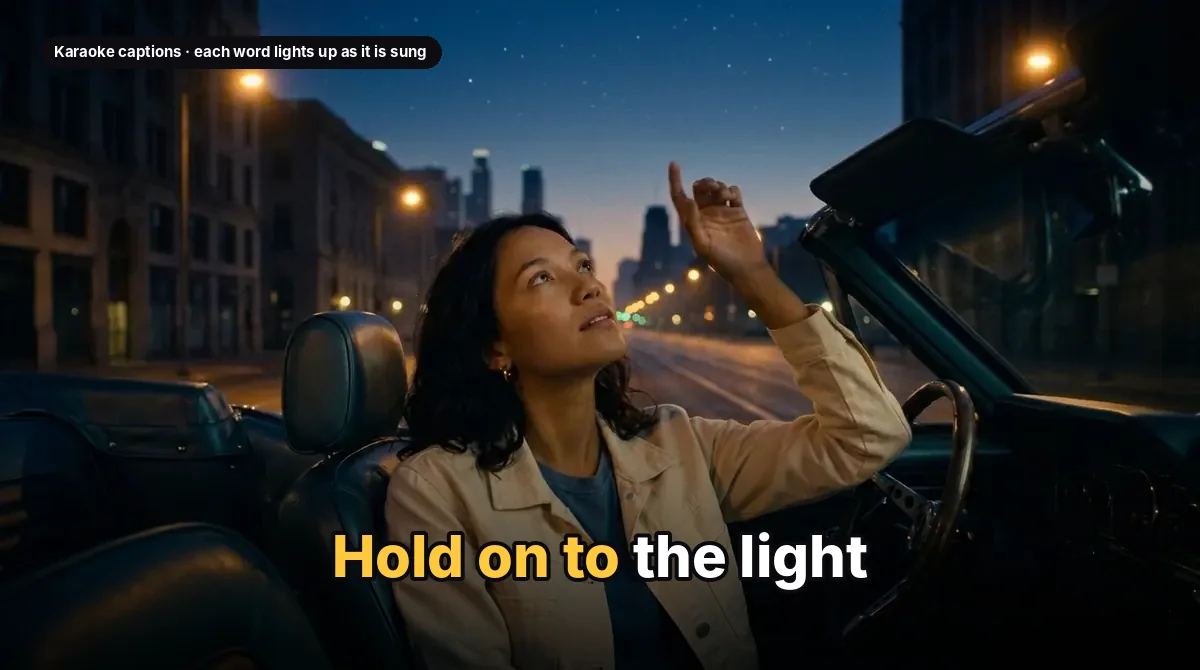
- Expect two touches you didn't draw. The short flash on each drop is white, which suits the look. In the Lyric style, karaoke captions keep their colors: white words that turn yellow as they're sung.
Skip the blank page
Upload your song and Muvora's AI director plans a shot-by-shot storyboard on the beat. Edit every shot for free, and pay only if you render.
Think in tones, not colors
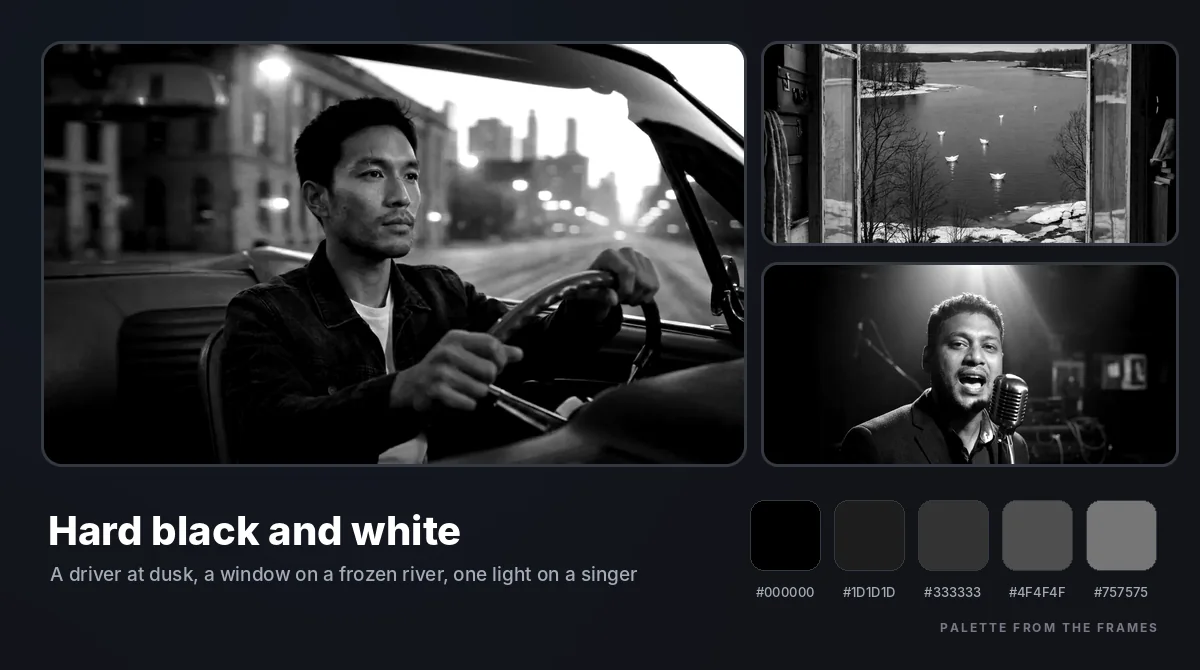
In black and white every color becomes a shade of gray, and two colors of the same brightness become the same gray. So describe the picture in lights and darks: a pale face against a dark wall, a black coat crossing a white field, a white shirt in a dark room. Wardrobe matters most. Give each person one clear value (light, middle or dark) and keep the background a different one.
| Look | Light | Wardrobe and places | Write it like this |
|---|---|---|---|
| Hard noir | One hard source, deep shadow, shapes cut by blinds or railings | Dark suits, pale shirts, wet streets, stairwells | “black and white, one hard light, deep shadows” |
| High-key | Bright, soft and nearly shadowless | White clothes on a white set, one dark accent | “black and white, high-key, white studio” |
| Low-key | Mostly black with a few small highlights | Dark clothes, faces lit from one side | “black and white, low-key, faces lit from one side” |
| Soft window light | A big window or skylight, gentle falloff | Mid-gray knits and linen, old rooms and studios | “black and white, soft window light, fine grain” |
| Grainy documentary | Available light outdoors, handheld | Work clothes, harbors, markets, roads | “black and white 35mm documentary photography, coarse grain” |
| Silent era | Bright, flat stage light, a soft dark vignette | Bowler hats, long dresses, painted backdrops | “black and white 1920s silent film, flicker and vignette” |
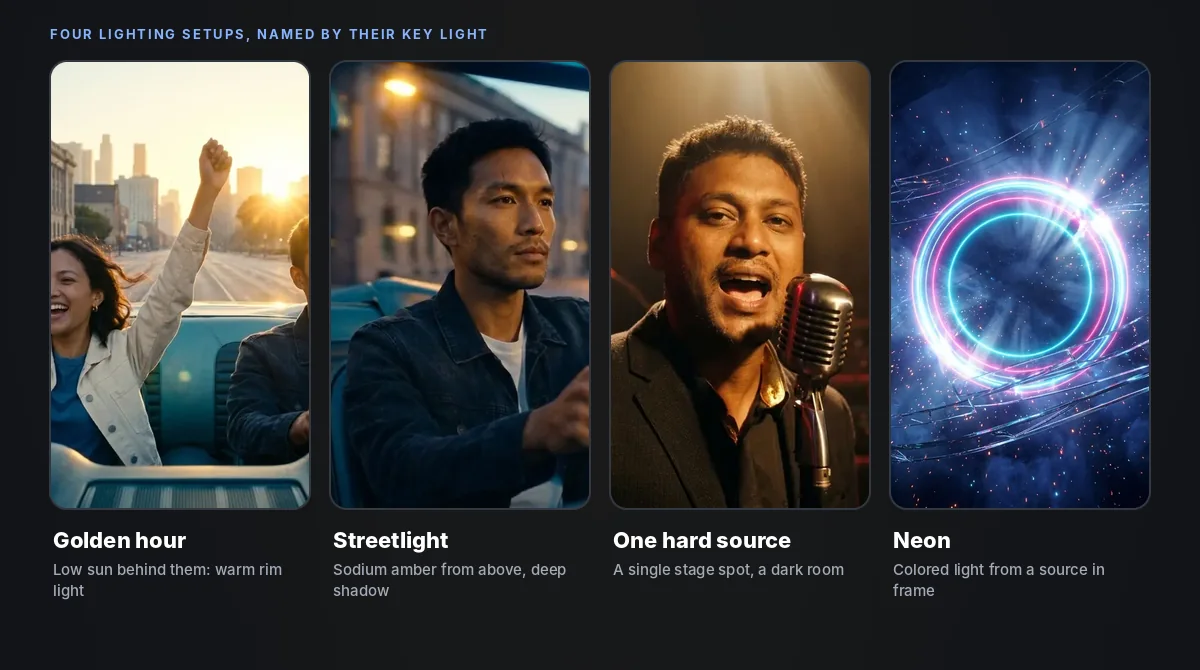
For the craft behind these, music video lighting covers hard and soft light, motivated sources and practicals, and music video color palettes is useful in reverse: a palette that depends on hue alone won't survive the move to gray. The aesthetic music video ideas set minimal monochrome beside other looks.
Hard light and contrast
These five live on contrast: one hard source, deep black around it, and a subject that cuts a clear shape against the dark or the light. They suit rock, hip-hop, dark pop and any song with edges.
- Story · 1950s city · night
Flashbulb
Black and white, the 1950s: a press photographer works a city at night, each pop of her flashbulb freezing a scene in hard white light. Verses are her rounds: a diner counter, a fire escape, a quarrel under an awning. Each chorus her flash catches the same stranger in a pale raincoat at the edge of the frame. On the last chorus she photographs him, and he smiles.
Use this idea on my songUse this idea on my song - Story · old theater · spotlight
The vanishing act
Black and white, an old variety theater: a magician's assistant steps into a tall box under one hard spotlight while the magician sweeps his cape. Verses are their act for half-empty rows. On the first chorus the trick works too well and she vanishes for real, into a backstage of ropes and dark corridors. Each chorus she finds a new way back. On the last she takes the spotlight alone.
Use this idea on my songUse this idea on my song - Story · sculptor's studio · skylight
The marble
Black and white: a sculptor in a dusty studio carves a white marble figure under one hard skylight, chips flying at each blow of the mallet. Verses are rough stone and the first shapes of shoulders. Each chorus more of the figure comes out of the block, and the light swings round with the afternoon. On the last chorus the finished statue slowly turns its head toward her.
Use this idea on my songUse this idea on my song - Performance · rain · black background
Backlit rain
Black and white: the singer stands in a downpour against pure black, lit by one hard lamp behind her so every drop shines white. Verses are sung close, rain running off her jaw. Between lines the camera pulls back to a small figure in a curtain of falling light. Each chorus the rain gets heavier. On the last chorus it stops, and only the drips catch the light.
Use this idea on my songUse this idea on my song - Performance · high-key to low-key
Ink floods the white room
Black and white: the singer in white clothes in an all-white room, lit so brightly there are almost no shadows. Verses are sung close against the white. Each chorus black ink seeps across the floor and climbs the walls. By the bridge only a white circle around her is left. The last chorus is sung in near darkness, her face lit from one side, the room fully black.
Use this idea on my songUse this idea on my song
Try a black and white idea on your song
Upload the track and press “Use this idea on my song” under a concept. Each one opens with black and white, so the style frames and the storyboard are made in it. Reading and editing the storyboard costs nothing, and the free plan includes 5 new storyboards a month.
Soft light, faces and real places
Soft light in black and white makes faces and places feel remembered rather than staged. These five lean on windows, overcast skies and open landscapes, and on stories small enough to fit inside one song.
- Performance · portrait studio · skylight
The sitting
Black and white, soft north light: the singer sits for a portrait in an old photographer's studio under a big slanted skylight, a wooden camera on a tripod facing her. Verses are sung close in the gentle light. Between lines the photographer moves a reflector and a cat crosses the floor. Each chorus a cloud passes and the light changes on her face. The last chorus ends on the shutter.
Use this idea on my songUse this idea on my song - Story · snow · one walk
Across the white field
Black and white: a woman in a long black coat crosses miles of snowfield toward a farmhouse on the horizon, a small dark shape on endless white. Verses are the walk: a fence, a frozen stream, a crow. Each chorus the farmhouse is closer and its single window glows brighter. On the last chorus the door opens and someone she hasn't seen in years steps out.
Use this idea on my songUse this idea on my song - Story · documentary · fishing boat
Harbor at five
Black and white 35mm documentary photography, coarse grain: a fishing harbor at five in the morning, nets, rope, gulls and diesel smoke. The lead, a young deckhand, starts her first day on her father's boat. Verses are a routine she's still learning; each chorus the boat is further out and the sea bigger. On the last chorus the catch comes in and her father gives one small nod.
Use this idea on my songUse this idea on my song - Story · traveling circus · dawn
Striking the tent
Black and white: a small traveling circus takes down its big top at dawn in a muddy field. The lead, a trapeze artist in her last season, coils ropes and folds canvas beside the crew. Each chorus flashes back to the ring at night under bright spotlights, the crowd a dark mass beyond them. On the last chorus she climbs the empty rigging one final time before it comes down.
Use this idea on my songUse this idea on my song - Story · 1950s · father and daughter
Airfield driving lesson
Black and white, 1958: a father teaches his teenage daughter to drive his big sedan on an empty airfield one Sunday afternoon. Verses are stalls, lurches and his hand over his eyes. Each chorus she drives a little faster down the runway, and his hat blows off. On the last chorus she drives alone down a coast road, the sea bright on one side.
Use this idea on my songUse this idea on my song
A ballad in soft gray light sits close to the folk music video ideas and the sad song music video ideas, and a late, smoky black and white is at home among the jazz music video ideas.
Drawn, silent-era, lyric and abstract ideas
Black and white isn't only photography. Charcoal, ink and woodcut prints are black and white by nature, and so is the silent film. Name the medium first in the idea box and the whole video is drawn in it. These five also include a Lyric video and an Abstract one with no cast.
- Story · silent comedy · 1920s
The runaway cake
Black and white 1920s silent comedy, with flicker and a soft dark vignette: a baker in a white apron chases a three-tier wedding cake that has rolled off on a delivery cart through a busy small town. Verses are near-misses: a tram, a policeman, a ladder. Each chorus the chase grows wilder and more people join it. On the last chorus the cake lands safely on the wedding table.
Use this idea on my songUse this idea on my song - Story · drawn · charcoal on paper
Charcoal fox
Drawn in smudged black charcoal on rough white paper, every mark visible: a fox crosses a sleeping town in winter, past a bakery's back door and a churchyard, looking for somewhere warm. Verses are its careful route through the dark. Each chorus the strokes grow bolder and the snow heavier. On the last chorus an old woman opens her back door and sets a bowl on the step.
Use this idea on my songUse this idea on my song - Story · drawn · woodcut print
Woodcut storm
Drawn as a black and white woodcut print, every wave and cloud carved in thick lines: a small fishing boat rides out a storm at night. Verses are its crew of two lashing ropes. Each chorus the waves are bigger and the carved lines wilder. In the bridge the harbor lights find them. On the last chorus the sea lies flat under a white sky.
Use this idea on my songUse this idea on my song - Lyric · captions · rain
Yellow words in a gray city
Black and white: karaoke-style captions over a gray city in the rain, seen from inside a slow tram: umbrellas, steamed windows, puddles throwing back the streetlights. Every sung word lights up yellow, the only color in the video. Verses are close details through the glass. Each chorus the tram crosses a bridge and the city opens out. On the last chorus the rain stops and the clouds break.
Use this idea on my songUse this idea on my song - Abstract · no people · paper
Folding paper
Black and white, no people: a sheet of white paper on a black table folds itself into shapes under one hard light. Each section is a new shape: a bird, a boat, a star, a house. Verses fold slowly, crease by crease. Through the build the folds come faster. On the drop the shape snaps open into a flat sheet that lifts and flies off into the dark.
Use this idea on my songUse this idea on my song
Drawn looks in a single medium are covered in how to make an animated music video, and the lyric video ideas put captions over pictures in any palette.
A black and white video, section by section
With no color to shift, a black and white video builds through its light: how much of the frame is lit, how hard the light is and how close the camera gets. Here is how a typical song's sections can move from soft gray toward full contrast.
| Section | Tones | Light | Shot ideas |
|---|---|---|---|
| Intro | Mostly gray, little contrast | Overcast, or a dim room | A wide of the place, empty; a detail in shadow |
| Verse | A pale face against a darker ground | Soft light from one side | Close-ups while the words matter, the room around them |
| Pre-chorus | Shadows deepening | The light hardening or moving | Tighter frames, a shape crossing the light |
| Chorus | Full contrast: true black and bright white | One hard source | The concept's big image: the flash, the backlit rain, the open field |
| Bridge | One extreme: almost all white or almost all black | High-key, or a single highlight | The shot you've held back |
| Last chorus | The hardest contrast of the video | The brightest source at its strongest | The payoff, at its widest and its closest |
| Outro | Back to gray | The light fading | One long shot as the last note dies |
Choose the genre look for the music rather than the picture: lo-fi holds shots longest for a ballad or a slow jazz number, hip-hop and rock cut quicker, and pop keeps a steady pace on the bar. Black and white suits every one of them; the rock and hip-hop genre pages show how those two cut. Every section change and drop is a cut whichever you pick.
From a black and white idea to a storyboard
- 01
Decide the light first
Hard light for drama and silhouettes, soft window light for faces and intimacy, flat stage light for a silent-film look. The rest of the idea follows from that choice.
- 02
Upload the song
Upload the finished track (MP3, WAV, M4A, AAC or FLAC, up to 8 minutes and 60 MB) and confirm you have the rights to it. Paste the lyrics so the director reads what the song means.
- 03
Pick a style and a look
Story for a plot, Performance to sing on screen from one photo of you, Lyric for yellow words over gray, Abstract for shapes and paper with no cast. Then choose the genre look that suits the music.
- 04
Open the idea box with black and white
Start with the look in a cinematographer's words, such as “Black and white 35mm film, fine grain, one hard light”, then the place, the people in lights and darks and what each chorus changes, in up to 600 characters.
- 05
Check the brief, the palette and the style frames
The brief's look should say black and white, its palette should be black, white and grays, and the establishing and hero frames should show it. Edit the brief or rewrite a shot for free if any of them don't.
- 06
Render and re-roll anything tinted
Check the exact price and generate. Re-roll any shot that picks up a tint or loses its contrast, then post the video, the vertical and square versions and the Canvas loop.
Visualizer, at 38 credits a second, covers a three-minute song for about 6,840 credits. Standard, at 60, holds a recurring face and coat steadier from shot to shot, and Cinematic, at 110, is made at 1080p, where film grain and the texture of rain or marble have the most room. Sung seconds in a Performance video are 75 credits each, and the exact price shows before you generate.
How to make a music video look cinematic goes further into light, framing and pace, and the Cinematic music video maker explains the highest quality. For concepts in every genre and mood, start at music video ideas.
Music video mood boardArrange reference pictures from your device into a mood board and get the look written as a sentence for the idea box. For black and white, pick references that already read in grays.Make your song in black and white
Upload the track, open the idea box with “Black and white” and the light you want, and read a free storyboard cut on your downbeats. Change any shot for free and render when every frame holds its contrast.
Written by the Muvora team. Last updated November 18, 2026. Spotted something out of date? Tell us at [email protected].