The short answer
Strong rock music video ideas put the band in a place with a story and let the performance carry the song: a gig in the middle of a demolition derby, a pier set as a storm rolls in, a band playing the empty mill on its last shift. Keep verses dim and close, open the chorus wide and backlit, and give the guitar solo its own moment.
- Performance is the spine; a story intercut with it keeps the video moving.
- Light it like a show: backlight, haze and practical lamps, dim verses and bright choruses.
- Describe each band member once and keep the cast small.
- Frame instruments from a little further back: fingers on strings are where AI still slips.
- Treat the guitar solo as its own section, with its own image.
On this page (7 sections)ShowHide
What makes a rock music video work
Rock is a live genre, and its videos borrow the language of a show: sweat, volume, a band that looks like it's playing for its life. But a pure performance video can feel samey by the second chorus. The classic answer is to intercut: the band plays in one place while a story unfolds in another, and the edit moves between them with the song's dynamics.
- Dynamics you can see. Rock moves between quiet and loud more than most genres. Verses get close, dim shots with one light; choruses go wide, bright and backlit.
- Light that feels live. Bare tungsten bulbs, par cans through haze, a single hard key light from the side, car headlights. Backlight a band and every strand of hair and cymbal edge glows.
- Movement with weight. Sticks coming down on a snare, a singer gripping the mic stand, a guitarist stamping on a pedal. Rock reads as physical effort, so give every shot an action.
- Wardrobe that looks lived in. Worn denim, a leather jacket with a cracked collar, a striped shirt with the sleeves rolled. Pick one look per member and keep it for the whole video.
- A place with grit. Practice rooms, empty halls, garages, piers, factories. Rock suits spaces with texture: concrete, rust, old wood, water.
Pacing follows the drums. Most rock sits between 100 and 160 BPM, so a bar lasts 1.5 to 2.4 seconds: verse shots can hold two bars, the chorus can cut every bar, and a heavy breakdown can go faster if the energy calls for it. In Muvora, rock is one of the driving genre looks, so its cuts come a little faster than a mid-tempo song's at the same energy. For heavier, faster songs, metal music video ideas covers blast beats felt in half time and how to cut a breakdown.

Story ideas to intercut with the band
Each of these pairs a story with a place where the band can play, so the edit can cut between the two. The story carries the verses, the band takes over the choruses, and the final chorus brings them into the same frame.
- Story · working town
Last shift at the mill
The band are workers at a steel mill on its final day. Verses follow the shift: hard hats, sparks from a grinder, a lunch pail on a bench, the foreman's last look at the furnace. Each chorus the band plays among the machines as they shut down one by one, and the final chorus is the remaining workers watching them on the empty floor as the doors open to daylight.
Use this idea on my songUse this idea on my song - Story · night arena
Demolition derby
The band plays on a flatbed trailer in the middle of a muddy demolition derby arena under floodlights. Verses follow one driver, a woman in a dented green station wagon and a taped-up helmet, getting ready in the pits. Each chorus the cars crash on the snare around the trailer, mud flying, and in the final chorus the green wagon is the last car still moving.
Use this idea on my songUse this idea on my song - Story · weather
Pier in a storm
The band sets up at the end of a long wooden pier as a storm rolls in off the sea. Verses cut to the town behind them battening down: shutters closing, a fisherman hauling in nets, a girl racing home on a bicycle. Each chorus the waves break higher against the pilings, and lightning splits the sky on the final chorus as the band plays on, soaked.
Use this idea on my songUse this idea on my song - Story · bittersweet
The send-off
A rowdy wake for a friend in the back room of a pub, the band playing in the corner while friends raise their glasses and tell stories. Verses are the memories each story brings back: a road trip, a terrible haircut, a fight they lost together. Each chorus returns to the room, louder, and the final chorus spills out onto the street at closing time.
Use this idea on my songUse this idea on my song - Story · small town
Homecoming dance
Ten years after graduating, the band plays the homecoming dance in their old high school gym: crepe paper, a punch bowl, a mirror ball. Verses follow the four of them wandering the empty halls past the lockers and the trophy case. Each chorus returns to the gym, a little fuller; in the last chorus their old chemistry teacher gets up to dance.
Use this idea on my songUse this idea on my song
Storyboard your band's next video
Upload the track, paste the concept and get a shot list timed to every downbeat, with the band, the story and the chorus planned section by section. Editing is free; you pay only when you render.
Performance ideas: where the band plays
If the band is the story, the location and the light have to change the video from one chorus to the next. Each of these performance concepts has a built-in way to grow.
- Performance · one light
One bulb
The band in a black void, lit by a single bare bulb hanging over the drum kit and swinging on the snare. Verses stay inside its small circle of light in tight close-ups; each chorus another bulb snaps on over another member, until the final chorus, when a whole ceiling of bulbs blazes over the band at once.
Use this idea on my songUse this idea on my song - Performance · daytime
Drained pool show
The band plays in the deep end of a drained, cracked swimming pool behind an abandoned motel, amps standing on the tiles, while skaters carve the walls above them. Verses are low angles from the pool floor; each chorus the skaters land their tricks on the downbeat; the final chorus is shot from the diving board, looking down on the whole scene.
Use this idea on my songUse this idea on my song - Performance · night weather
Rooftop in the rain
A rooftop set in a downpour, the city's lights smeared behind the band, rain bouncing off the cymbals and drum skins. Verses stay under a tarp lit by one work lamp; each chorus the tarp tears a little further loose, until the final chorus is played out in the open rain, every drop lit white from behind.
Use this idea on my songUse this idea on my song - Performance · one room
Chapel of amps
A wall of amplifiers stacked where the altar used to be in an empty stone chapel, candles along the pews, light falling through tall clear windows. The singer stands in the aisle for the verses; each chorus more candles flare and the dust in the window beams thickens, until the final chorus fills the whole chapel with the band's light.
Use this idea on my songUse this idea on my song - Performance · one take feel
The circle
The four members face each other in a tight circle in an empty warehouse, playing to one another instead of the camera. The camera orbits slowly around them in the verses and faster in each chorus, lit by a ring of work lamps on the floor, and on the final chorus it rises straight up above the circle as they hit the last chord.
Use this idea on my songUse this idea on my song
Skip the blank page
Upload your song and Muvora's AI director plans a shot-by-shot storyboard on the beat. Edit every shot for free, and pay only if you render.
Low-budget, lyric and animated ideas
For a B-side, an acoustic version or a deep cut, these five ideas keep it to one place, or to no band at all. Each one commits to a single rule, which is what stops a small video from looking like a cheap one. For more concepts built on ordinary places, friends and a straight face, see indie music video ideas.
- One location · retro
Tape-era practice room
The band rehearses in a cramped practice room lined with egg-crate foam and old rugs, shot with the look of a 1990s camcorder tape: soft color, a warm cast, a slight blur. Verses are the band bickering between takes and tuning up; each chorus they lock in and the room seems to shake; the final chorus ends with a broken string and laughter.
Use this idea on my songUse this idea on my song - Lyric · one location
After the show
Karaoke-style lyric captions over the venue after the crowd has gone home: spilled cups on a sticky floor, a lone mic stand under one work light, a roadie coiling cables, the bartender counting tips. Each chorus the camera finds the stage again as the house lights flicker, and the last shot is the doors locking behind the final roadie.
Use this idea on my songUse this idea on my song - Visualizer · no cast
Feedback
Extreme close-ups of guitar strings and amp valves: strings shivering in slow motion, sparks of light running along them on every downbeat, valves glowing orange in the dark. The chorus melts the steel into rivers of molten orange and blue, and the solo is one long shot of a single string vibrating until it blurs.
Use this idea on my songUse this idea on my song - Animated · folk rock
Woodcut legend
The song told as an old woodcut print come to life, black ink on cream paper: a traveler crossing bare hills, a crow on a fence, a barn on fire, a river crossing at night. Each chorus the carved lines shiver on the beat and a single deep red bleeds into the frame, filling it by the final chorus.
Use this idea on my songUse this idea on my song - One location · drummer's view
Behind the kit
The whole video from behind the drummer: sticks in the foreground, the backs of the band and a small club beyond them. Verses stay on the drummer's shoulders and the singer's back; each chorus the stage lights swing out over a room that fills a little more, and the final chorus rises up and back over the kit to show the whole sweaty room.
Use this idea on my songUse this idea on my song
Making a band video with AI: what works and what to avoid
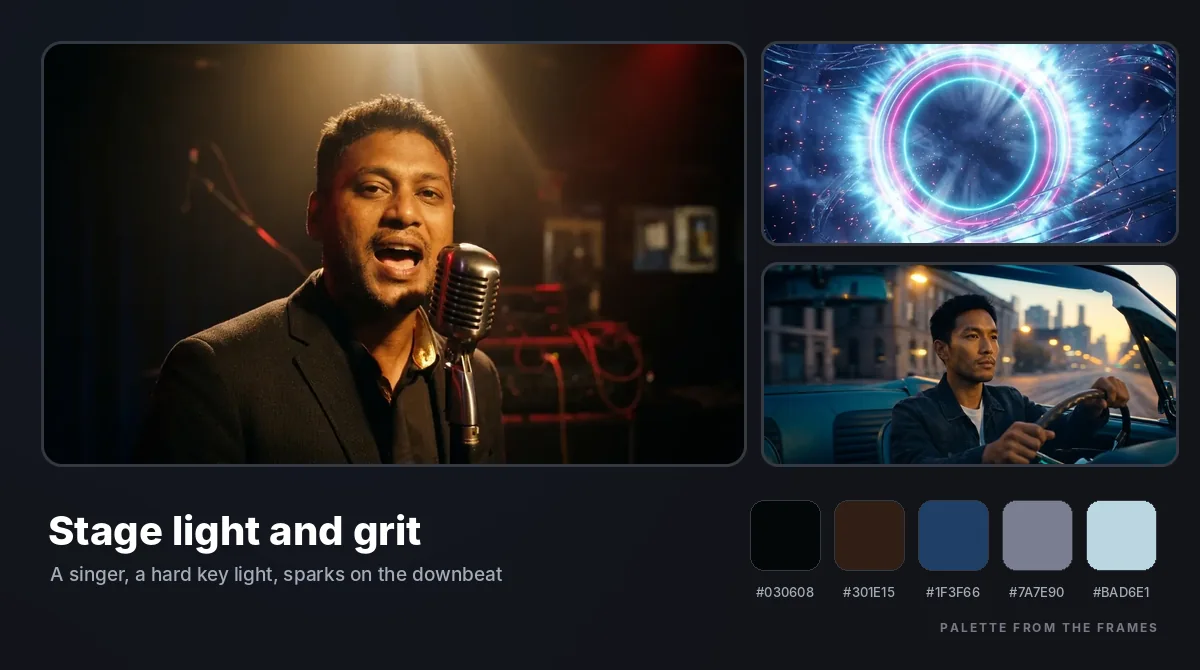
AI video is good at rock's raw ingredients: light through haze, rain, sparks, sweat, big rooms and small ones. It is less reliable at the fine detail of playing an instrument. Plan around that and the band looks real.
- Frame instruments from the chest up or wider. A strumming arm reads as playing in a medium shot; a close-up of fingers on a fretboard is where generated video still slips, with extra fingers or chords that don't match the sound.
- Let the drums carry the rhythm. Sticks hitting a snare or a cymbal shaking on the downbeat sell the beat better than any guitar close-up.
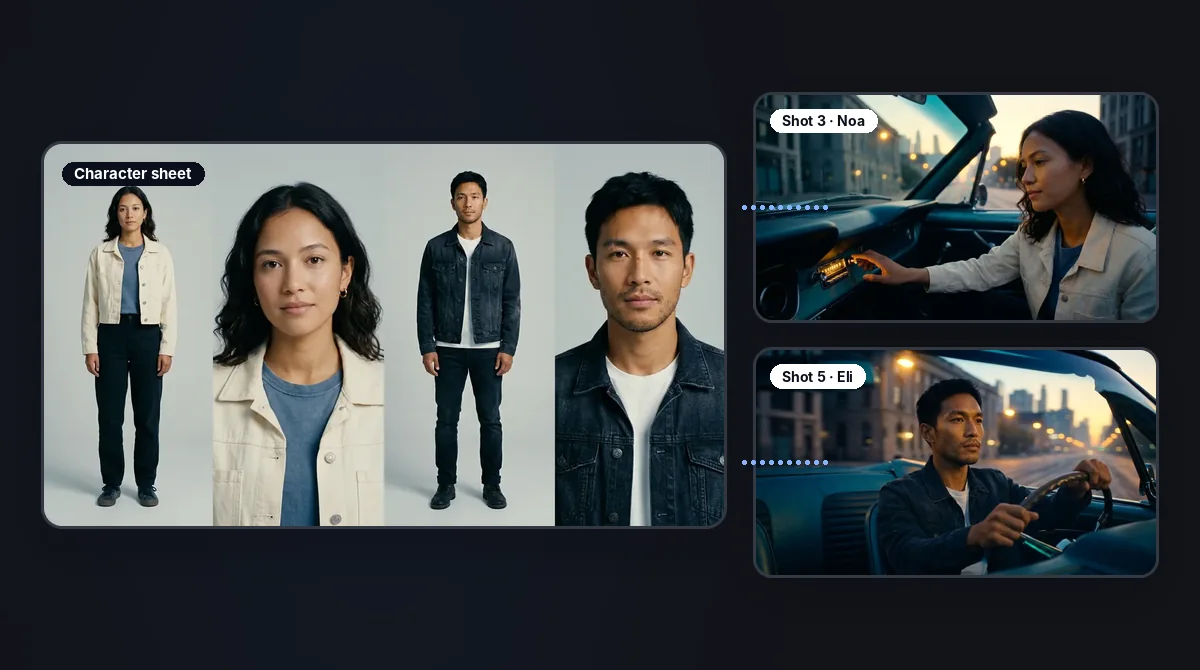
- Keep the cast small. The singer plus two or three described members is plenty. Every extra face in a frame is one more that can drift from shot to shot.
- Describe each member once, in fixed words. Hair, build, one or two pieces of clothing and the instrument, such as “a tall drummer with a shaved head and a sleeveless black shirt”. Use the same words in every shot they appear in.
- Let the singer lip-sync and the band play. In the Performance style the singer comes from one photo and lip-syncs the sung parts; the rest of the band are characters in the shots around them.
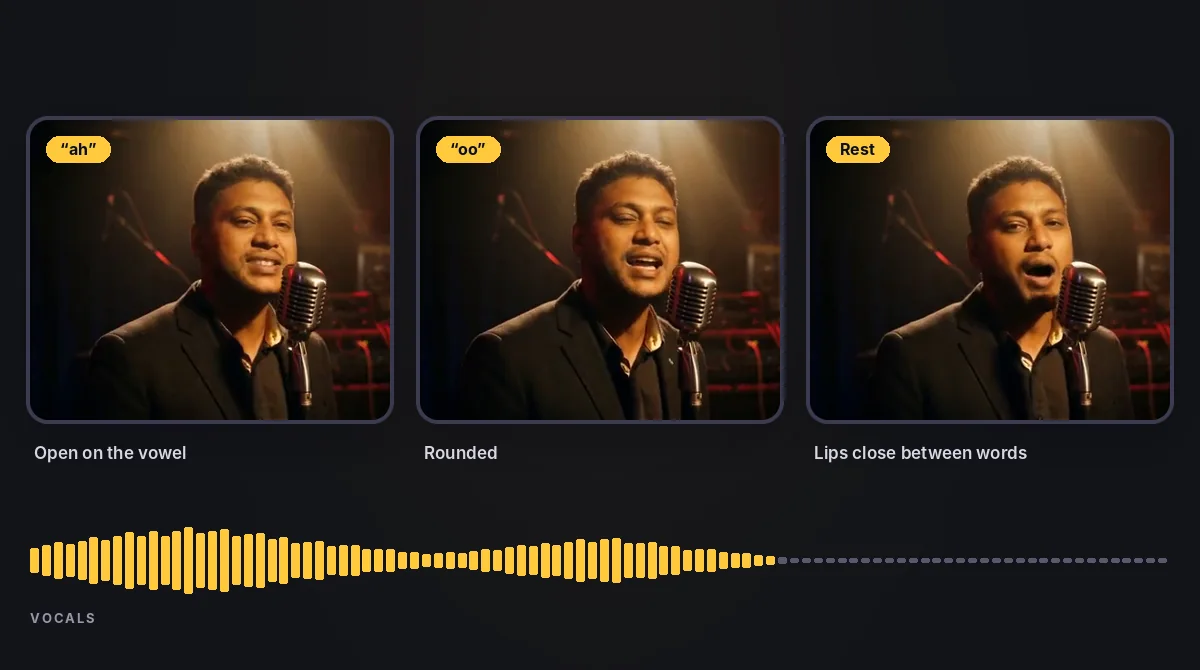
For more on which framings to use where, see music video shot types. For the singer's lip-synced shots, the AI lip sync music video page explains the photo it needs.
Shot ideas for each section of a rock song
Rock songs are built on contrast, so this table pairs each section with its light as well as its shots. Use it to check your storyboard: if two neighboring rows look the same on screen, the dynamics are lost.
| Section | What it does | Shot ideas | Light |
|---|---|---|---|
| Intro or riff | Announce the band | Close on the riff: the amp, a foot on a pedal, the drummer counting in; then the first wide of the room | Dark, with one source |
| Verse | Tell the story | Story scenes intercut with the singer in close-up; slow pushes | Dim and warm, one key light |
| Pre-chorus | Tighten | Quicker cuts between members, the drummer, the bassist's hands from a distance | The light starts to build |
| Chorus | Release | The whole band wide and backlit, or the story's payoff, cuts on every bar | Full backlight and haze, the brightest frames |
| Solo | The peak | The guitarist from the waist up, head back; the rest of the band in silhouette | A color change, such as all red |
| Bridge or breakdown | Drop and rebuild | One long shot, the singer alone, or the story's turning point | Near darkness, then one light returning |
| Final chorus | Everything together | Band and story in the same frame, the widest shot in the video | Every light on |
| Outro | Ring out | Feedback, a cymbal still shaking, the empty stage | Fading to one source |
Wide
Where are we?
Medium
What are they doing?
Close-up
How do they feel?
Insert
A detail that matters
Change the framing at every cut, so two shots in a row never look alike.
From idea to storyboard
- 01
Decide: performance, story or both
Choose whether the band, a story or an intercut of the two carries the video. Most rock songs suit an intercut: the story in the verses, the band in the choruses, both together at the end.
- 02
Write the band down
Describe the singer and the members you want on screen once each: hair, build, one or two pieces of clothing and the instrument. Keep those words fixed so every shot matches.
- 03
Upload the master
Upload the final mix (MP3, WAV, M4A or FLAC, up to 8 minutes) and confirm you have the rights. The analysis maps the tempo, the downbeats, the sections, the energy, the drops and the kicks, and times the lyrics.
- 04
Pick the style and the rock look
Choose Performance to make the singer from one photo with lip-synced vocals, or Story if nobody sings on screen. Select the rock genre look and paste your concept and band descriptions into the idea box (up to 600 characters).
- 05
Tune the storyboard
Check that verses and choruses look different, that the solo has its own moment and that no shot is a tight close-up of fingers on strings. Rewrite any prompt, move a cut onto a drum fill or ask AI to rewrite a shot, all free.
- 06
Check the frames, render and release
Look at the style frames and the character sheet, choose a quality, see the exact price and generate. Re-roll any shot that misses and download the widescreen, vertical, square and Canvas versions.
For a whole album track, Visualizer quality at 38 credits a second is the most affordable way to cover the song; Standard, at 60, holds a band's faces more consistently; and Cinematic, at 110, is the highest quality for the single. Lip-synced seconds are 75 credits each. The rock music video page covers the genre's look, and music video ideas has concepts for every other genre.
Turn the band's song into a video
Upload the track, describe the band once and get a free storyboard cut on the drums. Fix every shot before you render, and re-roll any that misses afterwards.
Written by the Muvora team. Last updated November 13, 2026. Spotted something out of date? Tell us at [email protected].