The short answer
Music video shots are described three ways: by size (extreme wide, wide, medium, close-up, extreme close-up), by angle (eye level, low, high, overhead, dutch, over-the-shoulder, POV) and by camera move (static, push-in, pull-out, pan, tilt, tracking, crane, orbit, handheld, whip pan). Use wide, still shots in quiet sections and closer, moving ones in the chorus, and change the size at every cut.
- Change the shot size at every cut so each cut reads as a cut.
- Eye level is the default; every other angle should mean something.
- Quiet sections: wide, still and long. Choruses: close, moving and short.
- Inserts and cutaways are the cheapest shots and the easiest to cut on the beat.
- In AI video, plant the camera and let walkers move through the frame.
On this page (8 sections)ShowHide
- 1.Shot sizes, from extreme wide to extreme close-up
- 2.Camera angles and what they say
- 3.Camera movements and when each fits
- 4.Inserts and cutaways: the shots that keep the rhythm
- 5.Coverage: how many framings each section needs
- 6.Let the song's energy choose the shot
- 7.A sample shot sequence for a verse and a chorus
- 8.The complete shot type reference
- Questions
Shot sizes, from extreme wide to extreme close-up
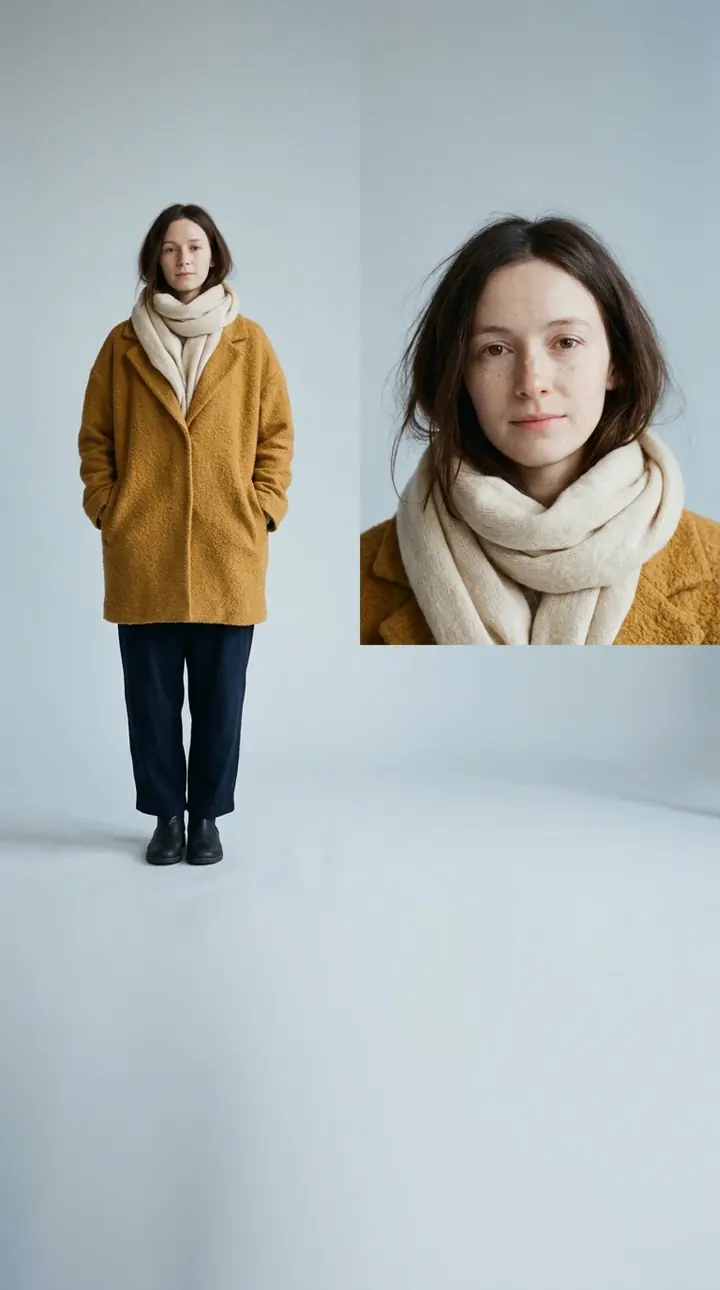
Shot size is how much of the scene the frame holds, measured against a person. It decides what the viewer looks at: the place, the action or the feeling. Music videos change size at almost every cut, and that alternation is much of why they feel rhythmic.
Wide
Where are we?
Medium
What are they doing?
Close-up
How do they feel?
Insert
A detail that matters
Change the framing at every cut, so two shots in a row never look alike.
| Shot size | What's in frame | What it does | Where it fits |
|---|---|---|---|
| Extreme wide (EWS) | Landscape or city, people tiny in it | Scale, isolation, a sense of place | Intro, outro, a new section |
| Wide (WS) | People head to toe with their surroundings | Sets the scene and the action | First shot in a new place, verses |
| Medium wide (MWS) | From the knees up | Body language and movement together | Dance, walking, performance |
| Medium (MS) | From the waist up | Action and interaction | Verses, two people together |
| Medium close-up (MCU) | Chest and shoulders up | Performance with expression | Singing shots, pre-chorus |
| Close-up (CU) | A face, or one object, filling the frame | Emotion and attention | Key lines, the chorus, the turn |
| Extreme close-up (ECU) | Eyes, lips, fingers, one detail | Intensity, texture, a hit | Drops, accents, one-bar cuts |
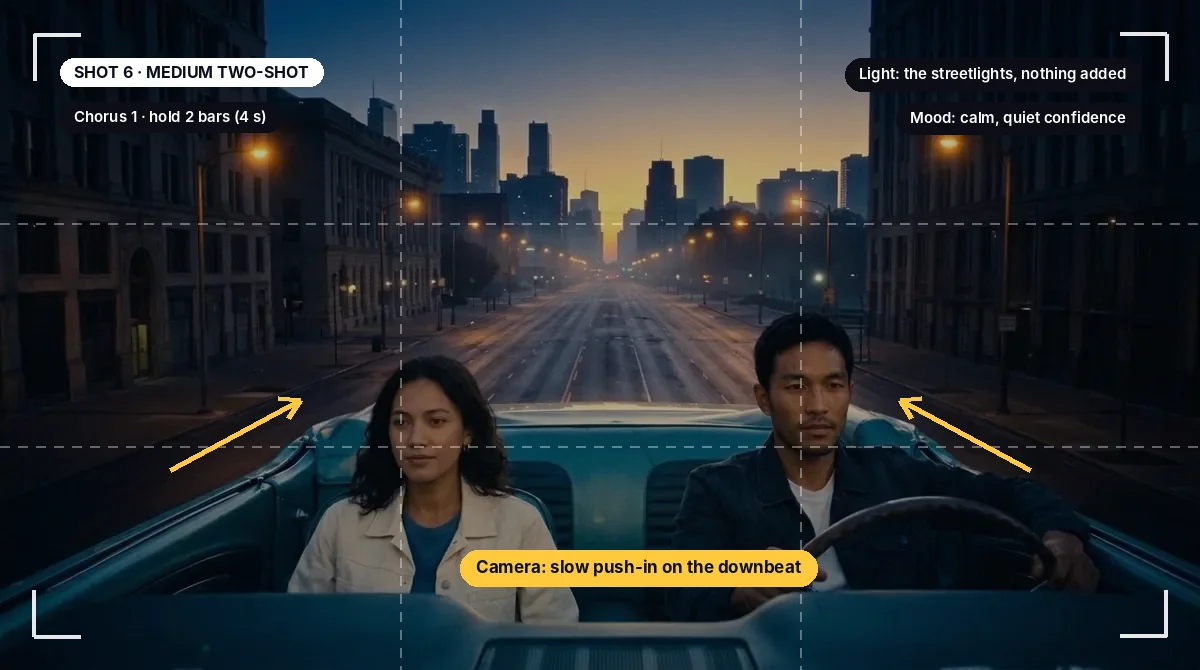
| Two-shot | Two people in one frame | A relationship in one image | Verses, the bridge, the last chorus |
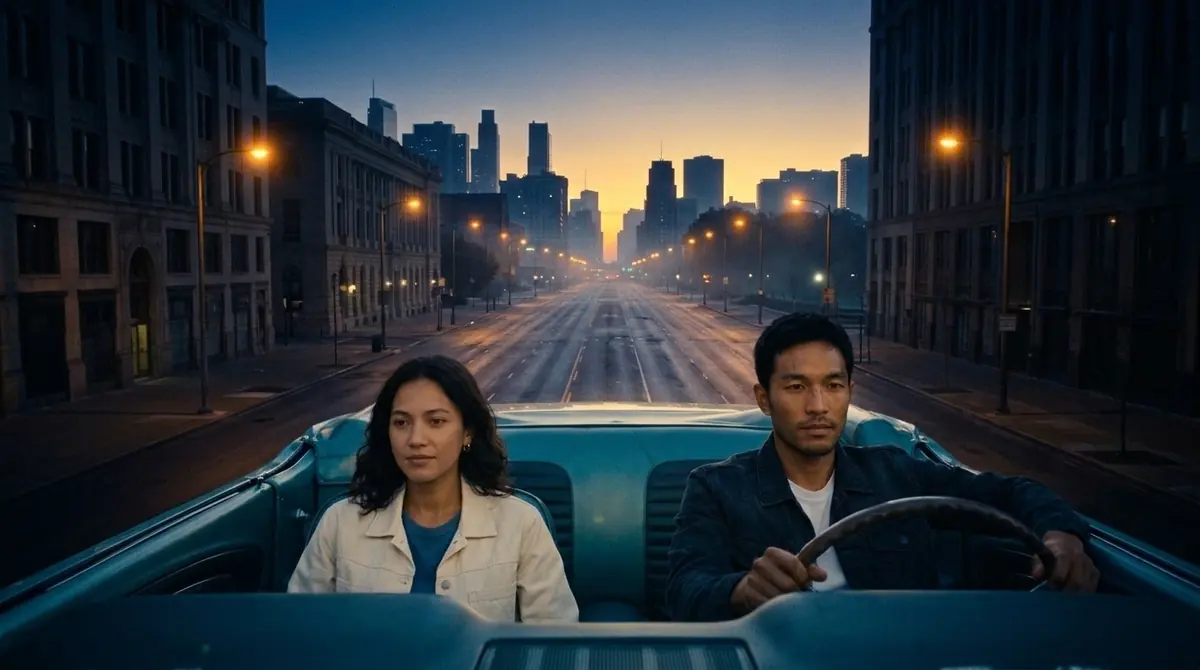


One rule keeps an edit readable: don't cut between two shots of the same subject at the same size. Wide to close-up reads as deliberate; medium to a slightly different medium reads as a mistake. Editors call that a jump cut, and music videos sometimes use it on purpose, for energy, but rarely by accident.
Camera angles and what they say
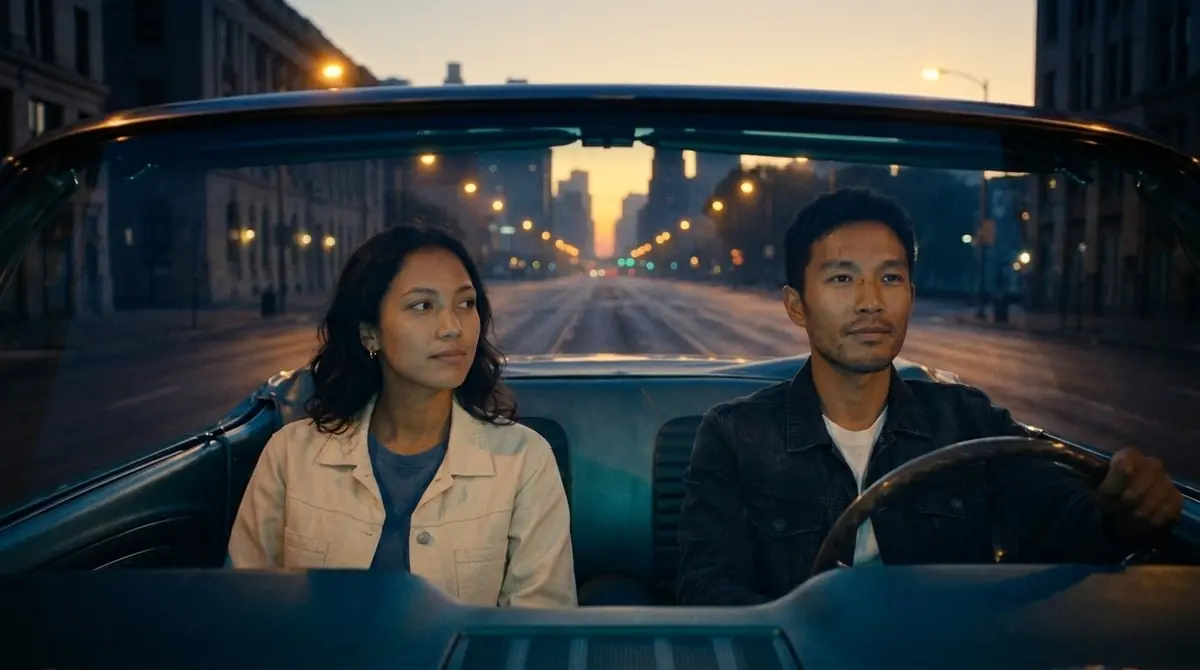
Angle is where the camera sits relative to the subject. Most shots belong at eye level, which feels neutral and close. The other angles are seasoning: each one tells the viewer how to feel about the person in frame, so use them when you mean it.
| Angle | Where the camera is | Effect | Use it for |
|---|---|---|---|
| Eye level | Level with the subject's eyes | Neutral, honest, close | Most shots; intimate verses |
| Low angle | Below the subject, looking up | Power, confidence, scale | Hip-hop and rock performance, a chorus entrance |
| High angle | Above the subject, looking down | Smallness, vulnerability | A lonely verse, someone overwhelmed |
| Overhead (bird's-eye) | Straight down from above | Pattern, design, distance | Dancers, a bed, a table, a car on a road |
| Dutch angle | Tilted on its side | Unease, disorientation, swagger | A short burst in a bridge or drop |
| Over-the-shoulder | Behind one person, looking past them | Connection, a shared moment | Two-person stories, a look across a room |
| Point of view (POV) | Where a character's eyes are | Puts the viewer inside the scene | Driving, arriving, reaching for something |
| Worm's-eye | On the ground, looking up | Monumental scale | Skylines, a figure looming at a drop |
Skip the blank page
Upload your song and Muvora's AI director plans a shot-by-shot storyboard on the beat. Edit every shot for free, and pay only if you render.
Camera movements and when each fits
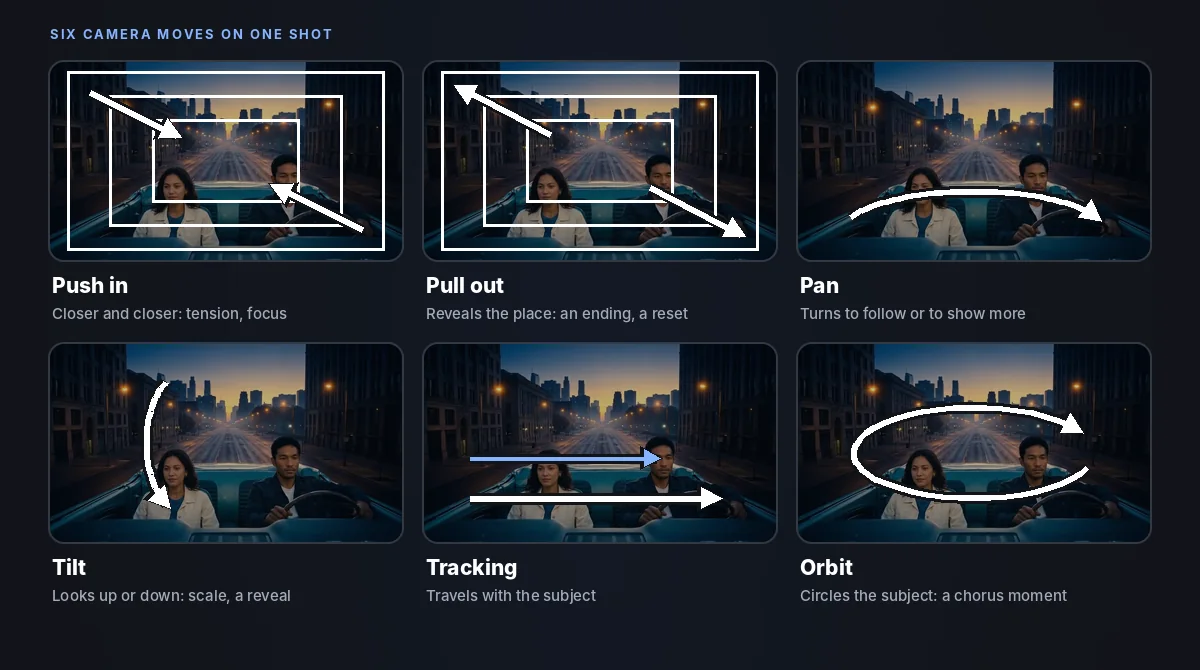
A camera move changes the frame during the shot. Moves add energy, but when every shot moves, nothing lands. Match the move to the music: still or slow in quiet passages, bigger and quicker as the song builds.
| Move | What the camera does | Feels | Fits |
|---|---|---|---|
| Static (locked off) | Doesn't move at all | Calm, deliberate, watchful | Intros, quiet verses, a held last image |
| Push-in | Moves slowly toward the subject | Growing attention or tension | A key lyric, a decision, the pre-chorus |
| Pull-out | Moves away to reveal more | Release, isolation, a reveal | Endings, the bridge, after a drop |
| Pan | Turns left or right from one spot | Follows action or surveys a place | Someone crossing a room, a skyline |
| Tilt | Turns up or down from one spot | Reveals height or detail | Shoes to face, street to sky |
| Tracking | Travels through space with the subject | Momentum, a journey | Cars, bikes, trains; the chorus |
| Crane | Rises or falls through the air | Lift, scale, arrival | A chorus opening, a final rise |
| Orbit | Circles the subject | Heightened, celebratory | The chorus peak, a dancer, a couple |
| Handheld | Carried, with a slight human shake | Urgency, intimacy, a live feel | Performance, parties, documentary looks |
| Whip pan | Pans so fast the image blurs | A jolt, often a transition | On a snare hit or into a drop |
How you name a move in a prompt matters as much as which move you pick. The AI music video prompts guide shows how to write framing, angle and camera move into a shot description, with pacing words for each level of energy.
Inserts and cutaways: the shots that keep the rhythm
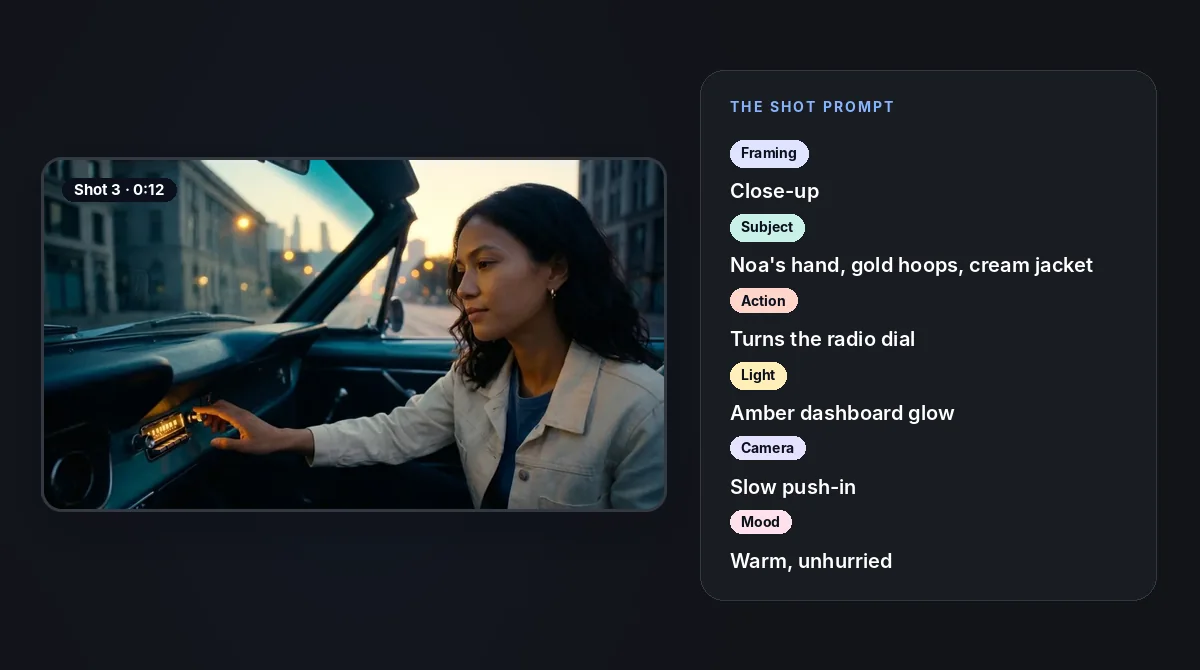
An insert is a close shot of a detail that belongs to the scene: hands on a wheel, a lighter, a ring, a radio dial. A cutaway leaves the main action for something nearby, such as a window, a street or a passing train. Neither needs a performance, so they are the cheapest shots to make and the easiest to land on a beat.
- Hands at work: tying laces, turning a key, pouring coffee, tuning a guitar.
- Objects that carry the story: a letter, a photograph, a dashboard, a phone face down on a table.
- Places between scenes: an empty street, a lit window, a train going by, rain on glass.
- Accents on the beat: a needle dropping, a match striking, a light switching on, timed to a downbeat or a drop.
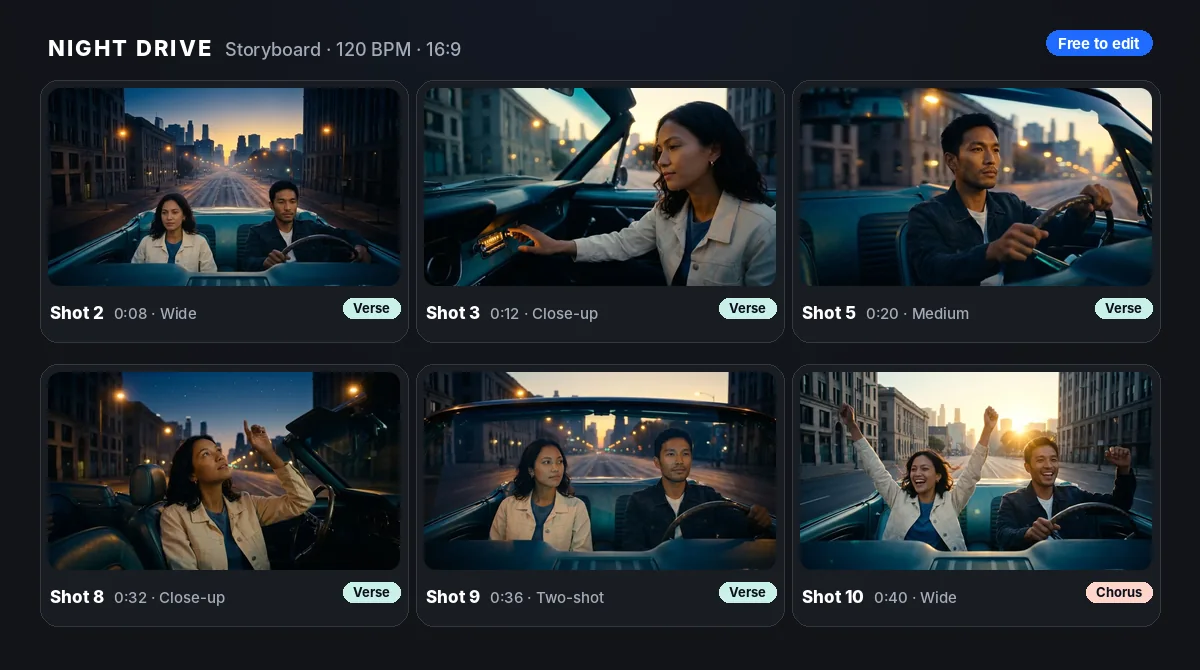
Use them to bridge two places, rest the eye between faces and hit accents. In a chorus that cuts every bar, two or three inserts keep the pace up without asking your lead for twenty moments. Night Drive's first verse has three: an aerial of the sleeping city, a headlight sweeping an apartment wall and the dashboard gauges glowing amber.
Coverage: how many framings each section needs
On a film set, coverage means shooting the same moment from several sizes and angles so the editor has choices. In a music video, and especially an AI one where every shot is made on its own, it means planning enough different framings across a section that no two neighboring shots look alike.
| Section | Typical length | Shots | Different framings to plan |
|---|---|---|---|
| Intro | 8 to 16 seconds | 1 to 3 | An extreme wide or an insert, perhaps a close-up |
| Verse | 30 to 40 seconds | 8 to 10 | At least four: wide, medium, close-up, insert |
| Pre-chorus | 8 to 16 seconds | 3 to 6 | Three: medium close-up, insert, a push-in |
| Chorus | About 30 seconds | 12 to 16 | Five or more: add aerial, orbit, low angle, two-shot |
| Bridge | 15 to 20 seconds | 3 to 5 | A new angle or place: overhead, high angle, wide |
| Outro | 8 to 16 seconds | 1 to 3 | Wide or extreme wide, held |
Count framings rather than shots. A chorus of fifteen shots built from three framings feels repetitive; the same chorus built from six feels like it is growing. Muvora's director writes a framing and a camera move for every shot, so you can scan a section in the storyboard and see at a glance whether it repeats itself. Planning coverage is part of the director's prep, covered with blocking and the rest of the job in how to direct a music video.
Let the song's energy choose the shot
Shot choice should follow the music's energy. Quiet passages want wider frames, slower moves and longer holds; loud ones want closer frames, bigger moves and faster cuts. It is the most reliable way to make picture and sound feel like one thing.
Each block is a shot. Same tempo, same bar grid: only the shot length changes with the energy.
| Energy | Shot sizes | Angles | Moves | Shot length |
|---|---|---|---|---|
| Low: intro, quiet verse, outro | Extreme wide, wide, held close-ups | Eye level, high | Static, slow push-in, slow pan | Two to four bars |
| Medium: verse, pre-chorus, bridge | Medium, medium close-up, inserts | Eye level, over-the-shoulder | Pan, tilt, handheld | One to two bars |
| High: chorus, drop | Close-up, extreme close-up, aerial wides | Low, overhead, a dutch beat | Orbit, crane, fast push-in, whip pan | One bar or less |
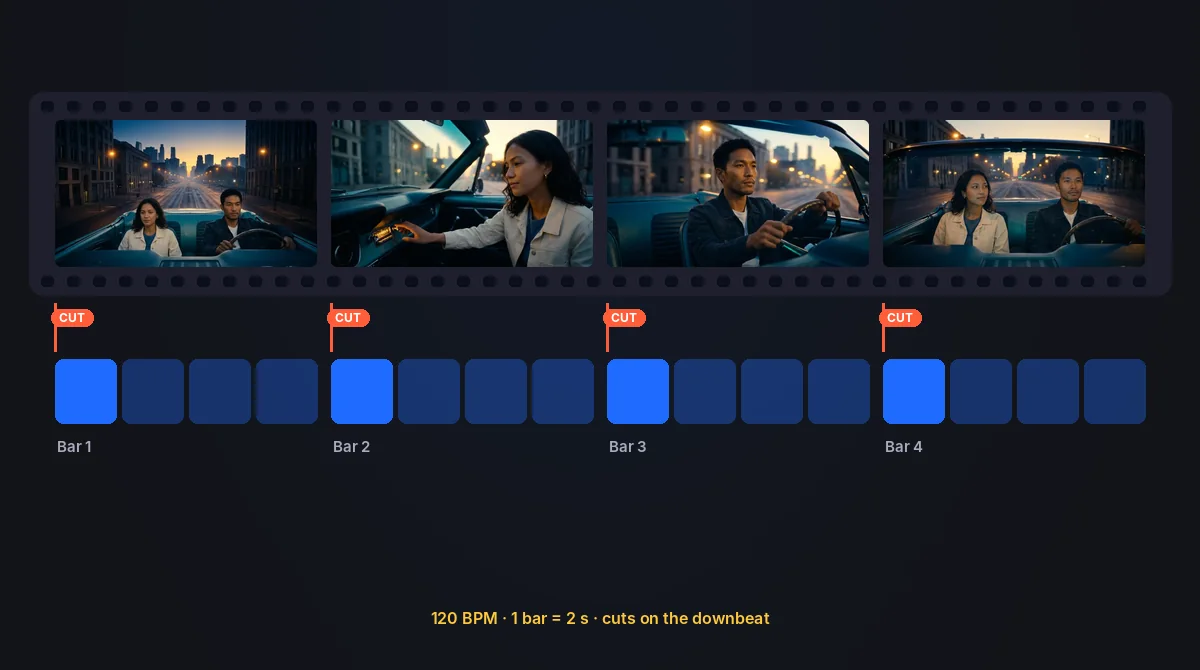
In Muvora the cuts come from the song's analysis, not from a person guessing: they land on downbeats, every section change and every drop is a cut, quiet sections get longer shots while loud sections and choruses get one bar or less, and a laid-back genre cuts slower than a driving one. The director chooses the framing and the move inside those cuts.
See your song's shots planned on the beat
Upload a track and Muvora maps every beat and section, then writes a framing, a camera move and an action for every shot. Check the plan in the storyboard editor for free.
A sample shot sequence for a verse and a chorus
Here is how the pieces fit. At 120 BPM a bar lasts two seconds. The verse shows someone packing up an apartment to leave town, the chorus the drive out, and the first eight bars of each are planned below.
- 01
Mark the section and its energy
Note where the section starts and ends in bars and how loud it is. That sets the shot length: two to four bars when quiet, one to two in the middle, one or less when loud.
- 02
Split it into shots on downbeats
Divide the section into shots that each begin on the first beat of a bar, with a cut at the section's start and one on any drop.
- 03
Open with a size that orients
Begin a section in a new place with a wide or an extreme wide so the viewer knows where they are, then move closer.
- 04
Alternate sizes and slot in inserts
Never put two same-size shots of one subject side by side, and place an insert or a cutaway between faces to keep the rhythm.
- 05
Give each shot one move that matches the energy
Static or slow moves in quiet bars, bigger ones in the chorus, one per shot, and the biggest change at the drop.
- 06
Save the strongest framing for the chorus
Hold your best image for the first bar of the chorus, then make each later chorus wider, closer or faster than the one before.
| Shot | Section | Bars | Size and angle | Move | Action |
|---|---|---|---|---|---|
| 1 | Verse | 2 | Wide, eye level | Static | She carries a box down an apartment stairwell under the hallway light |
| 2 | Verse | 2 | Insert | Static | Her hand drops a key ring into the dish by the door |
| 3 | Verse | 2 | Medium, eye level | Slow push-in | She tapes the last box shut on the kitchen floor under a bare bulb |
| 4 | Verse | 2 | Close-up, high angle | Static | She looks around the empty room, then switches off the light |
| 5 | Chorus | 2 | Extreme wide, low angle | Crane up | Her car pulls out onto the highway at dawn |
| 6 | Chorus | 1 | Close-up, eye level | Handheld | She winds the window down and the wind catches her hair |
| 7 | Chorus | 1 | Insert | Static | Her hand turns the radio up |
| 8 | Chorus | 1 | POV | Riding with the car | The road opens onto a long bridge as the sun clears the hills |
| 9 | Chorus | 1 | Overhead | Slow drift forward | The car crosses the bridge over a wide river |
| 10 | Chorus | 1 | Medium close-up, low angle | Slow orbit | She laughs, drumming the wheel in time |
| 11 | Chorus | 1 | Extreme close-up | Whip pan | The low sun hits the rearview mirror as the city shrinks behind |
Read the size column from top to bottom and you can see the rhythm: wide, insert, medium and close-up in the verse, then a chorus that opens enormous and swings between near and far every bar. The moves grow with the energy too, from static to orbit and whip pan.
The complete shot type reference
Every term in this guide in one table, with words that work when you describe the shot in an AI prompt. For fuller definitions, see the music video glossary.
| Shot type | Kind | What it does | Best for | Prompt words |
|---|---|---|---|---|
| Extreme wide | Size | Scale and place | Openings, endings | “extreme wide shot, figures tiny in the landscape” |
| Wide | Size | Sets the scene | New locations | “wide shot, full body, the room around them” |
| Medium wide | Size | Body and movement | Dance, walking | “medium wide shot, from the knees up” |
| Medium | Size | Action and interaction | Verses | “medium shot, waist up” |
| Medium close-up | Size | Expression in performance | Singing | “medium close-up, chest up” |
| Close-up | Size | Emotion | Key lyrics, choruses | “close-up on her face” |
| Extreme close-up | Size | Intensity, texture | Drops, accents | “extreme close-up of his eyes” |
| Two-shot | Size | A relationship | Couples, duos | “medium two-shot of both of them” |
| Insert | Type | A telling detail | Rhythm, story without words | “insert of her hand on the radio dial” |
| Cutaway | Type | Bridges places, rests the eye | Between faces | “cutaway to rain running down the window” |
| Establishing shot | Type | Says where we are | First shot in a place | “establishing wide of the empty avenue at night” |
| Eye level | Angle | Neutral, close | Most shots | “eye-level shot” |
| Low angle | Angle | Power | Performance, entrances | “low-angle shot looking up at him” |
| High angle | Angle | Vulnerability | Lonely moments | “high-angle shot looking down at her” |
| Overhead | Angle | Pattern, distance | Dancers, tables, cars | “overhead shot, looking straight down” |
| Dutch angle | Angle | Unease, swagger | Brief accents | “tilted dutch angle” |
| Over-the-shoulder | Angle | Connection | Two-person scenes | “over-the-shoulder shot from behind him toward her” |
| Point of view | Angle | Puts the viewer inside | Driving, arriving | “point-of-view shot through the windshield” |
| Static | Move | Calm | Quiet sections | “static camera” |
| Push-in | Move | Builds attention | Key lines | “slow push-in toward her face” |
| Pull-out | Move | Reveal, release | Endings | “slow pull-out revealing the empty street” |
| Pan | Move | Follows or surveys | Following action | “slow pan right, keeping him in frame” |
| Tilt | Move | Reveals height | Shoes to face, street to sky | “tilt up from the street to the skyline” |
| Tracking | Move | Momentum | Vehicles, the chorus | “camera rides alongside the car” |
| Crane | Move | Lift, arrival | Chorus openings | “crane up over the rooftops” |
| Orbit | Move | Celebration | Chorus peaks | “slow orbit around the two of them” |
| Handheld | Move | Urgency, intimacy | Performance, parties | “handheld camera” |
| Whip pan | Move | A jolt, a transition | Into a drop | “fast whip pan” |
Get a shot-by-shot storyboard for your song
Muvora picks a framing and a camera move for every shot, times them to your beats and lets you rewrite any shot before you render. The storyboard is free.
Written by the Muvora team. Last updated November 13, 2026. Spotted something out of date? Tell us at [email protected].