The short answer
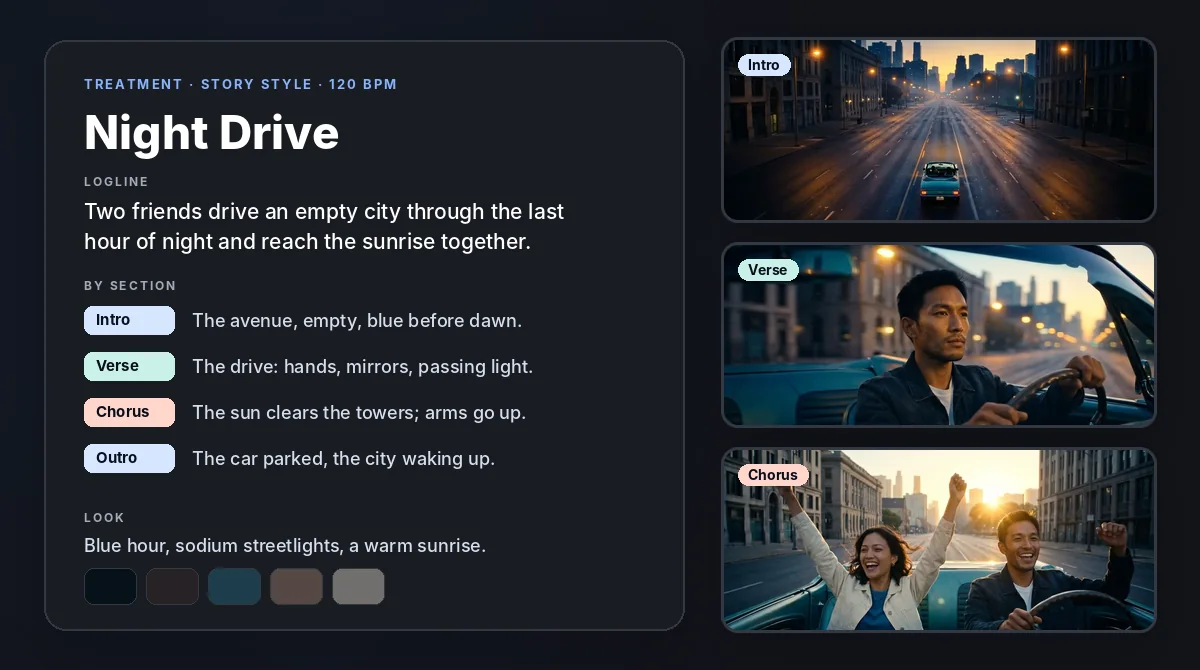
A good music video storyboard example has a one-line concept, a look (palette, light, camera language), characters described once, and a shot for every stretch of the song with its time, framing and action. In “Night Drive”, two friends cross a sleeping city until sunrise: two-bar shots hold the verses, one-bar shots drive the choruses, and the gold light grows every chorus.
- One sentence carries the whole video: a night drive that ends at sunrise.
- The light changes by section, so the arc is visible even with the sound off.
- Characters are described once and the words are repeated in every shot.
- Verse shots hold two bars; chorus shots cut every bar, and the drop gets a cut of its own.
- Small details (a radio dial, dashboard gauges) make cheap, strong cutaways.
On this page (8 sections)ShowHide
What you're looking at
“Night Drive” is one of the test songs Muvora is developed against: a synthetic pop track at 120 BPM, 2 minutes 56 seconds long, with lyrics written for the test, so the song, the story and the characters are ours. The vibe typed into the upload step was a single line: “A night drive that ends at sunrise.” Everything below came from the AI director and the image model from that line and the song's analysis.
The pictures are storyboard frames, which are still images. In a render, the video model starts each shot from its frame and animates it for the length of the shot. The storyboard was written by an earlier version of the director, so a few details differ from what the current one would write; where that matters, it's noted.
The song map behind the storyboard
Before any shot is written, the song is analyzed into beats, bars, sections and energy. The storyboard is laid out on that map, which is why every cut lands on a downbeat and every section change is a cut. Here is the map for “Night Drive”.
| Section | Time | Energy | Shot length | Shots |
|---|---|---|---|---|
| Intro | 0:00 to 0:08 | Low | One 8-second shot | 1 |
| Verse 1 | 0:08 to 0:40 | Medium-low | 4 seconds (2 bars) | 8 |
| Chorus 1 (drop at 0:40) | 0:40 to 1:12 | High | Mostly 2 seconds (1 bar) | 15 |
| Verse 2 | 1:12 to 1:28 | Medium-low | 4 seconds | 4 |
| Chorus 2 (drop at 1:28) | 1:28 to 2:00 | High | Mostly 2 seconds | 15 |
| Bridge | 2:00 to 2:16 | Medium | 4 seconds | 4 |
| Chorus 3 | 2:16 to 2:48 | High | Mostly 2 seconds | 15 |
| Outro | 2:48 to 2:56 | Low | 4 seconds | 2 |
Sixty-four shots for a three-minute song, and the rhythm is audible in the numbers: the quiet edges hold, the verses walk, the choruses run. You can get the same kind of plan for any tempo and form with the free shot list generator, or see how sections are counted in song structure explained.
Skip the blank page
Upload your song and Muvora's AI director plans a shot-by-shot storyboard on the beat. Edit every shot for free, and pay only if you render.
The brief: concept, palette, light and camera
The brief is the storyboard's rulebook. Every shot is written to match it, and every frame is drawn with it. “Night Drive” has a short one:
- Logline: two quiet companions drive through a sleeping city, and the road carries them into a golden sunrise.
- Visual world: a sleeping city, empty avenues and a vintage teal convertible. The motif that returns each chorus is golden light spilling across the car and the couple's hands in the wind, stronger every time.
- Palette: midnight navy (#0B1030), deep blue (#1E3A8A), teal (#14B8A6), amber (#F59E0B) and pale gold (#FDE68A).
- Lighting: verses lit by sodium streetlights and dashboard glow with deep blue shadows; choruses by warm gold bleeding in from the horizon, stronger toward sunrise.
- Camera language: quiet parts slow, wide and steady; choruses closer and faster, with tracking and sweeping moves around the car.
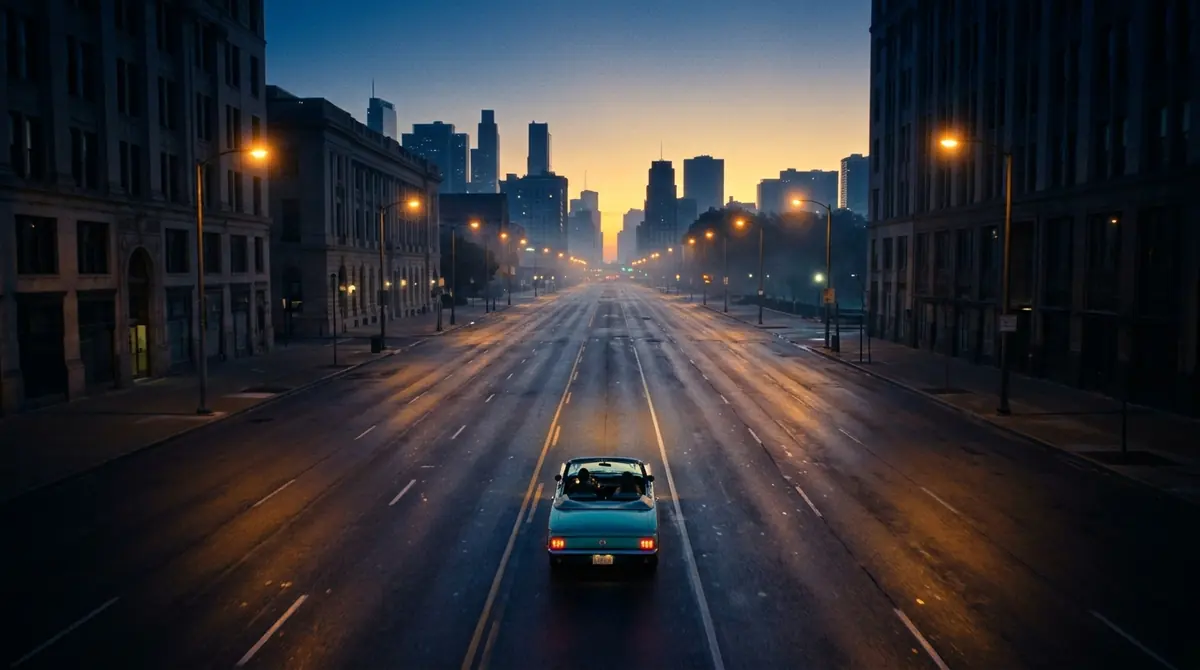
Notice what the lighting plan does: it turns the story arc into colour. Blue night in the verses, gold in the choruses, more gold each time. Even someone watching on mute sees the video move from night to morning. A plan like this is worth writing even if you shoot on a phone; the how to storyboard guide explains how to build one, and the same brief written up as a pitch, section by section in bars, is the Night Drive treatment example.
Two characters, described once
The cast is two people, which is plenty for a three-minute video. Each gets a fixed description of face, hair, skin and build, and a wardrobe:
- Noa (the lead): a woman in her mid 20s, slim, with a soft oval face, dark wavy shoulder-length hair, light brown skin and small gold hoop earrings, in a cream cropped jacket over a faded blue tee.
- Eli (the driver): a man in his late 20s, lean, with short black hair, light stubble, warm tan skin and a thin scar through his left eyebrow, in a dark denim jacket over a white tee.
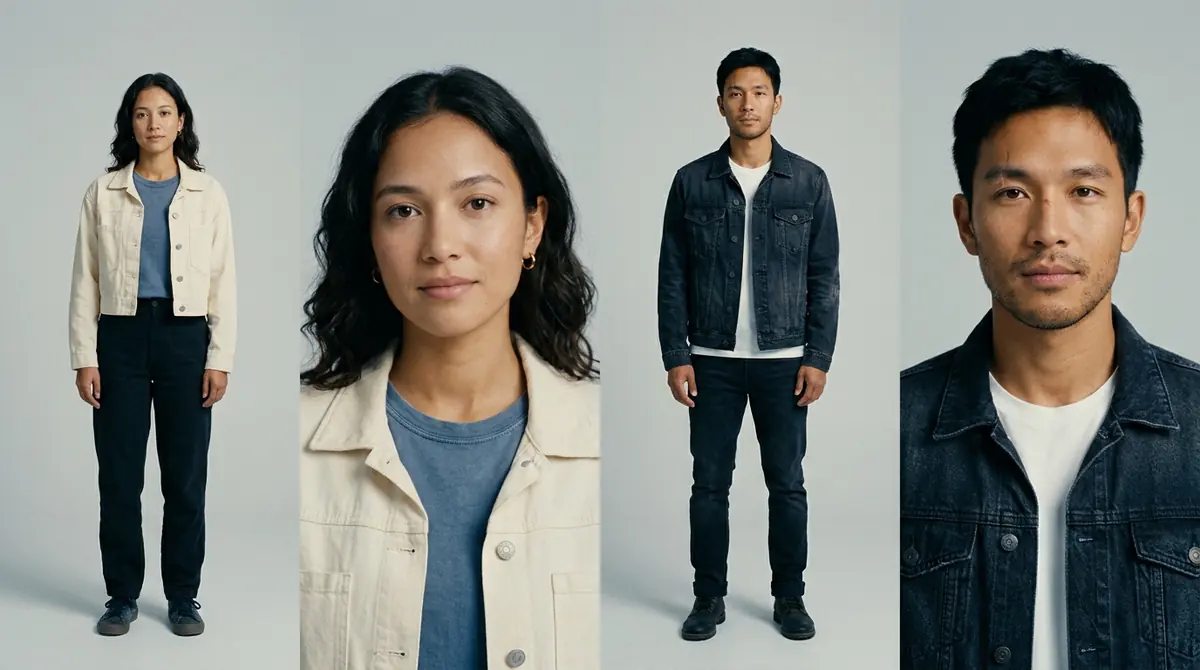
Two rules keep them recognisable. First, the description is pasted word for word into every shot they appear in; the director checks this and is asked to rewrite any shot that paraphrases it. Second, every keyframe is compared with the sheet before any video is made. On these opening shots the check scored 0.90 to 0.93 out of 1, so no redraw was needed; a frame that drifts below the threshold is drawn again. Small identifying details, like Eli's scar and Noa's hoops, give both the model and the viewer something to lock onto.
Verse 1, shot by shot
The first verse has eight 4-second shots, two bars each. Its job is to set up the relationship and the city before the chorus releases them. Five of its frames, with what each shot is for:
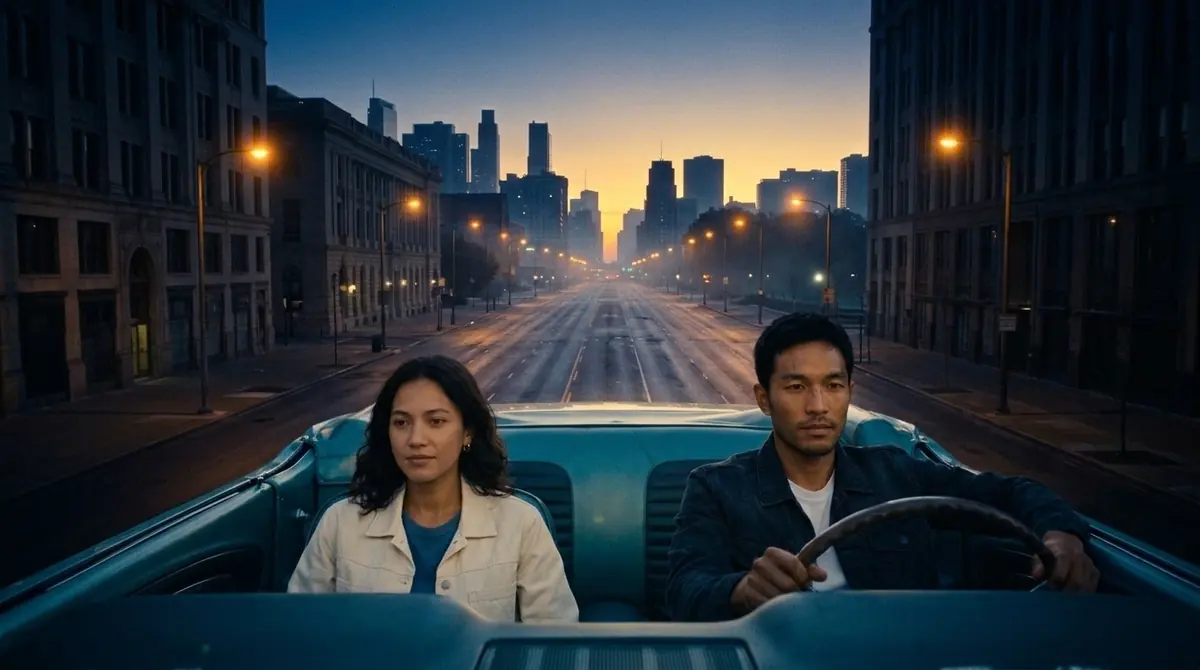


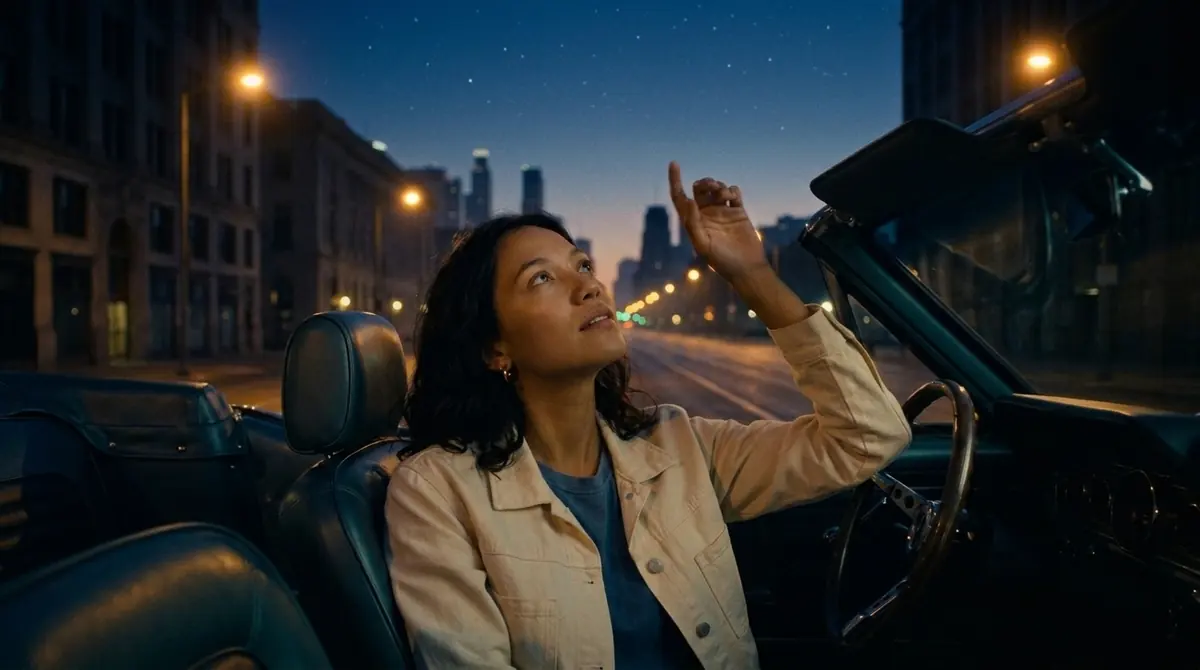
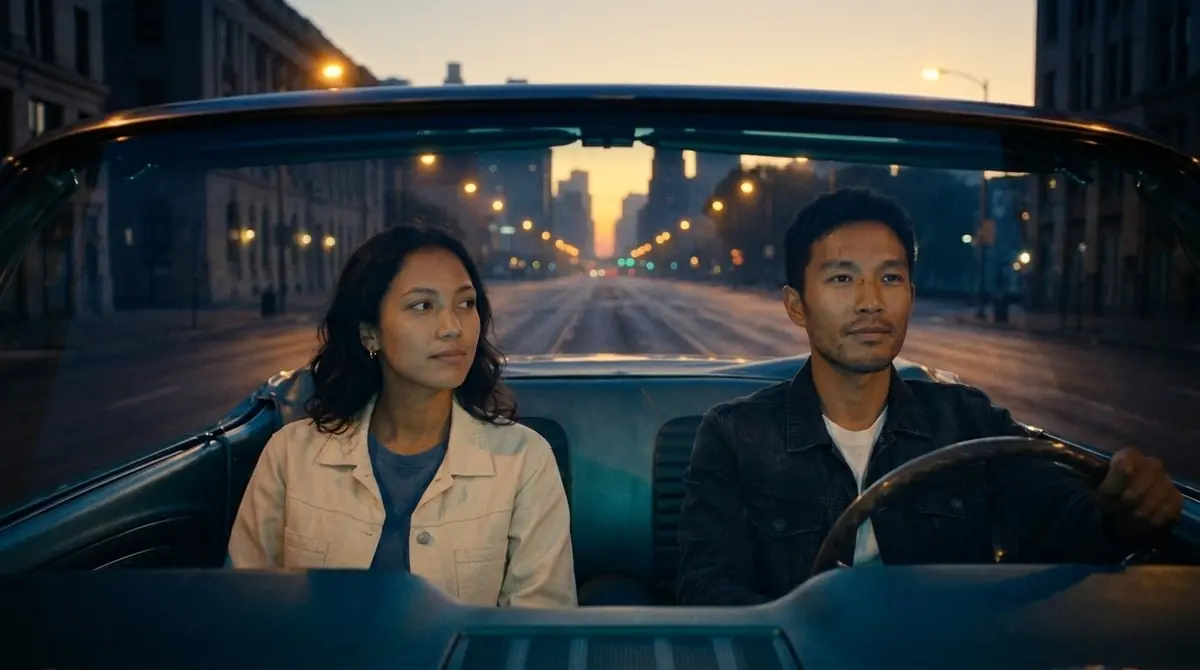
Between those, three shots do the connecting work: an aerial of the sleeping city (shot 4), dark apartment windows with a headlight sweeping the wall (shot 6) and an insert of the dashboard gauges glowing amber (shot 7). Inserts and wide cutaways like these are the cheapest shots in any storyboard and some of the most useful, because they keep the rhythm going without needing a performance.
Chorus 1: the drop, faster cuts and the hero frame
At 0:40 the song drops into the first chorus and the storyboard changes gear. The first shot is a 4-second wide of the convertible speeding toward gold light on the horizon, then the cuts halve to one bar each: Noa with her hair in the wind, Eli laughing at the wheel, an aerial crane up as the car passes a line of streetlights, an insert of their clasped hands over the gearshift, a pan across an empty town square at first light, an orbit around the car as they trade a look, and an extreme wide of the car climbing a hill as the horizon cracks orange.

Three things make this chorus work. The framing changes every bar (wide, medium, close-up, aerial, insert), so each cut reads as a cut. The camera starts moving where the verses held still, which matches the jump in energy. And the motif from the brief appears in almost every shot: gold light on the car and their hands in the wind. In this version, the second and third choruses replay the first chorus's shots on the same cuts, a common budget trick that makes the hook feel familiar.
The bridge turns, the outro lands
The bridge (2:00 to 2:16) slows back down to 4-second shots and changes the situation: the car has stopped, and Noa and Eli sit on its hood facing an orange horizon, before pulling out onto an open road through golden fields. That pause is the turn: the night is over and the question of where they're going is answered by the road ahead.
The outro (2:48 to 2:56) is two shots: the convertible parked on a field road at sunrise with the two of them side by side and long shadows, then an extreme wide of the empty road running toward the sun. The video ends on a place rather than a face, which gives the song room to fade. That final image is the button: it rhymes with the empty avenue of the first shot, but in gold instead of blue.
What to copy for your own storyboard
- A logline with a lead, a world and a change, written before any shot.
- A lighting plan per section that makes the arc visible on mute.
- One or two characters, described once and repeated word for word.
- Long shots at the quiet edges, two-bar shots in verses, one-bar shots in choruses.
- A cut on every section change and on the drop.
- Inserts and cutaways for rhythm: hands, dials, windows, roads.
- A final image that answers the first one.
Get a storyboard like this for your song
Upload your track, type your idea in one line and Muvora's director writes the brief, the characters and every shot, then draws the frames. The storyboard is free; you choose whether to render it.
Written by the Muvora team. Last updated November 13, 2026. Spotted something out of date? Tell us at [email protected].