The short answer
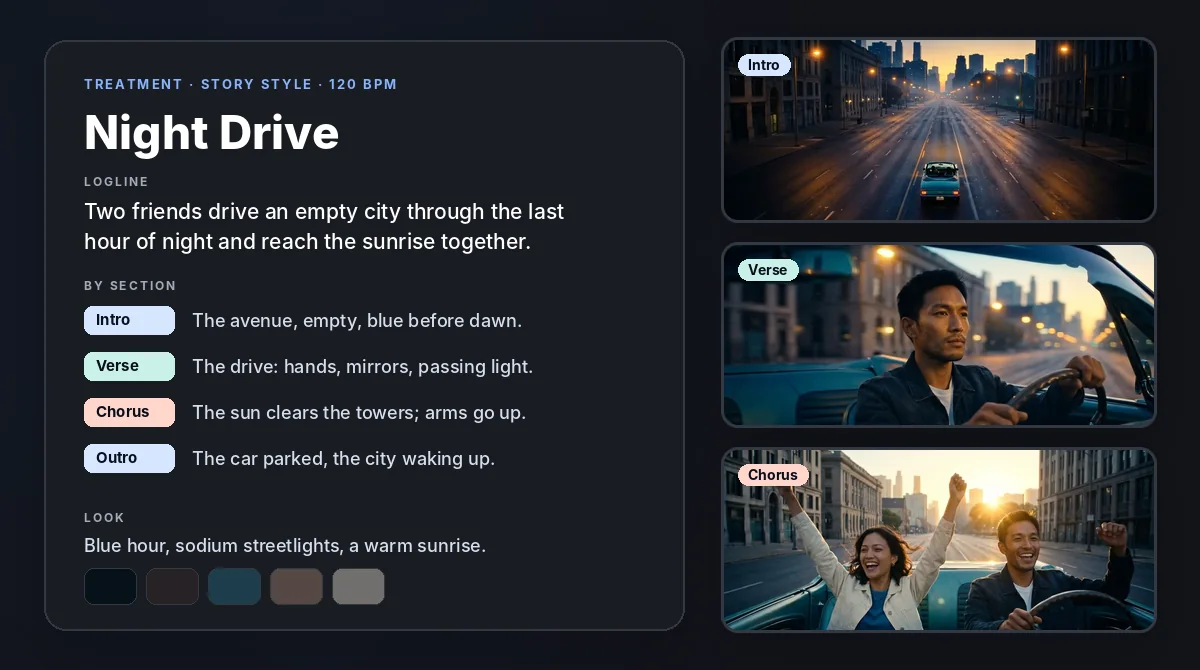
Here is a sample music video treatment for “Night Drive”, a 2:56 pop song at 120 BPM, in which two friends drive an empty city through the last hour of night and reach the sunrise together. It runs from a title page and logline through the cast, five locations and their light, a beat for each section timed in bars, key shots, a performance plan and deliverables.
- Time the story in bars: at 120 BPM a bar is 2 seconds, so a 16-bar chorus is 32 seconds of picture.
- Give every location its own light, and let the light carry the arc from blue night to gold.
- Describe each character once, with one detail to recognize them by, and never paraphrase it.
- Write a new image for every chorus, each one wider and warmer than the last.
- Finish on the practical page: formats, quality, schedule and what it costs.
On this page (7 sections)ShowHide
Title page, logline and concept
What follows is the treatment a director could have handed in for “Night Drive”, written at full length. The song is one of Muvora's test tracks, a synthetic pop song with lyrics written for it, so the story and the two people in it are ours to show. The look and the cast come from the brief Muvora's AI director wrote for the song and the frames it drew. The Night Drive storyboard example takes those shots apart one by one, and how to write a music video treatment explains what each part of a treatment is for.
- Title: “Night Drive”, music video treatment, version 2.
- Song: 2:56 long, 120 BPM in 4/4, 88 bars, pop.
- Style and format: a Story video with a 16:9 master; vertical, square and Canvas versions from the same render.
- Mood: wide awake, unhurried, quietly hopeful.
- Logline: In the last hour of night, two friends drive an empty city with the radio up, and the road brings them to the sunrise.
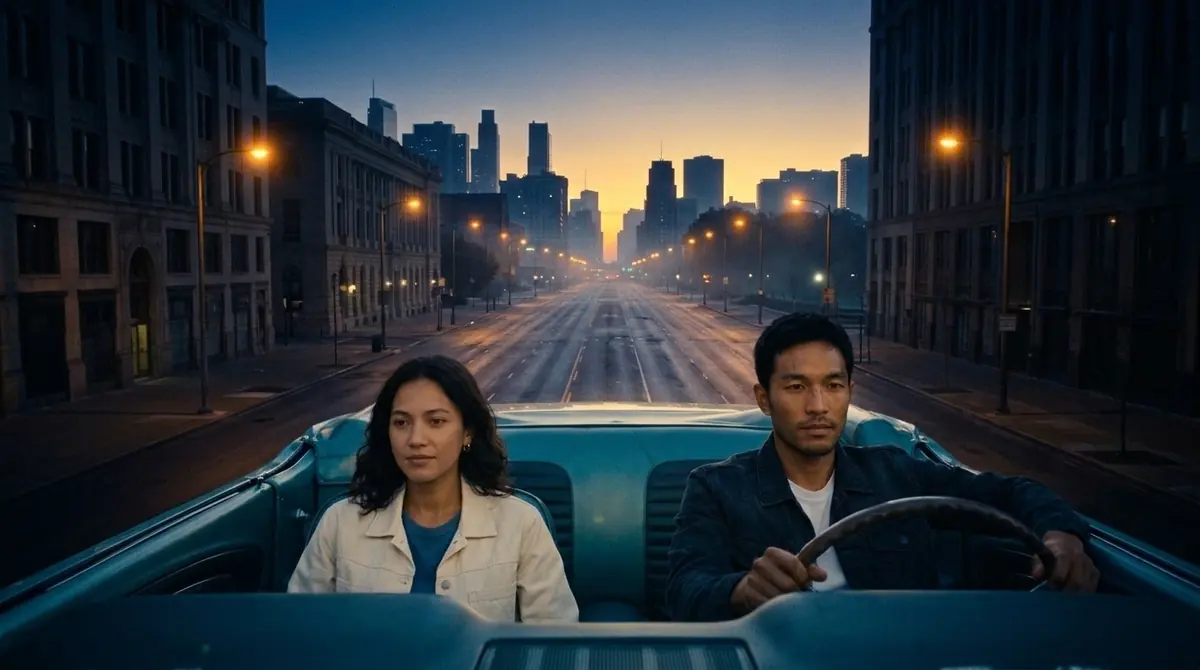
Concept. Everyone else in the city is asleep, and that is the point: for one hour the streets belong to two people and a radio. The video never explains who Noa and Eli are to each other. It watches what they share instead: the station she chooses, the long way he takes, a red light they wait out at a crossing with nobody around. The night does the storytelling. It starts blue and still, every chorus pulls more gold out of the horizon, and the last chorus is full sunrise on an open road.
Why it fits the song. At 120 BPM the beat moves like a car at cruising speed, steady and never rushed, with a pulse a moving shot can ride. The verses sit low and close, which suits the inside of a car at night; each chorus lifts, which suits a road opening up. The song also climbs toward its last chorus instead of peaking early, so the light can keep rising with it, and the verse line about streetlights counting down sets the clock without anyone checking one.
The cast, the places and the look
This is the part of a treatment that decides whether a video holds together. Each person is described once, in words that get pasted into every shot they appear in. Each place gets its own light source. The palette and the camera get rules rather than adjectives.
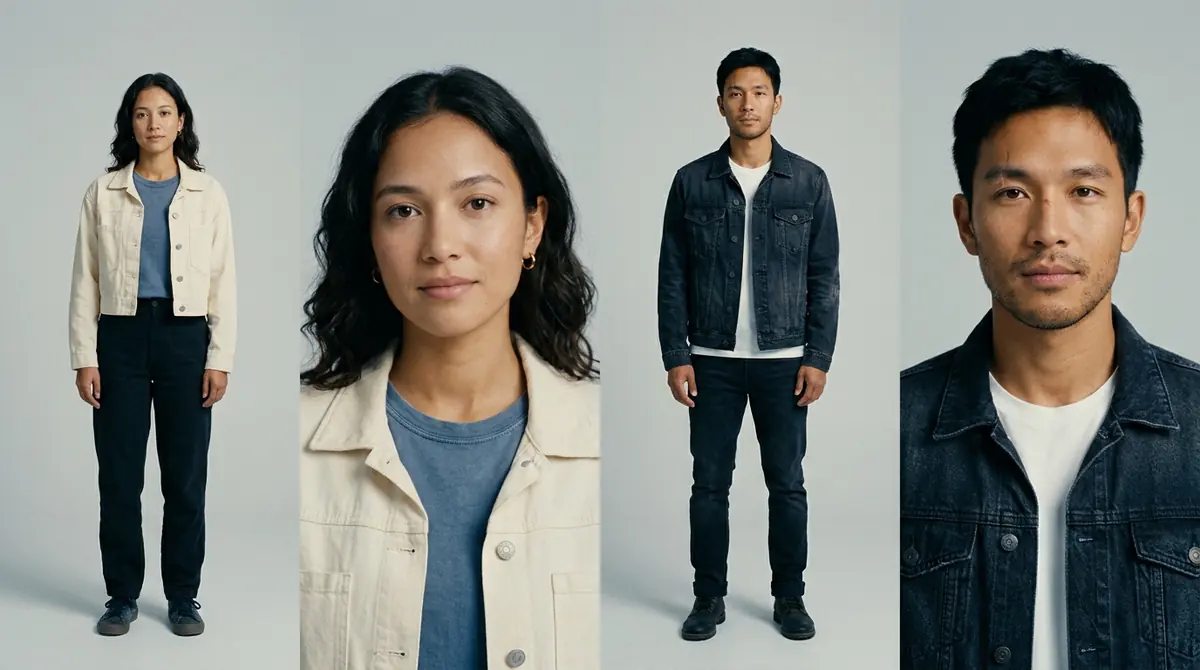
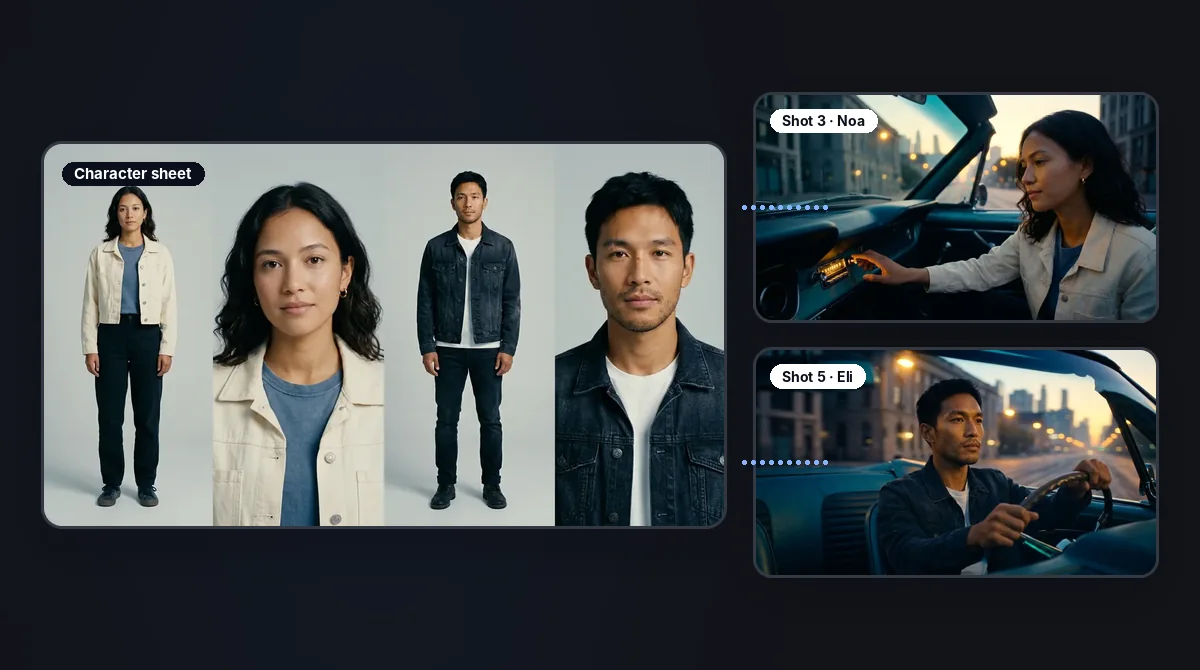
- Noa, the lead, in the passenger seat: mid-20s, slim, a soft oval face, dark wavy shoulder-length hair, light brown skin and small gold hoop earrings. She wears a cream cropped jacket over a faded blue tee in every shot. The hoops are her detail: they catch every passing light.
- Eli, the driver: late 20s, lean, short black hair, light stubble, warm tan skin and a thin scar through his left eyebrow. A dark denim jacket over a white tee, start to finish. The scar is his detail, visible in every close-up.
- The car: a vintage teal convertible with the top down, chrome trim and gauges that glow amber. It's the third character and the one set the video can't do without.
| Location | Sections | Light | What's in it |
|---|---|---|---|
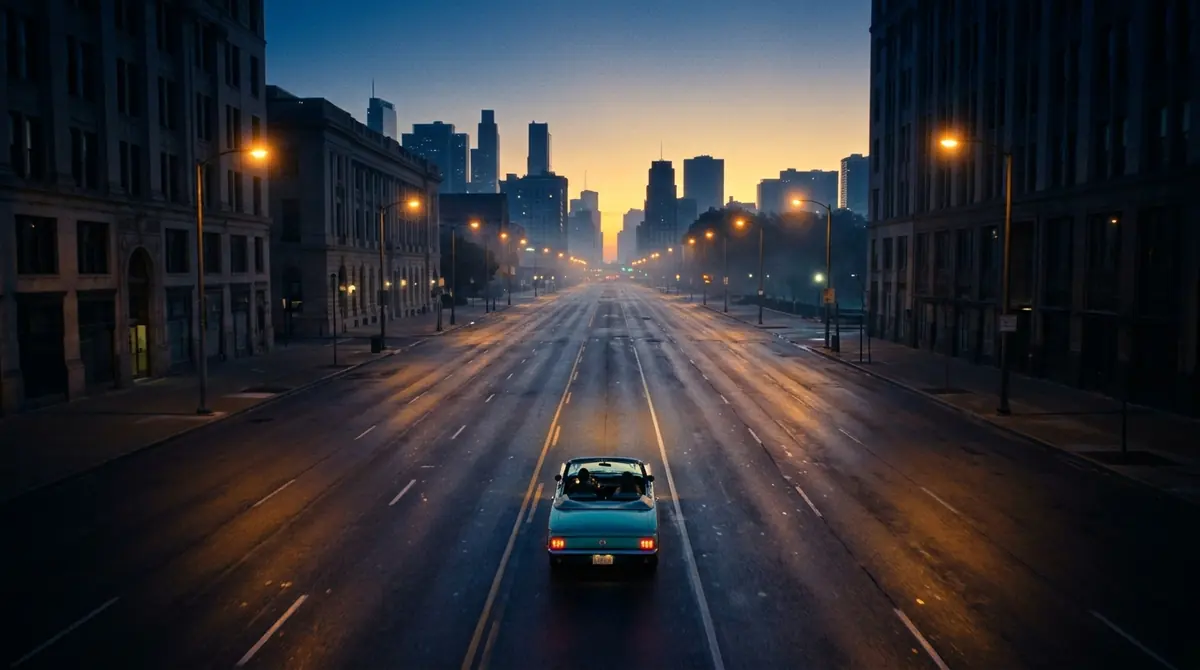
| Downtown avenue | Intro, verse 1, chorus 1 | Sodium streetlights in amber pools under a deep blue sky | Six empty lanes, dark towers, a traffic signal cycling for nobody |
| Sleeping side streets | Verse 1, verse 2 | Dark windows, a headlight sweeping a wall, the dashboard's amber | Parked cars, one crossing with a red light |
| Ring road out of the center | Chorus 2 | Overhead lights passing one per beat as the sky pales | An on-ramp, the skyline shrinking in the mirror |
| Hill road above the city | Chorus 2, bridge | Orange dawn ahead, the city's last lights below | A gravel pull-off where the car finally stops |
| Field road | Final chorus, outro | Full sunrise, then low sun and long shadows | Gold wheat on both sides of a straight road running east |
- Palette, darkest to brightest: midnight navy (#0B1030), deep blue (#1E3A8A), the car's teal (#14B8A6), streetlight amber (#F59E0B) and pale gold (#FDE68A). Nothing else saturated: no neon, and no red apart from one traffic light.
- Light: every source is in the scene. Verses are streetlight and dashboard; each chorus adds gold from the horizon. Whoever we're closest to is always lit by something we could point at.
- Camera: in quiet sections it is planted or on a slow push, and wide shots hold for two bars. In the choruses it moves with the car: riding on the hood, sweeping in behind, craning up past a streetlight.
- Framing: a new framing at every cut (wide, medium, close-up, insert, aerial), so each cut reads as a cut even when the place stays the same.
- Texture: real-feeling night photography with soft grain; no lens flares and no glow added in the edit.
Skip the blank page
Upload your song and Muvora's AI director plans a shot-by-shot storyboard on the beat. Edit every shot for free, and pay only if you render.
The story by section, counted in bars
At 120 BPM in 4/4 a beat lasts half a second and a bar exactly 2 seconds, so bars turn into time without a calculator: bar 21 starts at 0:40. Counting in bars keeps the treatment honest about how much room each beat of the story has. Sixteen bars of chorus is 32 seconds, enough for a dozen or more shots; four bars of intro is a single held shot.
| Section | Bars | Time | Story beat | Light |
|---|---|---|---|---|
| Intro | 1 to 4 | 0:00 to 0:08 | The convertible waits alone under one streetlight on the empty avenue, engine running, nobody in frame | One amber pool, blue sky |
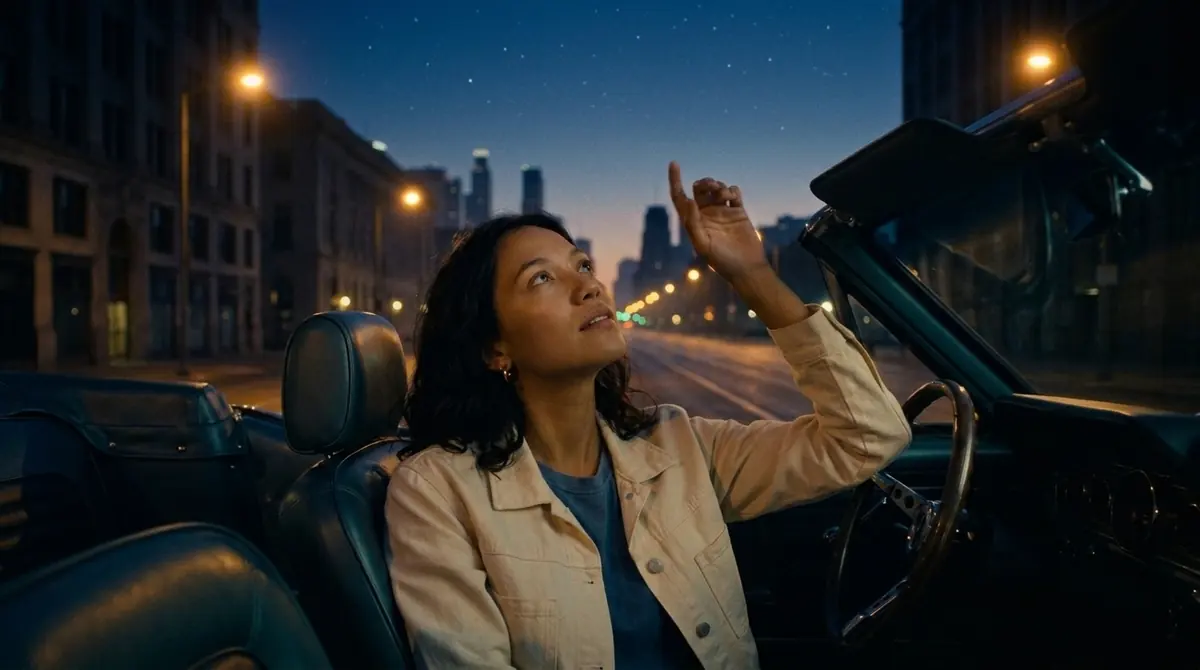
| Verse 1 | 5 to 20 | 0:08 to 0:40 | They drive the sleeping city: Noa finds a station, Eli takes the long way, she traces the stars, and both see the first warmth at the end of the avenue | Streetlights sliding across faces, amber dash |
| Chorus 1 | 21 to 36 | 0:40 to 1:12 | The drop: the avenue opens and the car runs toward gold between the towers; Noa turns the radio up and their hands meet over the gearshift | First gold on the horizon |
| Verse 2 | 37 to 44 | 1:12 to 1:28 | Quieter and closer: they stop at a red light with nobody for blocks and wait it out anyway, sharing a look while it changes | Blue night, the signal's red, then green |
| Chorus 2 | 45 to 60 | 1:28 to 2:00 | The second drop: they leave the center on the ring road, overhead lights passing on the beat and the skyline shrinking behind them | Gold stronger, streetlights going pale |
| Bridge | 61 to 68 | 2:00 to 2:16 | The turn: they pull off on the hill, switch off the engine and sit on the hood facing the orange horizon, then take the field road east | Orange dawn |
| Final chorus | 69 to 84 | 2:16 to 2:48 | Open road through gold wheat: the car tiny in huge aerials, the two of them close in a cabin full of sun | Full sunrise |
| Outro | 85 to 88 | 2:48 to 2:56 | The car parked on the field road with the two side by side, then the empty road running into the sun | Low sun, long shadows |
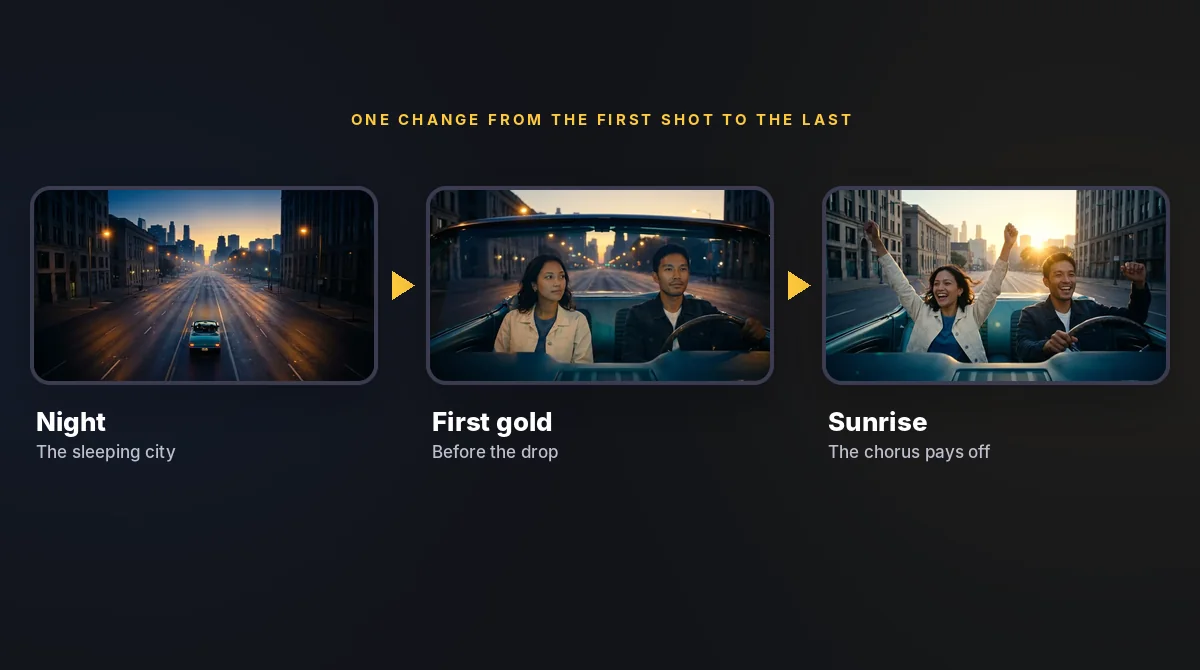
Two choices in that table do most of the work. Each verse stays in one kind of place, so the story moves through small actions rather than new locations. And each chorus gets an image of its own (the first gold, the ring road, the open fields), wider and warmer than the one before, instead of replaying chorus 1. The bridge is the only time the car stops, which is exactly why it reads as the turn.
Count your own song's bars
Upload your song and the free analysis finds its tempo, every downbeat and the sections, then the AI director plans a beat for each one. Reading and editing the storyboard costs nothing.
The key shots
A treatment names the moments the video can't do without and leaves the rest to the storyboard. These twelve are Night Drive's, each pinned to the bar it starts on, with its framing and how the camera behaves. The full storyboard for the test song came to 64 shots; these are the ones the others are built around.
| Bar | Section | The shot | Framing and camera |
|---|---|---|---|
| 1 (0:00) | Intro | The convertible alone under one streetlight on the empty avenue | Extreme wide, a slow push over four bars |
| 5 (0:08) | Verse 1 | The two ride the sleeping avenue under amber streetlights | Wide, the camera riding on the hood |
| 7 (0:12) | Verse 1 | Noa's hand turns the glowing radio dial | Close-up insert, still |
| 11 (0:20) | Verse 1 | Eli at the wheel, streetlight sliding across his face | Medium from the side, steady |
| 19 (0:36) | Verse 1 | From the back seat, both face the long avenue as the horizon warms | Medium two-shot, a slow push |
| 21 (0:40) | Chorus 1 | The car bursts onto the open avenue toward gold light between the towers | Wide and low, the camera sweeping in behind |
| 25 (0:48) | Chorus 1 | Noa reaches across and turns the radio up, hair whipping in the wind | Close-up, moving with the car |
| 41 (1:20) | Verse 2 | The car waiting at a red light, not another car for blocks | Overhead wide, locked off |
| 45 (1:28) | Chorus 2 | Overhead lights strobe across the car on the on-ramp, one per beat | Medium, riding beside the car |
| 61 (2:00) | Bridge | The two on the hood, engine off, facing the orange horizon | Wide from behind, held for two bars |
| 69 (2:16) | Final chorus | The car on a field road through gold wheat, the sun just clear of the horizon | Aerial, craning up |
| 87 (2:52) | Outro | The empty road running into the sun | Extreme wide, still |
Notice how many of them are small. A hand on a radio dial, a red light at an empty crossing, an engine switched off: inserts and quiet beats like these are cheap on a filmed shoot and dependable in an AI render, and they carry a relationship better than dialogue would. For the timing of every shot in between, the free shot list generator lays a song's form out bar by bar.
The performance plan and the practical page
Performance plan, as written. Nobody sings to the lens. “Night Drive” is a Story video, and the song lives inside the car: it's the station Noa tunes in during verse 1 and turns up at the first drop. Keeping the leads as people rather than performers leaves the lyrics in the soundtrack and keeps the pictures about the night.
Performance plan, artist version. If the artist wants to be in the video, they take Noa's seat. In Muvora's Performance style that means one clear, front-facing photo and the consent box; the vocals are separated, the shots where the song is sung (mostly in the choruses) are lip-synced from the passenger seat, chest up, with the dashboard light on their face, and in every other shot they act without singing. Those sung seconds are priced at 75 credits each instead of the quality's own rate.
- Deliverables: a 16:9 master at 1080p; 9:16 and 1:1 versions and an 8-second Canvas loop from the same render; captions off, since the story carries the song and nobody needs to read along.
- Quality: Standard, because Noa and Eli appear in most shots and must stay recognizable. At 60 credits a second, the 2:56 song comes in just under the 10,800 credits of a full three minutes, and the exact figure shows before rendering.
- Re-rolls: save the free re-rolls (10% of the length) for the drop at bar 21 and the hands over the gearshift, the two shots that carry the most weight.
- If it were filmed: a picture car towed by a camera vehicle so neither actor drives, a downtown street held from about 4 a.m., two nights for the city and two dawns for the bridge and the final chorus, since the low gold light lasts well under an hour each morning.
- Rights: the song, the lyrics and both characters belong to the test project. For your own video, the song you upload has to be yours or licensed to you.
A fill-in-the-blanks treatment template
Here is the same treatment with the Night Drive answers taken out. Copy it into a document, fill every blank, and stop whenever a line wants more than three sentences: that detail belongs in the storyboard.
- Title page: “________” by ________, treatment by ________, version __, dated ________.
- Song: length _:__, ___ BPM, time signature ___, ___ bars, genre ________.
- Style and formats: ________ (story, performance, lyric or abstract), main shape ________.
- Mood in three words: ________, ________, ________.
- Logline: ________ (who) ________ (where) until ________ (what has changed by the last shot).
- Concept: what the video is about, in two sentences: ________.
- Why it fits the song: the tempo, the shape of the energy and one lyric it answers: ________.
- Lead: age, build, face, hair, skin, one detail to recognize them by, two pieces of clothing worn throughout: ________.
- Second character, or the key prop or vehicle: ________.
- Locations (three to six), each with its light source and the sections it serves: ________.
- Palette: five colors from darkest to brightest, with hex codes if you have them: ________.
- Camera: in the quiet sections ________; in the loud sections ________.
- Intro, bars __ to __: the opening image and the question it asks: ________.
- Verses, bars __ to __ and __ to __: the small actions that move the story: ________.
- Choruses: the image for each one, and how each grows on the last: ________.
- Bridge, bars __ to __: what turns (the place, the hour or the point of view): ________.
- Outro: the last image, and how it answers the first: ________.
- Key shots (five to ten), each with its bar, framing and camera move: ________.
- Performance plan: who sings to the lens, in which sections, and where nobody does: ________.
- Practical page: deliverables, captions on or off, quality or crew, schedule, permissions and the total: ________.
The skeleton fits any song, but the example's numbers won't. Fit it to yours in this order:
- 01
Find your tempo and count the bars
In 4/4 a bar lasts 240 divided by the BPM, in seconds: about 2.67 at 90 BPM, 2 at 120 and 1.71 at 140. Find the tempo with the free tap tempo tool, then map the sections and the bar each one starts on with the song structure visualizer.
- 02
Swap the world, keep an arc
Night Drive's arc is a change of light, from night to sunrise. Yours might be empty to crowded, winter to spring or alone to together. Decide it first, because it fills the light column of every row.
- 03
Write the cast to the same standard
About 20 words per person: age, build, face, hair, skin, one detail you'd spot from across a room and two pieces of clothing worn throughout. Then never paraphrase them.
- 04
Fit the beats to your song's form
No bridge? Put the turn in the last verse or a breakdown. Only two choruses? Make the second the biggest. A long outro can hold one image for eight bars or more.
- 05
Pin the key shots to bars
List five to ten shots by the bar they start on, and make sure the first downbeat of every chorus and every drop has one.
- 06
Boil it down to 600 characters
That's the size of Muvora's idea box: the logline, the lead and their detail, the places, the change and the mood. Night Drive's version: “Two friends drive an empty city at the end of the night in a vintage teal convertible, radio up; streetlight blue in the verses, more gold each chorus; they stop on a hill at dawn and finish on a field road at sunrise; calm, warm, unhurried.”
From treatment to storyboard in Muvora
Muvora's AI director writes something very close to this treatment for every song it's given. Upload a track and the free analysis measures the tempo, every downbeat, the sections, the drops and the energy, and times the lyrics to the vocal. The director reads that map with your idea and writes a brief (the concept, the mood, the palette, the light, the camera language and a small cast, each person described once), then one shot for every slot, with cuts on downbeats and a cut at every change of section.
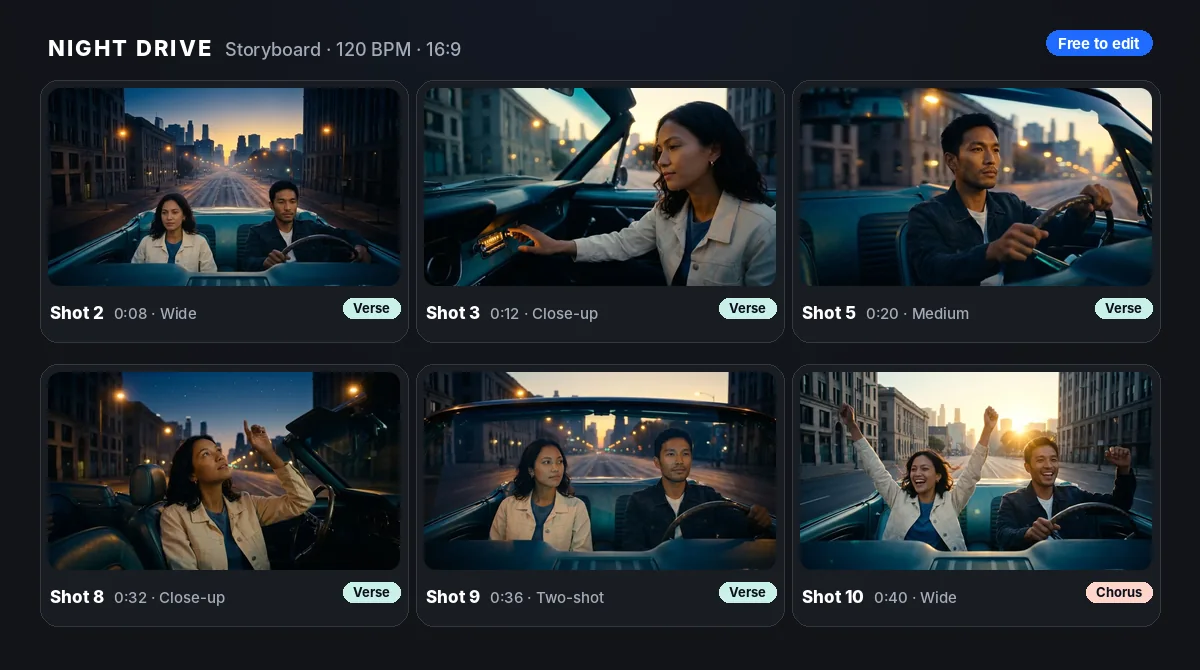
Before you pay anything, three style frames (an establishing shot, a chorus hero shot and a character sheet) show whether the look matches what you wrote. Rewrite a shot, drag a cut to another downbeat, split or merge shots, or change a character's description and every shot that repeats it follows. The free plan includes 5 new storyboards a month, and the AI storyboard generator page shows the editor in more detail.
Turn your treatment into a storyboard
Upload your song, paste the logline and the lead into the idea box, and read the brief and every shot timed to your bars. It stays free until you decide to render.
Written by the Muvora team. Last updated November 14, 2026. Spotted something out of date? Tell us at [email protected].