Tempo markings in BPM, from larghissimo to prestissimo
Type a tempo and see what a score would call it, the likeliest name first and then every other marking whose range takes it in, and hear it on a click. The chart lists twenty markings from larghissimo to prestissimo with the BPM ranges Wikipedia's tempo article gives them, beside what older and newer metronomes marked the main ones at, then explains the words that bend a tempo and the tempos genres often sit at. It all runs in your browser, and nothing is uploaded.
Free, no sign-up. Runs in your browser: nothing is uploaded.
From 20 to 300 BPM.
What 92 BPM is called
Andante
Walking: a moderate, flowing pace: 56 to 108 BPM on the chart below.
Also inside the range of Andantino and Andante moderato. The ranges overlap, so one tempo can carry several names.
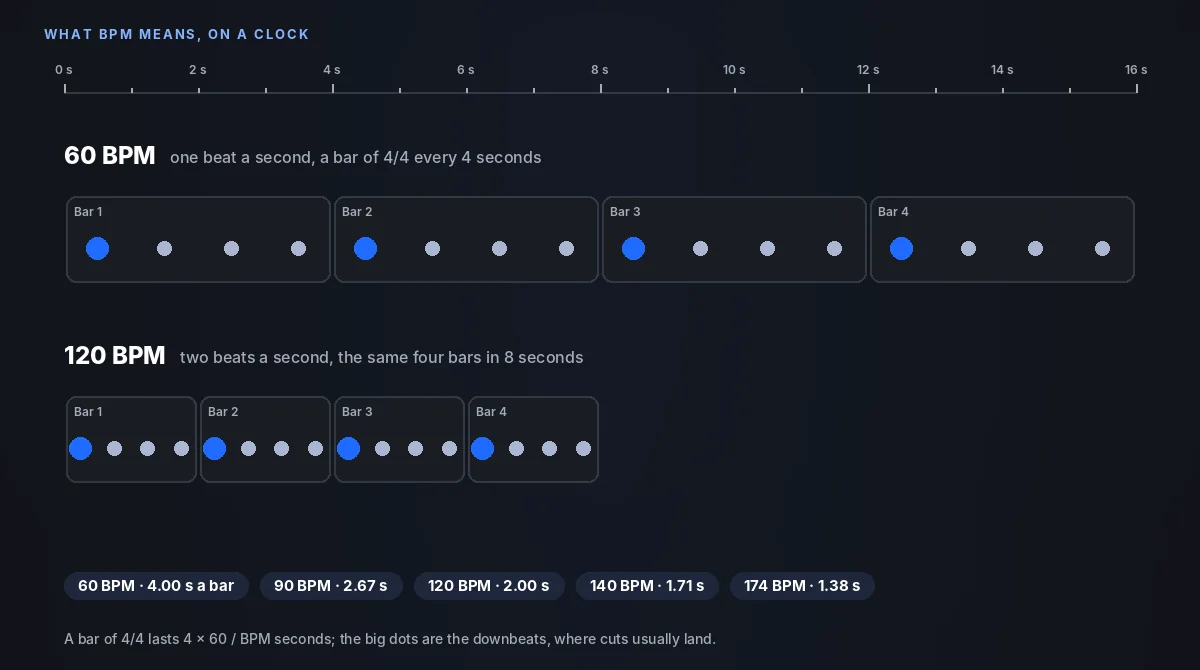
- One beat lasts
- 0.652 s
- A bar of 4/4 lasts
- 2.61 s
Often heard at this tempo: Hip-hop and boom bap (85 to 95); Reggaeton (90 to 100).
Upload your song and Muvora measures its tempo itself, then cuts every shot of its video on a downbeat.
Make the videoUpload a new song92 BPM: most likely Andante.
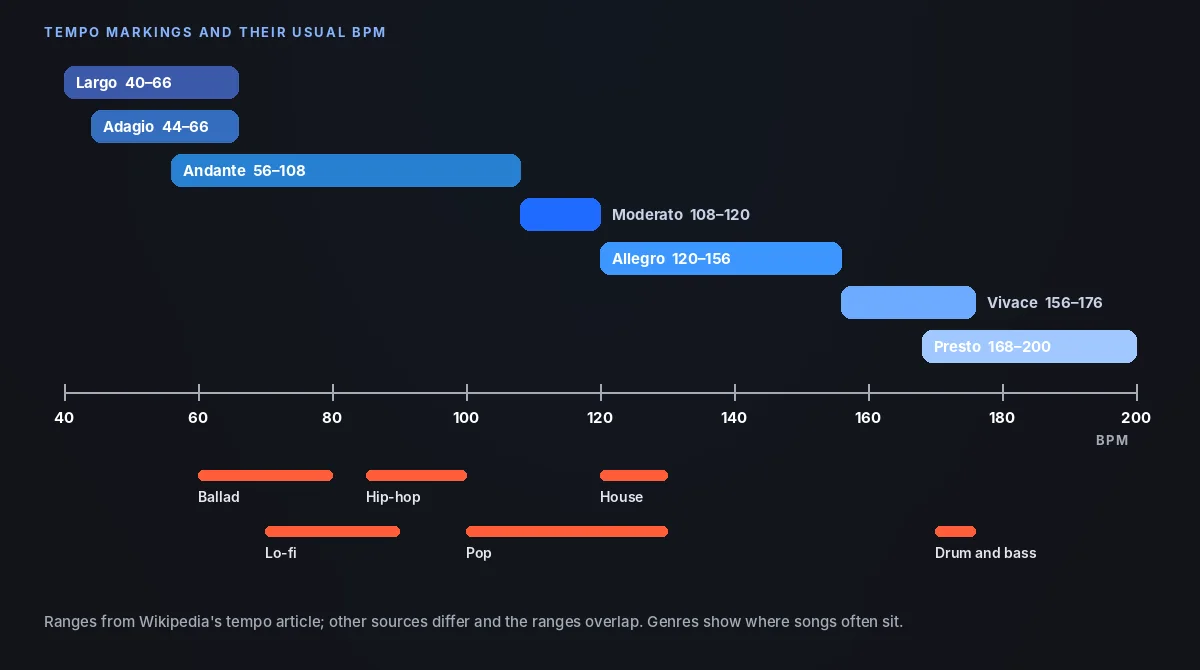
Tempo markings, slowest to fastest
Bars run from 20 to 220 BPM; the coral line is your tempo.
Words that change the tempo as the music goes
- Accelerando (accel.)
- Get gradually faster until the next marking.
- Stringendo (string.)
- Press on: faster, with a sense of urgency.
- Ritardando (rit., ritard.)
- Get gradually slower.
- Rallentando (rall.)
- Get gradually slower; in practice much like ritardando.
- Ritenuto (riten.)
- Held back at once: slower straight away, not bit by bit.
- Allargando (allarg.)
- Broaden: slower and often fuller, usually near an ending.
- Calando
- Slower and softer together.
- Più mosso / meno mosso
- A new, quicker (più) or slower (meno) tempo from here.
- A tempo
- Back to the tempo before the last change.
- Tempo primo (Tempo I)
- Back to the tempo the piece started at.
- Rubato
- Time stretched and given back for expression, so the pulse bends while the shape holds.
- L'istesso tempo
- The same beat as before, though the time signature or the note that counts the beat changes.
Words that adjust a marking
- Molto
- Very, much. Molto allegro: very quick.
- Assai
- Very, much. Allegro assai: very quick.
- Poco
- A little. Poco più mosso: a little more movement.
- Non troppo
- Not too much. Allegro non troppo: quick, but not too quick.
- Ma non tanto
- But not so much, a milder non troppo. Adagio ma non tanto: slow, but not very.
- Più
- More. Più lento: slower.
- Meno
- Less. Meno mosso: less movement, so slower.
- Con moto
- With movement. Andante con moto: a walking pace that keeps going.
Tempos genres often sit at
| Style | Often (BPM) |
|---|---|
| Ballads and slow R&B | 60 to 80 |
| Lo-fi hip-hop | 70 to 90 |
| Hip-hop and boom bap | 85 to 95 |
| Reggaeton | 90 to 100 |
| Afrobeats | 100 to 115 |
| Pop | 100 to 130 |
| Rock | 100 to 140 |
| House | 120 to 128 |
| Techno | 125 to 140 |
| Trap | 130 to 150, often felt at half time |
| Dubstep | about 140, often felt at half time |
| Drum and bass | 170 to 175, often felt at half time |
Habits, not limits: plenty of songs sit outside them.
Ranges from Wikipedia's tempo article (opens in a new tab), read on November 18, 2026, which calls them very rough approximations. Older and newer metronomes' readings from Dolmetsch Online (opens in a new tab). Sources and eras disagree, and a marking names a character as much as a speed. The click is made in your browser; nothing is recorded or sent anywhere.
Song finished? Upload it and Muvora plans the whole video on its beats. The storyboard is free.
Make the videoUpload a new songHow to use the tempo markings chart
- 01
Set a tempo
Type a BPM from 20 to 300, step it one at a time or drag the slider. A song's tempo from the tap tempo tool or your DAW works as it is.
- 02
Read its names
The likeliest marking comes first, then every other one whose range holds the tempo, marked when it sits right at a range's edge, and the genres often heard there.
- 03
Hear it
Press Hear for a click with beat one accented, or a marking's own button for the middle of its range. Change the tempo while it plays and the click follows at the next beat.
- 04
Look up the other words
Under the chart, the words that move a tempo as the music goes (accelerando, ritardando, a tempo, rubato) and the ones that shade a marking (molto, poco, non troppo) are put in plain English.
Where the numbers come from, and why they overlap
The ranges on this chart are the ones Wikipedia's tempo article lists, as read on November 18, 2026, and the article itself calls them very rough approximations that vary with the composer and the piece. They overlap: Largo runs from 40 to 66 BPM, Adagio from 44 to 66, and Andante stretches from 56 to 108, so one tempo can carry several names. Metronomes have never agreed either: the tempo lesson at Dolmetsch Online quotes a nineteenth-century Maelzel metronome marking Adagio at 60, a 1950 metronome at 54 and a modern electronic one at 70. Meanings have moved as well. A Baroque largo was quicker than an adagio, where a modern one is slower, and allegretto went from just quicker than andante to just slower than allegro. Read every figure here as a guide to a character, not a speed limit.
- Ranges from Wikipedia's tempo article
- Metronomes have long disagreed
- A marking names a character as well as a speed
Words that move a tempo, and words that shade one
A score's opening word sets the tempo, and others move it as the music goes. Accelerando (accel.) gets gradually faster, ritardando (rit.) and rallentando (rall.) gradually slower, and ritenuto holds back at once rather than bit by bit. Più mosso and meno mosso start a quicker or a slower tempo from that bar. A tempo returns to the speed before the last change, and tempo primo to the one the piece began with. Rubato lets a phrase stretch and then catch up, so there is no steady BPM to measure while it lasts. Smaller words shade a marking: molto means very, poco a little, assai very or much, and non troppo not too much, so allegro non troppo is quick, but not too quick.
- Accel. faster; rit. and rall. slower
- A tempo: back to the speed before
- Molto, poco and non troppo shade a word
From an Italian word to a number your DAW can use
A DAW, a drum machine or a click track needs one number, so pick one inside the marking's range and adjust by ear: play the passage against a metronome at that tempo and nudge it until it feels like the word. Going the other way, tap along to a recording for its BPM and look it up here. Popular styles often sit in narrower bands than the Italian words: house often around 120 to 128 BPM, hip-hop and boom bap 85 to 95, drum and bass 170 to 175, while trap's 130 to 150 is often felt at half that, which the chart's genre list counts too. The BPM calculator turns any tempo into the length of a beat and a bar, and what BPM is explains half and double time.
- One number from inside the range
- Genres often sit in narrow bands
- Fast styles are often felt at half time
From a tempo to a video cut on the beat
Muvora measures a song's tempo itself: upload the track and the free analysis finds every beat and downbeat as they really fall, along with the sections and the drops. The storyboard it drafts puts every cut on a downbeat, holds longer shots in the quiet parts and cuts faster in the loud ones, and counts a very fast song in half time so no shot flashes past. Read it, change it, and see the price before anything renders.
Questions, answered
Can't find what you need? Start a free storyboard and see for yourself.
What BPM is allegro?
On this chart's source, Wikipedia's tempo article, allegro runs from 120 to 156 BPM, with molto allegro from 124 to 156 inside it. Other charts differ: Dolmetsch Online quotes a nineteenth-century Maelzel metronome marking allegro at 120 and a modern electronic one at 120 to 160. Read it as quick and bright rather than one exact number.
Is adagio faster than andante?
No, adagio is the slower of the two. Adagio means at ease and sits at about 44 to 66 BPM on this chart, while andante, a walking pace, covers about 56 to 108. Their ranges overlap from 56 to 66, where a performer's reading of the piece decides which feels right.
What are the slowest and fastest tempo markings?
Larghissimo is the slowest, listed at 24 BPM and under, with grave and adagissimo at 24 to 40. Prestissimo is the fastest, 200 BPM and over, just past presto at 168 to 200. The chart's buttons play 22 and 208 BPM if you want to hear the two ends.
What does rit. mean in music?
Rit. is short for ritardando: get gradually slower until the next marking, usually a tempo, which returns to the speed before. Rall. (rallentando) is used in much the same way, and riten. (ritenuto) means slower at once rather than gradually.
Why do tempo charts give different BPM for the same word?
Because the words are older than the metronome and describe a character as well as a speed, every chart is someone's reading of them, and the readings have changed with the era. This chart quotes one source and shows where metronomes from three eras put the main markings, so the spread is visible. The metronome on this site labels its tempo from a simpler chart with no overlaps, which is why its ranges differ slightly.
Does the click keep good time, and is anything uploaded?
The clicks are booked on the browser's audio clock a moment before they sound, so a busy page delays the booking rather than the beat. Nothing plays until you press a button, and nothing you type is uploaded or saved.
Keep exploring
What is BPM?
Beats per minute explained: what BPM measures, how to find a song's tempo, half and double time, tempos by genre and how BPM sets a video's cuts.
Read the guideMetronome
A steady click from 20 to 300 BPM in seven time signatures, with accents, subdivisions, tap tempo and a tempo trainer.
Open the toolTap tempo
Tap along to any song to find its BPM, with half and double time and how steady you are.
Open the toolBPM calculator
Beats and bars in seconds, frames and milliseconds: cut lengths for video and delay times for mixing.
Open the toolClick track generator
Make a click track and download it as a WAV: any tempo and time signature, a count-in, accents, subdivisions and a length in bars or minutes.
Open the toolDelay time calculator
Every note value at your tempo in milliseconds, hertz and samples, dotted and triplet, with starting points for delay, reverb, release and LFOs.
Open the tool
More free tools: tempo and timing
Keep time, make a click track, find the BPM, work out bar lengths and mark the beats for a video editor.
Your song deserves a music video
Upload a track and get a free beat-synced storyboard in minutes. Render it when you are ready.
No card needed to start.






