Delay times for any tempo, in milliseconds and hertz
Type the song's tempo or tap it in, and every note value from a whole note to a 1/128 appears straight, dotted and triplet: in milliseconds, in hertz, or in samples at 44.1, 48 or 96 kHz. Under the table, starting points for echoes, slapback, reverb pre-delay and decay, compressor release and LFO rates are worked out at the same tempo, and the whole table copies into a spreadsheet as columns. It's plain arithmetic in your browser, so nothing is uploaded.
Free, no sign-up. Runs in your browser: nothing is uploaded.
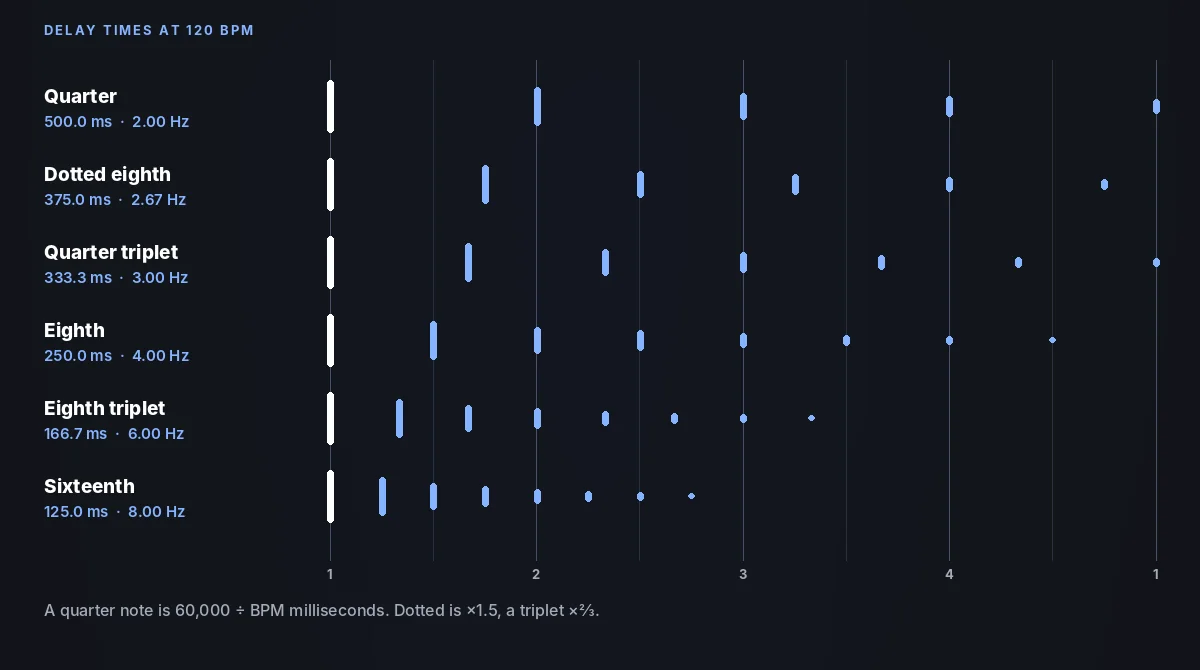
A quarter note at 120 BPM lasts 500 ms.
The tempo counts
Show
| Note | Straight | Dotted | Triplet |
|---|---|---|---|
| 1/1 | 2,000 | 3,000 | 1,333.33 |
| 1/2 | 1,000 | 1,500 | 666.67 |
| 1/4 | 500 | 750 | 333.33 |
| 1/8 | 250 | 375 | 166.67 |
| 1/16 | 125 | 187.5 | 83.33 |
| 1/32 | 62.5 | 93.75 | 41.67 |
| 1/64 | 31.25 | 46.88 | 20.83 |
| 1/128 | 15.63 | 23.44 | 10.42 |
Dotted is 1.5 times the note, triplet two thirds of it. Hertz is one cycle per note.
Starting points at 120 BPM
Common settings to dial in first, then adjust by ear: none of them is a rule.
Echoes on a vocal or a lead
A quarter or an eighth note often sits a repeat right in the groove; a dotted eighth lands each echo between the beats for a bouncing rhythm.
- 1/4
- 500 ms2 Hz
- Dotted 1/8
- 375 ms2.67 Hz
- 1/8
- 250 ms4 Hz
- 1/4 triplet
- 333.33 ms3 Hz
Slapback
One short repeat with little or no feedback, often a 1/16 or a 1/32 note, thickens a voice or a guitar without sounding like an echo.
- 1/16
- 125 ms8 Hz
- 1/32
- 62.5 ms16 Hz
Reverb pre-delay
A short note value such as a 1/64 or a 1/128 is a common starting point: the gap keeps a word's first consonant ahead of its room.
- 1/64
- 31.25 ms32 Hz
- 1/128
- 15.63 ms64 Hz
Reverb decay that fills a note
Set the decay to the note's length less the pre-delay, and the tail often fades out just as the next beat or bar arrives.
- To fill 1/4
- 468.75 ms2.13 Hz
- To fill 1/2
- 968.75 ms1.03 Hz
- To fill a bar
- 1,968.75 ms0.508 Hz
- To fill 2 bars
- 3,968.75 ms0.252 Hz
After a 1/64 pre-delay of 31.25 ms.
Compressor release
A release of about a 1/16 or a 1/8 note often lets the gain recover before the next hit, so the compressor breathes with the beat; a 1/4 note gives sidechain ducking a slower pump.
- 1/16
- 125 ms8 Hz
- 1/8
- 250 ms4 Hz
- 1/4
- 500 ms2 Hz
LFO, tremolo and auto-pan rates
One cycle per note value: faster notes for a tremolo's flutter, a bar or more for a slow filter sweep or a pan across the stereo field.
- 1/16
- 8 Hz125 ms
- 1/8
- 4 Hz250 ms
- 1/4
- 2 Hz500 ms
- 1/2
- 1 Hz1,000 ms
- 1/1
- 0.5 Hz2,000 ms
- 2 bars
- 0.25 Hz4,000 ms
- 4 bars
- 0.125 Hz8,000 ms
Settling the low end and the harsh spots before the effects? The EQ frequency chart shows where each instrument sits.
Song finished? Upload it and Muvora plans the whole video on its beats. The storyboard is free.
Make the videoUpload a new songHow to use the delay time calculator
- 01
Set the tempo
Type the BPM your session shows, decimals included, or press Tap on every beat of the song. Half and Double fix a tempo you counted at half or double time.
- 02
Say what the tempo counts
Leave it on quarter notes, as DAWs and synced plug-ins count. If you count a 6/8 or 12/8 song in dotted quarters, pick that instead, and the table converts it for you.
- 03
Choose the unit
Milliseconds for a delay or a pre-delay set by hand, hertz for an LFO, a tremolo or an auto-pan, and samples at 44.1, 48 or 96 kHz for an offset that has to be exact to the sample.
- 04
Dial in a starting point
Read the value from the table or from the starting points under it, set it on the plug-in or the pedal, then adjust by ear. Copy the table to keep it with the session notes.
From BPM to milliseconds, hertz and samples
Everything here comes from one division. A minute is 60,000 milliseconds, so a quarter note lasts 60,000 ÷ BPM: 500 ms at 120 BPM, 666.67 ms at 90 and 468.75 ms at 128. Each shorter note value is half the one before (an eighth at 120 is 250 ms, a sixteenth 125), a dotted note is one and a half times its plain value (a dotted eighth at 120 is 375 ms), and a triplet note is two thirds of it, because three triplets fill the time of two (an eighth-note triplet at 120 is 166.67 ms). A rate in hertz is 1,000 ÷ the time in milliseconds, so a 500 ms quarter note is 2 Hz, one cycle per beat. A length in samples is the milliseconds times the sample rate ÷ 1,000: the same quarter note is 22,050 samples at 44.1 kHz and 24,000 at 48 kHz. For bar lengths in seconds and video frames, use the BPM calculator; for the terms themselves, read what BPM means.
- Quarter note = 60,000 ÷ BPM ms
- Dotted ×1.5, triplet ×2/3
- Hz = 1,000 ÷ ms
Echoes, slapback and reverb that move with the song
A delay set to a note value repeats inside the groove instead of smearing across it. A quarter or an eighth note is the usual place to start on a vocal, and a dotted eighth is popular on guitars and synths because its repeats fall between the beats and answer the line with a rhythm of their own. A slapback is a single short repeat, often a 1/16 or a 1/32 note, that thickens a voice without sounding like an echo. Reverb has two times worth setting. Pre-delay, the pause before the reverb starts, often begins at a short note value such as a 1/64 or a 1/128 (31.25 or 15.63 ms at 120 BPM), which keeps a word's first consonant clear of its own reverb. The decay can be set to fill a note value: take the pre-delay off the note's length, and the tail fades just as the next beat or bar arrives. Many engineers run both effects on sends, filter the returns and keep them lower than they sound soloed; how to mix vocals walks through it.
- Dotted 1/8 repeats fall between the beats
- Pre-delay: a 1/64 or 1/128 note
- Decay = the note's length minus the pre-delay
Compressor release, LFOs and when to leave the grid
Times set to the tempo help dynamics and modulation too. A compressor's release of about a 1/16 or a 1/8 note often lets the gain recover before the next kick or snare, so the compression breathes with the beat instead of against it, and a 1/4-note release gives sidechain ducking under a kick its slower pump. An LFO, a tremolo or an auto-pan locked to a note value moves in time: at 120 BPM a 1/8-note tremolo is 4 Hz and a filter sweep over four bars is 0.125 Hz. A plug-in with a sync switch reads the session's tempo and does this arithmetic itself; the numbers matter for pedals and outboard gear, for controls that take only milliseconds or hertz, and for checking what a synced setting really is. The grid is a start, not a rule: a delay a few milliseconds off the note can feel looser, and the right release depends on the material. Before the effects, settle the balance and the tone with the EQ frequency chart and how to mix a song.
- Release that recovers before the next hit
- A 1/8-note tremolo at 120 BPM is 4 Hz
- Synced plug-ins do the sums themselves
Your mix is the video's soundtrack
Muvora never remixes, masters or retimes a song: every export's audio is the file you upload, from its first sample, so the echoes and reverb tails you set are exactly what viewers hear. Upload the final master and Muvora reads its tempo, beats, sections and drops, then writes a storyboard with every cut on a downbeat of that same tempo. Reading and editing it is free, and the price shows before you render.
Questions, answered
Can't find what you need? Start a free storyboard and see for yourself.
How do I calculate delay time from BPM?
Divide 60,000 by the tempo to get a quarter note in milliseconds, then halve it for each shorter value. At 120 BPM a quarter note is 500 ms, an eighth 250 ms and a sixteenth 125 ms; multiply by 1.5 for a dotted note and by two thirds for a triplet.
What is a dotted eighth note delay at 120 BPM?
375 milliseconds. An eighth note at 120 BPM lasts 250 ms and a dotted note is one and a half times as long, so the repeats fall between the beats rather than on them. That offset is why a dotted-eighth echo on a guitar or synth line sounds like a second rhythm part.
What should I set reverb pre-delay to?
A short note value is a common starting point, such as a 1/64 or a 1/128 note: 31.25 or 15.63 ms at 120 BPM, 41.67 or 20.83 ms at 90. More pre-delay keeps a vocal's consonants clear of the room and sets the reverb behind it; less puts the voice inside the space. Adjust it by ear from there.
How do I convert a delay time to hertz for an LFO?
Divide 1,000 by the time in milliseconds. At 120 BPM a quarter note lasts 500 ms, so a 2 Hz LFO completes one cycle per beat; an eighth note is 4 Hz, a bar of 4/4 is 0.5 Hz and four bars are 0.125 Hz. The table's Hertz view does this for every note value.
Why is my 6/8 song's tempo different in my DAW?
Musicians often count 6/8 and 12/8 in dotted quarters, while DAWs and synced plug-ins count quarter notes in every meter. A dotted quarter is one and a half quarters, so a 6/8 song felt at 80 runs at 120 in the session. Pick dotted quarters under the tempo and the table shows the quarter-note figures your plug-ins use.
Do I need these numbers if my plug-in syncs to tempo?
Not for the synced controls themselves, which read the session's tempo. You need them for a delay pedal or an outboard unit, for pre-delay, attack and release knobs that take only milliseconds, for an LFO that takes only hertz, and to confirm that a synced setting is the note value you meant.
Keep exploring
How to mix a song
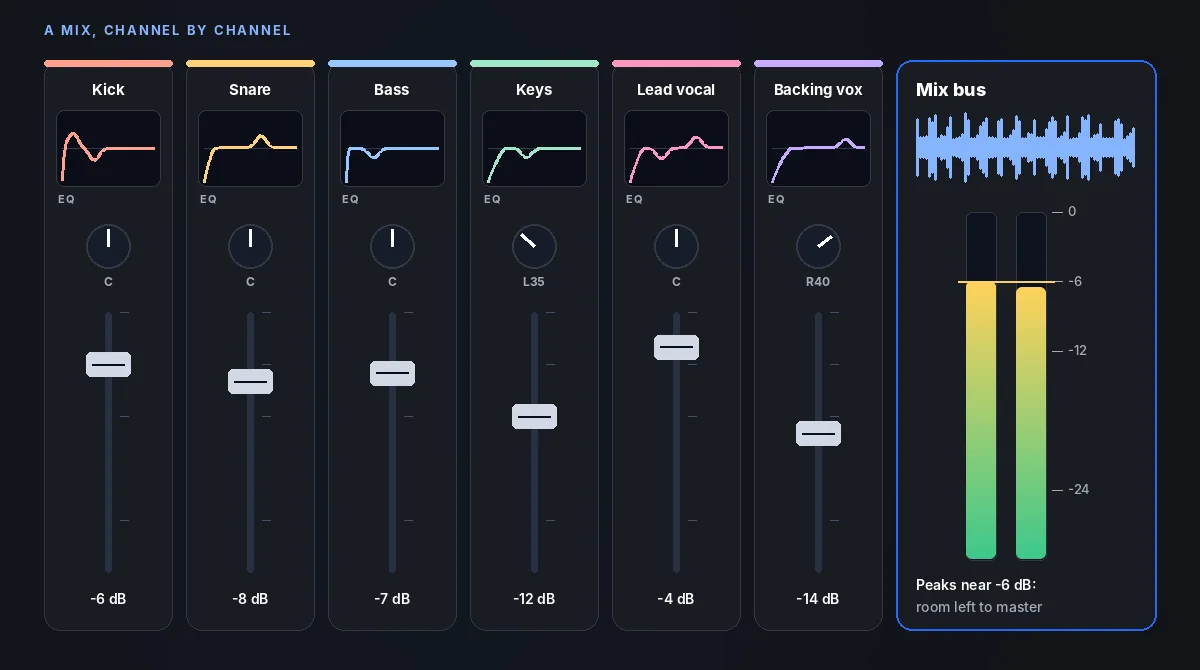
Gain staging, a fader-and-pan balance, EQ, compression, reverb and delay on sends, automation, reference checks and the premaster bounce, step by step.
Read the guide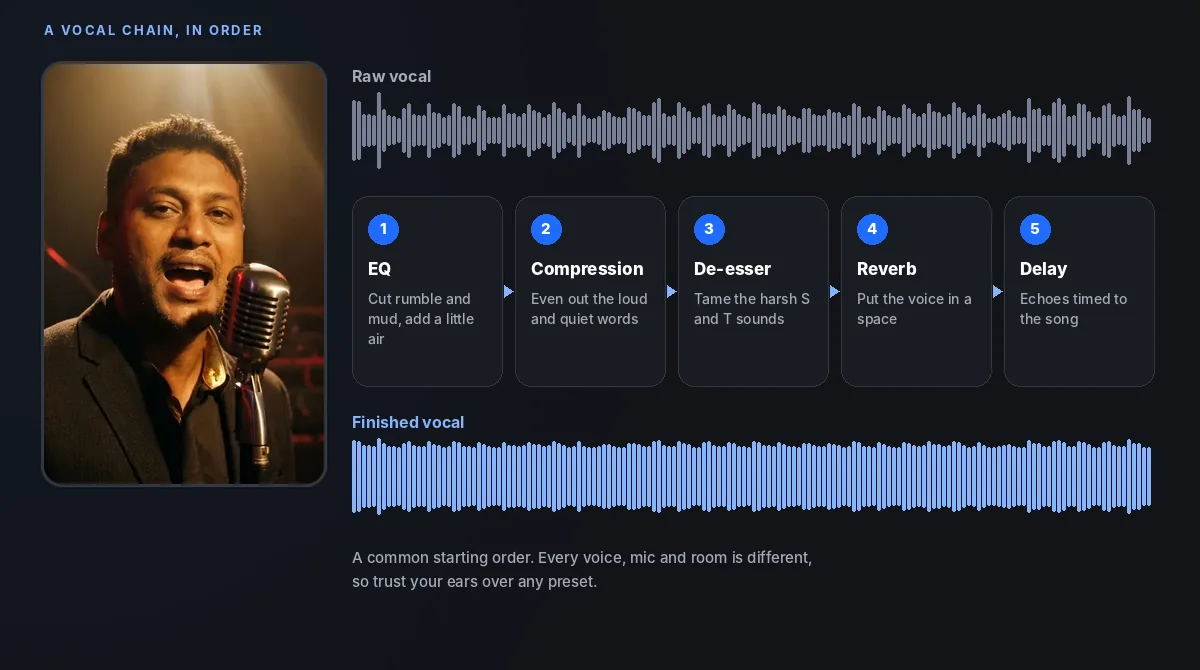
How to mix vocals
A vocal chain in order (cleanup, EQ, compression, de-essing, saturation, reverb and delay), then doubles, ad-libs and the level rides that make every word land.
Read the guideEQ frequency chart
Where each instrument and voice sits from 20 Hz to 20 kHz, the bands from sub-bass to air, and common EQ moves as starting points, with tones to hear each band.
Open the toolTap tempo
Tap along to any song to find its BPM, with half and double time and how steady you are.
Open the toolBPM calculator
Beats and bars in seconds, frames and milliseconds: cut lengths for video and delay times for mixing.
Open the tool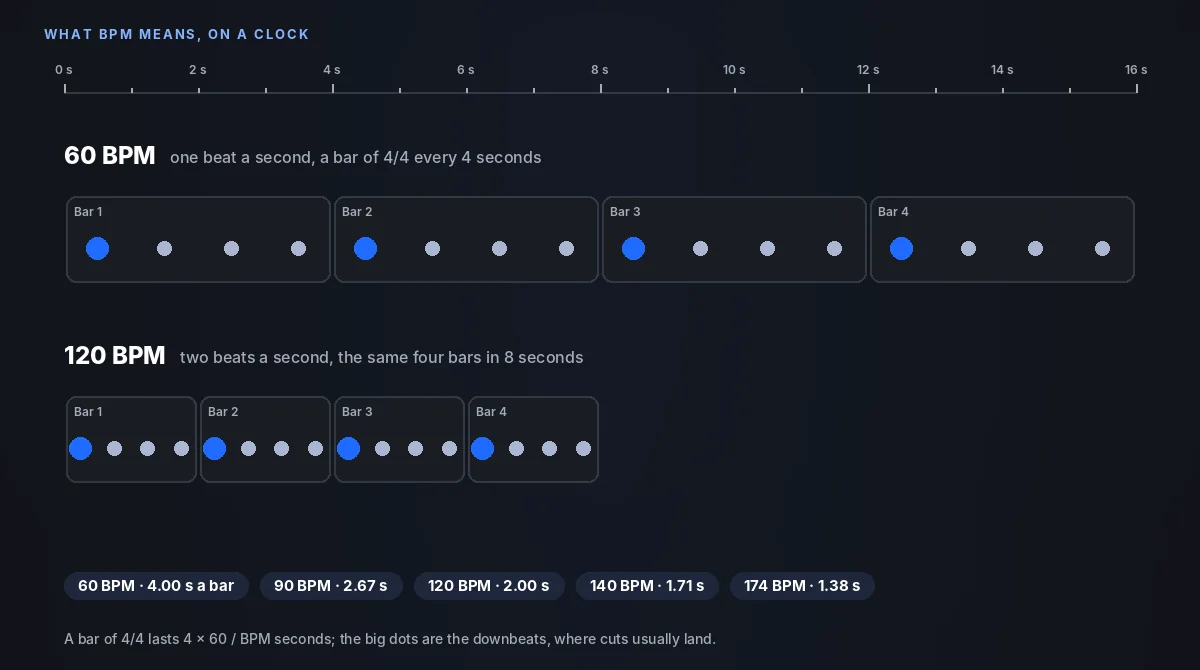
What is BPM?
Beats per minute explained: what BPM measures, how to find a song's tempo, half and double time, tempos by genre and how BPM sets a video's cuts.
Read the guideMetronome
A steady click from 20 to 300 BPM in seven time signatures, with accents, subdivisions, tap tempo and a tempo trainer.
Open the toolBPM to frames calculator
Frames per beat and bar at any frame rate, where every cut lands as a frame and as timecode (drop-frame too), and the tempos that fit whole frames.
Open the tool
More free tools: tempo and timing
Keep time, make a click track, find the BPM, work out bar lengths and mark the beats for a video editor.
Your song deserves a music video
Upload a track and get a free beat-synced storyboard in minutes. Render it when you are ready.
No card needed to start.






