Bars to seconds and frames, for any tempo
Type a tempo and see how long a beat, a bar and a phrase last in seconds and in video frames, plus every note value in milliseconds. It's the arithmetic behind a cut that lands on the beat and a delay that sits in the groove.
Free, no sign-up. Runs in your browser: nothing is uploaded.
500 ms a beat
Time signature
Frame rate
| Length | Seconds | Frames at 24 fps |
|---|---|---|
| ½ bar | 1.00 s | 24 |
| 1 bar | 2.00 s | 48 |
| 2 bars | 4.00 s | 96 |
| 4 bars | 8.00 s | 192 |
| 8 bars | 16.00 s | 384 |
Note lengths for delay and reverb
| Note | Straight | Dotted | Triplet |
|---|---|---|---|
| 1 bar (4/4) | 2,000 ms | 3,000 ms | 1,333.33 ms |
| 1/2 note | 1,000 ms | 1,500 ms | 666.67 ms |
| 1/4 note (1 beat) | 500 ms | 750 ms | 333.33 ms |
| 1/8 note | 250 ms | 375 ms | 166.67 ms |
| 1/16 note | 125 ms | 187.50 ms | 83.33 ms |
| 1/32 note | 62.50 ms | 93.75 ms | 41.67 ms |
Song finished? Upload it and Muvora plans the whole video on its beats. The storyboard is free.
Make the videoUpload a new songHow to use the BPM calculator
- 01
Enter the tempo
Type the BPM, or tap it in with the tap tempo tool first.
- 02
Set the meter and frame rate
Choose 4/4 or 3/4 and the frame rate of your edit: 24, 25, 30 or 60 fps.
- 03
Read the lengths
Each row shows half a bar to eight bars in seconds and frames, and every note value in milliseconds.
Plan shots in bars, convert at the end
Editors who cut on the beat think in bars: a two-bar shot in the verse, one bar in the chorus, half a bar into a drop. The calculator turns those bars into the seconds and frames your editing software asks for, so every cut lands where the music does.
- Half a bar to eight bars
- Seconds to two decimals
- Frames at 24, 25, 30 or 60 fps
When a bar isn't a whole number of frames
At 128 BPM a bar is 1.875 seconds, which is 45 frames at 24 fps but 56.25 at 30. A cut can only fall on a frame, so the tool marks lengths that don't land on one; over a long edit, round per cut rather than per shot, or the drift adds up.
- Whole frames shown plainly
- Fractions flagged with their decimal
- Round each cut, not each shot
Delay and reverb times too
The same maths sets time-based effects. A quarter-note delay at 120 BPM is 500 ms; dotted and triplet values give the bounce of a dotted-eighth echo or the swing of a triplet. The note table lists them all.
- Whole bar to 1/32 note
- Straight, dotted and triplet
- Milliseconds to two decimals

Let the cuts calculate themselves
Muvora measures every beat of your song, not just its average tempo, so cuts land on the real downbeats even when a song drifts. Upload a track to get a storyboard timed to the bar, free.
Questions, answered
Can't find what you need? Start a free storyboard and see for yourself.
How long is one bar at 120 BPM?
Two seconds in 4/4: four beats of half a second each. At 24 fps that is exactly 48 frames.
How do I work out a bar's length myself?
Multiply the beats in a bar by 60 and divide by the BPM. In 4/4 at 90 BPM: 4 × 60 ÷ 90 = 2.67 seconds.
Which frame rate should I pick?
The one your edit and export use. Muvora renders at 24 fps; many phone videos are 30 fps; 25 fps is common in Europe.
What is a dotted or triplet note?
A dotted note lasts one and a half times its plain value; a triplet note lasts two thirds of it, so three fit where two would. Both are common delay settings.
Keep exploring
Tap tempo
Tap along to any song to find its BPM, with half and double time and how steady you are.
Open the toolBeat marker generator
BPM to timecode: a marker on every beat or bar, as an EDL for DaVinci Resolve, a CSV or plain timecodes.
Open the toolShot list generator
Type a song's tempo and sections and get a beat-timed shot list, made by Muvora's own planner.
Open the tool
Edit a music video to the beat
The bar maths, the shot lengths by section and the cutting tricks that make a video play the song.
Read the guide
Song structure explained
Intro, verse, chorus, bridge and drop: what each section does, how long it runs and how to hear it.
Read the guide
How long a music video should be
As long as the song, usually. Plus the right length for teasers, Shorts, Reels, TikTok and a Canvas, and what length does to cost.
Read the guideMetronome
A steady click from 20 to 300 BPM in seven time signatures, with accents, subdivisions, tap tempo and a tempo trainer.
Open the toolDrum machine
A 16-step drum sequencer in your browser: eight synthesized drums, grooves by genre, swing, accents and rolls, saved as a WAV loop or a MIDI file.
Open the tool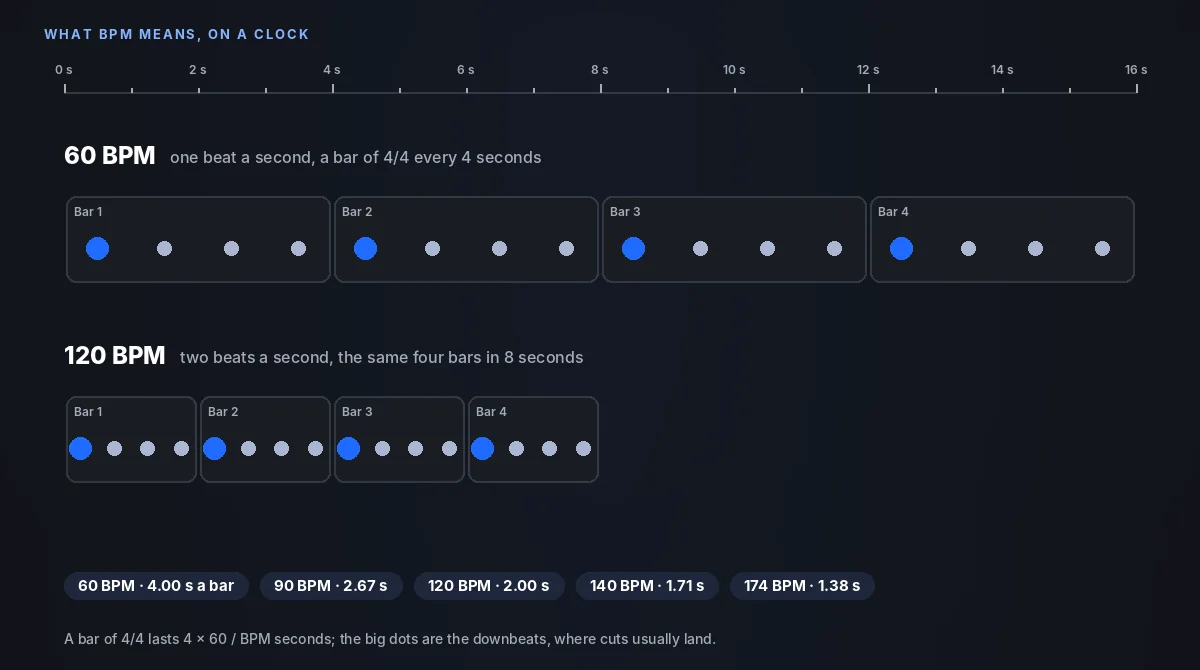
What is BPM?
Beats per minute explained: what BPM measures, how to find a song's tempo, half and double time, tempos by genre and how BPM sets a video's cuts.
Read the guideSong structure builder
Lay out a song's sections in bars at your tempo and see every start time, the length and a colored timeline. Export text, CSV or YouTube chapters.
Open the toolDelay time calculator
Every note value at your tempo in milliseconds, hertz and samples, dotted and triplet, with starting points for delay, reverb, release and LFOs.
Open the toolTempo markings chart
Largo to prestissimo with each marking's BPM range from a cited chart, the names any tempo goes by, and a click to hear each one.
Open the toolBPM to frames calculator
Frames per beat and bar at any frame rate, where every cut lands as a frame and as timecode (drop-frame too), and the tempos that fit whole frames.
Open the tool
More free tools: tempo and timing
Keep time, make a click track, find the BPM, work out bar lengths and mark the beats for a video editor.
Your song deserves a music video
Upload a track and get a free beat-synced storyboard in minutes. Render it when you are ready.
No card needed to start.




