The short answer
BPM stands for beats per minute: how many beats, the steady pulse you tap your foot to, a piece of music has in one minute. It measures tempo. At 60 BPM each beat lasts one second and at 120 BPM half a second. Most pop songs sit around 100 to 130 BPM, and in 4/4 a bar lasts 240 divided by the BPM, in seconds.
- BPM is tempo: a beat lasts 60 divided by the BPM, in seconds.
- The time signature groups the beats into bars; the BPM says how fast they come.
- The same song can be counted at half or double its BPM, and both readings describe it.
- In 4/4 a bar lasts 240 divided by the BPM: 2 seconds at 120 BPM.
- Music videos are cut on bars, so the BPM decides how long a shot can hold.
On this page (9 sections)ShowHide
What BPM means
A beat is the regular pulse under a piece of music: the count of "1, 2, 3, 4" a drummer gives, the moment a crowd claps along. BPM, beats per minute, counts how many of those pulses fit in a minute, so it is a measure of speed, the music's tempo. It says nothing about how busy the music is: a ballad at 70 BPM can be full of fast notes, and a house track at 124 BPM can have nothing but a kick on every beat.
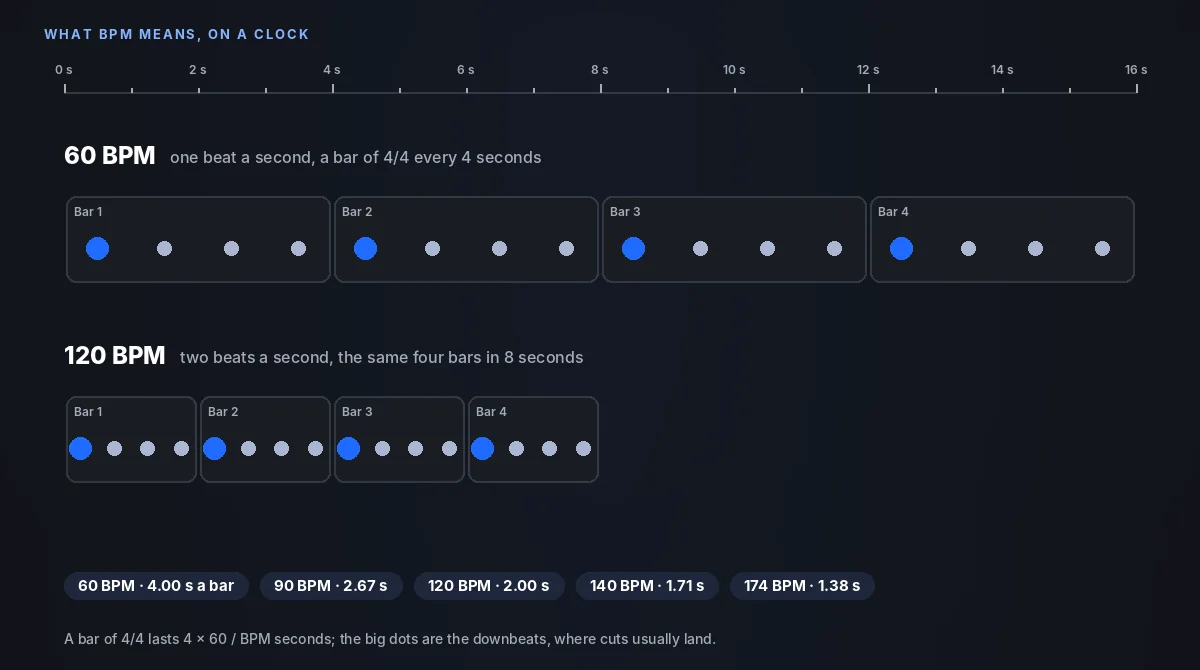
Because a minute has 60 seconds, one beat lasts 60 divided by the BPM. At 60 BPM a beat is exactly one second, like a clock's second hand; at 120 BPM it is half a second; at 90 BPM, two thirds of one. In written music the beat is usually a quarter note, so "♩ = 120" at the top of a score means 120 quarter notes a minute. For the curious: divide a BPM by 60 and you have the beat's rate in hertz, so 120 BPM is a pulse of 2 Hz, far below the 27.5 Hz of a piano's lowest note on the note frequency chart. Rhythm and pitch are the same idea, repetition, at very different speeds.
Bar 1
Bar 2
Bar 3
Bar 4
- BPM
- Beats per minute: how many beats a piece of music has in a minute, the usual measure of its tempo.
- Beat
- One pulse of the music's steady count, the moment you would tap your foot.
- Downbeat
- The first beat of a bar, usually the strongest, and the natural place for a section, a chord change or a video cut to start.
- Bar
- A group of beats, also called a measure: four of them in 4/4, three in 3/4.
- Tempo
- The speed of the music, given in BPM or with a marking such as Andante or Allegro.
How to find a song's BPM
If you made the track, the BPM is already in your DAW's session. For anything else, you can find it by ear in under a minute, or let software measure it. Either way, finish by checking the number against the song itself.
- 01
Pick the pulse
Play the song and listen for what repeats evenly: the kick drum, the snare on the backbeat or a strummed chord. Nod along until the count feels settled before you measure anything.
- 02
Tap along
Open tap tempo and tap the space bar on every beat for eight to twelve taps. It averages your taps, so one early or late tap barely moves the result.
- 03
Or count with a stopwatch
Count the beats you hear in 15 seconds and multiply by four. Thirty beats in 15 seconds is 120 BPM. It is rougher than tapping, so round to the nearest common tempo and check it.
- 04
Or let software read it
Most DAWs and DJ apps detect tempo from the audio, and the BPM and key finder reads a song file's tempo and key for free. Detectors are good on steady, drum-led music and less sure of rubato ballads and swung grooves.
- 05
Decide between half and double time
If the number seems too fast or too slow for how the song feels, try half or double it. Choose the reading where a bar feels like one phrase of the groove, usually 2 to 3 seconds long.
- 06
Check it against a click
Play a metronome at your number alongside the song for a minute. If the clicks slowly drift ahead or behind, nudge the tempo by 1 BPM, or a fraction of one, until they stay together.
Skip the counting: let the song be measured
Upload a song and Muvora finds its BPM, every beat and downbeat, the sections and the drops for free, then writes a storyboard with every cut on the beat.
Tempo vs time signature vs meter
Three words get mixed up here, and each answers a different question. Tempo (the BPM) is how fast the beats come. The time signature is how they are written: the top number says how many beats a bar holds and the bottom one which note value counts as a beat, so 3/4 is three quarter notes to a bar. Meter is how the music feels: which beats are strong and which weak, and whether each beat splits into two (simple meter) or three (compound meter). Two songs at 120 BPM can feel nothing alike if one is in 4/4 and the other in 3/4.
| Time signature | Counted as | Feel | Often heard in |
|---|---|---|---|
| 4/4 | Four quarter-note beats a bar | Simple, strong on 1, backbeat on 2 and 4 | Most pop, rock, hip-hop, R&B and dance music |
| 3/4 | Three quarter-note beats a bar | Simple triple, a lilt on 1 | Waltzes, some ballads and folk songs |
| 2/4 | Two quarter-note beats a bar | Simple duple, a march-like push | Marches, polka, some country and Latin styles |
| 6/8 | Two dotted-quarter beats a bar, each three eighths | Compound, a rocking 1-2-3 4-5-6 | Slow ballads, Irish jigs, some rock and soul |
| 12/8 | Four dotted-quarter beats a bar | Compound, a shuffle or swing over four | Slow blues, doo-wop and soul ballads |
| 5/4 and 7/8 | Five quarters; seven eighths grouped 2+2+3 or 3+2+2 | Uneven, a limp or a skip | Progressive rock, jazz and some film music |
Need to record or rehearse to the right count? The click track generator makes a WAV in any of these meters, with the tempo read either way and a count-in before bar 1.
Skip the blank page
Upload your song and Muvora's AI director plans a shot-by-shot storyboard on the beat. Edit every shot for free, and pay only if you render.
Half time and double time
A tempo is partly a matter of which pulse you choose to count, so most songs can be read at two BPMs, one double the other. A trap beat with hi-hats racing at 140 BPM puts its snare on beat 3 of each bar, so the groove itself moves like 70. Drum and bass runs at about 174, but dancers and editors often feel it at 87. A slow soul ballad at 66 can be counted at 132 if you follow its eighth notes. Tempo detectors pick one or the other, which is why two apps can disagree by exactly a factor of two and both be right.
Which one to use depends on the job. A DJ matching two tracks needs the number the software uses for both. A producer selling a beat should list the tempo the DAW session runs at and mention the feel. An editor cutting a video should count the reading where a bar lasts about 2 to 3 seconds, because that is the phrase the picture follows: a 174 BPM track cut on every bar changes shot every 1.4 seconds, which feels frantic, while cutting on every other bar, as if it were 87, gives the eye time to read each shot.
Typical BPM by genre
Every style has a home range, set by how people dance, sing or nod to it. The ranges below are habits, not rules: plenty of hits sit outside them, and a song's feel matters more than its number. Use them to sanity-check a reading (a house track that reads 62 is almost certainly 124 counted at half time) or as a starting point for a new song.
| Style | Often (BPM) | How it usually feels |
|---|---|---|
| Ballads and slow R&B | 60 to 80 | Slow and spacious, sometimes counted in eighth notes |
| Lo-fi hip-hop | 70 to 90 | Laid back, with a lazy, swung beat |
| Hip-hop and boom bap | 85 to 95 | A head-nod, with the snare on 2 and 4 |
| Reggaeton | 90 to 100 | The dembow rhythm over a kick on every beat |
| Afrobeats | 100 to 115 | A rolling, syncopated groove |
| Pop | 100 to 130 | Mid-tempo and danceable |
| Rock | 100 to 140 | Driving, with the backbeat on 2 and 4 |
| House | 120 to 128 | A kick on every beat, four on the floor |
| Techno | 125 to 140 | Steady and hypnotic, four on the floor |
| Trap | 130 to 150 | Felt at half time, around 65 to 75 |
| Dubstep | About 140 | Felt at half time, around 70 |
| Drum and bass | 170 to 175 | Fast breakbeats, often felt at half time, around 87 |
Italian tempo markings
Before metronomes, composers described tempo in words, mostly Italian, and classical scores still do. The markings describe a character as much as a speed, and charts that give them numbers differ by a few BPM, so read these as rough guides. They are the ranges the metronome on this site shows under its tempo.
- Largo (broad): about 40 to 59 BPM.
- Adagio (at ease): about 66 to 75 BPM.
- Andante (at a walking pace): about 76 to 107 BPM.
- Moderato (moderately): about 108 to 119 BPM.
- Allegro (fast and bright): about 120 to 155 BPM.
- Presto (very fast): about 176 to 199 BPM.
You'll also meet words that change the tempo rather than set it: accelerando (gradually faster), ritardando or rallentando (gradually slower), a tempo (back to the tempo before) and rubato (stretched freely for expression). Songs played this way have no single BPM, which is worth knowing before you set a DAW grid or plan cuts on a fixed one.
How BPM sets a bar's length in seconds
The arithmetic is short. One beat lasts 60 ÷ BPM seconds. A bar of 4/4 has four beats, so it lasts 240 ÷ BPM seconds; a bar of 3/4 lasts 180 ÷ BPM. Multiply by the frame rate for frames: a video at 24 frames a second gets 48 frames in a 2-second bar. Because song sections usually run 4, 8 or 16 bars, the same sum tells you how long a verse or a chorus lasts.
| BPM | Seconds per beat | Seconds per bar (4/4) | Frames per bar at 24 fps | 8 bars |
|---|---|---|---|---|
| 60 | 1.000 | 4.000 | 96 | 32.0 s |
| 90 | 0.667 | 2.667 | 64 | 21.3 s |
| 120 | 0.500 | 2.000 | 48 | 16.0 s |
| 140 | 0.429 | 1.714 | 41.1 | 13.7 s |
| 174 | 0.345 | 1.379 | 33.1 | 11.0 s |
Two things follow. At most tempos a bar doesn't land on a whole number of frames (140 BPM gives 41.1), so an editor rounds each cut to the nearest frame and lets the next one catch up, rather than adding rounded lengths together and drifting off the beat. And the faster the song, the shorter a one-bar shot gets, which is why fast songs are usually cut every two bars.
Why music videos are cut on bars
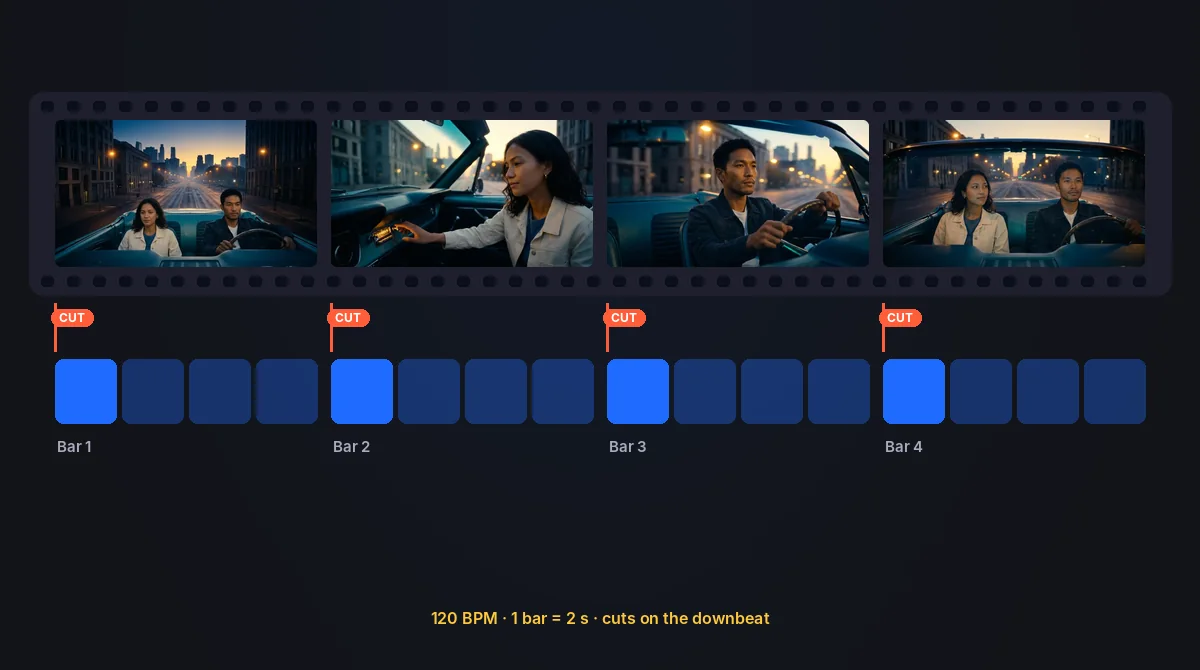
A cut is the picture's beat. When it lands on a downbeat, the change feels caused by the music; a few frames early or late and it reads as a mistake, even to viewers who couldn't say why. Cutting on bars rather than on every beat also matches how songs are built: phrases run 2, 4 or 8 bars, so a shot that lasts a whole number of bars ends where the music takes a breath. The usual pattern is longer shots of two bars or more in verses and intros, one-bar or half-bar shots in choruses, and a cut on the first beat of every new section and every drop. For the full method, read how to edit a music video to the beat, and to find where the sections fall, song structure explained.
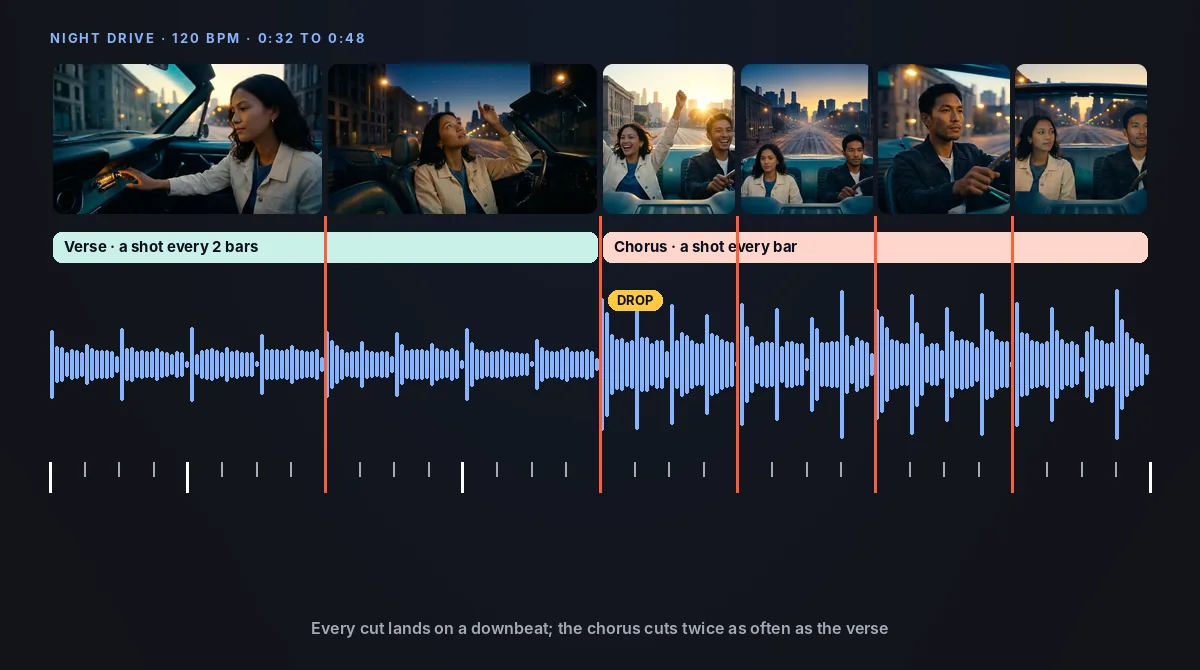
Muvora finds every beat for you
Knowing the BPM gets you the grid; a real song rarely sits on it perfectly. Upload a song to Muvora and the free analysis measures its tempo and tracks every beat and downbeat as they really fall, along with the sections, the drops, the energy of every beat and the key. The shot planner then places every cut on a downbeat, cuts at each section change and drop, holds longer shots in the quiet parts and moves faster in the loud ones, and paces by genre, slower for lo-fi and quicker for hip-hop, EDM and rock. A very fast song is cut in pairs of bars, as an editor would count it.
The storyboard that comes back is yours to change for free: drag a cut and it snaps to the nearest beat, split or merge shots, rewrite any prompt. On the free plan that's 5 new storyboards a month, and you pay credits only when you render, at a price shown before you press Generate.
Get a storyboard cut to your song's beats
Upload an MP3, WAV, M4A, AAC or FLAC file and Muvora plans every shot on the beat, from the intro to the last chorus. Reading and editing the storyboard costs nothing.
Written by the Muvora team. Last updated November 16, 2026. Spotted something out of date? Tell us at [email protected].