The short answer
A music video treatment is a short pitch, usually one to three pages, that explains what a video is about and how it will look before anything is made. Write a title and credits, a one-sentence logline, the concept, the story by song section, the look (palette, light, camera, wardrobe, places), the cast, references, the key shots, and the logistics and budget.
- The treatment sells the idea; the storyboard and shot list come after it.
- Lead with a logline that names a lead, a world and a change.
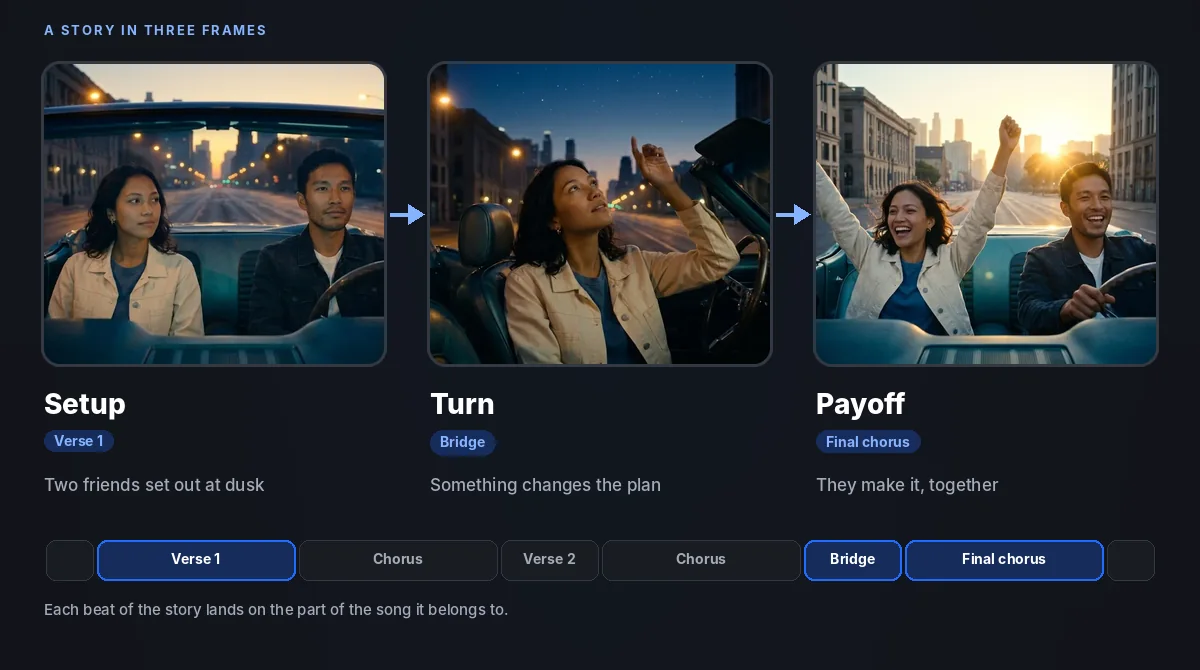
- Plan the story by song section, not by lyric line.
- Keep it to one to three pages and let a few images do some of the talking.
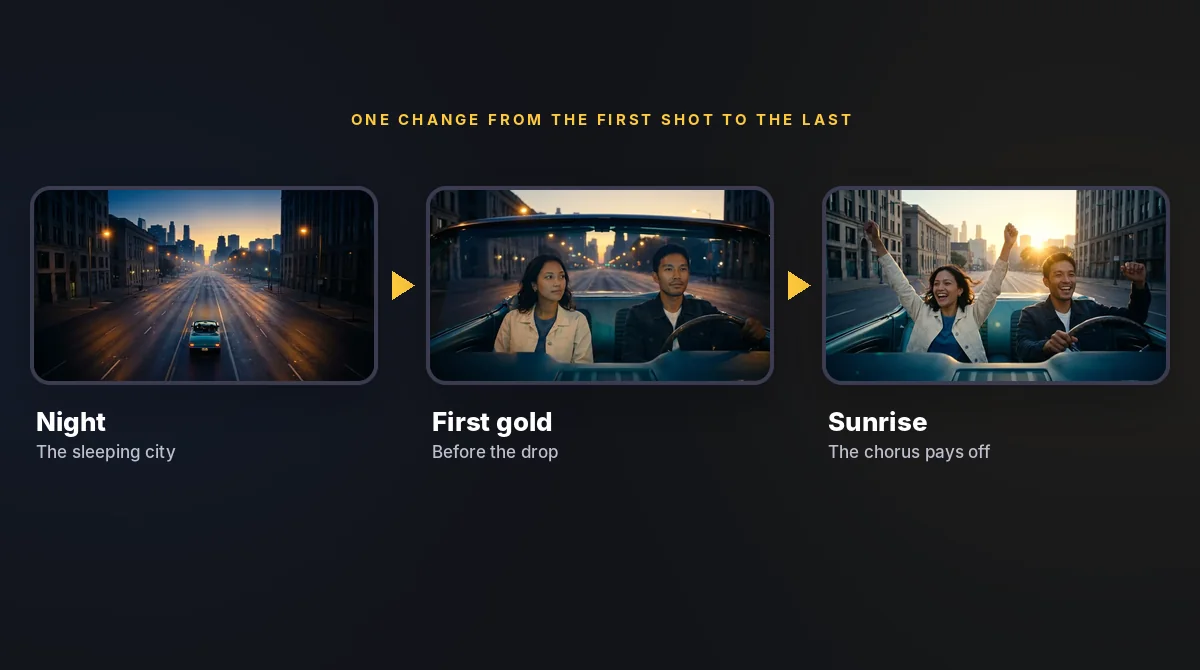
- Make something change: the last image should answer the first.
On this page (8 sections)ShowHide
- 1.What a treatment is, and who reads it
- 2.The ten parts of a music video treatment
- 3.How to write a treatment, step by step
- 4.A complete example treatment: Night Drive
- 5.A fill-in music video treatment template
- 6.Tips for pitching a director, or writing one for yourself
- 7.Mistakes that sink a treatment
- 8.How Muvora's AI director writes a treatment for your song
- Questions
What a treatment is, and who reads it
A music video treatment is the written pitch for a video. Directors write them to win a job from an artist or a label; artists write them to brief a director, a friend with a camera or an AI tool. Either way it answers three questions: what is the video about, what will it look like, and why does it fit this song?
It sits at the top of the planning stack. The treatment fixes the idea, the storyboard turns it into shots timed to the track, and the shot list turns those shots into a work plan. A good storyboard can't rescue a weak idea, which is why the treatment deserves an evening of your time.
| Reader | What they want to know | What wins them over |
|---|---|---|
| The artist | Does this feel like my song and my image? | A concept that matches the mood, not just the lyrics |
| Label or manager | Will it work on release, and what will it cost? | A clear idea, a realistic scope, every format covered |
| Director or crew | What exactly are we making? | Specific places, light, wardrobe and key shots |
| Funder or commissioner | Is this team worth backing? | Clarity, references and a budget that adds up |
| You, writing for yourself | What am I making next week? | A plan short enough to remember and follow |
The ten parts of a music video treatment
Layouts vary, but most strong treatments contain the same ten parts in roughly this order. On a small project some shrink to a single line; none should vanish entirely.
| Part | What it says | Length |
|---|---|---|
| Title and credits | Song, artist, writer or director, date, version | A few lines |
| Logline | The whole idea: a lead, a world, a change | One sentence |
| Concept | What the video is about and why it fits the song | One or two paragraphs |
| Story by section | What happens in the intro, verses, choruses, bridge and outro | A line or two per section |
| Look | Palette, lighting, camera language, wardrobe, locations | A short list |
| Cast | Each character in a fixed description, and the artist's role | A line per character |
| References | Images that show the look, each with a note on what to take | Four to eight images |
| Key moments | The shots the video can't do without | Five to ten lines |
| Logistics | Locations, days, people, permissions, deliverables | A short list |
| Budget | The total and where the money goes | A few lines |
Two parts carry most of the weight. The logline is what people remember; if you can't write it, the idea isn't ready. The story by section makes it a music video treatment rather than a short film pitch, tying every change in the picture to a change in the song. Map the sections with the free song structure visualizer or song structure explained.
Skip the blank page
Upload your song and Muvora's AI director plans a shot-by-shot storyboard on the beat. Edit every shot for free, and pay only if you render.
How to write a treatment, step by step
- 01
Listen for the feeling and the shape
Play the song several times before writing a word. Name its mood in three words (cool, confident, unbothered; or tender, restless, hopeful) and mark where the energy rises, where it falls back and where the hook lands.
- 02
Write the logline
Write one sentence that names who we follow, where, and what is different by the end. If you have three candidates, keep the one that would still work with the sound off.
- 03
Expand it into a concept
In a paragraph or two, say what the video is really about and how that connects to the song. Use the lyrics for meaning, not as a script: a breakup song can be about a house being emptied without anyone crying on camera.
- 04
Give each section one story beat
The intro hooks, the verses move things along, each chorus grows, the bridge turns, and the outro lands on a final image. One or two lines per section is enough.
- 05
Define the look
Choose three to five colors, the light in each place and how it changes over the song, how the camera behaves in quiet and loud parts, the wardrobe, and three to six locations.
- 06
Describe the cast once
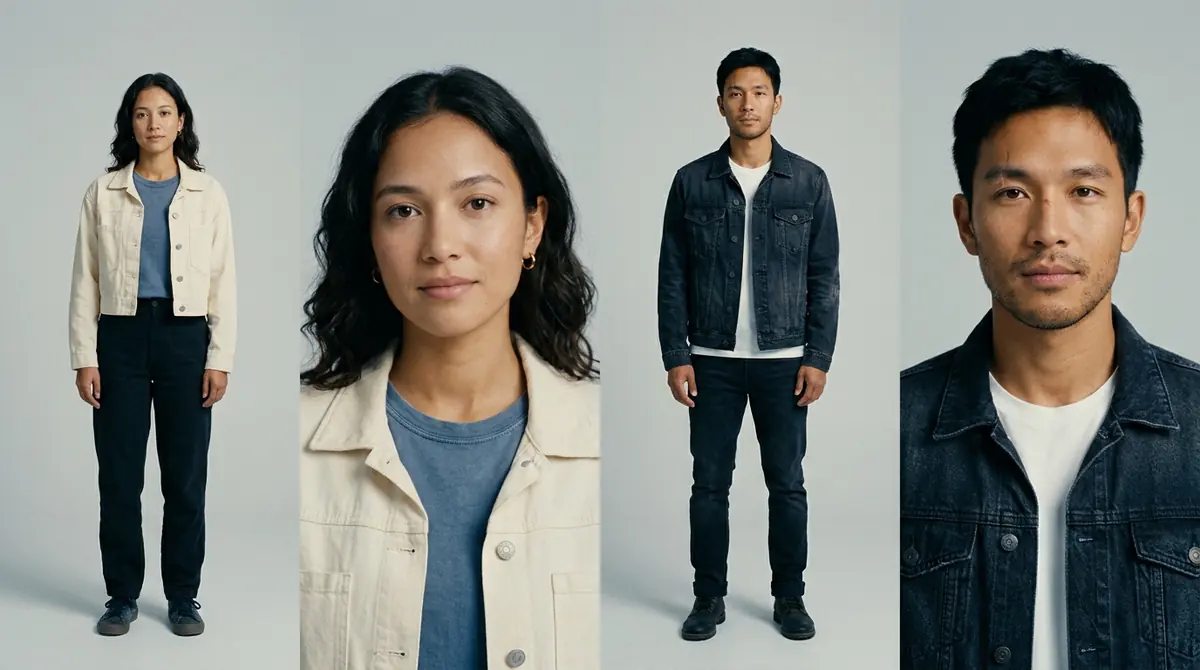
Write each character in about 20 words: age, build, face, hair, skin, one memorable detail and two pieces of clothing. These words will travel into every shot later, unchanged.
- 07
Finish with references, key moments and the practical page
Add a few reference images, list the shots the video must have, then the locations, schedule, deliverables and budget. Cut anything that doesn't help a reader say yes.
Stuck on the logline? Start from a list of music video ideas by genre and bend the closest one toward your song, or let a tool draft the skeleton for you.
Music video treatment generatorEnter the song's title, genre, mood, idea, lead and places, and get a draft treatment: logline, concept, look and a beat per section.A complete example treatment: Night Drive
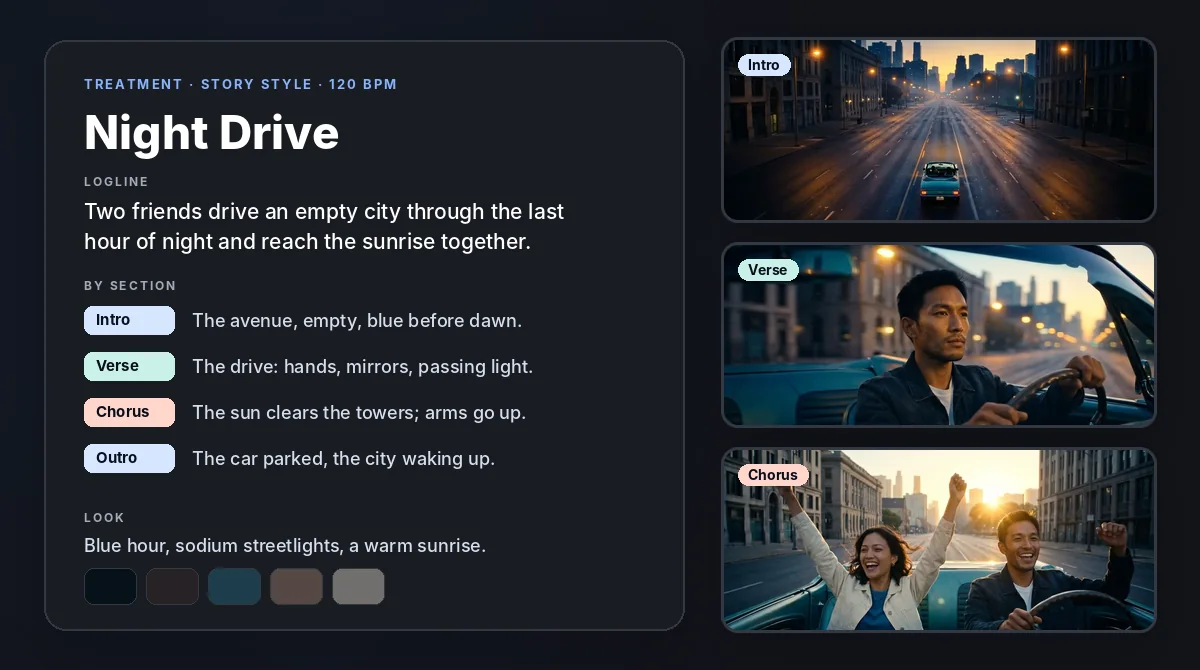
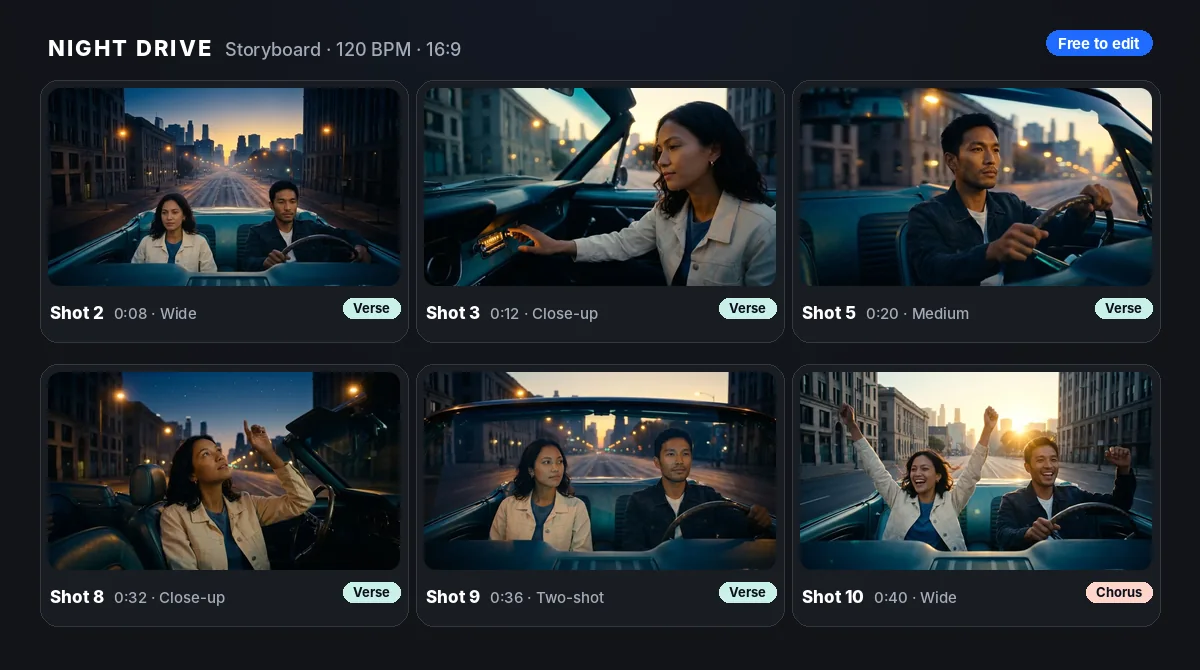
Here is a full treatment for “Night Drive”, a 120 BPM pop test song of 2 minutes 56 seconds, written from the brief Muvora's director produced for it and laid out as a director could have handed it in. The Night Drive storyboard example shows the shots that followed, and the full Night Drive treatment example adds bar counts for every section, the locations and their light, and a performance plan.
- Title: Night Drive, music video treatment, version 1.
- Song: “Night Drive”, 2:56, 120 BPM, pop.
- Format: Story style; a 16:9 master with vertical, square and Canvas versions.
- Logline: Two quiet companions drive through a sleeping city, and the road carries them into a golden sunrise.
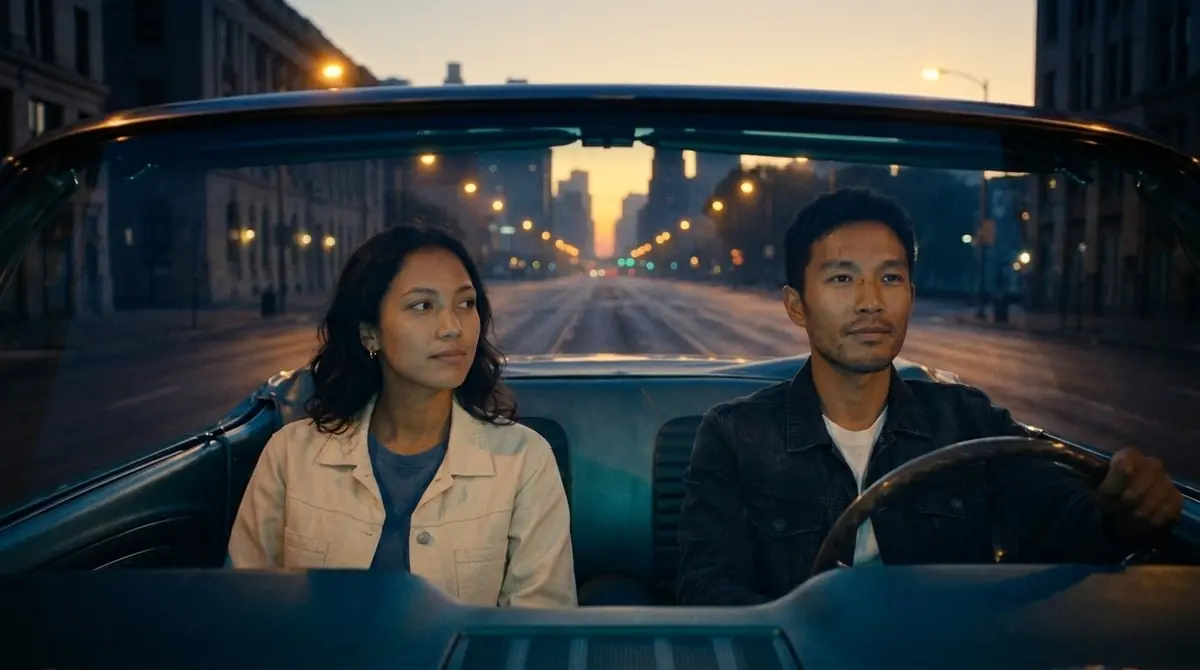
Concept. The song is about being awake while everyone else sleeps, and sharing that with one person. We never explain who Noa and Eli are to each other; we watch them share a car, a radio and a long road. The city starts blue and empty, and every chorus pulls more gold from the horizon. The change is the light itself, from streetlight to sunrise.
| Section | Time | What happens | Light |
|---|---|---|---|
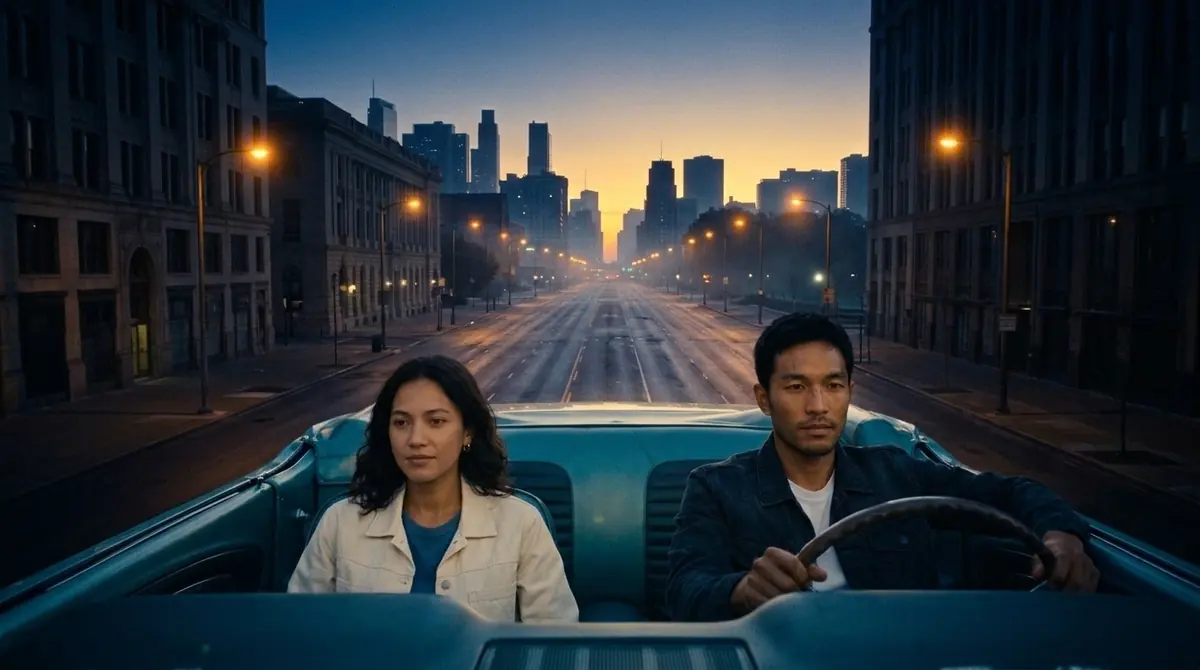
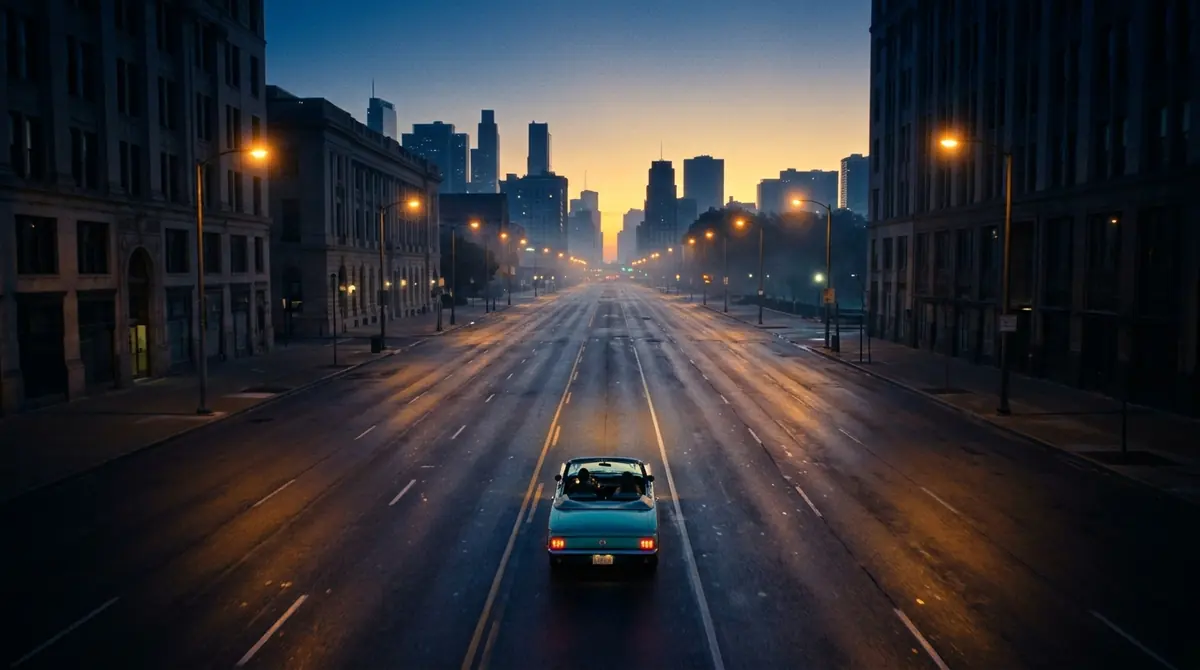
| Intro | 0:00 to 0:08 | The empty avenue at blue hour, a convertible waiting under one streetlight | Sodium streetlight, deep blue sky |
| Verse 1 | 0:08 to 0:40 | They drive the sleeping city; Noa finds a station, Eli watches the road | Streetlights and dashboard glow |
| Chorus 1 | 0:40 to 1:12 | The drop: the car opens up on wide avenues, the first gold on the horizon | A warm edge to the sky |
| Verse 2 | 1:12 to 1:28 | Quieter and closer: hands on the wheel, a look between them | Blue night, amber dash |
| Chorus 2 | 1:28 to 2:00 | Wider and brighter as they leave the center behind | Gold growing stronger |
| Bridge | 2:00 to 2:16 | The turn: they stop on the hood facing an orange horizon, then take a road through fields | Orange dawn |
| Chorus 3 | 2:16 to 2:48 | Open road and golden fields, the biggest shots of the video | Full sunrise |
| Outro | 2:48 to 2:56 | The car parked on a field road, then the empty road running toward the sun | Low sun, long shadows |
- Palette: midnight navy, deep blue, teal, amber and pale gold.
- Lighting: verses lit only by sources in the scene, the streetlights and the dashboard; choruses by warm gold from the horizon, stronger each time.
- Camera: wide, slow and steady in quiet sections; closer and moving in the choruses, riding with the car and sweeping around it.
- Wardrobe: one outfit each for the whole video, a cream jacket and a denim jacket that read clearly against the blue night.
- Locations: an empty downtown avenue, a sleeping residential street, a hill road above the city, a field road at sunrise.
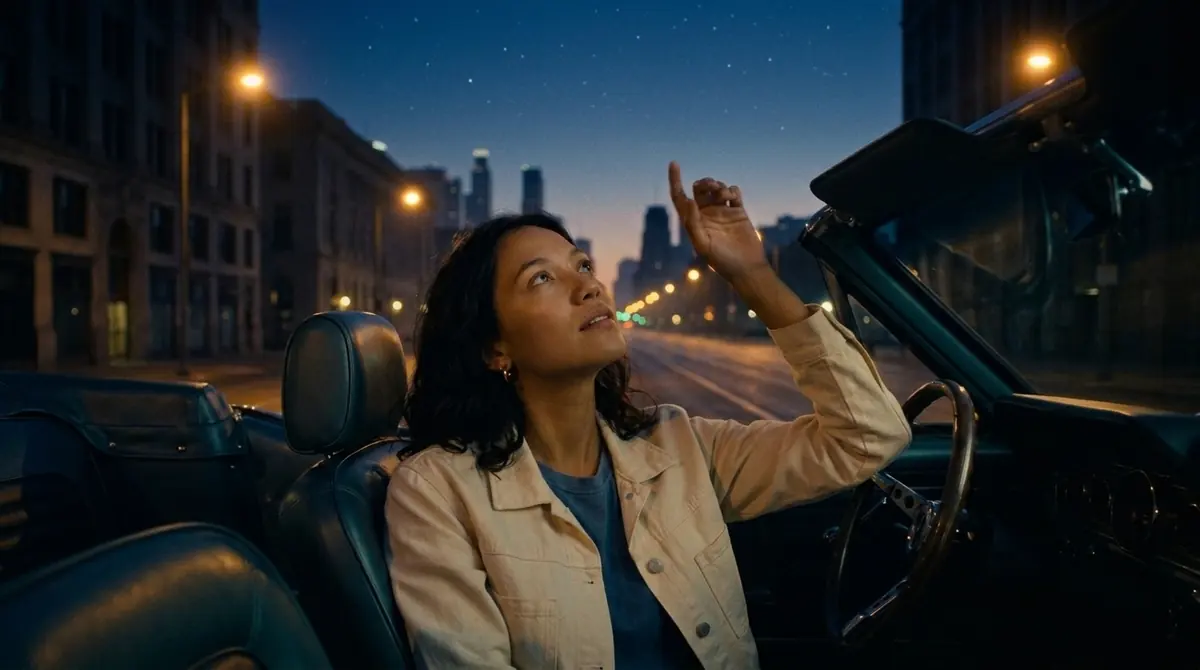
- Cast: Noa, the lead, mid-20s, slim, soft oval face, dark wavy shoulder-length hair, light brown skin, small gold hoops, cream cropped jacket over a faded blue tee. Eli, the driver, late 20s, lean, short black hair, light stubble, warm tan skin, a thin scar through his left eyebrow, dark denim jacket over a white tee.
References. This treatment's references are its own style frames: the avenue at blue hour and the chorus at sunrise. A pitch for a filmed video does the same with four to eight stills from films or photographers, each noting what to take from it: the color, the framing or the time of day.
- Key moment, verse 1: Noa's hand turning the radio dial, lit by the dashboard.
- Key moment, chorus 1: the car bursting onto an open avenue as the first gold appears.
- Key moment, chorus 1: their hands together over the gearshift.
- Key moment, bridge: the two of them on the hood, facing the orange horizon.
- Key moment, outro: an extreme wide of the empty road running into the sun.
Logistics and budget. As an AI video: one upload, Story style, 16:9, at Standard quality for consistent characters, about 10,800 credits for a three-minute cut, with every other format exported from the same render. Filmed, it needs a classic convertible, night and dawn permits downtown, a camera car and two actors over two nights; the music video cost guide shows typical ranges.
A fill-in music video treatment template
Copy this checklist into a document and fill in every line. If a line needs more than a few sentences, the detail belongs in the storyboard, not here.
- Title block: song, artist, length, BPM, your name, date and version.
- Logline: one sentence with a lead, a world and a change.
- Mood: three words for how the song feels.
- Concept: one or two paragraphs on what the video is about and why it suits the song.
- Intro: the opening image and the question it raises.
- Verses: how the story moves forward in each one.
- Choruses: the payoff image, and how it grows each time.
- Bridge: what changes, whether the place, the time or the point of view.
- Outro: the final image, and how it answers the first.
- Palette: three to five colors.
- Lighting: the source in each place, and how it changes across the song.
- Camera: how it behaves in quiet parts and in loud parts.
- Wardrobe: what each person wears, and whether it changes.
- Locations: three to six, each in a few concrete words.
- Cast: each character in about 20 words, plus the artist's role.
- References: four to eight images, each with what to take from it.
- Key moments: the five to ten shots the video can't do without.
- Deliverables: 16:9 master, 9:16, 1:1, a Canvas loop, captions or not.
- Logistics and budget: places, days, people, permissions and the total.
Skip the blank page
Upload your song and Muvora's director writes a brief for it, with the concept, the look, the cast and a plan for every section, then storyboards every shot. Editing it is free.
Tips for pitching a director, or writing one for yourself
When someone else has to say yes:
- Open with the logline and one strong image; most readers decide within the first page.
- Write in the present tense: “The car crests the hill and the sun hits the windshield.”
- Show you heard the song: name the moment of the drop or the line the chorus turns on.
- Keep references to a handful of images and say what each one is for.
- Be honest about scope. A budget that fits the idea earns more trust than a big idea with no plan.
When you're writing it for yourself:
- One page is enough. Its job is to stop you drifting, not to impress anyone.
- Decide the change first; most other choices follow from it.
- Pick places you can actually reach, or that an AI model can draw the same way twice.
- Write the cast descriptions as carefully as the concept; they decide whether the video holds together.
- Keep the logline in view while you storyboard, and cut any shot that doesn't serve it.
Mistakes that sink a treatment
| Mistake | Why it hurts | Fix |
|---|---|---|
| Too long | Ten pages of prose bury the idea; nobody reads to the end | One to three pages; move shot detail into the storyboard |
| Illustrates every lyric | Literal pictures feel like a slideshow of the words | Use the lyrics for meaning and show what the song is about |
| Nothing changes | A video that ends where it began feels like a loop | Write the change into the logline: night to sunrise, crowded to empty |
| Too many places | Ten locations make ten looks and no world | Three to six places that belong together |
| A vague look | “Moody and cinematic” lets everyone picture something different | Name the colors, the light sources and the camera behavior |
| No section plan | The best image lands in a verse and the chorus has nothing | Save the strongest image for the first chorus and grow it |
| References doing the work | A mood board of other videos isn't an idea | Say what to take from each reference and keep the concept your own |
| A budget that doesn't fit | A helicopter shot on a small budget kills trust | Scale the idea to the money, or cover the costly shots with AI |
The two that sink the most treatments are the lyric slideshow and the missing change. Both come from writing before listening. Go back to the song, name what it feels like, and ask what would have to be different at the end of the video for that feeling to land.
How Muvora's AI director writes a treatment for your song
Upload a song to Muvora, describe your idea in the idea box (up to 600 characters), and its AI director writes a creative brief that covers most of a treatment: a concept with a hook, the visual world, palette, lighting, camera language, the song's mood and a small cast, each described once. It writes shots for each section's role, from an intro that hooks to a chorus that grows and a bridge that turns, using the lyrics for meaning rather than illustrating them line by line.
| Treatment part | In Muvora |
|---|---|
| Logline and concept | The brief's concept and hook, written from your idea and the song |
| Story by section | Shots written for each section's role, timed to the song's analysis |
| Look | The brief's visual world, palette, lighting and camera language |
| Cast | A small cast described once, drawn as a character sheet |
| References | Style frames: an establishing frame and a chorus hero frame |
| Key moments | Every shot with its image prompt, motion prompt, framing and camera move |
| Budget | The exact price, shown before you click Generate |
| Deliverables | 16:9, 9:16, 1:1 and an 8-second Canvas loop from one render |
Treat the brief as a first draft. Read it, rewrite any shot, drag a cut, change the look or the quality, and the price updates as you go. Nothing costs anything until you render, and the free plan gives you 5 new storyboards a month. Already have a treatment? Put its logline and key image into the idea box and the director builds the storyboard around them.
Get a treatment-ready brief for your song
Upload a track, describe the idea in a line, and read the concept, the look, the cast and every shot before you spend a credit.
Written by the Muvora team. Last updated November 13, 2026. Spotted something out of date? Tell us at [email protected].