The short answer
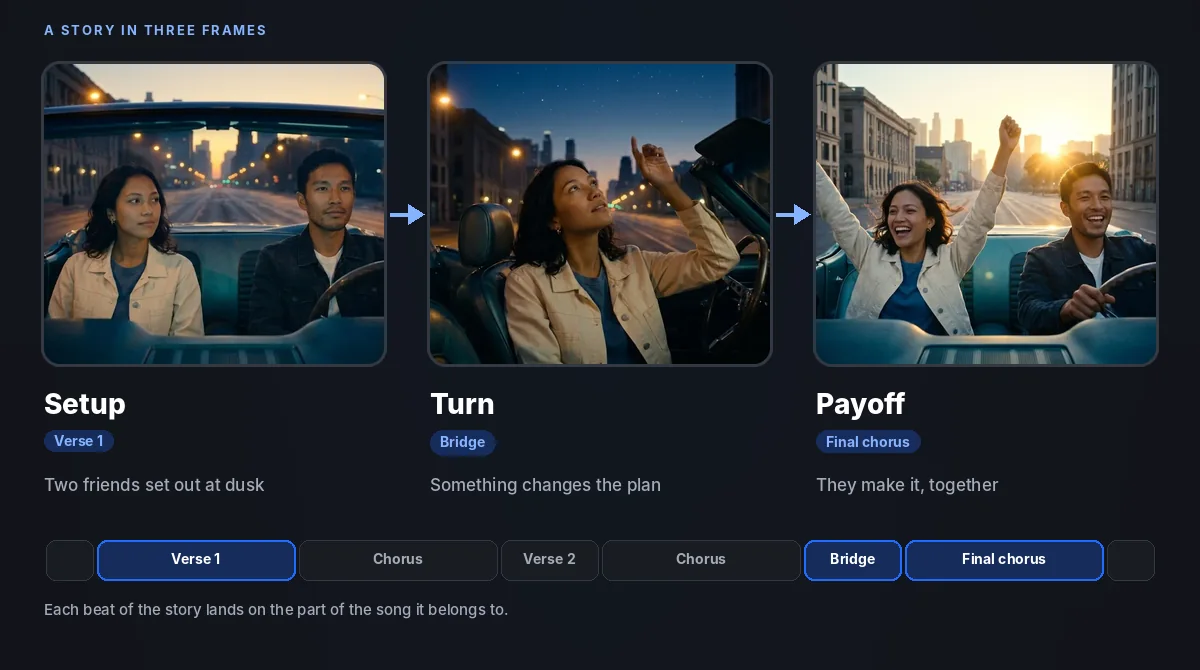
A good music video story has one lead who wants something, an obstacle that grows each chorus, a turn at the bridge and a payoff in the final chorus: a girl working up the nerve to jump off the high dive, or two roommates on opposite shifts who never meet. Map setup, turn and payoff onto the song's sections, keep the cast to three and tell it without dialogue.
- Give one lead one clear want, and let each chorus raise the stakes.
- Put the setup in the verses, the turn at the bridge and the payoff in the final chorus.
- Keep the cast to three, each described once, so every shot shows the same faces.
- Tell it with actions and objects: no dialogue, and no notes, texts or signs on screen.
- Use the lyrics for the story's meaning, not a picture for every line.
On this page (8 sections)ShowHide
- 1.What makes a music video story work
- 2.Setup, turn and payoff, mapped to the song
- 3.Stories of a want, a setback and a win
- 4.Stories with a twist at the bridge
- 5.Stories with a built-in shape
- 6.Casting the story and keeping faces the same
- 7.Telling a story with no dialogue and no text
- 8.From a story idea to a storyboard
- Questions
What makes a music video story work
A music video story is closer to a silent short film than to a movie. The song plays from the first bar to the last, nobody speaks, and the plot has to read at a glance in shots of a few seconds each. The stories that work share a handful of choices.
- One want. The lead wants one thing you can see: to jump, to win, to find, to get home. If the want can't be shown in a single shot, it's too abstract for three minutes.
- A lead in most of the shots. Viewers follow a person, not a plot. Muvora's director keeps the lead in at least half the shots of a Story video and gives them close-ups with something going on behind the eyes.
- A small cast. One lead and at most two others. Every extra character needs shots to introduce, and a song doesn't have many to spare.
- Escalation by chorus. The song repeats its chorus; the story shouldn't. Each chorus raises the stakes, so the last one feels like the top of a climb.
- A turn and a button. The bridge changes something (a setback, a reveal, a choice), the final chorus pays it off, and the outro ends on one small image after the big one.
Muvora's Story style is built on that shape. The director writes a concept with a hook, a turn and a payoff around a lead and up to two others, and cuts it with a performance thread: the lead moving to the song in a designed space, without singing. That thread gives the plot room to breathe and gives each chorus somewhere big to land.
Setup, turn and payoff, mapped to the song
A song already has three acts; the trick is to hang the plot on them rather than fight them. The table follows one idea from this guide, The high dive, through a typical pop song.
| Section | Story job | What it shows | Pace |
|---|---|---|---|
| Intro | The hook image | The ten-meter board against a blue sky, nobody on it | Two bars or more |
| Verse 1 | Setup: who she is and what she wants | She climbs to the top, looks down and climbs back down | One to two bars |
| Chorus 1 | The want, made big | The pool seen from the top of the board, the drop below her toes | About a bar |
| Verse 2 | Trying harder | Practice jumps off the low board, her brother timing her from a deckchair | One to two bars |
| Chorus 2 | Higher stakes | Two steps higher, a few swimmers stopping to watch | About a bar |
| Bridge | The turn | A storm rolls in and the lifeguard closes the pool for the season | Long holds |
| Final chorus | The payoff | The last afternoon of summer: she jumps | About a bar |
| Outro | The button | She surfaces grinning and swims straight back to the ladder | Two bars |
Bar height: how loud the section is. The strip under them: the shots, each cell one cut. Louder sections get more, shorter shots.
Two habits keep the map honest. Decide the turn before anything else, because it tells you what the verses have to set up. And make the final chorus answer the first one: the same place, the same angle, a different outcome. Song structure explained covers how sections work, and how to write a bridge explains the musical turn a story's turn can ride on.
Skip the blank page
Upload your song and Muvora's AI director plans a shot-by-shot storyboard on the beat. Edit every shot for free, and pay only if you render.
Stories of a want, a setback and a win
The most dependable shape: someone wants something, fails, nearly gives up and gets there. These five suit upbeat pop, rock and anything with a big final chorus, and each one's win lands on a single image you can picture before the song starts. The pop look paces most of them well, and the rock look cuts harder for a louder song.
- Story · town pool · summer
The high dive
A twelve-year-old spends a whole summer at the town pool trying to jump off the ten-meter board. In verse one she climbs to the top and climbs back down. Each chorus she gets a step further while her older brother times her from a deckchair. At the bridge a storm closes the pool for the season. On the final chorus, the last afternoon, she jumps.
Use this idea on my songUse this idea on my song - Story · grandfather · dawn
Skatepark at seventy
A seventy-year-old retired electrician wants to learn to skateboard before his granddaughter leaves for college. In verse one he wobbles down the driveway in borrowed knee pads. Each chorus she teaches him a new move at the skatepark at dawn, before anyone else arrives. At the bridge he falls hard and sits out a week. On the final chorus he drops into the bowl and she cheers.
Use this idea on my songUse this idea on my song - Story · picture-book style · siblings
Cardboard rocket
In a soft picture-book drawing style, two siblings build a rocket from cardboard boxes in their garage, with a laundry basket for a cockpit and a colander for a helmet. Each chorus their imagined flight goes further: over the roof, through the clouds, past the moon. At the bridge a rainstorm soaks the rocket flat. On the final chorus they rebuild it twice as tall and reach the stars.
Use this idea on my songUse this idea on my song - Story · beach · father and daughter
The sandcastle
A father and his young daughter enter a beach sandcastle contest with one bucket and a toy spade, beside teams with real shovels. Verses are the digging and the sideways looks from the neighbors. Each chorus their castle rises: towers, a moat, a driftwood bridge. At the bridge the tide comes in early and takes the walls. On the final chorus the other teams help them rebuild before sunset.
Use this idea on my songUse this idea on my song - Story · backyard party · first show
The magic show
A shy eleven-year-old practices magic in his bedroom for his little sister's birthday party: silk scarves, a top hat, a borrowed rabbit that won't stay put. Each chorus a trick almost works. At the bridge, on a stage of milk crates in the backyard, every trick fails and the kids go quiet. On the final chorus the rabbit hops out of his sister's gift bag and the yard erupts.
Use this idea on my songUse this idea on my song
Storyboard a plot on your song
Press “Use this idea on my song” and upload the track. Muvora maps your sections and downbeats, writes the brief and one shot per slot around your lead, and draws a character sheet before you spend a credit. The free plan includes 5 new storyboards a month.
Stories with a twist at the bridge
Here the bridge doesn't just raise the stakes; it changes what the story means: a reveal, a choice, a stranger who turns out to matter. These five suit R&B, indie, ballads and mid-tempo pop, and they reward a second watch, because the verses read differently once you know the ending.
- Story · love · one small apartment
Opposite shifts
Two roommates share a tiny apartment but work opposite shifts, a night nurse and a daytime bike courier, and have never met. Verses are the handover hours: one comes home as the other leaves. They know each other only by what's left behind: a warm mug, a watered plant, a mended coat. At the bridge a snowstorm cancels both shifts. On the final chorus they meet in the kitchen.
Use this idea on my songUse this idea on my song - Story · friendship · two timelines
The time capsule
Two old friends, now in their thirties, dig up the tin box they buried under a schoolyard oak at twelve. Each chorus an object from the box opens a flashback in warm summer light: a cassette, a friendship bracelet, a photo of a treehouse. At the bridge the last thing in the box is a key neither of them remembers. On the final chorus it opens the old treehouse.
Use this idea on my songUse this idea on my song - Story · day off · seaside town
The wrong stop
A commuter in a gray suit falls asleep on the morning train and wakes at the end of the line in a seaside town. Verse one is panic on the platform. Each chorus he says yes to something: a swim in his shirt, a fishing-boat ride, a dance at a seafront bar. At the bridge the evening train pulls in. On the final chorus he lets it leave.
Use this idea on my songUse this idea on my song - Story · watercolor style · growing up
The scarecrow
Drawn in warm storybook watercolor, a scarecrow in a wheat field watches a farm girl grow up. At six, she hangs her straw hat on him. Each chorus she's older: reading in his shade, then packing a car for the city. At the bridge the farm is sold and he's pulled down. On the final chorus she drives back for him and stands him in her city balcony garden.
Use this idea on my songUse this idea on my song - Story · heist comedy · three cousins
The pan heist
Three cousins break into the rival diner across the street after closing to steal back their grandmother's lucky cast-iron pan, planned like a heist movie: black hoodies, a getaway bicycle, a bead curtain dodged like lasers. Each chorus another stage of the job goes wrong. At the bridge the rival's own grandmother catches them. On the final chorus both grandmothers cook side by side.
Use this idea on my songUse this idea on my song
A twist needs a fair setup: show the key, the mug or the train in the verses so the bridge pays off something the viewer already saw. For more in these moods, see the love song music video ideas and the sad song music video ideas, and for the end of a relationship told from quiet to free, the breakup music video ideas.
Stories with a built-in shape
Some plots come with their structure attached: a day that repeats, a room that fills up, a route with one stop per section, a training montage that ends on the drop. These shapes suit songs whose choruses barely change, because the story supplies the change, and most of them happen in one or two places.
- Story · time loop · rain
Same Tuesday
A young barista lives the same rainy Tuesday on repeat. In verse one everything goes wrong: a missed bus, a spilled tray, the stranger at the crossing walking away. Each chorus the day restarts and she fixes one thing. At the bridge she stops fixing anything and just sits on the curb in the rain. On the final chorus the stranger from the crossing sits down beside her.
Use this idea on my songUse this idea on my song - Story · two strangers · one elevator
Stuck between floors
Two strangers get stuck in an old elevator between the ninth and tenth floors for the length of the song. Verses are awkward silence and a shared granola bar. Each chorus they loosen up: rock paper scissors, a slow dance in the tiny space, a picnic on the floor. At the bridge the lights go out. On the final chorus the doors open and neither wants to leave.
Use this idea on my songUse this idea on my song - Story · hip-hop · a room that fills
First apartment
A young musician moves from his mother's flat into his first apartment with a mattress, a speaker and nothing else. Verses are bare walls and takeout on the floor. Each chorus the room fills with something found or earned: a lamp from the curb, a thrifted sofa, a plant. At the bridge rent day comes and he sells the speaker. On the final chorus his mother arrives with dinner.
Use this idea on my songUse this idea on my song - Story · retirement · one route
The last round
On his last day before retiring, a postman walks his round. Verse one is an ordinary morning: a gate, a barking dog, a porch swing. Each chorus a house on the route has something waiting for him: a cake, a child's drawing, a neighbor playing him out on a trumpet. At the bridge the last house is empty. On the final chorus his oldest neighbors wait at the depot.
Use this idea on my songUse this idea on my song - Story · night shift · build to the drop
The dance battle
A quiet warehouse worker trains for a street dance battle on her night shifts, practicing between tall shelves under fluorescent light. In verse one she keeps slipping on the same spin. Each chorus a coworker joins in, first as coach, then a second as hype man. At the bridge a sprained ankle costs her a week. On the drop she wins the circle in a parking garage lit by headlights.
Use this idea on my songUse this idea on my song
A built-in shape makes the director's job easier, because the change in each section is already written. A slow song can use the same trick with the words on screen (see the lyric video ideas), and a track that wants no one on screen at all has the music visualizer ideas.
Casting the story and keeping faces the same
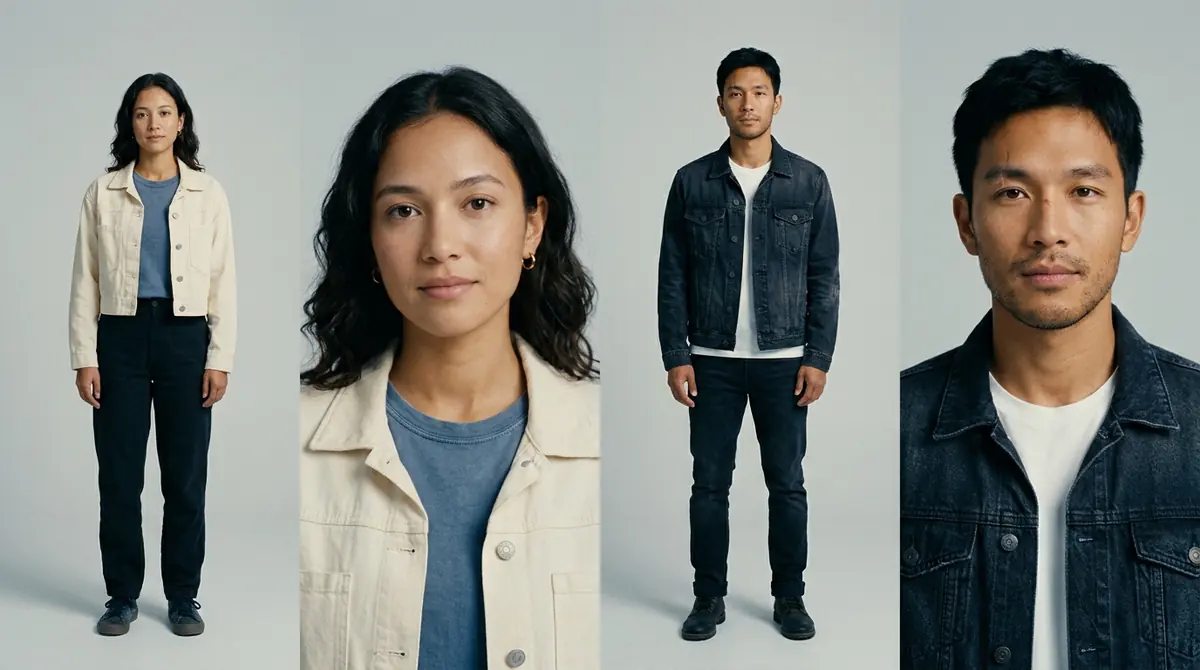
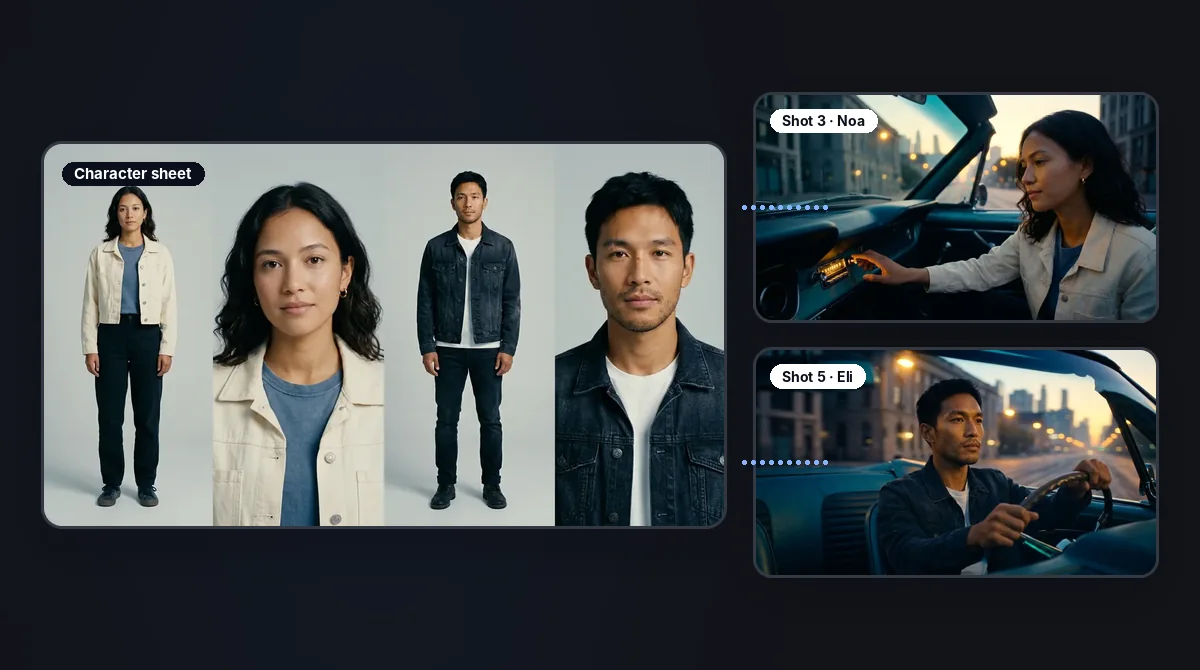
A story only works if the viewer recognizes the lead in every shot. Muvora keeps faces steady with a character sheet, but it starts with how you describe the cast in the idea box.
- Describe each character once, in fixed words. Age, build, hair and one or two pieces of clothing: “a seventy-year-old man, gray beard, red windbreaker, knee pads”. The brief carries the same words into every shot that shows him.
- Up to three characters. The brief holds a lead and at most two others, and a character sheet is drawn for up to two of them. Keep anyone else far away, out of focus or seen from behind.
- Checked against the sheet. Every keyframe is drawn from the character sheet and checked against it, and one that drifts is drawn again. Hands and fast motion can still slip in a single shot, which a re-roll fixes after the render.
- You as the lead. With the Performance style, one clear, front-facing photo of the singer (yourself, or someone who agreed, with the consent box ticked) becomes the lead: lip-synced where the song is sung, and acting in the story shots in between.
- No real people. Celebrities and anyone without consent are blocked, so a story can't star a famous face or a lookalike.
Telling a story with no dialogue and no text
Nobody speaks in a music video, and Muvora draws no lettering into its pictures, so a plot has to travel through actions, faces and things. Those limits are useful: they push a story toward images people remember.
- Objects instead of messages. A note on the fridge won't appear, but a warm mug, a key or a mended coat says the same thing. Plant the object in a verse so the bridge can pay it off.
- Faces that react. Write each reaction as an action: she looks down at the water, he stops halfway up the ramp. Muvora's director gives every face an expression that fits the song's mood.
- The same angle twice. Frame the final chorus like the first verse, the same spot and the same distance, with a different outcome. Viewers measure the change without being told.
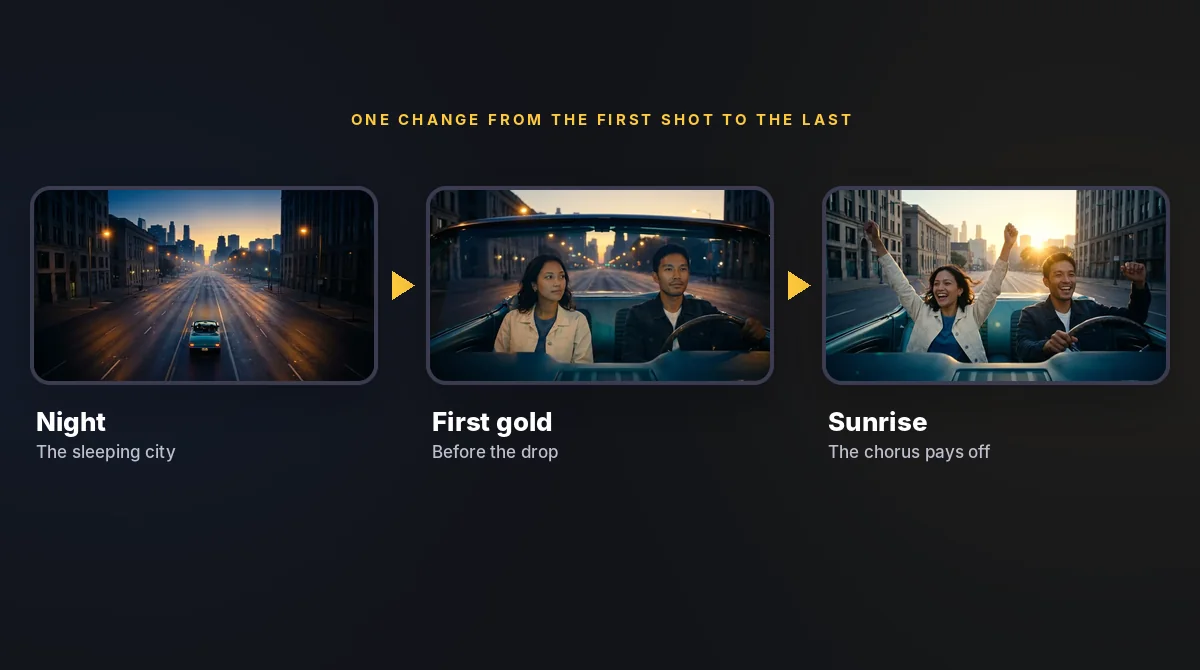
- Time told by light and season. Flashbacks in warm gold and the present in cool blue, summer turning to snow, a haircut growing out: no caption needed to say when.
- The lyrics for meaning. The director reads your lyrics for what the song is about rather than picturing each line. A plot that agrees with the song's meaning beats one that copies its words.
From a story idea to a storyboard
- 01
Write the logline
One sentence with the lead, the place and the want, such as “a twelve-year-old spends a summer trying to jump off the high dive”. If it won't fit in one sentence, simplify it.
- 02
Decide the turn and the final image
Choose what changes at the bridge and the single picture the final chorus ends on, then work back to what the verses must set up.
- 03
Upload the song
Upload the finished track (MP3, WAV, M4A, AAC or FLAC, up to 8 minutes and 60 MB) and confirm you have the rights to use it. The free analysis finds the sections your three acts will hang on.
- 04
Choose Story and a genre look
Story tells a plot around a lead; Performance puts you in it from one photo. Then pick the look that matches the song's pace: pop, rock, hip-hop, EDM or lo-fi.
- 05
Write the plot into the idea box
In up to 600 characters: the lead in fixed words, the want, how each chorus raises it, the turn and the final image.
- 06
Read the storyboard as a story
Go through it section by section, rewrite any shot that doesn't move the plot, check the character sheet and style frames, then render when the price suits you.
Standard, at 60 credits a second, is the usual choice for a story, because it keeps characters consistent from shot to shot. Visualizer, at 38, covers a whole song for less, and Cinematic, at 110, is the most detailed of the three. Lip-synced seconds in a Performance video cost 75 credits each. After the render, re-roll any shot that breaks the story: re-rolls are free up to 10% of the video's length.
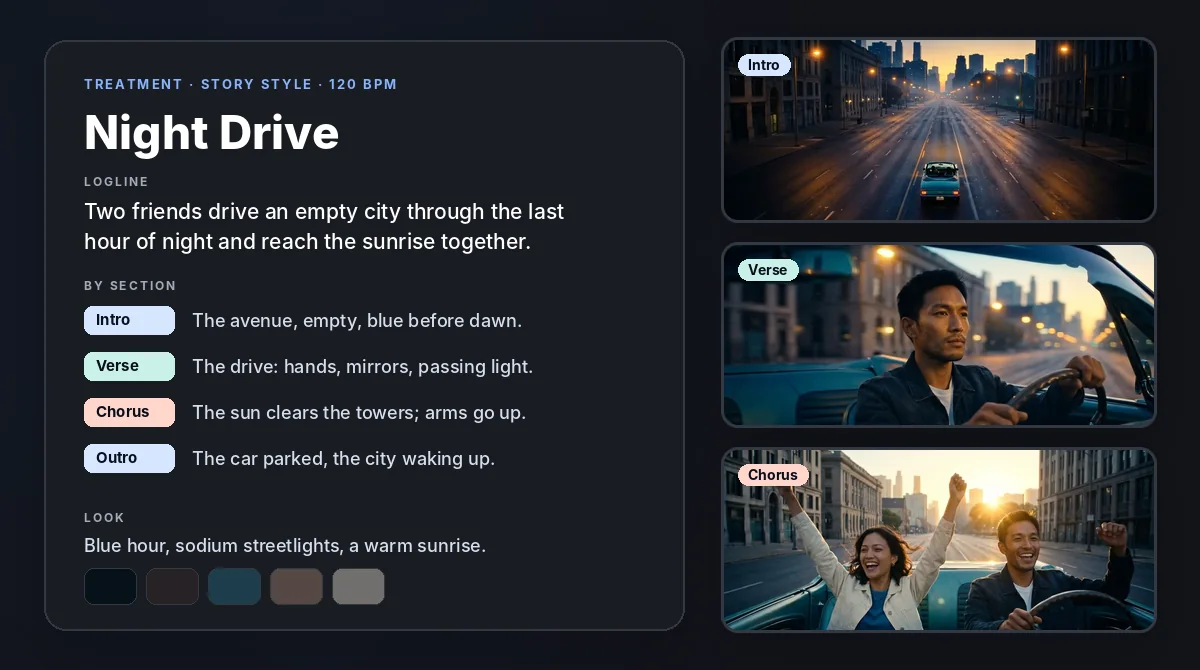
For concepts sorted by genre, start at music video ideas. To write the plot up properly, read how to write a music video treatment and the sample treatment, and to settle the look, collect reference pictures in the music video mood board.
Tell your song's story
Upload the track, write the lead, the want, the turn and the final image in the idea box, and read a free storyboard with the plot laid on your sections. See how the storyboard works, then render when it tells the story you meant.
Written by the Muvora team. Last updated November 18, 2026. Spotted something out of date? Tell us at [email protected].