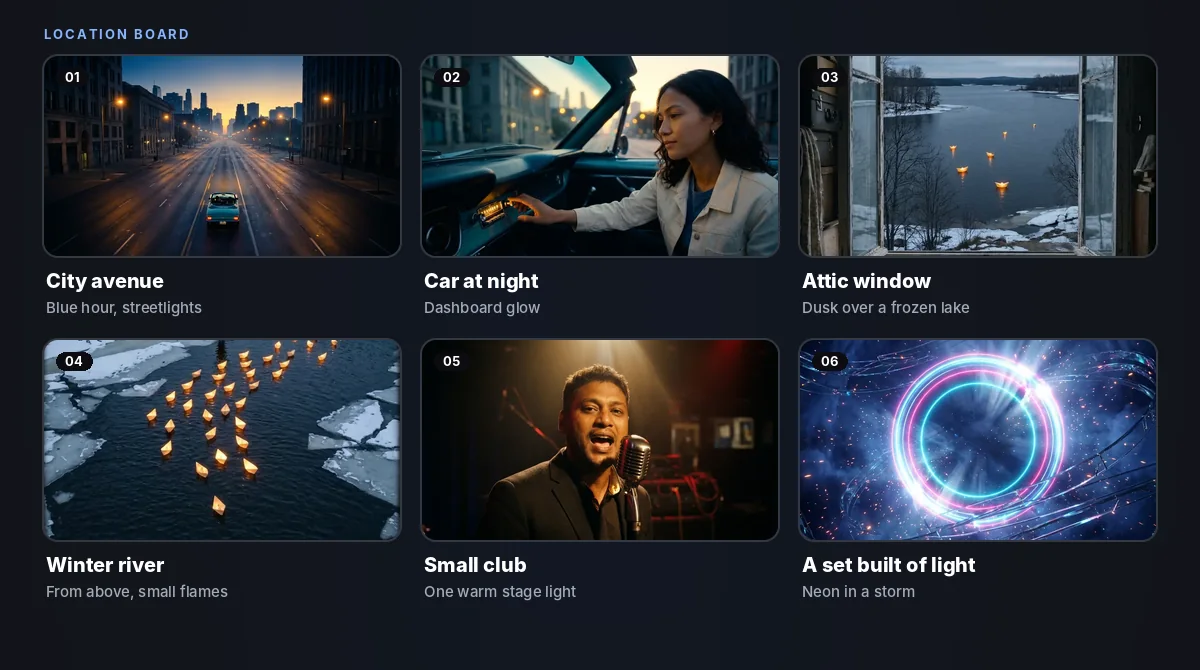
The short answer
Choose a music video outfit for its silhouette first and its color second: a shape that reads in a wide shot, colors the location doesn't share and the palette does, and fabrics with some texture. Skip fine stripes, small checks and visible logos, give the lead one signature piece, and keep every look identical from shot to shot and day to day.
- Dress the character in this video, not the artist on an ordinary day.
- Shape reads before color: a strong outline survives a wide shot and a phone screen.
- Pick colors against each location and its light, not on a hanger.
- Fine stripes, small checks and tight mesh can shimmer on video; solids and big patterns hold still.
- One signature piece, the same in every shot, makes a lead recognizable for a whole song.
On this page (14 sections)ShowHide
- 1.How to choose a music video outfit
- 2.Hip-hop and R&B outfit ideas
- 3.Pop, dance and electronic outfit ideas
- 4.Rock, punk, indie and country outfit ideas
- 5.Concept outfits: uniforms, eras and characters
- 6.Silhouette: the shape that reads in a wide shot
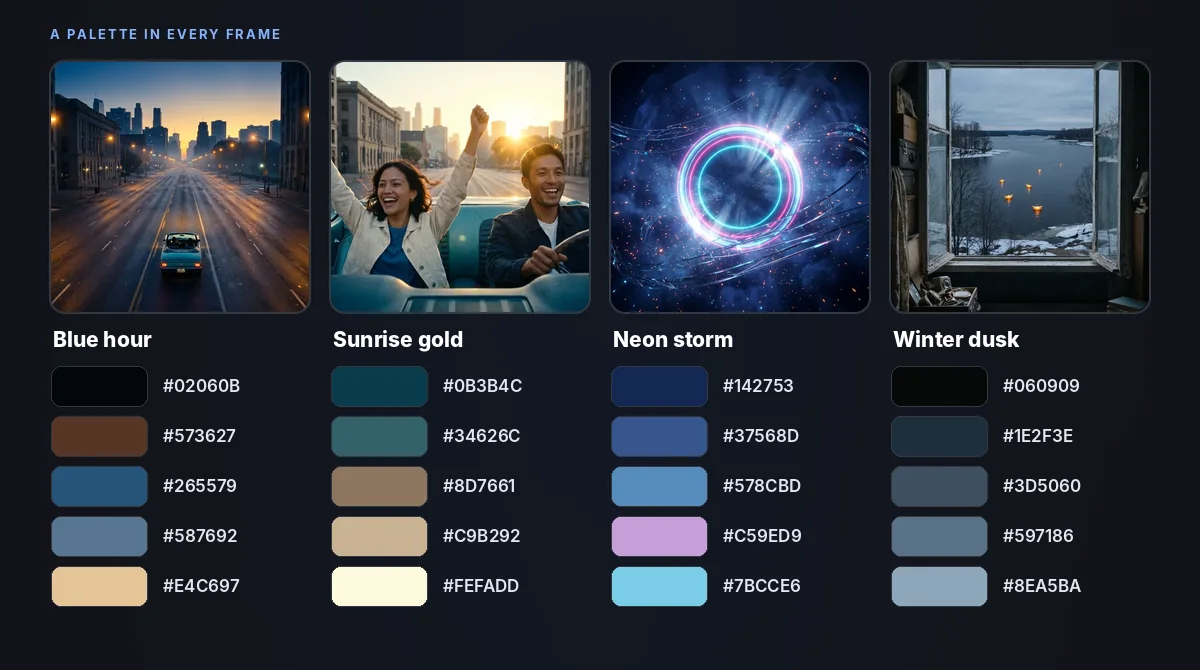
- 7.Color against the palette and the location
- 8.Texture: what fabric does on camera
- 9.Patterns that strobe, and logos to leave out
- 10.One signature piece
- 11.Continuity across shots and days
- 12.A performer's look across a whole video
- 13.Music video outfits by genre
- 14.How Muvora keeps a character's outfit the same in every shot
- Questions
How to choose a music video outfit
Wardrobe in a music video is costume, even when it looks like everyday clothes. The camera sees it from far away and very close, under light that isn't a fitting room's, cut together from shots filmed hours or days apart. That's why a favorite outfit can disappoint on screen and a plain one can carry a video. Work through it in this order.
- 01
Decide who the character is
Write one line about the person in this video, not the artist on an ordinary day: a delivery rider on the night shift, a bride who left her own wedding, a band that has played the same basement for ten years. The clothes follow from that line.
- 02
Start from the silhouette
Choose the overall shape first (long and narrow, wide and boxy, fitted on top with a full skirt) and check that it reads as a shadow on a wall. Shape is what a viewer recognizes in a wide shot and on a small screen.
- 03
Choose colors against each location
Hold the outfit up against photos of every place in the video and the light there. Keep colors the background doesn't share and the video's palette does.
- 04
Check the fabric under the real light
Put the shoot's light on the fabric, or take it to the location at the hour you'll film: satin shines, velvet goes dark, sequins sparkle, matte cotton stays as it is.
- 05
Strip out logos, slogans and fine patterns
Swap shirts with big logos or words for plain ones, and swap fine stripes and small checks for solid colors or large, bold patterns.
- 06
Choose one signature piece
Pick the item the lead keeps in every shot (a coat, a hat, a ring, a pair of boots) and make sure it shows both in a wide shot and in a close-up.
- 07
Test-film it and watch on a phone
Record a few seconds at the widest framing you plan and in close-up, then watch on a phone. Look for shimmer, whites burned out to blank, colors that vanish into the background and anything that flares.
- 08
Photograph the final look
Photograph each look front, back and both sides, with close-ups of the jewelry and of how the sleeves and collar sit, and keep the photos with the shot list for every shoot day.
Dress your characters before the storyboard is written
In Muvora, describe what each character wears in the idea box when you upload your song. The AI director writes the outfits into the brief, a character sheet you see before paying is drawn from them, and every shot keeps the same words. The storyboard is free to read and edit.
Hip-hop and R&B outfit ideas
Hip-hop wardrobe works in volume and in matching: big outerwear, one color head to toe, a crew dressed as one. R&B leans the other way, toward soft fabrics that move and catch warm light. In each idea below the outfit holds steady, and the light, the place or the people around it change instead.
- Hip-hop · tonal look
One color, head to toe
The lead wears one color head to toe: a camel tracksuit, a matching bucket hat and suede sneakers, a thin gold chain at the collar. The verses are a gray concrete block at dusk, the camel glowing against the stone. Each chorus a friend joins in the same outfit in another tone (rust, olive, navy), until the last chorus is a row of five under one streetlight.
Use this idea on my songUse this idea on my song - Rap · winter night
Black puffers in the steam
A black oversized puffer jacket with the hood up, gray cargo pants, white sneakers and one small silver hoop in the left ear. The lead raps the verses beside a street grate venting steam under an orange streetlight. Each chorus the steam thickens and the crew steps out of it, every one in the same black puffer. The last chorus is the crew's breath clouding in the cold.
Use this idea on my songUse this idea on my song - R&B · lounge at night
Silk in lamplight
A loose champagne silk shirt open at the collar, high-waisted black trousers, a thin gold bracelet on the right wrist, bare feet on a deep green carpet. The singer moves through a dim lounge lit by low brass lamps, the silk catching every highlight. Each chorus the camera finds the shirt in a different lamp's glow. The last chorus is a slow turn as every lamp brightens.
Use this idea on my songUse this idea on my song - Hip-hop · victory lap
Cream suit at sunrise
A cream double-breasted suit over a black turtleneck, cream loafers and small dark oval sunglasses. The lead walks the verses through a marble hotel lobby at night, the suit bright against the dark stone. Each chorus moves outside, and the light on the cream warms from white streetlight to the first blue of dawn. The last chorus is a rooftop at sunrise, the suit turned gold.
Use this idea on my songUse this idea on my song - R&B · two singers
Mirrored sets for a duet
Two singers in matching knit two-piece sets of the same cut, one deep burgundy and one cream, so they mirror each other. They sing the verses on either side of a frosted glass wall in a bare white studio, each lit in their own color. Each chorus they step closer to the glass. In the last chorus the glass is gone and the two sets stand side by side.
Use this idea on my songUse this idea on my song - Hip-hop · coming of age
Borrowed varsity jacket
A worn varsity-style jacket two sizes too big, with plain felt patches and no lettering, over a white tank top and baggy light-blue jeans. The lead crosses a high school football field as the floodlights switch off one bank at a time. Each chorus flashes back to the night it was lent to them. The outro is the lead at the gate as the last bank goes dark.
Use this idea on my songUse this idea on my song
Skip the blank page
Upload your song and Muvora's AI director plans a shot-by-shot storyboard on the beat. Edit every shot for free, and pay only if you render.
Pop, dance and electronic outfit ideas
Pop rewards one bold idea that reads in a thumbnail: a single strong color, a group in coordinated looks, a fabric that does something in the light. Electronic music goes further toward fabric as light, with sequins, metallics and white that glows under ultraviolet.
- Pop · winter
Red coat in a gray city
A tailored red wool coat over a black turtleneck and black trousers, and nothing else in the frame colored. The lead crosses a gray city in winter: a stone bridge, a train platform, a square of bare trees. Each chorus a little more red appears around her: an umbrella, a door, a passing tram. The last chorus fills the square with red umbrellas opening on the downbeat.
Use this idea on my songUse this idea on my song - Dance-pop · crew
Five pastel tracksuits
Five dancers in matching tracksuits, each a different pastel (mint, lilac, butter yellow, powder blue, peach), with white socks and white sneakers. They rehearse the verses in a mirrored dance studio under bright tubes. Each chorus the routine moves outside to a new spot: a parking lot, a footbridge, a fountain. The last chorus is all five in formation on a rooftop at sunset.
Use this idea on my songUse this idea on my song - EDM · warehouse
Sequins in the strobes
A silver sequined jacket over a plain black tee and wide black trousers. Through the build the warehouse is dark, lit by one work lamp, and the sequins barely show. At each drop the strobes fire and the jacket throws them back as hundreds of points of light. The last drop adds a room of dancers dressed in black, the jacket the only thing that shines.
Use this idea on my songUse this idea on my song - Club · blacklight
White under ultraviolet
Everything white: a white boiler suit, white sneakers and small white painted dots across the cheekbones, in a black room lit only by ultraviolet tubes, so the clothes glow violet-white and nothing else shows. The verses are slow moves in the dark. Each chorus a strobe catches the whole body for an instant. The last chorus fills the room with dancers dressed the same.
Use this idea on my songUse this idea on my song - Pop ballad · after the dance
Satin prom dress at 3 a.m.
A pale blue satin prom dress with a borrowed black tuxedo jacket over the shoulders, heels carried in one hand. The lead walks home barefoot through an empty town at 3 a.m., streetlights on wet pavement. Each chorus the satin catches a different light: a shop window, a passing car's headlights, a lit phone booth. The last chorus is sunrise on the dress, its hem dark with rain.
Use this idea on my songUse this idea on my song - Summer pop · hill town
Cream linen in high sun
A loose cream linen shirt and wide trousers, rope sandals, a straw hat with a black band and tortoiseshell sunglasses. The lead climbs a seaside town of blue doors and hot stone steps at noon, the cream bright against the blue. Each chorus the wind lifts the shirt as the camera reaches another flight of steps nearer the sea. The last chorus is golden hour on the harbor wall.
Use this idea on my songUse this idea on my song
Rock, punk, indie and country outfit ideas
Guitar music dresses in wear and texture: leather with creases, denim faded at the knees, knits with a mend in them. These looks reward hard light and close-ups, which show the texture, and they read as a band when everyone shares one element rather than one outfit.
- Rock · basement show
Thrift-store marching jackets
A four-piece band in matching secondhand marching band jackets, dark red with brass buttons, over black tees and ripped black jeans. They play a cramped basement under one bare bulb. Each chorus the room is more crowded and the bulb swings harder, light sliding over the brass. The last chorus is the band soaked in sweat, jackets still buttoned, the bulb spinning on its cord.
Use this idea on my songUse this idea on my song - Punk · skate park
Safety pins and bleach
A black denim jacket spotted with bleach and held together with safety pins, a plain white tee cut into a tank, red tartan trousers and scuffed black boots. The singer screams the verses in an empty concrete skate park under one floodlight. Each chorus more friends drop in, each in a homemade jacket of their own. The last chorus is everyone in the bowl at once.
Use this idea on my songUse this idea on my song - Indie · off-season town
Oatmeal sweater by the sea
A hand-knit oatmeal sweater with a darned elbow, moss-green corduroy trousers, worn white canvas shoes and round wire glasses. The lead wanders a seaside town out of season under flat gray skies, the knit close in soft daylight. Each chorus the wind tugs at the sweater on the pier as the clouds break yellow. The last chorus is the end of the pier at sunset.
Use this idea on my songUse this idea on my song - Country · porch to dance hall
Denim on denim
A faded denim jacket over a darker denim shirt, worn brown boots and a brown felt hat with a narrow band. The singer sings the verses on a farmhouse porch at dusk under one bare porch light. Each chorus moves to a barn dance strung with bulbs, the hat bobbing among the dancers. The last chorus is the porch again, the dance lights glowing across the field.
Use this idea on my songUse this idea on my song - Rock · night quarry
Black leather in the quarry
Black jeans, a black leather jacket with silver zips, black boots and one heavy silver ring on the right hand. The band plays in a rock quarry at night lit by two work lights, the hard light picking out every crease in the leather. Each chorus the work lights swing and the band's shadows tower up the quarry wall. The last chorus is rain on the leather and the guitars.
Use this idea on my songUse this idea on my song - Folk · hay meadow
Rust linen dress at dawn
A long rust linen dress with a cream crocheted shawl, bare feet and a few wildflowers in loosely braided hair. The singer walks a hay meadow at dawn carrying a wooden guitar, dew on the grass. Each chorus the shawl lifts in the wind as the sun clears the hedges. The last chorus is the singer playing on a low stone wall, the whole field gold.
Use this idea on my songUse this idea on my song
Concept outfits: uniforms, eras and characters
Some videos are built on the costume itself: a uniform that says what someone does, a decade, a dress worn in the wrong place, a drawn character's design. These work for any genre, and they give the lead a look nobody forgets. Make sure the outfit has no lettering: invent the team, the company and the badge rather than borrowing a real one.
- Story · night shift
Delivery rider in the rain
A delivery rider in a bright orange rain jacket with silver reflective strips, black waterproof trousers, a black helmet with a scratched visor and an insulated backpack. The verses ride wet streets at night, the strips flaring in every passing headlight. Each chorus the rider stops at a different door and a different life opens. The last chorus is the rider's own front door.
Use this idea on my songUse this idea on my song - Story · surreal everyday
Wedding dress on a weekday
A secondhand wedding dress with a torn hem, worn under a faded denim jacket with white sneakers, through an ordinary weekday morning in the city: a bakery line, a crowded tram, a park bench. The verses play it completely straight. Each chorus a few more strangers fall in behind her, carrying the long train. The last chorus is the whole procession crossing a bridge at noon.
Use this idea on my songUse this idea on my song - Story · a team of five
Matching bowling shirts
A five-person bowling team in matching retro shirts, mint and cream with contrasting collars, no names or numbers stitched on, and pressed black trousers. The verses are practice night in a small bowling alley under blacklight, the white collars glowing. Each chorus a strike lands on the downbeat and the team erupts in the same move. The last chorus is the final frame, everyone frozen mid-cheer.
Use this idea on my songUse this idea on my song - Era look · the 1970s
Seventies basement den
Rust corduroy flares, a cream knit with a wide collar, a brown suede jacket with a short fringe and tinted aviator-shaped glasses. The lead dances alone in a wood-paneled basement den with an orange shag rug, warm lamplight and a record player turning. Each chorus another friend comes down the stairs in a seventies look of their own. The last chorus is a full dance floor on the shag.
Use this idea on my songUse this idea on my song - Animated · 2D cartoon
Paper crown, cardboard city
Drawn as a 2D cartoon with thick outlines. The lead: a small boy in an oversized purple hoodie with rolled sleeves, orange shorts, odd socks (one striped, one dotted) and a paper crown. He crosses a cardboard city by night, its windows lit yellow. Each chorus more kids follow, each in a paper crown. The last chorus is a parade of crowns under paper fireworks.
Use this idea on my songUse this idea on my song - Performance · club stage
One stage look, start to finish
The performer, from my photo, wears a black velvet blazer over a white shirt open at the collar, one small gold hoop in the left ear and a thin silver ring. The outfit never changes; the light does. The verses are close at a microphone under one warm spotlight in a small club. Each chorus the stage behind them washes deep blue, brighter every time.
Use this idea on my songUse this idea on my song
Wardrobe and place work as a pair, and many of these outfits were written for a location in the music video location ideas guide: the bowling shirts for a bowling alley under blacklight, the rider for a city at night. For whole concepts beyond the clothes, music video ideas has more by genre, and the low budget ideas build videos around one costume and one room.
Silhouette: the shape that reads in a wide shot
Before color, before fabric, a viewer reads an outfit's outline. In a wide shot, in a thumbnail and on a phone held at arm's length, the shape of a person is most of what's visible. Costume designers often check a design by its shadow for that reason, and a music video, cut every few seconds, needs a shape that registers in the first half second of each shot.
- Exaggerate one dimension. An oversized puffer, a long coat to the ankles, wide trousers, a tall hat or a full skirt. Pick one; when every piece is oversized, nothing stands out.
- Give each character a different outline. In a duo or a band, put one in something long and narrow and another in something short and boxy, so viewers can tell them apart before they see a face.
- Let the fabric move. A long coat in the wind, a skirt that flares on a spin, a loose shirt in a car's slipstream all add motion to a still camera. Stiff fabric stays still however the performer moves.
- Think about the vertical crop. A 9:16 version of a wide frame keeps the middle and loses the sides, so a look that reads from the waist up (a collar, a hat, a jacket's shape) survives on a phone better than one that depends on shoes.
Color against the palette and the location
An outfit's color is never judged on its own. It's judged against the wall behind it and under the light on it, and both change from place to place. The common failure is a lead who disappears: a green jacket in a park, a black coat at night, a white shirt against a white wall. Choose the color for the location, and check it under that location's light.
| Location or light | Colors that tend to vanish | Colors that tend to land |
|---|---|---|
| A green park, forest or garden | Greens, khaki, olive | Rust, mustard, cream, cobalt blue |
| A city at blue hour or night | Navy, black, charcoal | Cream, camel, red, yellow |
| Old orange sodium streetlights | Most colors flatten toward orange-brown; blues and greens go dark | Strong black-and-cream contrast; pale fabric that takes on the glow |
| A white studio or white walls | White, pale gray, beige | Black, denim, any saturated color |
| A wheat field or sand at golden hour | Gold, tan, beige | Denim blue, deep green, burgundy |
| Red, blue or green colored light | Fabric the light's opposite color, which can turn almost black | White or pale gray, which take on the light's color; black as a crisp silhouette |
| Gray concrete: garages, stairwells, underpasses | Gray, charcoal, stone | One strong color: red, cobalt, yellow, orange |
The lead's color should be one the rest of the frame doesn't use, and one the video's palette has a place for: the supporting color for a coat or a jacket, the accent for a single small piece like a scarf or a hat. The music video color palettes guide covers building the palette itself; here the job is to place the wardrobe inside it. Skin matters too: a color very close to the wearer's skin tone near the face (a beige turtleneck, a tan scarf) blurs the line where the face ends, so give the neckline some contrast.
Texture: what fabric does on camera
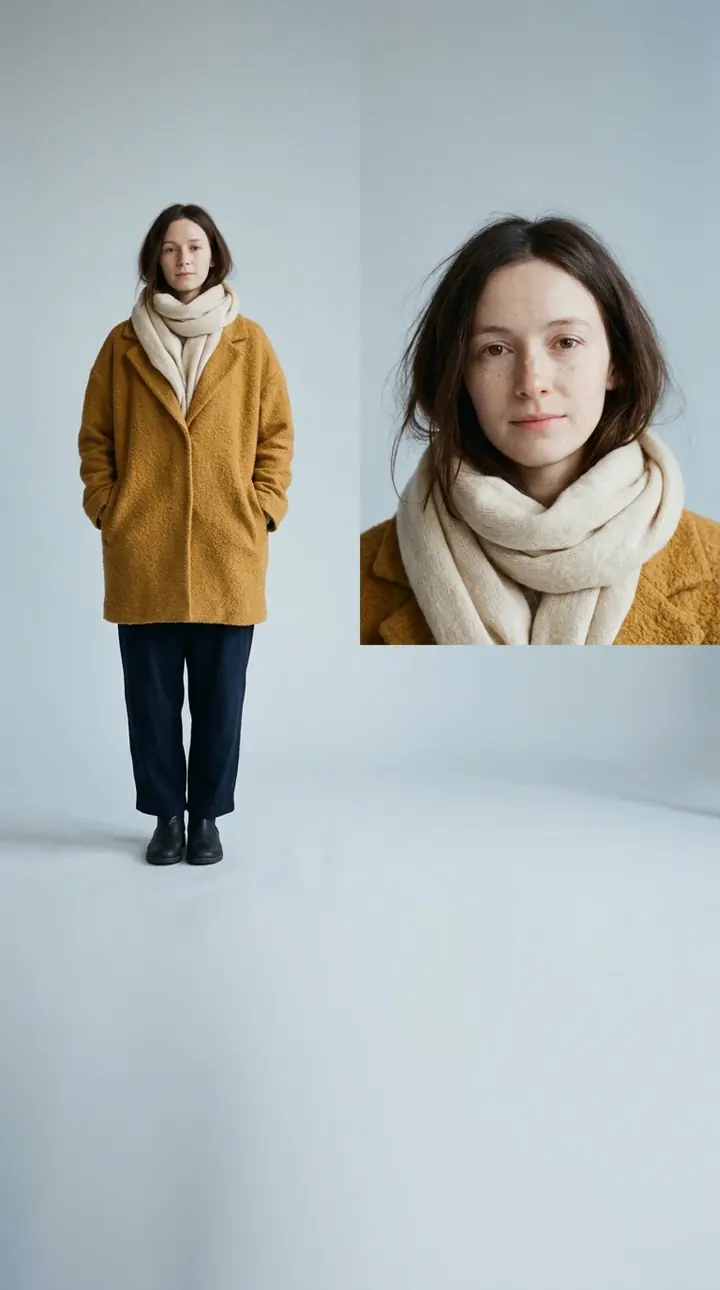
Fabric reacts to light, and the camera exaggerates it. A flat, matte fabric records the same under almost any light; a shiny one changes with every move of the performer and every light on set. Neither is better, but each needs choosing on purpose.
| Fabric | On camera | Suits |
|---|---|---|
| Matte cotton and denim | Holds its color and detail under most light; forgiving | Everyday characters, verses, long takes |
| Wool and chunky knits | Soft texture that reads well in close-ups | Indie, folk, winter stories |
| Velvet | Rich where light hits it, near black in shadow | R&B, night scenes, warm lamplight |
| Silk and satin | Catches every highlight and shows every crease | Ballads, R&B, slow moves under soft light |
| Leather and vinyl | Bright highlights under hard light, deep black elsewhere | Rock, hip-hop, night streets |
| Sequins and metallics | Sparkle that can burn out to white under strong light | Drops, stage looks, one moment of shine |
| Reflective strips | Bounce light straight back toward its source, so they flare in headlights or a light beside the lens | Night riders, workwear, a road at night |
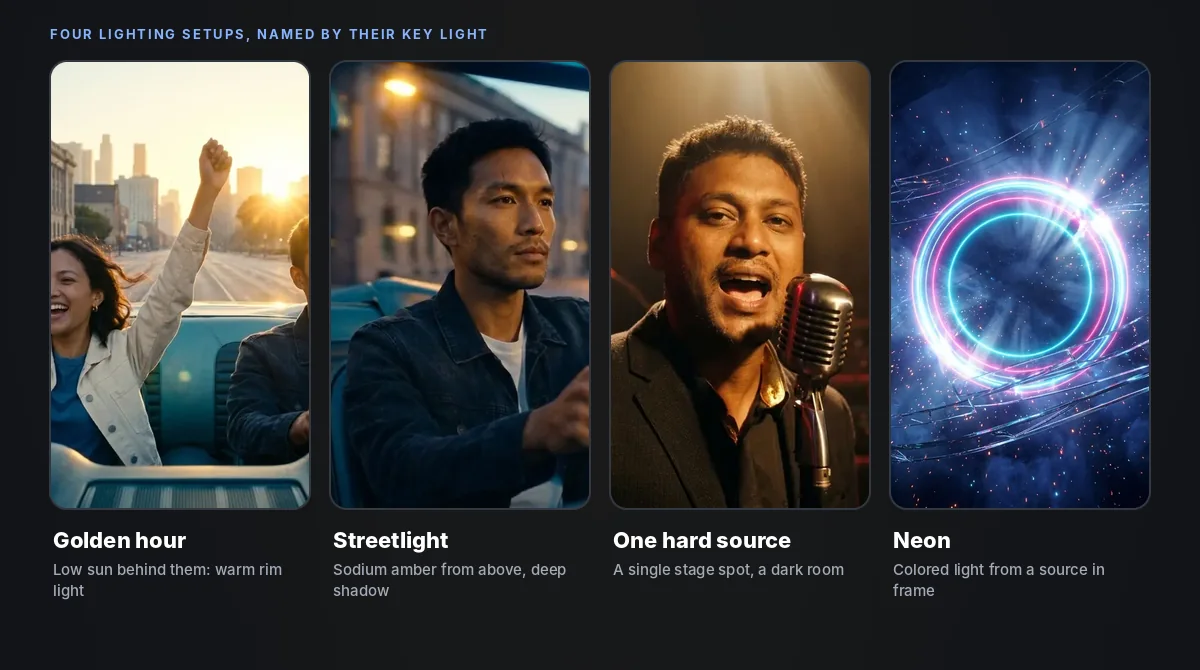
Two extremes need care. Bright white in direct sun can lose every fold and read as a cut-out, and black in shadow merges with the dark around it; cream, ivory, charcoal and deep navy give the camera something to hold on to. The exception is ultraviolet light, where bright white fabric is the point: many whites glow under it, and a test under the real tube shows which ones do. Hard light flatters leather, denim and knits by raking across their texture, while soft light flatters silk and skin, so match the fabric to the lighting setup of the scene it's worn in.
Patterns that strobe, and logos to leave out
Moiré is the shimmer, ripple or rainbow banding that appears when a fine, regular pattern meets the regular grid of a camera sensor, or gets scaled down for a phone screen. The two patterns interfere, and the fabric seems to crawl as the person moves. The same shirt can look fine in a close-up and shimmer in a wide, because the stripes get finer on the sensor as the person gets smaller in the frame.
- Usually trouble: narrow stripes and pinstripes, small checks and houndstooth, tight herringbone, fine mesh and netting, some fine-gauge knits, and narrow-wale corduroy in a wide shot.
- Usually safe: solid colors, wide stripes, large checks and tartans, big florals, chunky knits and wide-wale corduroy.
- Test at the widest framing. Film the outfit at the farthest distance you plan, then watch it at the size it'll be seen. If it crawls, change the outfit; softening it in the edit rarely looks right.
- AI video has its own version. Fine, busy patterns are harder for a video model to keep steady from frame to frame, so solid colors and large shapes hold up better in generated shots too.
Logos and lettering are the other thing to strip out. A big brand logo pulls the eye away from the performer, dates the video, and can cause trouble if the video is ever used in an ad or on TV, where brands often need clearing or blurring. A slogan tee competes with the lyrics, and reads backwards in any mirror shot. Turn it inside out, tape over a small mark, or wear something plain. The same goes for invented things: a team shirt, a uniform or a band jacket reads better with no words on it at all.
One signature piece
A signature piece is the one item a viewer would use to describe the lead afterwards: the yellow raincoat, the white guitar, the oversized hat, the thin gold chain. It does more than any full outfit, because it carries across scenes, across costume changes and across the cover, the thumbnail and the Canvas.
- Make it visible at every size. It should read in a wide shot and fill a close-up. A ring only works if the hands are in the story.
- Give it one color the rest of the video doesn't use. The piece then becomes the accent of the palette, and the eye goes to it in every frame.
- Keep it the same size and in the same place. The same wrist, the same ear, the same length of chain. Viewers notice a change in a small accessory sooner than a change in a whole outfit.
- Let it do something at the end. The jacket lent at the start comes back in the last chorus; the hat finally comes off at the outro. A signature piece can carry the story's last beat.
Continuity across shots and days
Music videos are shot out of order: the last chorus might be filmed first because the light is right, and the verses a week later. Continuity is the work of making the outfit look the same in every shot that's meant to be the same moment. On a small shoot that job usually falls to the artist or a friend, and a few habits cover it.
- Photograph every look front, back and both sides on the first day, with close-ups of jewelry, hair and how the collar and sleeves sit.
- Note which wrist, ear and finger each piece is on, which buttons are done up, and how far the sleeves are rolled.
- Keep each character's look in its own labeled bag, and don't lend pieces between characters or days.
- Buy or borrow doubles of anything that will get wet, torn or stained, so take five matches take one.
- Write down the outfit's state by scene (dry or soaked, clean or muddy, jacket on or off) so scenes shot out of order still match.
- Don't wash, iron, tailor or cut anything between shoot days unless the change is meant to show.
- Photograph hair and makeup as well: a parting on the other side is the change viewers spot first.
- Before wrapping each location, compare the last shot with the first on a laptop or a phone, at full size.
Weather is the continuity problem nobody plans for. A coat worn in sun on day one and in rain on day two is two different coats on screen. Plan the order of the shoot so scenes that cut together are filmed together, and keep the shot list marked with which look each shot needs.
A performer's look across a whole video
Most music videos give the performer one look, and most should. One look turns the performer into a fixed point the story moves around, it costs nothing in continuity, and it makes every frame usable as a thumbnail or a Canvas. Change the light, the place and the people around the performer, and the video moves without a single costume change.
- When a change earns its place. A second look works when it means something (before and after, day and night, the character transformed) and lands on a section change, usually the bridge or the last chorus.
- Keep a thread through the change. The signature piece survives the costume change, so the viewer still knows who they're watching.
- Performance and story can differ. Many videos dress the performance setup one way (a stage look) and the story another (the character's clothes). The cut between the two looks then also tells the viewer where they are.
- Keep the mouth clear for singing shots. No high collars over the chin, no hair across the lips, no microphone or hand covering the mouth in the frames that need to read as singing.
- Count the looks. One for a single-location performance, two or at most three for a three-minute story. Each extra look multiplies the continuity work.

Put your performer in one look
Choose Performance, add one clear, front-facing photo (yours, or someone who agreed) and tick the consent box. Describe the outfit and every accessory in the idea box, and Muvora draws a look sheet from it so the performer wears the same thing in every shot. See how a photo becomes a music video.
Music video outfits by genre
Genres have dress codes, and a video can follow one or bend it on purpose. This table is a starting point for each: the usual direction, colors that tend to work, and the most common mistake.
| Genre | Outfit direction | Colors that work | What to avoid |
|---|---|---|---|
| Hip-hop and rap | Volume and matching: big outerwear, tonal sets, one piece of jewelry worth seeing | Tonal neutrals, black with one bright color | Big brand logos, small busy prints |
| Drill | Dark layered outerwear, gloves, technical fabrics | Black, charcoal, one reflective strip | Symbols or colors tied to real groups |
| R&B | Soft fabrics that move: silk, satin, fine knit, open collars | Champagne, burgundy, chocolate, cream | Stiff, shiny synthetics that glare under lamps |
| Pop | One bold idea: a single strong color or a coordinated group | Saturated primaries or a set of pastels | Outfits the same color as the set |
| EDM and club | Fabric as light: sequins, metallics, white under ultraviolet | Black with silver, or white | Fine mesh that shimmers, dull dark fabric that vanishes |
| Rock and metal | Worn leather, black denim, boots, one heavy accessory | Black, off-white, one red | Black against black with no light on the edges |
| Punk | Homemade: pins, patches, bleach, cut-up tees, tartan | Black, white, red, a loud tartan | Real band patches and brand logos |
| Country | Denim, boots, felt or straw hats, snap-button shirts | Denim blues, rust, tan, cream | Hat brims that shade the eyes in midday sun |
| Indie and folk | Secondhand: knits, corduroy, linen, a mended elbow | Oatmeal, moss, mustard, rust | Narrow-wale corduroy and tight herringbone in wide shots |
| Lo-fi and bedroom pop | Comfortable: oversized hoodies, cardigans, socks, a beanie | Dusty, muted, sun-faded colors | Neon brights that fight the soft look |
| Gospel and choir | Matching robes or a shared color for the whole group | Deep blue, burgundy, gold accents | Pure white robes in direct sun |
For the looks around these outfits, the idea guides by genre go further: rap, country, EDM and 80s among them, and Muvora's hip-hop and rock pages show the genre looks that set the pace of the cuts.
How Muvora keeps a character's outfit the same in every shot
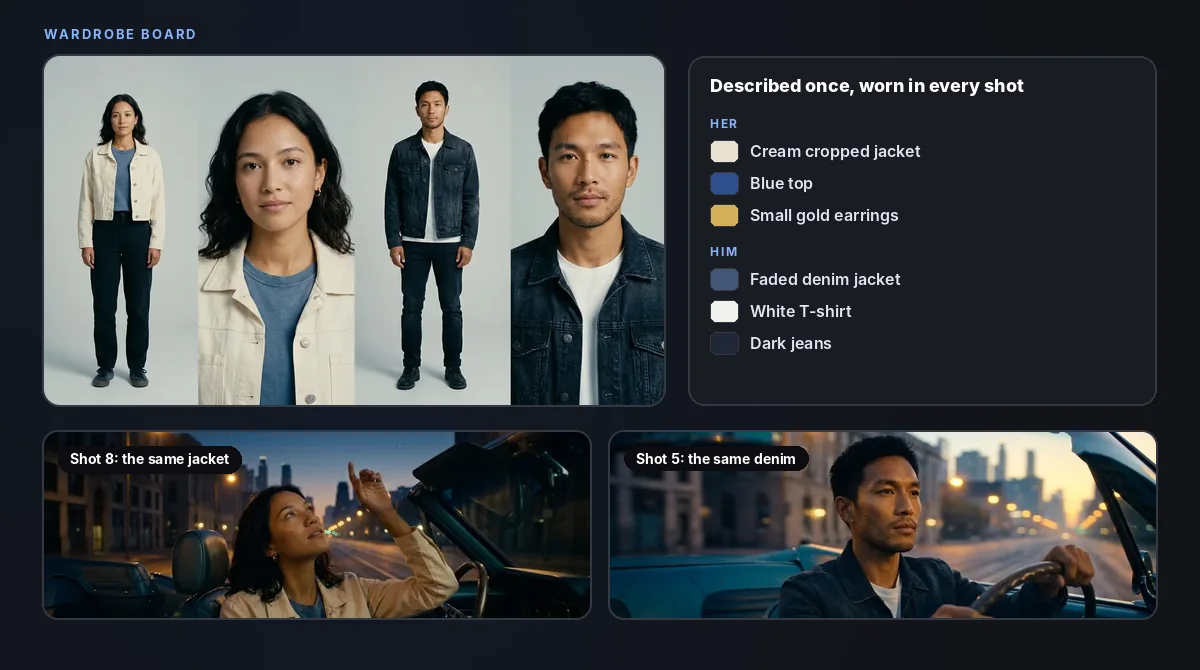
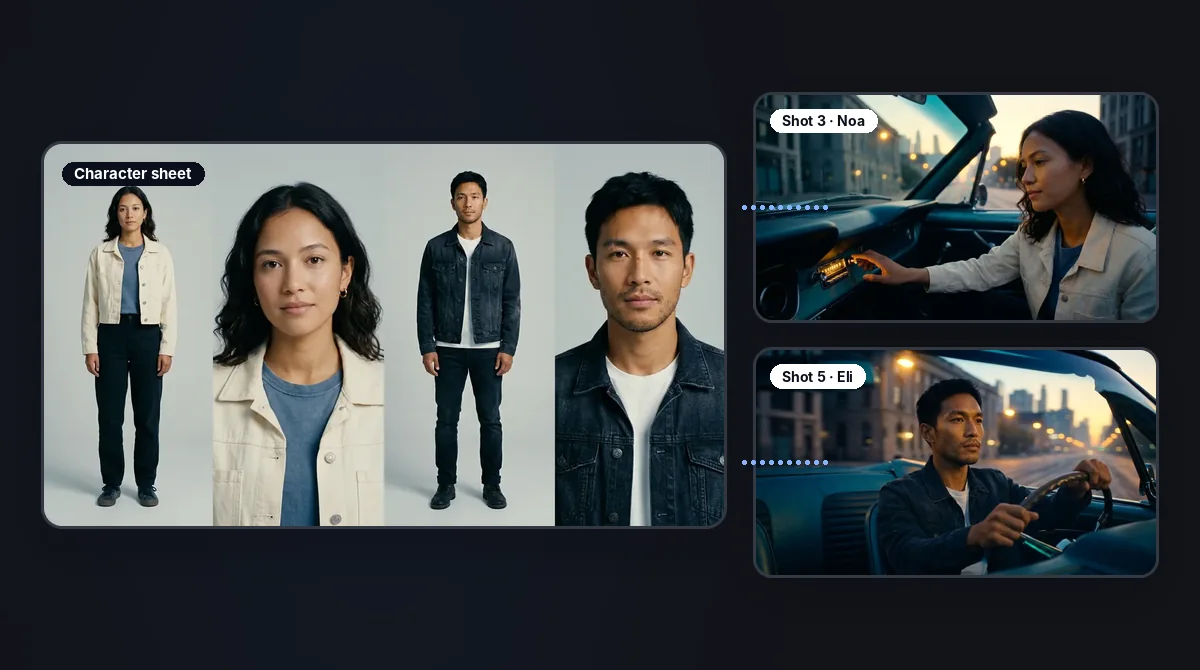
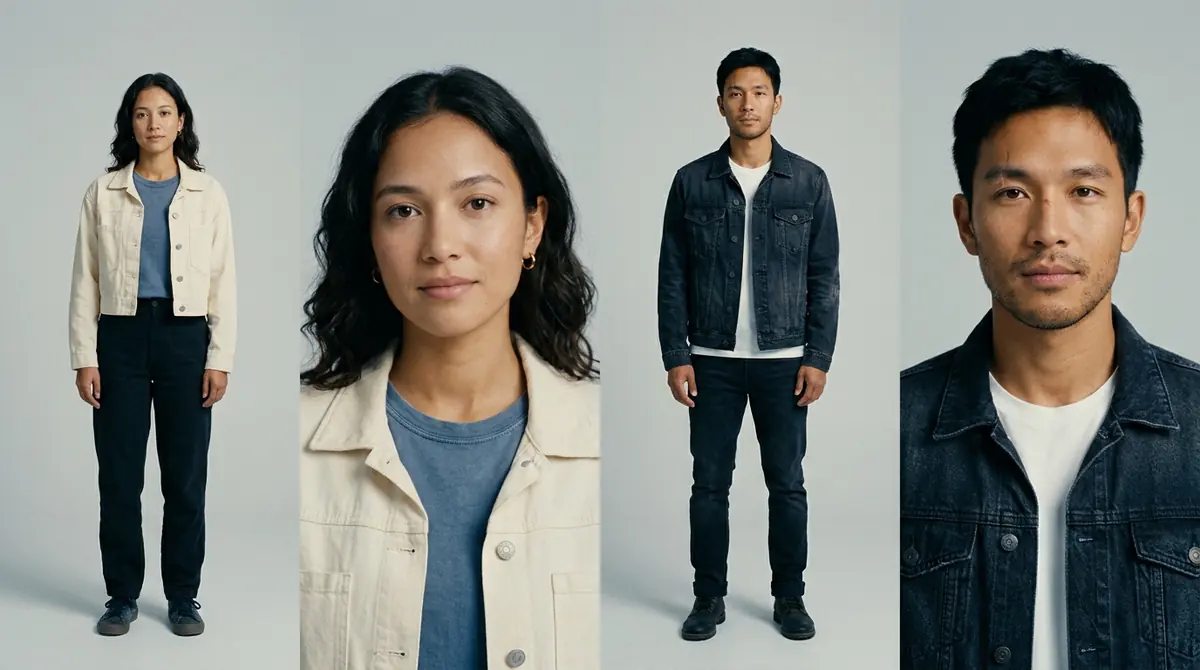
In an AI video, a costume that changes between cuts is the quickest giveaway, so Muvora treats wardrobe as part of the character. The AI director casts a small group (up to three characters) and writes each one once in the brief, as a short line of how they look and what they wear in this video. That same line goes word for word into the prompt of every shot that shows them. Before you pay for anything, a character sheet is drawn from those words: the cast on plain gray, full length and close up, up to two characters on the sheet.
When the video renders, every shot of a character starts from a keyframe drawn with the sheet as its reference, and an AI check compares that frame with the sheet: the same face, the same clothes, the same accessories. A frame that drifts is drawn again. In a Performance video, the performer's photo gives the face, and the director writes the performer's look (what they wear, and every accessory and its size) into the brief; a look sheet of the performer in that outfit is drawn from the photo, and every shot of the performer is drawn from both.
- Describe the wardrobe before the storyboard is written. Put it in the idea box when you upload. The sheets are drawn once: editing a description later changes the shot prompts but not the sheet.
- Name the cut, color and material of each piece. “A cropped cream bomber jacket” rather than “a nice jacket”.
- Give every accessory a size and a side. “A thin gold chain, small silver hoops in both ears” keeps jewelry from growing or moving between shots.
- Make two characters look different. Different colors and different outlines help the viewer, and give each character a distinct entry on the sheet.
- Leave out brands, designers and words. Describe the garment itself; no logos or lettering are drawn.
| Instead of | Write | Why it works |
|---|---|---|
| “Streetwear” | “A black oversized puffer, gray cargo pants, white sneakers, one small silver hoop in the left ear” | Every piece named, with its color and size |
| “A designer suit” | “A cream double-breasted suit over a black turtleneck, cream loafers” | A cut and colors the AI can draw; no label needed |
| “Cool jewelry” | “A thin gold chain at the collar and a heavy silver ring on the right hand” | Size and position keep it the same in every shot |
| “Two friends” | “Noa in a cream cropped jacket over a blue top; Eli in a faded denim jacket over a white tee” | Two looks a viewer can tell apart at once |
| “A band in matching outfits” | “Four players in dark red marching jackets with brass buttons over black tees” | One shared piece reads as a band |
The check looks at the first frame of each shot; in the seconds of motion after it, small things can still slip, especially hands, fast turns and jewelry. That's what the review page is for: re-roll a shot that slipped, edit its prompt first if you like, and make a new version of the video for free. The consistent characters page explains the whole process, and the music video prompt generator shows how a character's description sits inside a shot's prompt.
Start with two dressed characters
This button opens the upload with two characters already dressed in the idea box. Change the clothes to your own, then let the AI director write the storyboard around them. The free plan makes 5 new storyboards a month.
Written by the Muvora team. Last updated November 16, 2026. Spotted something out of date? Tell us at [email protected].