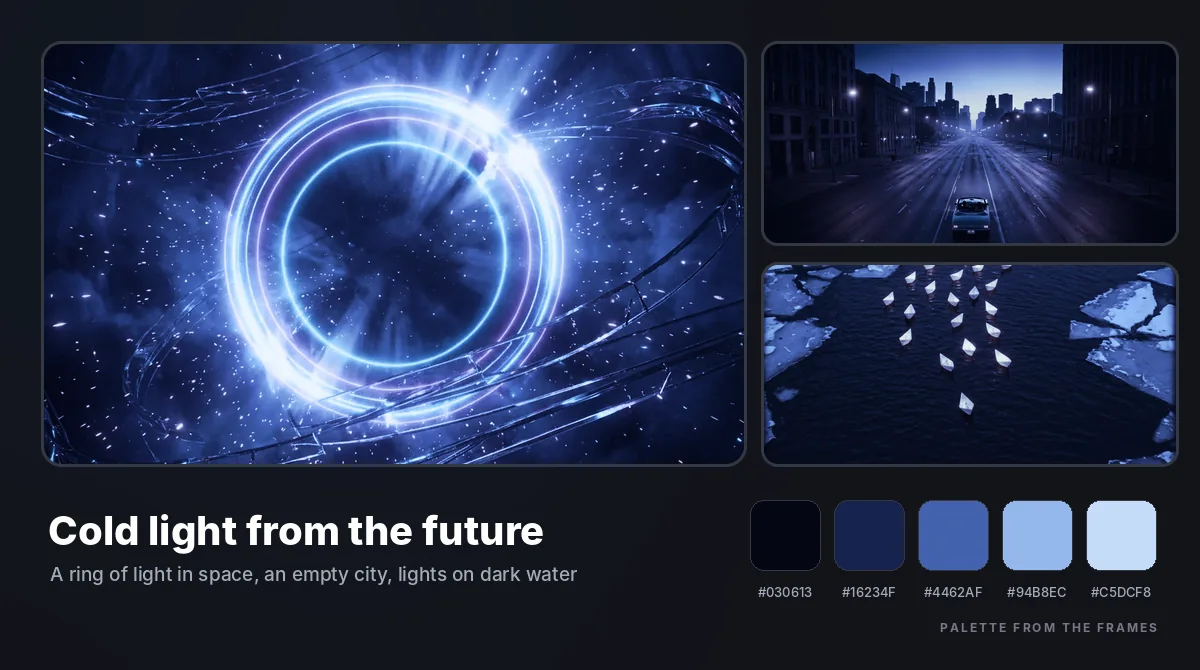
The short answer
Good sci-fi music video ideas change one thing about a familiar world and follow a person through it: a night technician at a radio telescope hears a signal in the song's rhythm, a clinic lets a woman relive one summer, a lounge singer performs on a moon base. Light it from practical sources, keep screens and signs free of words, and let each chorus reveal more of the future.
- Change one thing about a world the viewer knows, and follow one person through it.
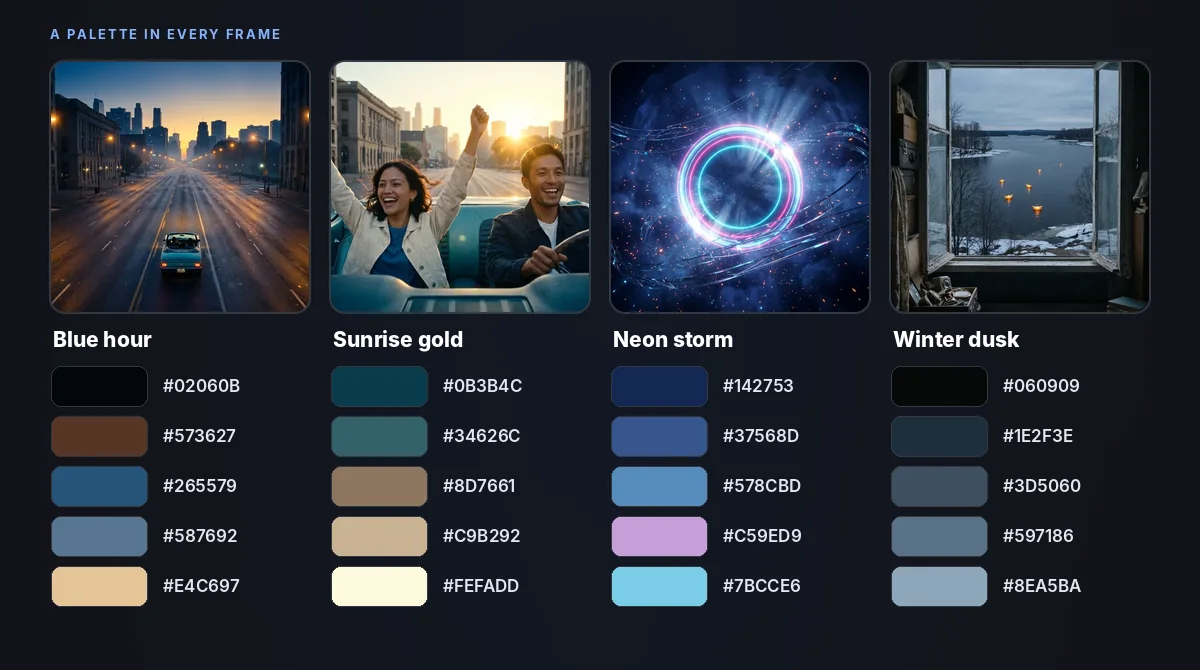
- Practical light sells the future: fluorescent tubes, monitor glow, headlights, a hard sun with no air.
- Muvora draws no lettering, so screens show shapes and signs are neon shapes, never words.
- Skip the computer-made clichés: glowing particles, lens flares and god rays read as generated.
- Give the lead one strong costume so they stay recognizable from shot to shot.
On this page (8 sections)ShowHide
- 1.What makes a sci-fi music video work
- 2.Five kinds of sci-fi, and the light behind each
- 3.Near-future and first-contact ideas
- 4.Space, stations and other worlds
- 5.Retro futures, neon cities and drawn worlds
- 6.The future without a word on screen
- 7.A sci-fi song, section by section
- 8.From a sci-fi idea to a storyboard
- Questions
What makes a sci-fi music video work
The sci-fi videos that hold up are rarely about technology. They take one idea (a signal, a machine that stores memories, a city that never sleeps) and show what it does to a person. A music video has three or four minutes and no dialogue, so that idea has to read from the pictures alone.
- One what-if. Pick a single change to the world and keep everything else familiar. A diner on the moon is stranger than an alien diner, because the viewer already knows how a diner should feel.
- Places that almost exist. Observatories, radio telescopes, server halls, desalination plants, wind farms at night, airport tunnels, empty concrete plazas. Real architecture already looks like the future, and an image model draws it convincingly.
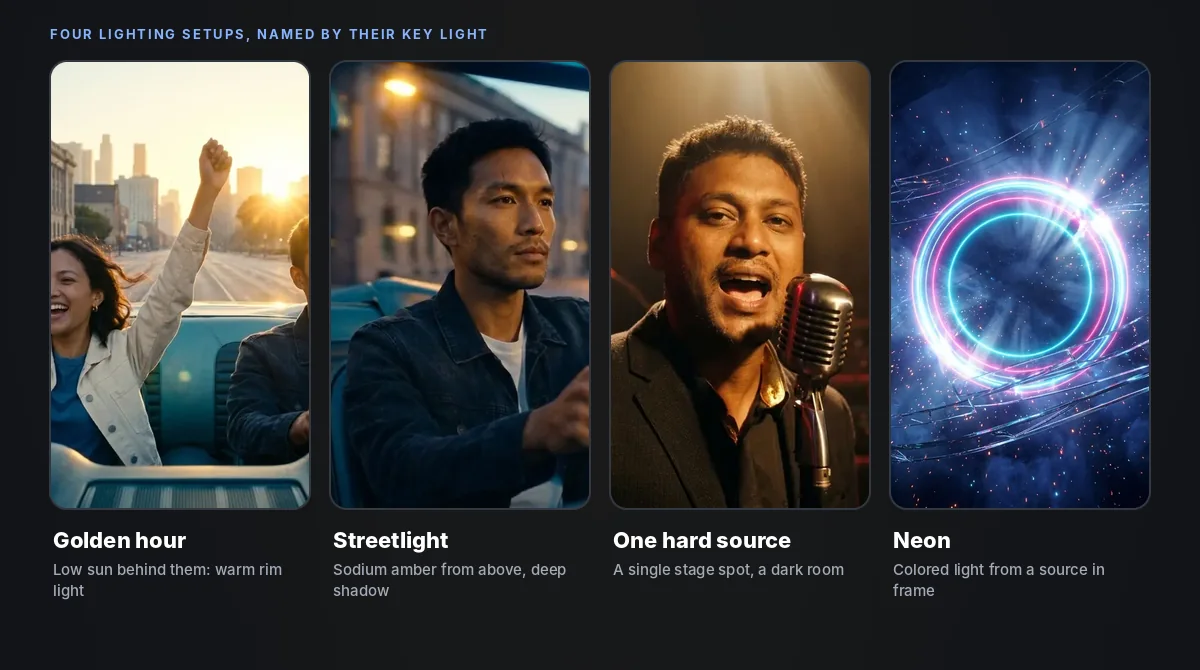
- Practical light. Fluorescent tubes, a monitor's glow on a face, a rover's headlights, a sodium lamp, hard white sun and black shadow where there's no air. Light from things in the scene makes a future look shot rather than rendered.
- Props without words. Consoles with blank or abstract screens, a suit with no patches, an unnamed ship, a map drawn in glowing lines. Color and shape do the job labels usually would.
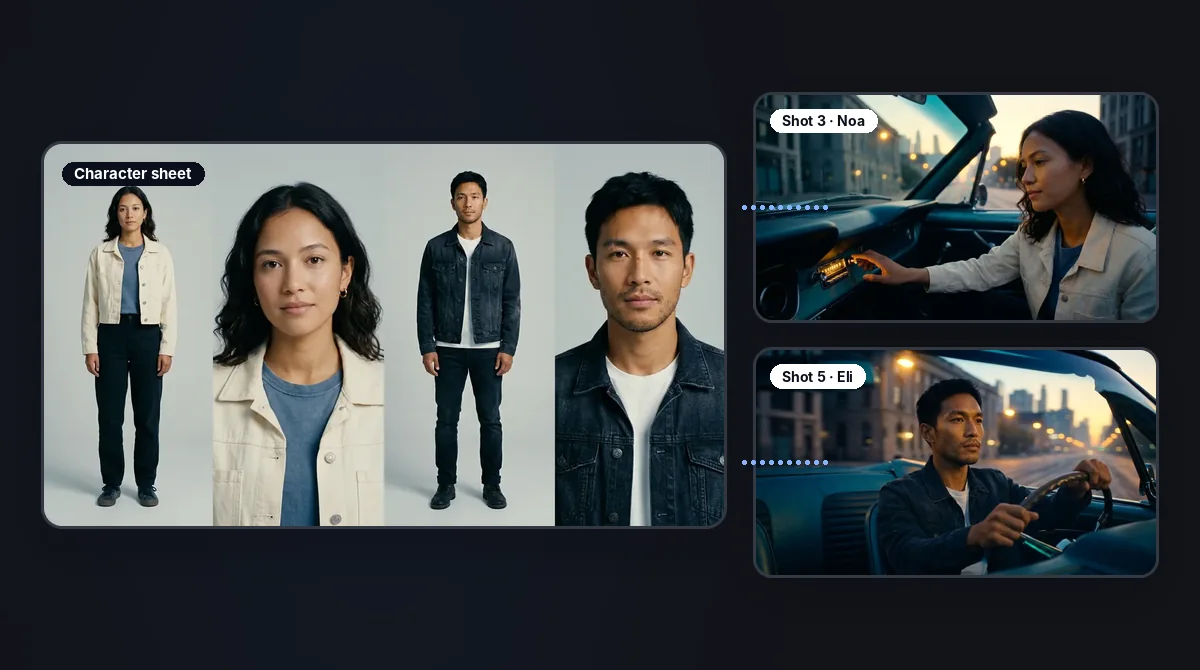
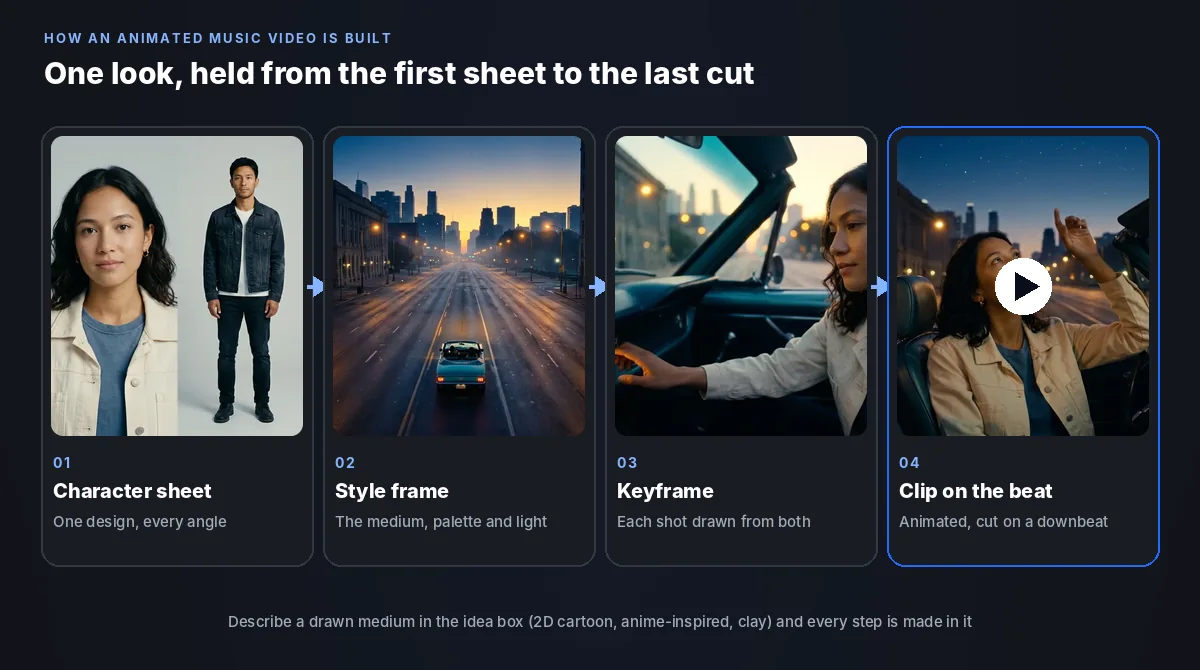
- A silhouette for the lead. One costume that reads from across a room: an orange flight suit, a white coat with a high collar, a silver jacket. Muvora draws a character sheet from it and checks each keyframe of that character against the sheet.
Five kinds of sci-fi, and the light behind each
Sci-fi covers a lot of ground. Deciding which kind your song belongs to settles the places, the palette and the light before you write a word of the idea.
| Kind | Places | Light and palette | Suits songs that are |
|---|---|---|---|
| Near future | Clinics, labs, radio telescopes, ordinary streets with one new thing in them | Clean daylight, fluorescent tubes, cool whites with one accent color | Reflective, uneasy, hopeful |
| Space and other worlds | Stations, moon bases, cockpits, alien deserts | Hard sun and black shadow, console glow, deep blues and warm metal | Vast, lonely, romantic |
| Retro future | World's fairs, chrome diners, mainframe halls, domed homes | Bright pastel daylight or warm tungsten, chrome and candy colors | Playful, nostalgic, upbeat |
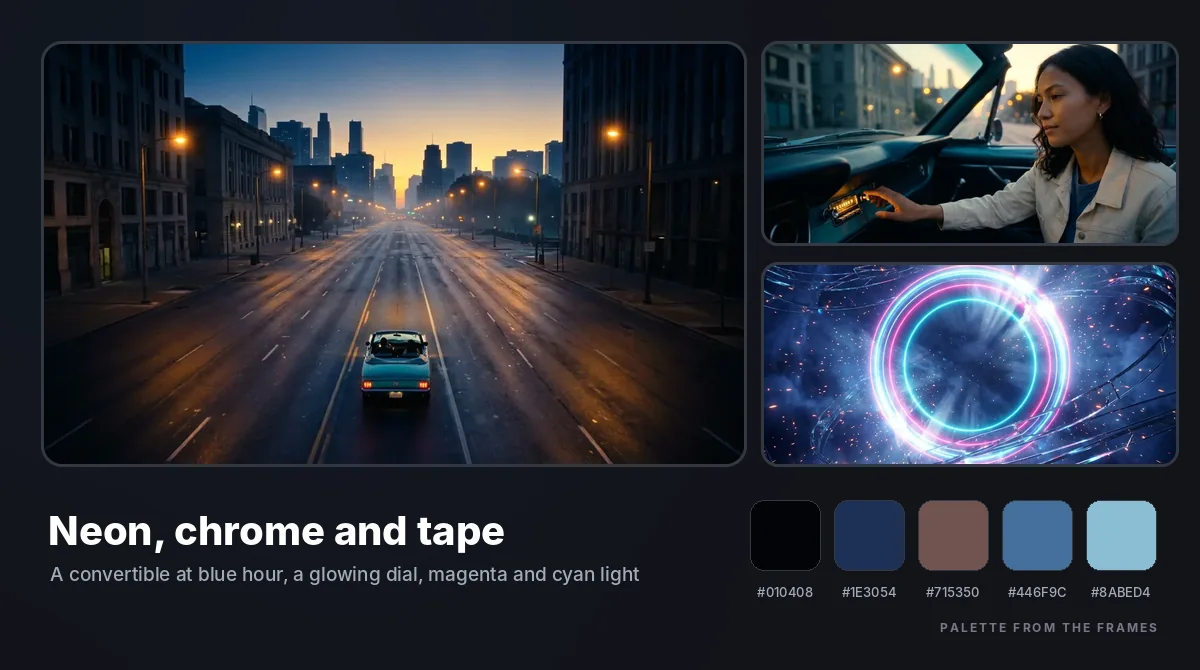
| Neon city | Overpasses, night markets, rainy alleys, a megacity's rooftops | Neon tubes bent into shapes, wet asphalt, magenta, cyan and sodium orange | Driving, dark, electronic |
| After the end | Overgrown cities, empty highways, abandoned malls | Soft overcast, green light through leaves, sun-bleached colors | Elegiac, defiant, quietly hopeful |
Electronic tracks often belong in the neon city or in space, and synth-led songs in the retro future: the synthwave music video maker and the 80s music video ideas go further into neon and chrome. A slow, sad song can live in any of the five, because sci-fi doesn't have to be loud. Whichever you pick, music video color palettes shows how to hold its colors steady across a whole song.
Skip the blank page
Upload your song and Muvora's AI director plans a shot-by-shot storyboard on the beat. Edit every shot for free, and pay only if you render.
Near-future and first-contact ideas
These five keep one foot in the present. The settings are ordinary or nearly so, and the strange part arrives slowly, a little more of it each chorus.
- Story · radio telescope · first contact
Night shift at the dish
A night technician alone at a radio telescope in the desert, the huge dish turning under the stars, coffee going cold by the consoles. Verses are her routine: a flashlight walk under the dish, a late sandwich. Each chorus the signal on her monitor pulses in the song's rhythm and the dish's lights blink back. On the last chorus a soft light crosses the sky and stops above her.
Use this idea on my songUse this idea on my song - Story · near future · one summer
The memory clinic
A clinic with white walls where you can relive one memory for an hour. The lead, a woman in her sixties, lies back in a reclining chair. Each chorus she's inside the memory: a summer beach thirty years ago, warm and grainy like old film. Verses return to the clean, cold clinic. On the last chorus she ends the session early and walks out into real rain, smiling.
Use this idea on my songUse this idea on my song - Story · time loop
The same evening
A young man lives the same rainy evening at a bus stop again and again: the same puddle, the same flickering shelter light, the same woman running for the same bus. Each chorus he tries one thing differently and the loop resets. In the bridge he stops trying and simply talks to her. On the last chorus they both miss the bus, and the night finally moves on.
Use this idea on my songUse this idea on my song - Story · homebuilt machine · hope
Test flight at dawn
An engineer and her younger brother build a flying machine in a barn beside a desert airstrip: welding sparks, a patched wing, coffee on an engine block. Verses are the work and the failed hops. Each chorus it lifts a little higher off the runway. On the last chorus it clears the ridge as the sun comes up, her brother running beneath it and waving.
Use this idea on my songUse this idea on my song - Story · comedy · 1950s suburb
The new neighbors
A tidy 1950s suburb of pastel houses and perfect lawns. A family of tall, pale-blue aliens moves in next door to the lead, a nosy man in a cardigan, and tries hard to fit in: a lawn mowed far too fast, a floating barbecue, a hovering car. Each chorus they get better at it. On the last chorus the whole street eats at their table under the stars.
Use this idea on my songUse this idea on my song
Try a sci-fi idea on your song
Press “Use this idea on my song” under a concept and upload the track. Muvora maps the tempo, the sections and the drops, writes a storyboard with a shot for every slot and draws style frames of your future before a credit is spent. The free plan includes 5 new storyboards a month.
Space, stations and other worlds
Space is where sci-fi music videos usually start, and where they most often slide into stock imagery. These five avoid that by staying with people and places at a human scale: a lounge, a relay hut, a window seat. Two use the Performance style, which lip-syncs you from one clear, front-facing photo (with the consent box ticked) wherever the song is sung.
- Performance · moon base · retro
Lunar lounge
A small 1970s-style lounge on a moon base: orange swivel chairs, warm lamps, a curved window with the Earth hanging in the black. The singer performs on a low stage, close in the lamplight. Between her lines, miners at the bar watch a dropped glass drift slowly to the floor. Each chorus the Earth rises higher in the window. On the last chorus the whole lounge gently lifts off.
Use this idea on my songUse this idea on my song - Performance · relay hut · lonely planet
Broadcast home
The singer alone in a relay hut on a cold, rocky planet, singing into an old microphone as if broadcasting home, a heater glowing at her feet and amber console lamps on her face. Between her lines: dust blowing past the window, a ringed planet low in the sky, the hut's single antenna. Each chorus the storm outside eases. On the last chorus a ship's lights answer from the dark.
Use this idea on my songUse this idea on my song - Story · two crew · closing down
Last shift on the station
The last two crew members close down an old space station before it's abandoned. Verses are the packing: unplugging racks, tying down floating bags, a last meal at the table they've shared for years. Each chorus they switch off another module and the station grows darker behind them. On the last chorus they undock and watch it from their capsule window as sunrise crosses it.
Use this idea on my songUse this idea on my song - Lyric · no people · launch
Window seat to orbit
Karaoke-style captions over the view from a spacecraft window as it climbs from the launch pad to orbit. Verses are the ground falling away: the pad, the coast, the clouds. Each chorus the sky darkens further and the horizon curves. The bridge is the first sunrise seen from above the atmosphere, and the last chorus drifts past the moon, gray and close.
Use this idea on my songUse this idea on my song - Abstract · no people · brass
The orrery
A giant brass orrery in a dark observatory, planets of polished stone on long arms circling a single lamp that stands in for the sun. Each section follows a different planet around its orbit, with close-ups of gears and rings turning. Through the build the arms speed up. On the drop every planet aligns in one line through the lamp, then the arms swing apart for the next section.
Use this idea on my songUse this idea on my song
Two things to plan for in space. The face has to stay visible for lip sync, so write the singer with the helmet off or the visor up in the sung shots, since a closed visor can hide the mouth. And keep spacewalks, floating hair and drifting objects to a few shots each: weightlessness reads well in one shot, but a whole video of it gets hard to follow.

Retro futures, neon cities and drawn worlds
The future as it used to be imagined is a look of its own: chrome, domes, pastel plastics and blinking computers. The neon city is its nighttime cousin. These five also show the other way into sci-fi: name a drawn medium in the idea box (an airbrushed paperback cover, anime, a comic) and the whole video is made in it.
- Story · retro future · world's fair
Home of tomorrow
A couple on a date at a 1960s-style world's fair of the future: a monorail gliding between white domes, a model home with a robot butler and a kitchen that cooks by itself, pastel crowds in the distance. Verses are the pavilions; each chorus brings a new marvel, bigger than the last. On the last chorus they ride the monorail home as fireworks burst over the domes.
Use this idea on my songUse this idea on my song - Story · neon city · night market
Under the flyover
A night market under a megacity flyover in the rain, stalls lit by neon tubes bent into shapes (a fish, a moon, a hand, never words), steam rising from food carts. The lead, a courier in a yellow rain cape, weaves through on a scooter with a package she mustn't open. Each chorus her pursuers get closer. On the last chorus she opens it on a rooftop: one green seedling.
Use this idea on my songUse this idea on my song - Story · after the end · hopeful
The green city
Decades after everyone left, a city is overgrown: vines up the towers, deer on the avenues, a lake where the stadium was. The lead cycles through it with a dog in her basket, collecting spare parts. Each chorus she finds traces of someone else: smoke from a chimney, a mended bridge, washing on a line. On the last chorus a dozen people share a long table in a rooftop garden.
Use this idea on my songUse this idea on my song - Story · drawn · 70s paperback art
Airbrushed frontier
Painted like an airbrushed 1970s science-fiction paperback cover, all smooth gradients and glossy chrome: an explorer in a white suit crosses a desert of glass dunes under two moons toward a city of crystal spires. Verses are the long crossing, the suit reflected in the dunes. Each chorus the city is closer and stranger. On the last chorus its gates open onto a sunrise.
Use this idea on my songUse this idea on my song - Abstract · retro computer · no people
Mainframe hall
A 1960s mainframe hall at night with nobody in it: rows of cabinets with blinking lamps, tape reels spinning behind glass, a printer feeding out blank paper, cool fluorescent light on a speckled floor. Verses glide slowly along the aisles. Through the build the reels spin faster and the lamps race. On the drop every lamp in the hall lights at once, then all go dark but one.
Use this idea on my songUse this idea on my song
For more drawn futures see the anime music video ideas and the anime music video maker; for chrome and pearly 2000s tech, the Y2K music video ideas.
The future without a word on screen
Sci-fi leans on text more than any other genre: control panels, ship names, warning labels, floating readouts, a countdown. Muvora draws no lettering inside its pictures, so each of those is shown another way. That suits a music video anyway, since a viewer has no time to read a console in a two-second shot.
- Screens show shapes. A waveform, a slowly turning planet, a grid of colored squares, a map of glowing lines. Ask for “a monitor showing a pulsing green waveform” rather than a readout.
- Signs are neon shapes. A city's signs become tubes bent into a fish, a moon or a hand, which reads as futuristic and keeps the frame clean.
- Countdowns are lights. A row of lamps going out one by one, a ring of light closing, a door seal turning from red to green.
- Suits and ships go unmarked. No patches, flags or names; one strong color identifies a crew or a ship instead.
- Captions come afterwards. In the Lyric style the words are added over the pictures, timed to the vocal, so the lyrics can still be on screen.
A sci-fi song, section by section
Most sci-fi concepts are reveals: the viewer learns a little more about the world each time the chorus comes round. Map the reveals onto the sections and the video builds by itself. Here is “Night shift at the dish” laid over a typical song.
| Section | What the viewer learns | Shot ideas | Light |
|---|---|---|---|
| Intro | Where we are | The dish turning under the stars, the control room's one lit window | Moonlight and a single monitor |
| Verse 1 | Who she is | Her routine: the flashlight walk, the cold coffee, her feet up on the desk | Fluorescent strip, monitor glow |
| Chorus 1 | Something is out there | The signal pulsing in the song's rhythm, her face lit green by it | The monitor brightening |
| Verse 2 | She isn't imagining it | Recording the signal, a phone in her hand she doesn't use, checking the sky | The dish's red marker lights |
| Bridge | The turn | The dish's lights blinking back on their own | Every marker light pulsing at once |
| Last chorus | Contact | A soft light crossing the sky and stopping above the dish | The whole desert lit from above |
| Outro | What it meant | Dawn: the dish still, her asleep at the console, the screen calm | First daylight |
The pace follows the music, not the setting: the EDM look cuts quicker for a driving synth track, lo-fi holds shots longer for an ambient one, and a song with no look gets a steady cut on the bar. Every section change and every drop is a cut whichever you choose, and each drop gets a short white flash, a natural moment for the signal to answer or the engines to fire.
From a sci-fi idea to a storyboard
- 01
Choose the kind of future
Near future, space, retro future, neon city or after the end. That one choice settles the places, the light and the palette.
- 02
Upload the song
Upload the finished track (MP3, WAV, M4A, AAC or FLAC, up to 8 minutes and 60 MB) and confirm you have the rights to it. The free analysis finds its tempo, sections and drops; paste your lyrics so the director reads what the song is about.
- 03
Pick a style and a look
Story for a crew or a lone explorer, Performance to sing on screen from one photo of you, Abstract for machines and planets with no cast, Lyric for the words over the view. EDM suits a driving synth track and lo-fi an ambient one.
- 04
Write the world into the idea box
In up to 600 characters: the what-if, the main places, the light sources, the lead's costume, what each chorus reveals and what happens on the drop. Name the medium first if the world is drawn.
- 05
Check the brief and the style frames
Read the brief's look and palette, then judge the establishing and hero frames: do they read as the future without a single word on screen? Rewrite any shot that drifts toward glowing particles or a readout.
- 06
Render and keep the crew consistent
Check the exact price and generate. Re-roll any shot where a costume or a ship changes shape, then post the video, the vertical and square versions and the Canvas loop.
Sci-fi rewards detail, so the quality matters more than usual. Visualizer, at 38 credits a second, is the affordable way to cover a whole song; Standard, at 60, keeps a crew's faces and suits steadier across many locations; Cinematic, at 110, is made at 1080p and draws the most detail into a control room or a city at night. A Performance video's sung seconds are 75 credits each, and the exact price shows before you render.
Recurring characters across a long story are covered on the consistent character music video page, and music video lighting explains lighting from sources in the scene. Club tracks with a neon setting pair well with the dance music video ideas and the EDM look; rain-soaked, shadowy futures sit beside the dark music video ideas. For every other genre and mood, start at music video ideas.
Music video prompt generatorBuild one shot's image and motion prompts from its framing, subject, action, place, light and camera move. It flags poses, clichés and lettering, which keeps a sci-fi shot from drifting into stock imagery.Build your song's future
Upload the track, paste the concept you liked and read a free storyboard of your world, cut on the downbeats with a flash on every drop. Change any shot for free and render when the future looks right.
Written by the Muvora team. Last updated November 18, 2026. Spotted something out of date? Tell us at [email protected].