The short answer
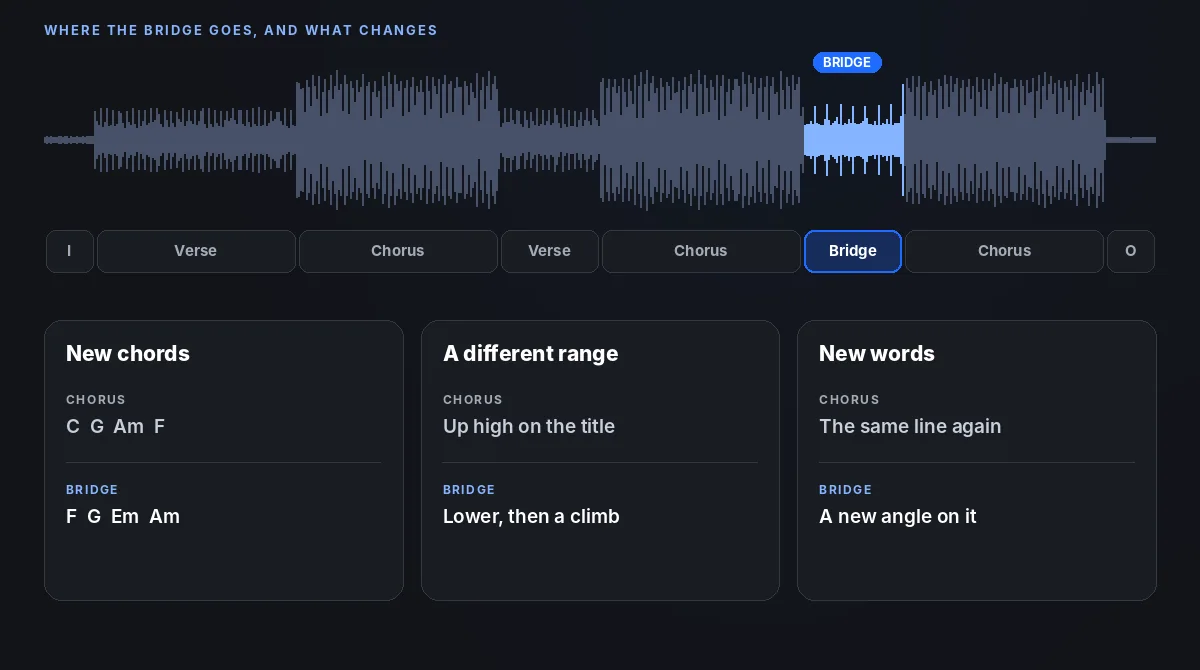
A bridge is a contrasting section, often 4 to 8 bars, that usually comes after the second chorus and leads into the last. To write one, change what the song has repeated: start on a chord it hasn't leaned on, such as IV or vi, move the melody into a new range or rhythm, give the lyric a new angle, and end on a chord that leads home.
- A bridge exists to make the last chorus feel new, so judge it by what comes after it.
- Change one or two things, not everything: the chords, the range, the rhythm or the point of view.
- Start away from home and end on the V chord, a held bass note or a pause that points back.
- The lyric turns: a time jump, a new speaker or a confession, never a third verse in disguise.
- If the song already lifts enough, a breakdown or a key change can do the bridge's job.
On this page (9 sections)ShowHide
- 1.What a bridge does
- 2.Where the bridge goes and how long it runs
- 3.How to write a bridge in seven steps
- 4.Chords: start somewhere the song hasn't been
- 5.Melody and rhythm: move the song somewhere new
- 6.Lyrics: turn the story
- 7.Lead back into the last chorus
- 8.When a song doesn't need a bridge
- 9.Let the video turn at the bridge
- Questions
What a bridge does
By the end of the second chorus, a listener knows the song: the verse's chords and tune, the chorus's hook, the way one leads into the other. A third pass through the same material risks sounding like a rerun. The bridge interrupts that. It brings something the song hasn't offered yet, a new chord, a new range, a new rhythm or a new way of seeing the story, and then hands back to the chorus, which now sounds like a return rather than a repeat.
| Section | How often it comes | What changes | Its job |
|---|---|---|---|
| Verse | Two or three times | The words, over the same music | Tells the story |
| Pre-chorus | Before each chorus | Little: it repeats | Points at the chorus every time |
| Chorus | Two to four times | Little: perhaps a last line or the key | Delivers the hook |
| Bridge | Usually once | Chords, melody, rhythm or the lyric's angle | Breaks the pattern so the last chorus lands |
| Breakdown | Once or twice | The arrangement thins out; the chords often stay | Lowers the energy before a lift |
| Solo or instrumental | Usually once | An instrument takes the voice's place | Contrast without new words |
Two other names come up. In Britain a bridge is often called the middle eight, after its usual place in the middle of the song and its usual length of eight bars. In the 32-bar AABA form of jazz standards and older pop, the B section is called the bridge or the release. In hip-hop, where "the hook" means the chorus, a sung section between the last verse and the last hook often does the bridge's job. Song structure explained maps every section in the common forms.
Where the bridge goes and how long it runs
- After the second chorus: verse, chorus, verse, chorus, bridge, chorus. The most common spot, because by then the listener has heard the main material twice.
- In place of a third pre-chorus: verse, pre-chorus, chorus, verse, pre-chorus, chorus, bridge, chorus. The bridge sits where a third climb would have gone.
- In AABA form: after two A sections and before the last A, so the song's middle is its contrast.
- Before a last double chorus: many songs follow the bridge with two choruses, the first stripped back and the second full.
- In dance music: the breakdown in the middle of a track does much of a bridge's job, pulling back before the last build and drop.
Bridges are often 4 or 8 bars, sometimes 16. "Lighthouse Hours", the example song, runs at 96 BPM, where a bar lasts exactly 2.5 seconds, so an 8-bar bridge takes 20 seconds. That's long enough to feel like a place of its own and short enough that the last chorus comes before the listener wonders where the song went. A bridge much longer than a chorus usually needs a reason, such as a solo or a story that has more to say.
Song structure builderLay out your song in bars at its tempo to see where the bridge starts, how long it runs in seconds and how the whole song adds up.Skip the blank page
Upload your song and Muvora's AI director plans a shot-by-shot storyboard on the beat. Edit every shot for free, and pay only if you render.
How to write a bridge in seven steps
- 01
List what the song repeats
Write down the verse and chorus chords, the melody's highest and lowest notes, how many words a line usually has and whose point of view the lyric takes, so you know exactly what the bridge can change.
- 02
Choose one or two things to change
Pick from the chords, the range, the rhythm and the lyric's angle. Changing everything at once sounds like a different song; changing one or two sounds like the same song turning a corner.
- 03
Pick the first chord
Start on a chord the verse and chorus don't start on, often IV, vi, ii or iii, and play it straight after the end of the second chorus to hear whether the change is clear.
- 04
Find the melody in a new place
Sing over the bridge chords starting lower or higher than the chorus, with phrases longer or shorter than the verse's, and keep the version that sounds least like anything before it.
- 05
Write the lyric turn
Decide what the bridge adds to the story, such as a jump in time, a new speaker, a confession or a reversal, and say it in two to four lines.
- 06
Build the way back
End the bridge on the V chord, a held bass note, a beat of silence or a rising line, so the last chorus arrives exactly on its downbeat.
- 07
Play it in context
Record the second chorus, the bridge and the last chorus as one take, and listen for whether the last chorus sounds fresher than the second one did.
Chords: start somewhere the song hasn't been
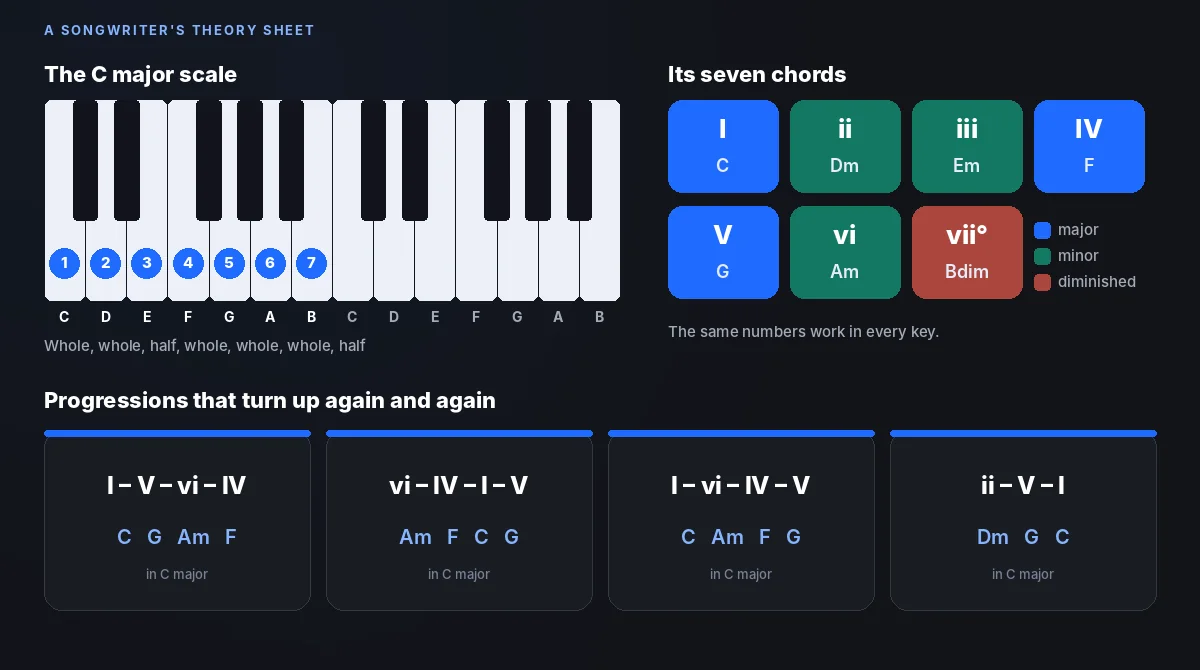
"Lighthouse Hours" is in C major, and like a lot of pop its verse and chorus share four chords: the verse loops Am–F–C–G (vi–IV–I–V) and the chorus C–G–Am–F (I–V–vi–IV). After two choruses, those four are all the listener has heard, so even one new chord stands out. Each row below is a different way out of that loop and back, written for this guide; the first is the bridge in the picture at the top.
| Move | Chords | Numerals | What it does |
|---|---|---|---|
| Start on IV, bring in iii | F–G–Em–Am | IV–V–iii–vi | E minor is the one chord the song hasn't played yet; ending on A minor makes the chorus's C sound like a lift |
| Climb by step | Dm–Em–F–G | ii–iii–IV–V | Rises a chord at a time and stops on G, the V, which wants the C of the chorus |
| Visit the relative minor | Am–Dm–E7–Am, then G | i–iv–V7–i in A minor, then V in C | Treats A minor as home for a few bars; E7's G♯ is a note the song has never used, and the G turns it back to C |
| Borrow the minor iv | F–Fm–C–G | IV–iv–I–V | F minor (F A♭ C) is borrowed from C minor: a bittersweet dip before the way home |
| Hold the bass on V | F/G–Dm/G–Em/G–G | IV, ii and iii over a G bass | The chords move over a G that never changes, so the whole bridge leans toward the chorus |
| Change key for the last chorus | Am–F–D–A7 | vi–IV–II, then V7 in D | D major and A7 lift the last chorus a whole step, into D major |
The IV and the vi are popular starting points because they're close enough to home to sound like the same song and far enough that the change is obvious. The ii and the iii do the same with a little more surprise, and borrowed chords such as the minor iv or the ♭VII add a color the key doesn't own. Whatever you start on, the last chord matters most: ending on V, or holding V in the bass, makes the return to I in the chorus feel like a resolution. Music theory for songwriters explains the numerals, cadences and borrowed chords behind these moves.
Melody and rhythm: move the song somewhere new
New chords alone can carry a bridge, but a melody that sits where the verse and chorus sat will pull it back toward the familiar. In "Lighthouse Hours" the chorus puts its title on the song's highest notes, so the bridge starts low, close to speaking pitch, then climbs one step a bar over its last two bars, and the chorus's high title arrives right on time. The table lists that move and others like it.
| Change | In the bridge | Why it works |
|---|---|---|
| A new range | Start below the verse, near speaking pitch, or above the chorus for a peak | The chorus that follows sounds higher or warmer by contrast |
| A climb | Rise one step a bar over the last two bars | Points the ear at the chorus's first note |
| Longer notes | Two or three words a bar where the verse had eight | Each word gets weight, and the listener leans in |
| A new phrase start | Begin lines on beat 2 instead of with a pickup into beat 1 | Same tempo, new phrasing: it sounds like different music |
| Half-time drums | The snare moves from beats 2 and 4 to beat 3 only | The song seems to slow down without changing tempo |
| A breakdown | Voice and one instrument for 4 bars, then the band builds back | The full band's return becomes the last chorus's lift |
- Don't change the tempo: most bridges keep the song's BPM and change the feel instead, which keeps the edit, the click and a video's cuts on one grid.
- Save the highest note: if the chorus already peaks high, a bridge that goes higher still can make the last chorus feel lower; climbing to the chorus's peak and stopping there often works better.
- Leave a hole: one bar with no vocal at the end of the bridge gives the last chorus a running start.
Lyrics: turn the story
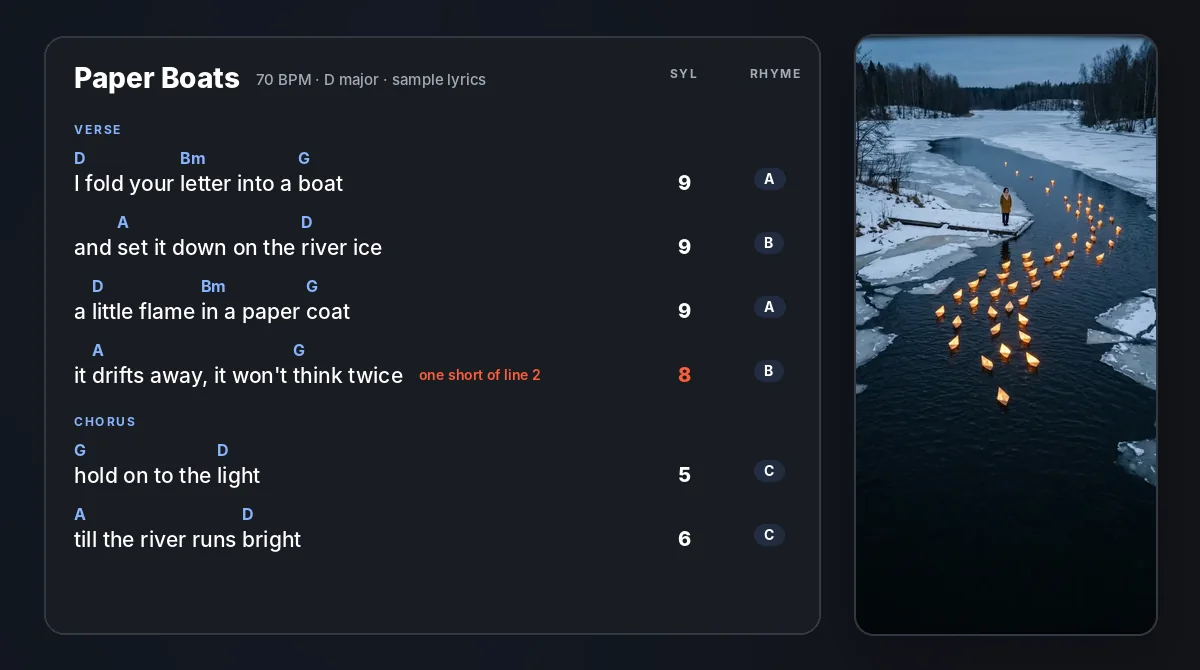
A bridge lyric shouldn't be a third verse. Verses add detail; the bridge changes how everything before it reads. In "Lighthouse Hours" the verses wait for someone in a harbor town ("The ferry's late and the harbor's gone quiet, your coat's still hanging on the back of the door") and the chorus asks: "Leave a light on through the lighthouse hours, I'll find my way in by the beam." The table shows five ways the bridge could turn that story, each written for this guide.
| Turn | What it does | Example lines |
|---|---|---|
| A time jump | Skips ahead or back, so the chorus means something new | "Twenty winters on, the keeper's gone / and the lamp still turns for no one" |
| A new speaker | Lets the other person answer | "You think I kept it burning for the boats / I kept it burning so you'd know" |
| A confession | Reveals what the singer held back | "I never told you I was scared of the water / I only learned to sail to reach your door" |
| Zooming out | Moves from one story to everyone's | "Every house along this coast has a window like ours / someone watching the dark for someone" |
| A reversal | Turns the chorus's meaning around | "Maybe the light was never there to bring me in / maybe it was there so I could leave" |
The finished bridge takes the time jump and carries it into the last chorus: "Twenty winters on, the keeper's gone / and the lamp still turns for no one / but I still count the beams the way you taught me / one for the rocks and two for the way home." Then the last chorus changes one line. Where the first two choruses ended "I'll find my way in by the beam", the last ends "so the next one finds you by the beam": the singer is now the one keeping the light. A small change after a big turn is often enough to make the last chorus land differently.
- Change the rhyme pattern: if the verses rhyme every other line, a bridge in rhyming pairs, or barely rhyming at all, sounds different before a note is sung.
- Keep the title out: save the hook for the chorus, so its return after the bridge feels earned.
- Fewer words: a bridge often says less than a verse, in longer notes, so each line has to count.
- Stay in the song's world: a turn is new information about the same people and places, not a new story.
Recorded the demo with its bridge?
Upload the song and Muvora finds its sections, bridge included, and its AI director writes a storyboard that turns where the song turns. Reading and editing it is free, with 5 new storyboards a month on the free plan, and with captions on the bridge's words light up as they're sung.
Lead back into the last chorus
The last bar of a bridge does more work than any other. It has to undo the bridge's detour and set up the chorus, so that the chorus's first downbeat sounds inevitable. These are the common ways, and the best bridges often stack two.
- End on V: a G chord at the end of a bridge in C is a question the chorus's C answers.
- A held bass note: keep the V in the bass for the last bar or two while the chords above it move, building tension without a new harmony.
- A stop: cut every instrument for a beat or a bar, so the chorus comes in out of silence.
- A pickup line: let the last bridge line run straight into the chorus's first word, with no breath between them.
- A drum fill: a snare roll or a tom run in the last two beats tells the listener the big section is coming.
Then decide what the last chorus does differently, because the bridge has bought it the right to change. It can move up a key, as the last row of the chord table does; start with just voice and one instrument for half its length before the band comes back; add a harmony or a new counter-melody; or change one line, as "Lighthouse Hours" does. How to write a hook covers keeping the chorus's hook strong through all of that.
When a song doesn't need a bridge
Plenty of songs have no bridge, and they don't feel unfinished. A bridge earns its place only if the last chorus sounds better for it. To check, play the song both ways: once with the bridge and once going straight from the second chorus to the last. If the last chorus sounds the same either way, the bridge isn't doing its job yet, or the song gets its contrast elsewhere.
- A stripped-back last chorus: start it with voice and one instrument, then bring the band in halfway, which gives a lift without a new section.
- A key change on its own: one bar of the new key's V chord, then the last chorus a half or whole step higher.
- An instrumental passage: a solo or a riff over the verse chords gives the voice, and the listener, a rest.
- A post-chorus that grows: a chant or a wordless line after the second chorus that builds into the last one.
- A third verse with a twist: the verse's music with a lyric that turns the story, for songs whose strength is the telling.
For the rest of the song, how to write a song walks through the form, the chords, the melody and the demo, and the syllable counter checks that the bridge's lines fit the rhythm you gave them.
Let the video turn at the bridge
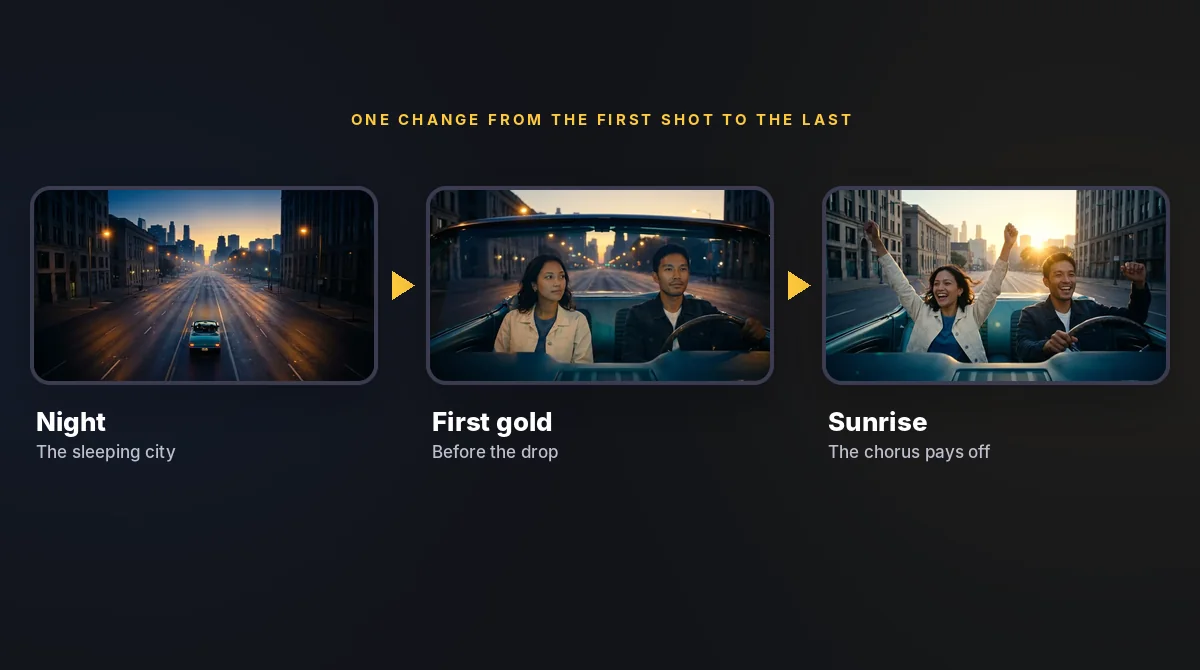
In a music video, the bridge is often where the picture turns too: a new place, a different light, a jump in time, a still moment before the last chorus. Muvora plans that from the song itself. Its analysis finds the sections, bridge included, and its AI director writes for each section's role, with an intro that hooks, verses that move, choruses that get bigger each time, a bridge that turns and an ending. The shot planner always cuts at the start of a section, on a downbeat, and holds longer shots where the song is quieter, which a stripped-back bridge often is.
Each block is a shot. Same tempo, same bar grid: only the shot length changes with the energy.
Tell the director what the bridge means. Paste your lyrics with the upload, since the director reads them for meaning, and say in the idea box what happens there, for example: "In the bridge, twenty years have passed: the lighthouse is empty and she climbs up to light the lamp herself." Then read the storyboard: any shot in the bridge can be rewritten by hand or with AI, and its framing and camera move changed, for free, before you pay to render. The soundtrack is your upload, untouched, so upload the final mix, MP3, WAV, M4A, AAC or FLAC up to 8 minutes. Music videos for singer-songwriters shows the whole process for a song like this one.
Make a video that turns where your song turns
Upload the song for a free storyboard with a cut at every section change and a bridge written as a turn in the story. The exact price shows before you render, from 38 credits a second in Visualizer, and shots that fail cost nothing.
Written by the Muvora team. Last updated November 18, 2026. Spotted something out of date? Tell us at [email protected].