Look up any guitar chord, hear it, and print your song's chords
Pick a chord or type its symbol, such as Am7, Cadd9 or D/F#, and the chart draws its shapes on a guitar in standard tuning: the shapes chord books teach first, then barre chords and voicings higher up the neck, each with its fingers, its open and muted strings and the note every string sounds. Press play to hear a shape on a plucked-string sound, set a capo or flip the diagrams for a left-handed guitar, or paste a song's chord chart for one diagram per chord on a sheet you can print. Everything runs in your browser and nothing is uploaded.
Free, no sign-up. Runs in your browser: nothing is uploaded.
C
C major
- CR
- E3
- G5
Shape 1
Open positionx32010Shape 2
Barre, 3rd fretx35553Shape 3
Open positionx35050Shape 4
Open positionx3205xShape 5
Barre, 8th fret8 10 10 9 8 8Shape 6
5th fret875558Shape 7
5th fret87558xShape 8
8th fret8 10 10 9 x x
Numbers are fingers: 1 index, 2 middle, 3 ring, 4 little, T thumb. A square marks the root and a bar is a barre. Shape 1 is the one chord books give; the rest were found on the neck and ranked by how easy they are to play.
C.
Standard tuning, E A D G B E from the 6th string to the 1st. Fingerings are suggestions: use whatever your hand finds comfortable. The sound is made in your browser; nothing is recorded or sent anywhere.
Song finished? Upload it and Muvora plans the whole video on its beats. The storyboard is free.
Make the videoUpload a new songHow to use the guitar chord chart
- 01
Choose the chord
Pick a root, a type and, for a slash chord, a bass note, or type the symbol: Bbmaj7, F#m7b5, G/B. Major, minor, sevenths, sus, add9, sixths, ninths, diminished, augmented and power chords are all there.
- 02
Read the diagrams
Strings run top to bottom with the low E on the left. An x means leave that string out, an o means let it ring open, and the number on a dot is the finger to use. A square dot is the root and a bar across strings is a barre.
- 03
Hear each shape
Press play on a shape to hear it strummed from the low string up, or switch to Each string to hear the notes one by one and check that every string you fret rings clean.
- 04
Print a song's chords
Switch to Song sheet, paste the chords (chords over lyrics, [Am] inline or a plain list), step through the shapes for each with the arrows, then print the sheet or save it as a PDF.
How to read a guitar chord diagram
A chord box is the neck seen face on and stood upright: the six vertical lines are the strings, from the thick low E on the left to the thin high E on the right, and the horizontal lines are the frets, with a heavy line at the top for the nut. When a shape starts further up the neck the top line is thin, and a label such as 5fr says which fret the first row is. Above the box, x marks a string you mute or don't strike and o one that rings open. The numbers are the fretting hand's fingers: 1 index, 2 middle, 3 ring, 4 little, and T for a thumb wrapped over the neck, as in the D/F# many players use. Each string's note is written under it, so you can see what the shape is made of.
- Vertical lines are strings, low E on the left
- x: leave it out; o: let it ring
- 1 to 4 are fingers, T the thumb
Open shapes, barre chords and moving a shape
The open chords most players learn first (C, A, G, E and D, with Am, Em and Dm) let some strings ring unfretted, which makes them easy to hold and full of resonance. Lay your index finger across every string and it becomes a moveable nut, so the E and A shapes slide anywhere: the E shape barred at the 1st fret is F and at the 3rd is G, while the A shape at the 2nd fret is B and at the 3rd is C. That is why the chart lists a barre first for F#, Bb or Fm. Teachers call the five open shapes moved up the neck the CAGED system, and many of the higher shapes here are those same patterns, so one chord's shapes teach you a map of the neck.
- Five open shapes: C, A, G, E and D
- E shape at the 3rd fret is G
- A barre works as a moveable nut
How the chart picks and ranks shapes
The first shapes for a chord come from a hand-checked table of the ones chord books print, such as the open G, the small four-string F and D/F# with the thumb. The rest are found by searching the neck up to the 15th fret for fingerings that sound every note of the chord, put the root lowest (or a slash chord's named bass under everything), stretch across four frets at most and need four fingers at most, a barre counting as one. A fifth may drop out of a seventh, sixth or ninth (and a 9th out of an 11th or 13th), as guitarists usually leave them out, and in the shapes the search finds, muted strings sit only at the edges, so a strum never catches a dead string in the middle. Fuller shapes with fewer fingers, lower on the neck, come first. To name a shape you found yourself, the chord finder works the other way, from notes to a name.
- Chord-book shapes first, then the neck searched
- Every note sounds; a fifth may drop out
- Four frets and four fingers at most
From the chords you play to the song's music video
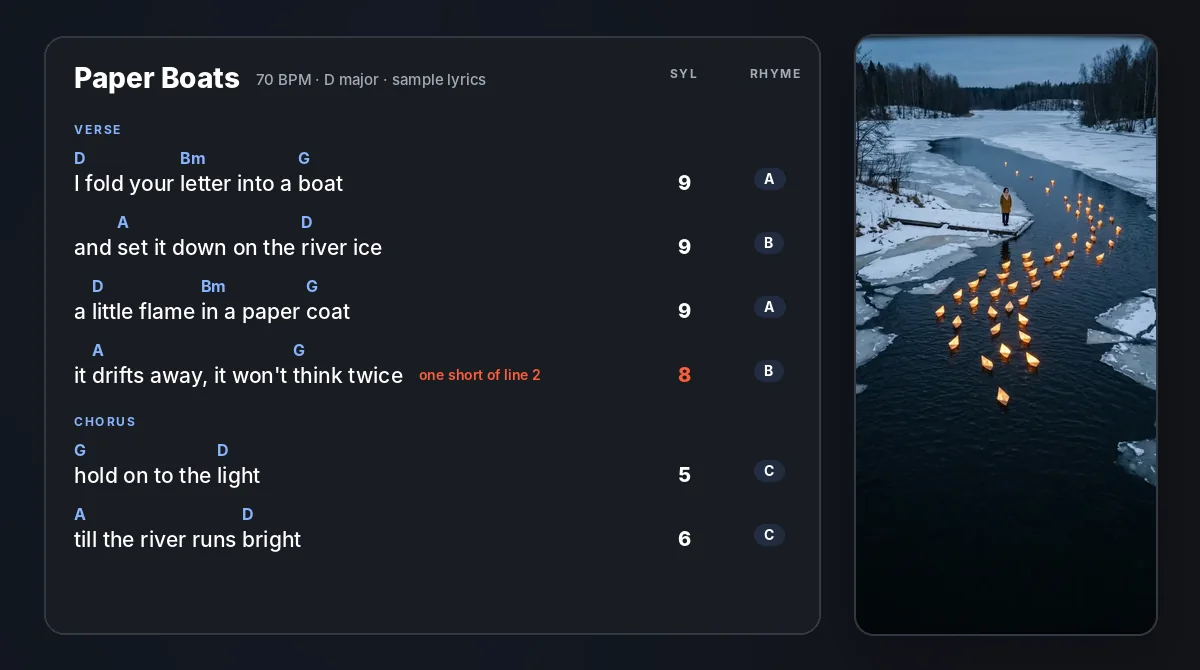
Muvora doesn't read chord charts or play your part: it works from the finished recording. Upload the mixed song and it measures the tempo and key, finds the verses, choruses and drops, and plans a storyboard with every cut on a downbeat. With the Performance style, one clear, front-facing photo of you becomes shots that lip-sync to your vocal where you sing. Reading and changing the storyboard costs no credits, and the render's price shows before you start it.
Questions, answered
Can't find what you need? Start a free storyboard and see for yourself.
How do you read a guitar chord chart?
Picture the guitar standing upright and facing you: the vertical lines are the strings, low E on the left, and the horizontal lines are the frets, with the nut at the top. Put the finger whose number is on a dot just behind that fret, let the strings marked o ring open, and skip or mute the ones marked x. A label such as 5fr beside the box means the shape starts at the 5th fret.
What is the easiest way to play an F chord on guitar?
Start with the small F: index finger flat across the top two strings at the 1st fret, middle finger on the G string at the 2nd and ring finger on the D string at the 3rd, strumming only those four strings (xx3211). Once that rings cleanly, the full barre F (133211) adds the two bass strings. The chart shows both as the first two shapes for F.
How do I play D/F# on guitar?
Play a D chord and make F# the lowest note. The usual way is the thumb over the top of the neck on the low E string's 2nd fret, the A string muted and the normal D shape on the top three strings (2x0232). For every slash chord the chart puts the bass note after the slash under the rest of the shape.
What does the capo setting change?
It shows the shape to play so the chord you typed still sounds. With a capo on the 2nd fret an A chord is played as a G shape and Bm as an Am shape, and the diagrams count frets from the capo. Playback includes the capo, so you hear the chord at its real pitch, and the printed sheet notes the capo's fret.
Are there chord diagrams for left-handed guitar?
Yes. Tick Left-handed and every diagram flips so the low E string is drawn on the right, the way a guitar strung for the left hand looks when you hold it up facing you. Frets, fingers and notes stay the same, and a sheet printed while it's ticked is flipped too.
Is that a recording of a real guitar?
No. Each note is made in your browser with the Karplus-Strong method: a short burst of noise circulates in a delay line one period long and loses its high frequencies as it goes, which sounds like a plucked string. It's in tune and good for hearing a shape's notes, but it isn't a sampled guitar, and nothing plays until you press a button.
Keep exploring
How to tune a guitar
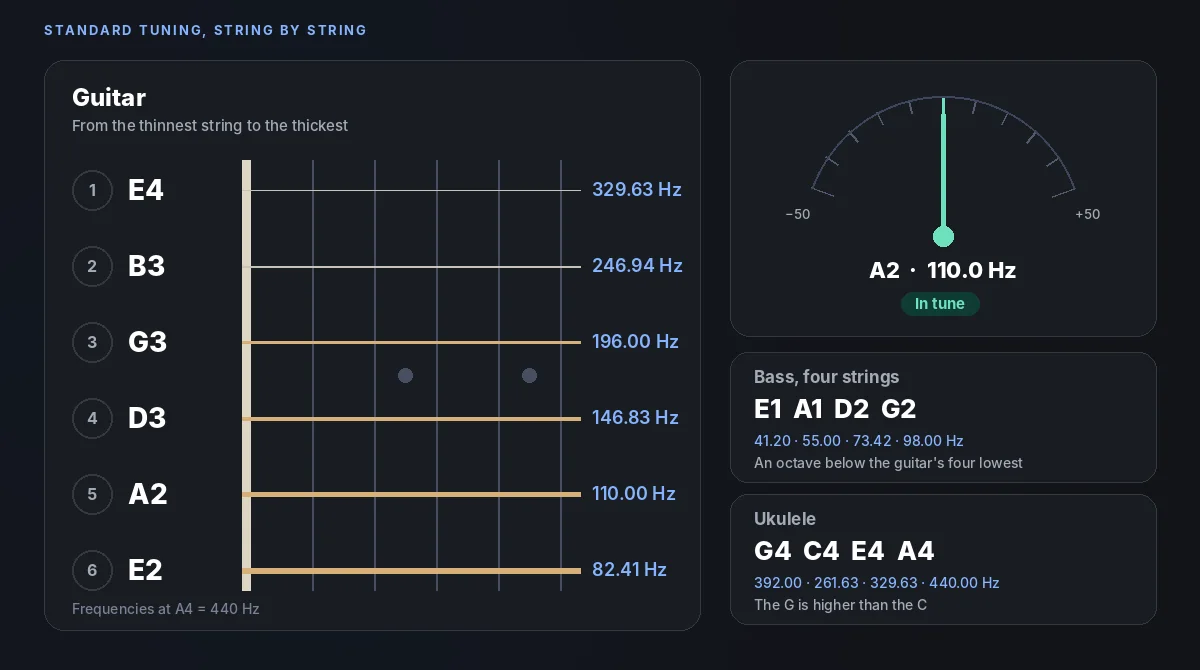
Standard tuning's notes and frequencies, tuning with a tuner or by ear, harmonics, new strings, alternate tunings, a capo and intonation.
Read the guideChord finder
Click notes on a piano or type them to name the chord, with its inversion and other names, or type a chord to see its notes.
Open the toolChord transposer
Paste a chord sheet and move it to any key, spelled for that key, with chords kept over the lyrics and the capo shapes to play.
Open the toolChord progression generator
Pick a key and a mood for common chord progressions as Roman numerals and chord names, then play them, copy the chart or save a MIDI file.
Open the toolGuitar tuner
Tune a guitar, bass or ukulele with your microphone: the note, the cents off and the nearest string, in standard or alternate tunings.
Open the toolScale finder
Any scale in any key on a keyboard and a guitar neck, played up and down, with its chords and related keys; or tick notes to find the scales that hold them.
Open the toolPiano chord chart
Any chord on a piano keyboard: its notes, root position and every inversion with fingerings, a two-hand voicing, and a printable chart of a key's chords.
Open the tool
More free tools: beats, chords and voice
Play a piano, program a beat, name a chord, find a key on the circle of fifths, build a progression, change key, tune up and find your vocal range.
Your song deserves a music video
Upload a track and get a free beat-synced storyboard in minutes. Render it when you are ready.
No card needed to start.






