The circle of fifths, interactive: keys, signatures and chords
The circle of fifths sets the 12 major keys round a clock face, each a fifth above the one before, with their relative minors inside and the number of sharps or flats in the middle. Pick a key on the circle or from the list to see its key signature, the seven chords that belong to it with their Roman numerals, the five closely related keys around it, common progressions spelled in that key and a pivot-chord route to a neighboring key. Press any chord to hear it on a piano synthesized in your browser.
Free, no sign-up. Runs in your browser: nothing is uploaded.
- The key
- Its other chords, by numeral
C major
No sharps or flats · relative minor
Chords in C major
Closely related keys
They share all but one note at most with C major, so a song can move to them smoothly.
Progressions to try in C major
- CI
- GV
- Amvi
- FIV
- CI
- FIV
- GV
- CI
- Amvi
- FIV
- CI
- GV
- Dmii
- GV
- CI
Change key to a neighbor
- CI
- Amvi = ii
- DV
- GI
Am is vi in C major and ii in G major: play it as the pivot, then D, the V of G major, and land on G. The two keys share C, Em, G, Am.
Mixing tracks as a DJ? The Camelot wheel numbers the same circle.
Chords are natural minor in a minor key, with harmonic minor's V and vii° shown apart; the key changes turn on a chord both keys share. The sound is synthesized in your browser when you press a chord; nothing is recorded or sent anywhere.
Song finished? Upload it and Muvora plans the whole video on its beats. The storyboard is free.
Make the videoUpload a new songHow to use the circle of fifths
- 01
Pick a key
Click its slice, major keys on the outer ring and minor keys on the inner one, choose it from the list, or step round with the clockwise and counterclockwise buttons. At the bottom of the circle, B, F♯ and D♭ have a second spelling one press away.
- 02
Read its signature
See how many sharps or flats the key has and the notes they fall on, in the order a staff writes them, beside its relative major or minor, which shares the same signature.
- 03
Play its chords
The key's seven chords appear with their Roman numerals, as triads or with their sevenths, and a minor key adds harmonic minor's major V. Press a chord to hear it, or play a common progression spelled in your key.
- 04
Plan a key change
Pick one of the closely related keys to see the chords the two keys share and a route between them through a pivot chord and the new key's V, then press Play to hear the move.
How the circle is built
Start at C major, with no sharps or flats, at the top. Each step clockwise goes up a fifth (seven semitones) and adds a sharp: G has one, D two, A three. Each step counterclockwise goes down a fifth, the same as up a fourth, and adds a flat: F has one, B♭ two. Sharps arrive in a fixed order, F C G D A E B, and flats in the reverse, B E A D G C F, so a major key's name sits a half step above its last sharp. Each major key's relative minor sits inside it, a minor third (three semitones) lower, with the same signature. At the bottom the sharp and flat sides meet: B and C♭, F♯ and G♭, C♯ and D♭ are the same pitches spelled two ways, and twelve steps bring you back to C.
- Clockwise: up a fifth, one more sharp
- Sharps F C G D A E B, flats the reverse
- The relative minor sits three semitones lower
The chords in a key, by Roman numeral
Stack thirds on each note of a major scale and you get the same pattern in every key: major chords on the first, fourth and fifth notes (I, IV, V), minor chords on the second, third and sixth (ii, iii, vi) and a diminished chord on the seventh (vii°). In natural minor the pattern becomes i, ii°, III, iv, v, VI and VII. Many minor-key songs raise the seventh note, as harmonic minor does, which turns v into a major V that pulls home, so the tool shows that V beside the natural minor chords. On the circle, a key's six major and minor chords sit together in one block: the key, its neighbors on either side and the three minor keys inside them. Take a progression further with the chord progression generator, or work out a voicing on the online piano.
- Major: I ii iii IV V vi vii°
- Natural minor: i ii° III iv v VI VII
- Harmonic minor makes v a major V
Circle of fifths or Camelot wheel?
The Camelot wheel is this circle renumbered for DJs: its numbers 1 to 12 run round the same order of fifths, A marks the minor keys and B the major ones, so 8B is C major and 8A its relative, A minor. It answers one question fast, which tracks will mix, without any theory. The circle of fifths keeps the keys' names and adds what a songwriter needs: signatures, the chords in each key, their numerals and the routes between keys. Both agree on the basics: neighbors share six of their seven notes, and a key and its relative share all seven. Writing a bridge or a key change, use the circle; planning a set, use the codes. Not sure of your song's key? The BPM and key finder measures it from the audio.
- Same circle, different labels
- Camelot codes: which tracks mix
- The circle: signatures, chords and key changes
From the key of your song to its music video
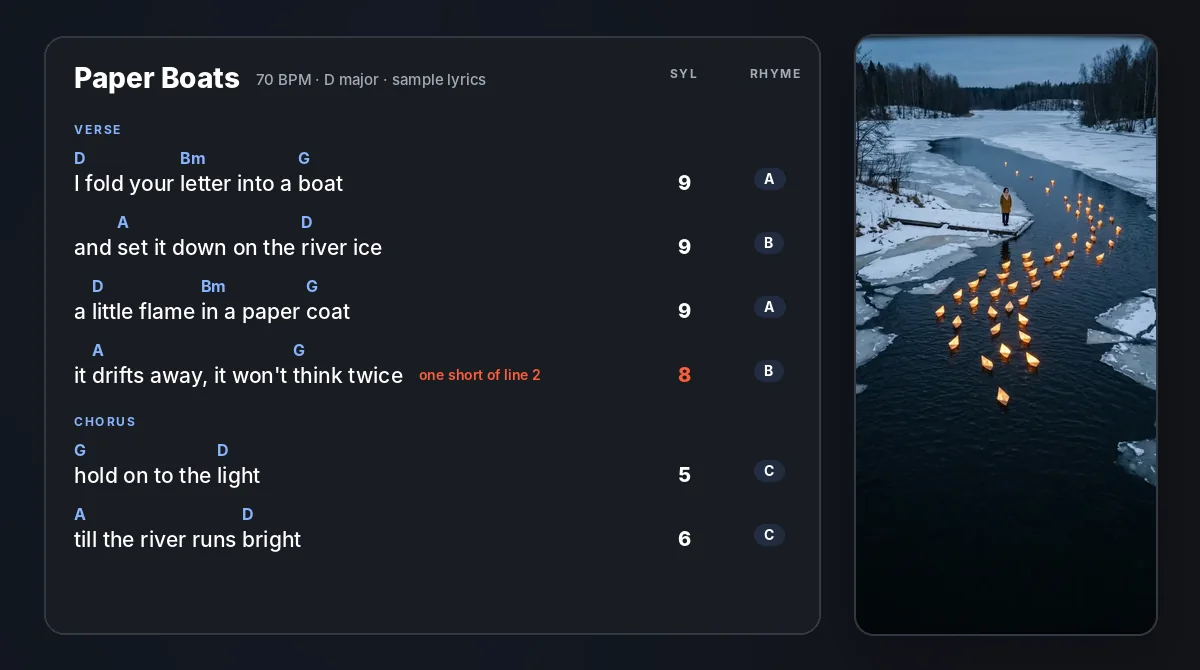
Once the song is written, recorded and mixed, upload it: Muvora measures its key and tempo, finds the verses, choruses and drops, and writes a storyboard that cuts on the downbeats and changes shot at every new section. Read and edit every shot before you pay, then render when the price shown suits you.
Questions, answered
Can't find what you need? Start a free storyboard and see for yourself.
How do you read the circle of fifths?
Start at C major at the top, with no sharps or flats. Each step clockwise is a fifth higher and adds a sharp, so G has one and D two; each step counterclockwise is a fifth lower and adds a flat, so F has one and B flat two. The minor key inside each major key is its relative minor, which uses the same signature.
What are closely related keys?
Keys whose signatures differ by one sharp or flat at most: a major key's relative minor, the keys one step either way round the circle and their relative minors. For C major they are A minor, G major, E minor, F major and D minor, and their tonic chords are also the six major and minor chords of C major.
Why are there two names at the bottom of the circle?
B and C flat, F sharp and G flat, and C sharp and D flat are enharmonic: the same pitches written with different letters. B major has five sharps against C flat major's seven flats, so B is far more common. F sharp and G flat major tie at six each, and D flat major, with five flats, is usually preferred to C sharp major with seven sharps.
What chords are in a minor key?
In natural minor they are i, ii diminished, III, iv, v, VI and VII: in A minor, Am, B diminished, C, Dm, Em, F and G. Most songs in a minor key also use the major V from harmonic minor, E major in A minor, because its raised seventh, G sharp, leads straight up to the tonic.
How do I use the circle of fifths to change key in a song?
Move to a neighboring key, since neighbors share most of their chords. Find a chord that belongs to both keys and play it as a pivot, then the new key's V chord, then its tonic. From C major to G major, A minor is vi in C and ii in G, so C, Am, D and G gets you there smoothly. Jumps further round the circle sound more abrupt.
Is the circle of fifths the same as the Camelot wheel?
They put the keys in the same order. The Camelot wheel swaps the key names for numbers and letters so DJs can match tracks at a glance, 8B for C major and 8A for A minor, while the circle of fifths keeps the names and shows the signatures and chords a songwriter or an arranger works with.
Keep exploring
Camelot wheel
Pick a key to see its Camelot code and the keys that mix harmonically with it, on an interactive wheel.
Open the toolOnline piano
Play a piano in your browser with the mouse, touch or your computer keys, with a sustain pedal, octave shift and chords and scales lit on the keys.
Open the toolChord progression generator
Pick a key and a mood for common chord progressions as Roman numerals and chord names, then play them, copy the chart or save a MIDI file.
Open the toolChord transposer
Paste a chord sheet and move it to any key, spelled for that key, with chords kept over the lyrics and the capo shapes to play.
Open the toolHow to write a song
From a title or hook to a finished demo: the form, the chorus, chords, melody, lyrics that fit, rhyme, the bridge and splitting it with co-writers.
Read the guideChord finder
Click notes on a piano or type them to name the chord, with its inversion and other names, or type a chord to see its notes.
Open the toolScale finder
Any scale in any key on a keyboard and a guitar neck, played up and down, with its chords and related keys; or tick notes to find the scales that hold them.
Open the tool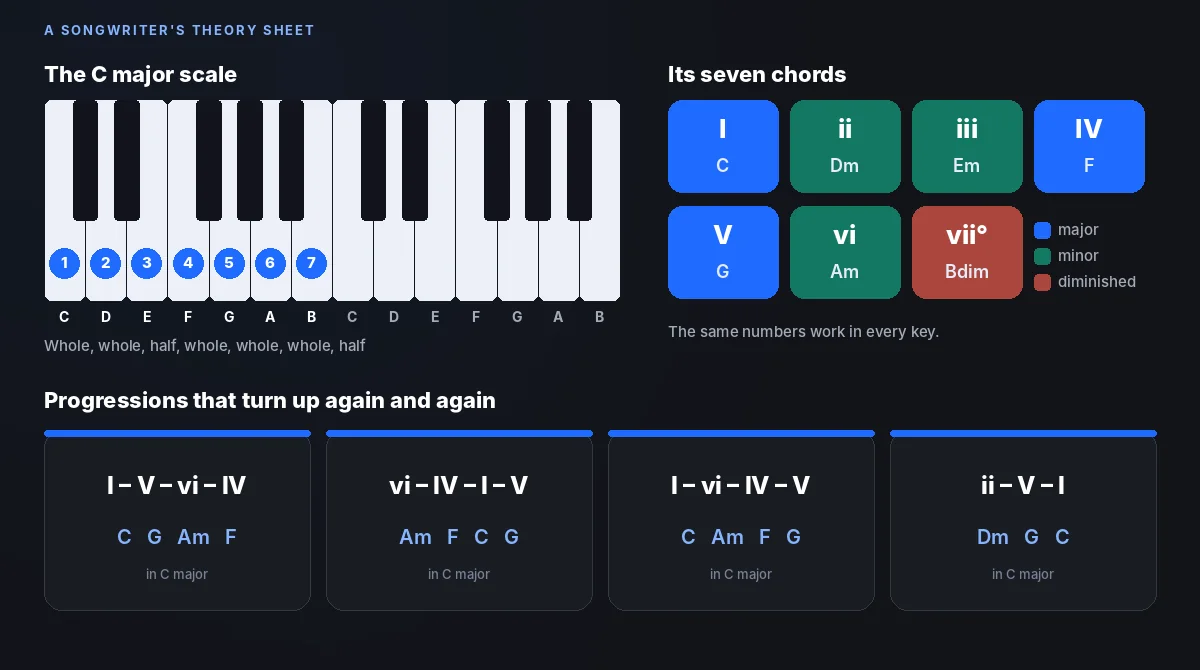
Music theory for songwriters
Notes, steps and intervals, scales and keys, chords and sevenths, Roman numerals, progressions, cadences, borrowed chords, modes and meter, in C and G.
Read the guideEar training
Name intervals up, down and together, chords from major to diminished 7th, and the degrees of a key, over four levels with a running score.
Open the toolPiano chord chart
Any chord on a piano keyboard: its notes, root position and every inversion with fingerings, a two-hand voicing, and a printable chart of a key's chords.
Open the tool
More free tools: beats, chords and voice
Play a piano, program a beat, name a chord, find a key on the circle of fifths, build a progression, change key, tune up and find your vocal range.
Your song deserves a music video
Upload a track and get a free beat-synced storyboard in minutes. Render it when you are ready.
No card needed to start.






