Train your ear with intervals, chords and scale degrees
Press Start and the trainer plays a question on a synthesized piano: two notes to name as an interval, a chord to name as major, minor, diminished, augmented or one of five seventh chords, or a short cadence that sets a key followed by one note to place in it. Each exercise has four levels, from three answers that sound far apart to the full set, and every reveal names the notes spelled the way a theory book writes them. Replay a question, take a hint, hear your answer beside the right one and keep score as you go. Nothing is recorded or uploaded, and no sound plays until you press a button.
Free, no sign-up. Runs in your browser: nothing is uploaded.
How the two notes sound
Press Start and listen
The first question plays as soon as you press Start.Level 1: major 3rd, perfect 5th and octave
Your score at this level
- Right
- –
- Streak
- 0
- Best streak
- 0
No answers yet
How each answer is going
Each answer's record shows here as you go, so you can see which ones to practice.
Keys: 1 to 9, 0, - and = pick an answer, R plays the question again, H gives a hint, K plays the key and N moves on. Only your first answer to each question counts. Scale degrees are heard after a I–IV–V–I cadence (in a minor key i–iv–V–i, its V major as classical harmony has it). The sound is synthesized in your browser, and the score stays in this tab; nothing is recorded or sent. This trains relative pitch, hearing how notes relate; it isn't a test of talent and doesn't teach perfect pitch.
Song finished? Upload it and Muvora plans the whole video on its beats. The storyboard is free.
Make the videoUpload a new songHow to use the ear training
- 01
Pick an exercise and a level
Choose intervals, chords or scale degrees, then a level. Level 1 offers three answers that are easy to tell apart; level 4 asks for all of them: twelve intervals, nine chord qualities in any inversion, or every note of the octave heard against a key.
- 02
Choose how the question sounds
Intervals can rise, fall, sound together or mix all three. Chords can sound at once, or note by note before the full chord. Scale degrees can be heard in a major or a minor key. A piano, an electric piano or an organ plays them all.
- 03
Listen, then answer
Press Start or N for a question, then click or tap an answer, or press its number key: 1 to 9, then 0, - and =. R plays the question again, H gives a hint, and K repeats the cadence in the scale-degree exercise.
- 04
Learn from the reveal
The reveal names the answer and spells its notes. Press any other answer to hear it from the same starting point, then go on with Next. Your score, your streak and a tally for each answer show which sounds still need work.
Intervals: hearing the distance, not the notes
An interval is the gap between two notes, and recognizing it by ear is the core of relative pitch: once you know a rising perfect 5th when you hear one, you can find a melody on an instrument from any starting note. A melodic interval plays its notes one after the other and a harmonic interval plays them together, and the two can feel like separate skills, so practice rising, falling and together on their own before you switch to Mixed. Some players tie each interval to the opening of a tune they already know; others listen for its character, the open sound of a 4th or the strain of a major 7th. Either way, sing the answer back once the reveal plays. The names follow the letters, which is why six half steps are an augmented 4th from F (F to B) but a diminished 5th from B (B to F). For the full table of intervals with examples in C, read music theory for songwriters, and try any of them on the online piano.
- Melodic: one note, then the other
- Harmonic: both notes at once
- Six half steps: an augmented 4th or a diminished 5th
Chord qualities: the 3rd first, then the top
Every chord in this trainer is built from stacked 3rds, so two questions name most of them. Is the 3rd above the root major (four half steps) or minor (three)? Then is the 5th perfect, flattened or raised? A major triad has a major 3rd and a perfect 5th, a minor triad a minor 3rd under the same 5th, a diminished triad squeezes its 5th down a half step and an augmented triad pushes it up one. The seventh chords add a fourth note, and its distance from the octave is the clue: a major 7th sits a half step below it and sounds bright with a soft rub, while the dominant, minor and half-diminished 7ths put their top note a whole step below. The diminished 7th stacks minor 3rds all the way, so every inversion of it is again a stack of minor 3rds and sounds the same. Level 4 inverts the chords, putting the 3rd, 5th or 7th in the bass. To name a chord you found yourself, play its notes into the chord finder.
- Major or minor: the 3rd decides
- Diminished and augmented: the 5th moves
- Sevenths: how far the top note sits from the octave
Scale degrees: where a note sits in the key
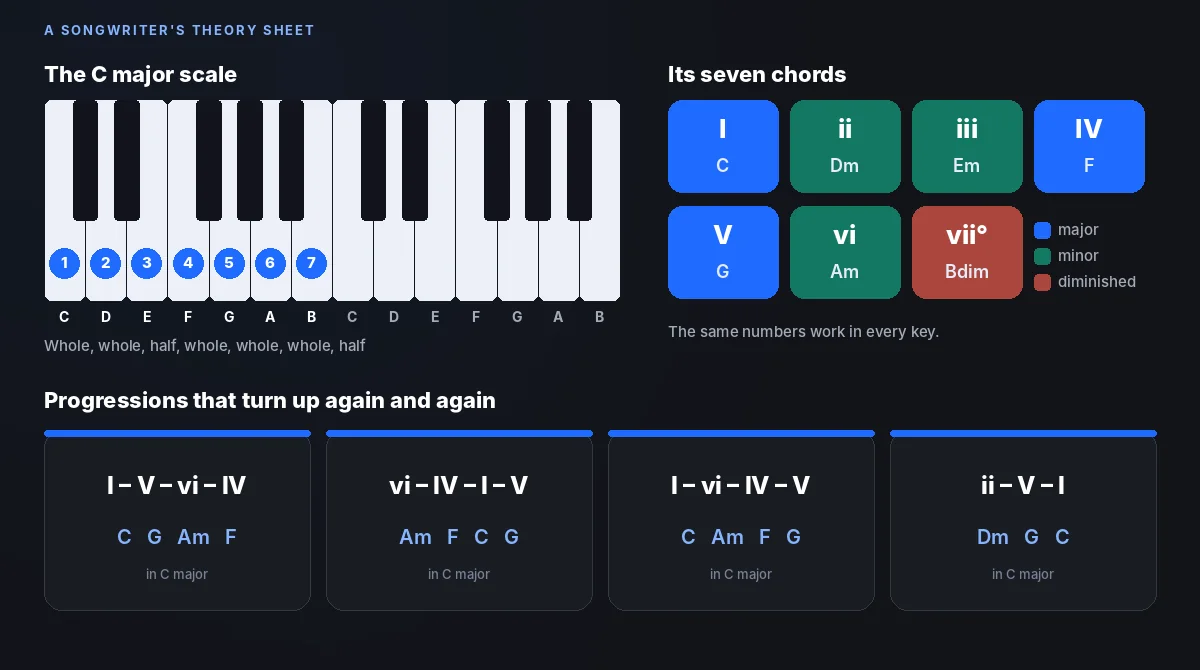
A note on its own has no degree until there's a key, so each question starts with a I–IV–V–I cadence (i–iv–V–i in a minor key) that settles the ear on the home note before the note to name. Degrees have tendencies you can learn to hear: the 7th leans up toward the home note, the 4th leans down toward the 3rd, and the 5th sounds stable but unfinished. The hint walks from the note back home one step of the key at a time, which is also a good way to sing it. This is relative pitch, the skill players use to work out a song by ear; it isn't perfect pitch, which names a note with no reference at all, and a score here measures practice at one level rather than talent. See every degree of any key spelled out in the scale finder or on the circle of fifths, and before singing answers back, find the notes that sit comfortably in your voice with the vocal range test and a few vocal warm-ups.
- The cadence sets the key first
- 7 leans up to 1, 4 leans down to 3
- Relative pitch, not perfect pitch
From a trained ear to a video cut on the beat
A sharper ear helps you write, arrange and sing the song; making its video is Muvora's part. Upload the finished track and Muvora measures its tempo, key and sections, writes a storyboard that cuts on the downbeats and at every section change and drop, lets you rewrite any shot before you pay, and shows the exact price before a frame renders.
Questions, answered
Can't find what you need? Start a free storyboard and see for yourself.
Can ear training give you perfect pitch?
Not this kind. Perfect pitch, also called absolute pitch, is naming a note with no reference, and this trainer doesn't teach it or test for it. It trains relative pitch instead: hearing the distance between two notes, the quality of a chord and a note's place in a key, the skill musicians lean on to play by ear and to sing in tune with a band. Your score shows how practice at one level is going, not how musical you are.
What is the difference between melodic and harmonic intervals?
A melodic interval plays its two notes one after the other, rising or falling, the way a tune moves. A harmonic interval plays them at the same moment, the way they sit inside a chord. Falling intervals and notes played together often feel harder at first than rising ones, so practice each setting on its own, then switch to Mixed to keep yourself honest.
Why does the trainer play chords before a scale-degree question?
Because a degree only exists inside a key. The cadence plays the key's home chord, moves to the chords on the 4th and 5th degrees and comes home again, so your ear settles on the home note before the question. If the note starts to float, press Hear the key, or K, to play the cadence again.
Why is the tritone sometimes an augmented 4th and sometimes a diminished 5th?
Both are six half steps and sound identical; only the letters differ. F up to B spans four letters (F, G, A, B), an augmented 4th, while B up to F spans five (B, C, D, E, F), a diminished 5th. The trainer counts the tritone as one answer and spells it in the reveal whichever way needs fewer sharps and flats from the starting note.
How do I get better faster at ear training?
Stay at a level until you name most questions right, then move up, and use the tally under the score to see which answers you mix up. Replay a missed question, press the answer you picked to hear it beside the right one, and sing both. Short sessions you can keep up beat long ones you skip.
Is my score saved anywhere?
Only in this browser tab. Your settings, score, streak and the tally for each answer are kept in the tab's session storage, so they survive a reload but not closing the tab, and nothing is sent anywhere. Reset clears the score of the level you're on.
Keep exploring
Music theory for songwriters
Notes, steps and intervals, scales and keys, chords and sevenths, Roman numerals, progressions, cadences, borrowed chords, modes and meter, in C and G.
Read the guideOnline piano
Play a piano in your browser with the mouse, touch or your computer keys, with a sustain pedal, octave shift and chords and scales lit on the keys.
Open the toolScale finder
Any scale in any key on a keyboard and a guitar neck, played up and down, with its chords and related keys; or tick notes to find the scales that hold them.
Open the toolChord finder
Click notes on a piano or type them to name the chord, with its inversion and other names, or type a chord to see its notes.
Open the toolCircle of fifths
An interactive circle of fifths: each key's signature and relative minor, the chords in the key with Roman numerals, and how to move to a neighboring key.
Open the toolVocal range test
Sing your lowest and highest notes into the microphone to find your vocal range in note names and the voice types whose typical ranges it fits.
Open the tool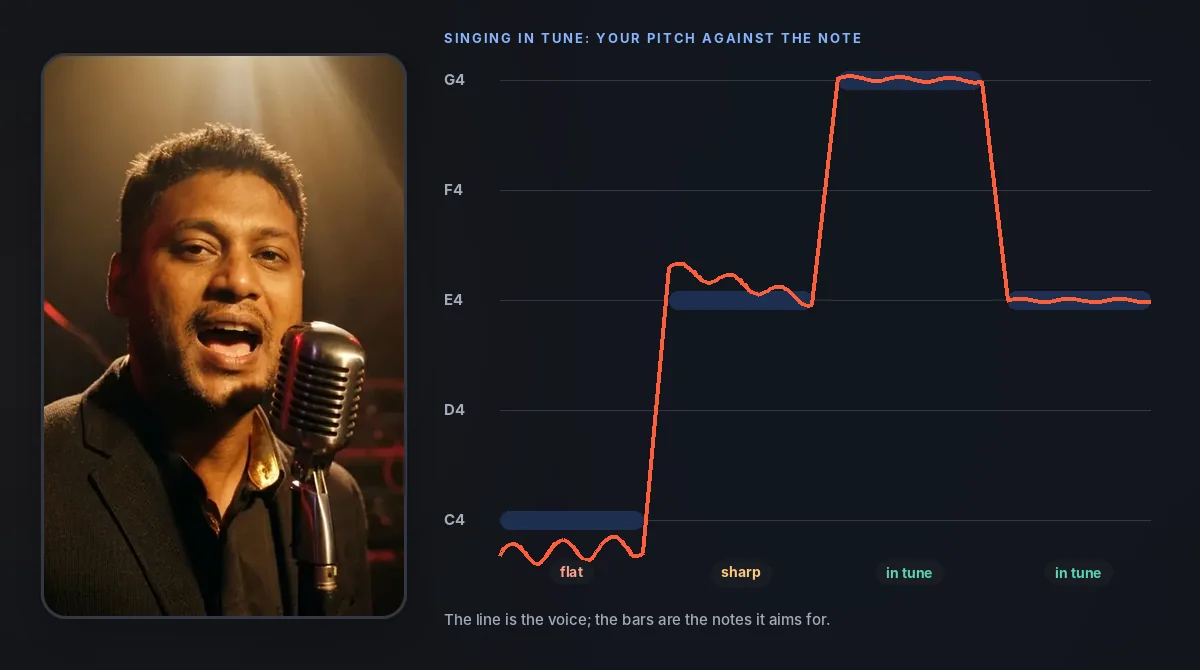
How to sing better
Posture and breath, singing in tune, tone and vowels, rhythm, recording yourself, a 20-minute daily routine, voice care and when to get help.
Read the guidePiano chord chart
Any chord on a piano keyboard: its notes, root position and every inversion with fingerings, a two-hand voicing, and a printable chart of a key's chords.
Open the tool
More free tools: beats, chords and voice
Play a piano, program a beat, name a chord, find a key on the circle of fifths, build a progression, change key, tune up and find your vocal range.
Your song deserves a music video
Upload a track and get a free beat-synced storyboard in minutes. Render it when you are ready.
No card needed to start.






