The short answer
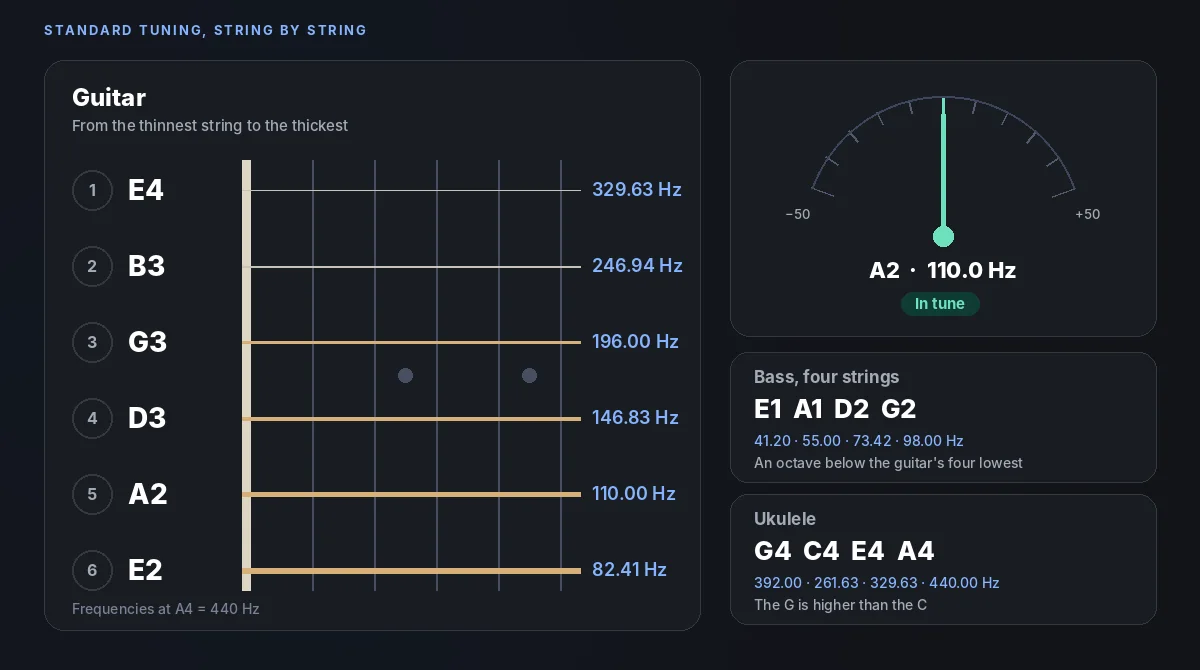
To tune a guitar to standard tuning, set the strings, from the thickest to the thinnest, to E2, A2, D3, G3, B3 and E4: 82.41, 110, 146.83, 196, 246.94 and 329.63 Hz with A4 at 440 Hz. Pluck one string at a time into a tuner, turn its peg until the needle centers, always tuning up to the note, then check all six again.
- Standard tuning, thickest string to thinnest: E2 A2 D3 G3 B3 E4, from 82.41 to 329.63 Hz.
- Tune one string at a time and always come up to the note from below.
- Without a tuner, a string's 5th fret matches the next open string, except the G, where it's the 4th fret.
- New strings stretch: pull them in gently and retune two or three times before they hold.
- Open strings in tune but chords sour up the neck means intonation, which a setup fixes.
On this page (10 sections)ShowHide
- 1.The notes and frequencies of standard tuning
- 2.How to tune a guitar with a tuner, step by step
- 3.Clip-on, pedal, app or ear: which tuner to use
- 4.How to tune a guitar by ear: the fifth-fret method
- 5.Tuning with harmonics
- 6.Why a guitar won't stay in tune, and how to settle it
- 7.Alternate tunings, the bass and the ukulele
- 8.Tuning with a capo on
- 9.In tune open, out of tune up the neck: intonation
- 10.Tuned and recorded: put the song in a video
- Questions
The notes and frequencies of standard tuning
Standard tuning names the six open strings, from the thickest to the thinnest, E A D G B E. Guitarists number them the other way round: the thin high E is the 1st string and the thick low E is the 6th, so "tune the 3rd string" means the G. Each note also carries an octave number in scientific pitch notation, where middle C is C4. That number is how a tuner tells the low E (E2) from the high one (E4).
| String | Note | Pitch | Frequency |
|---|---|---|---|
| 6th (thickest) | Low E | E2 | 82.41 Hz |
| 5th | A | A2 | 110.00 Hz |
| 4th | D | D3 | 146.83 Hz |
| 3rd | G | G3 | 196.00 Hz |
| 2nd | B | B3 | 246.94 Hz |
| 1st (thinnest) | High E | E4 | 329.63 Hz |
Two patterns in that table make tuning easier. The two E strings are the same note two octaves apart, so the high E vibrates four times as fast as the low one and either can be checked against the other. And each neighboring pair of strings is five semitones apart (a perfect fourth), except G to B, which is four (a major third). That single exception is why every by-ear method below has a different rule for the B string.
The frequencies assume A4 = 440 Hz, the concert pitch most tuners, keyboards and recordings use; on a guitar, A4 is the note at the 5th fret of the high E string. If the piano or the band you play with sits a little higher or lower, set the tuner's A4 to match it and every string's target moves with it. Any note's frequency is 440 × 2^((n − 69) / 12), where n is the note's MIDI number, and the note frequency chart works it out for every note from C0 to C8.
How to tune a guitar with a tuner, step by step
A tuner does the listening for you: it names the note it hears and shows how far above or below the target it is. The method is the same for a clip-on, a pedal, a phone app or a browser tuner.
- 01
Set the tuner and the reference
Choose guitar standard tuning (or chromatic mode, which names any note) and leave A4 at 440 Hz unless you're matching an instrument tuned elsewhere. In a noisy room, a clip-on that feels the vibration through the headstock works better than a microphone.
- 02
Mute the strings you aren't tuning
Rest your fretting hand lightly across the other strings so they don't ring along and confuse the reading, and start with the 6th string, the low E.
- 03
Pluck once and read after the attack
Pick the open string firmly near the middle of its length and read the display a moment after the loud first attack, once the pitch has settled. The note name says roughly where you are; the needle or the cents say which way to go.
- 04
Get the letter right first
If the tuner shows a different note, such as D♯ or F for the low E, turn the peg until it reads E before you watch the needle. Trace the string from the nut to its peg with a finger before turning, so you never wind the wrong one.
- 05
Come up to the note
If the needle sits left of center (flat), tighten slowly until it centers. If it sits right of center (sharp), loosen until it's clearly flat, then tighten back up to the center, so the string ends up held by tension rather than slack.
- 06
Work across, then go round again
Tune the A, D, G, B and high E the same way. Each change of tension pulls the neck very slightly and nudges the others, so check all six a second time; a guitar with a floating tremolo bridge may need three or four passes.
- 07
Check with a chord
Strum an open E major or G major chord. A tuned guitar rings clean; if one string sounds sour, play it alone into the tuner again.
Skip the blank page
Upload your song and Muvora's AI director plans a shot-by-shot storyboard on the beat. Edit every shot for free, and pay only if you render.
Clip-on, pedal, app or ear: which tuner to use
Every kind of tuner gets a guitar in tune. What differs is how it hears the string, and so how well it copes with the room you're in.
| Tuner | How it hears the string | Best for | Watch for |
|---|---|---|---|
| Clip-on | Feels the vibration through the headstock | Noisy rooms, rehearsals, acoustic guitars on stage | Clip it to the headstock itself; it reads only the instrument it's on |
| Pedal | Reads the signal in the guitar cable | Electric and acoustic-electric guitars on stage | Many mute the output while you tune, so you can tune silently between songs |
| Phone app or browser tuner | Listens through the microphone | Practice at home, or whenever nothing else is to hand | Background noise and ringing strings; low strings read less steadily through small microphones |
| Built-in tuner | Reads the pickup of an acoustic-electric's preamp | Acoustic guitars fitted with a pickup | Needs the preamp powered, often by a battery |
| Your ear and a reference note | You compare two pitches yourself | Matching a piano or another player, or when a tuner dies | Takes practice; the methods below make it quick to learn |
With a microphone tuner, get close to the guitar, mute the strings you aren't tuning and pluck a little harder on the low strings, whose deepest notes small phone and laptop microphones pick up least well. Tuners for other instruments work the same way: the ukulele tuner and the bass tuner open on those instruments' strings.
How to tune a guitar by ear: the fifth-fret method
Tuning by ear means matching two notes that should be identical: a fretted note on one string and the next string played open. You need one string right to begin. Take it from a tuner app's reference tone, a piano, another guitar that's in tune or a tuning fork; a standard A440 fork sounds A4, the note at the 5th fret of the high E string, so tune that string first if a fork is all you have.
| Fret this string | At this fret | It plays | Tune this open string to match |
|---|---|---|---|
| 6th (low E) | 5th | A2 | 5th (A) |
| 5th (A) | 5th | D3 | 4th (D) |
| 4th (D) | 5th | G3 | 3rd (G) |
| 3rd (G) | 4th | B3 | 2nd (B) |
| 2nd (B) | 5th | E4 | 1st (high E) |
Play the two notes together and listen. Two pitches that are nearly the same don't blend: they throb, a slow rise and fall in volume called beating, and the throb comes as many times a second as the frequencies differ, so notes 2 Hz apart pulse twice a second. Turn the open string's peg slowly. If the pulsing speeds up, you're going the wrong way; as it slows to a long, even wave and then disappears, the two strings match.
Tuning with harmonics
A natural harmonic is the clear, bell-like note you get by touching a string lightly directly over a fret wire, plucking it and lifting the finger away. Harmonics keep ringing with no finger pressing the string, so you can sound two at once and turn a peg while both ring, and nothing is bent sharp by a heavy fretting hand.
| Play this | Against this | Both sound |
|---|---|---|
| 6th string, 5th-fret harmonic | 5th string, 7th-fret harmonic | E4 |
| 5th string, 5th-fret harmonic | 4th string, 7th-fret harmonic | A4 |
| 4th string, 5th-fret harmonic | 3rd string, 7th-fret harmonic | D5 |
| 6th string, 7th-fret harmonic | 2nd string, open | B3 |
| 6th string, 5th-fret harmonic | 1st string, open | E4 |
There's one catch. Harmonics at the 5th and 7th frets give acoustically pure fourths and fifths, while a guitar's frets are spaced for equal temperament, where those intervals are about 2 cents different. Each harmonic match leaves the next string about 2 cents flat of a tuner's target, and because each string is tuned from the last, the gap grows to about 6 cents by the G string. That's fine for a quick check between songs; before recording, finish with a tuner. The last two pairs keep the B and the high E from inheriting that drift, since both are tuned straight from the low E (the B still lands about 2 cents sharp).
Why a guitar won't stay in tune, and how to settle it
Fresh strings stretch as they come up to tension and their windings bed in around the tuning posts, so a newly strung guitar drifts flat again minutes after you tune it, for the first day or so. You can speed that up. Tune to pitch, then take each string in turn and pull it gently away from the fretboard along its length a few times, and retune. Two or three rounds and the strings stop dropping. Nylon strings on a classical guitar stretch much more than steel and can take several days to settle.
- Temperature and humidity. A guitar carried from a cold car into a warm room, or from hot stage lights into air conditioning, changes pitch as the strings and the wood adjust. Let it sit in the room for a while and tune it there.
- Slipping at the post. Too few wraps of string around the tuning post can slip; a common guide is two or three neat wraps for the wound strings and a few more for the plain ones.
- A sticking nut slot. A string that catches in the nut stays sharp after a bend, then jumps flat with a ping. A little graphite from a soft pencil in the slots often helps, and a technician can recut a slot that's too tight.
- Old strings. Worn or corroded strings lose their brightness and often stop holding pitch and playing in tune up the neck. If a set won't hold its tuning after weeks of playing, change it.
- How hard you play. Heavy strumming and wide bends pull strings sharp for a moment, so tune with the same touch you play with.
Alternate tunings, the bass and the ukulele
An alternate tuning retunes one or more open strings, and a tuner set to that tuning checks each string against its new note. When you tune down from standard, loosen each string below its new note and come back up to it, as always. These are the tunings the guitar tuner has built in:
| Tuning | Strings | Frequencies (Hz) | What changes from standard |
|---|---|---|---|
| Standard | E A D G B E | 82.41, 110, 146.83, 196, 246.94, 329.63 | Nothing: the reference |
| Drop D | D A D G B E | 73.42, then as standard | The 6th string down a whole step |
| Half step down | E♭ A♭ D♭ G♭ B♭ E♭ | 77.78, 103.83, 138.59, 185, 233.08, 311.13 | Every string down a semitone |
| DADGAD | D A D G A D | 73.42, 110, 146.83, 196, 220, 293.66 | The 6th, 2nd and 1st strings down a whole step |
| Open G | D G D G B D | 73.42, 98, 146.83, 196, 246.94, 293.66 | The 6th, 5th and 1st strings down a whole step; the open strings make G major |
| Open D | D A D F♯ A D | 73.42, 110, 146.83, 185, 220, 293.66 | The 6th, 2nd and 1st down a whole step, the 3rd down a semitone; the open strings make D major |
A 4-string bass is tuned to the guitar's four lowest notes an octave down: E1, A1, D2 and G2, at 41.20, 55, 73.42 and 98 Hz, and a 5-string bass adds a low B0 at 30.87 Hz. A ukulele in standard tuning is G4 C4 E4 A4 (392, 261.63, 329.63 and 440 Hz), and its tuning is re-entrant: the G string sits higher than the C beside it. Each has a tuner of its own here, the bass tuner and the ukulele tuner.
Written something in an open tuning? Give it a video
Open tunings ring with drones that suit slow, wide pictures. Upload the recording and Muvora's lo-fi look cuts at a relaxed pace, with longer shots in the quiet parts and every cut on a downbeat. The storyboard is free to read and edit.
Tuning with a capo on
A capo clamps all six strings at one fret and raises every open string by that many semitones. With a capo at the 2nd fret, standard tuning sounds F♯ B E A C♯ F♯, and every chord shape you play sounds two semitones higher. Tune the guitar without the capo first, then clip the capo on just behind the fret wire, straight across the neck.
A capo that's clamped too tight, or sits in the middle of the fret, pulls strings sharp. Check them with the tuner in chromatic mode after clipping it on, and fix the capo (looser, closer to the fret wire) rather than turning the pegs, which would leave the guitar out of tune once the capo comes off. To find which shapes and capo position suit a singer's key, the chord transposer lists capo positions, and the guitar chord chart draws every chord's diagrams.
In tune open, out of tune up the neck: intonation
Sometimes every open string reads perfectly and chords near the nut sound fine, yet a barre chord at the 7th fret or a solo around the 12th sounds sour. That's intonation: whether fretted notes land where they should along the neck. It depends on each string's length from the nut to the saddle, how high the strings sit, the slight bow of the neck and the strings themselves, and it's set at the bridge, where the saddle each string rests on fixes how long the vibrating part of the string is.
To check it, tune a string open, then fret it at the 12th fret and read the tuner: it should show the same note an octave up, within a few cents. If the fretted note reads noticeably sharp or flat on several strings, a technician can correct it in a setup, adjusting the saddles along with the string height and the neck's relief. Many electric guitars have saddles you can move with a screwdriver; an acoustic's fixed saddle is a job for a technician.
Tuned and recorded: put the song in a video
When you record, tune before every take and again between takes in a long session: a guitar that drifts a few cents between the verse and the chorus is hard to fix in the mix. Record to a click if you want a steady tempo (the metronome and the click track generator both make one), and see how to record vocals at home for the rest of a home session. If you write as you play, music theory for songwriters explains the chords and keys your shapes belong to.

Once the song is mixed, Muvora turns the finished file into a music video. It reads the tempo, key, sections and sung words, and an AI director writes a storyboard with every cut on a downbeat, which you can read and change for free. For a singer who plays, the Performance style makes the sung parts lip-sync from one clear, front-facing photo of you, with the consent box ticked, between story shots written for the song. One honest limit: the AI pictures won't finger your real chords, so if you want your own hands playing your own part, film them and cut them into the exported video in any editor. Music videos for singer-songwriters and acoustic music video ideas show what suits a song built on a guitar.
Your guitar's in tune. Now give the song a video
Upload the finished track (MP3, WAV, M4A, AAC or FLAC, up to 8 minutes) and get a free storyboard cut to its beats, with 5 new storyboards a month on the free plan. You see the full price before anything renders.
Written by the Muvora team. Last updated November 17, 2026. Spotted something out of date? Tell us at [email protected].