Tune your bass with your microphone, low B included
Press Start tuner, allow the microphone and pluck an open string: the tuner shows which string you're nearest, the note it hears and how many cents sharp or flat it is. It opens on a 4-string's E A D G and also tunes drop D, half step down, a 5-string's low B and a 6-string's high C, with A4 from 432 to 445 Hz. If your phone barely hears the low strings, switch on 12th-fret harmonics and tune each one an octave up. The sound is analyzed in your browser and never recorded or sent.
Free, no sign-up. Runs in your browser: nothing is uploaded.
–
E A D G · A4 = 440 Hz
Press Start, then play one string.
Strings: press one to hear its note
The microphone is on only between Start and Stop, and goes off when you leave the page. The sound is analyzed in your browser and never recorded, stored or sent.
Song finished? Upload it and Muvora plans the whole video on its beats. The storyboard is free.
Make the videoUpload a new songHow to use the bass tuner
- 01
Choose 4, 5 or 6 strings
Pick 4-string for E A D G, Drop D or Half step down for a 4-string tuned lower, 5-string for B E A D G, or 6-string for B E A D G C.
- 02
Get the sound to the microphone
Press Start tuner and allow the microphone. An unplugged electric bass is quiet, so hold the phone close to the strings, or play through an amp and set the phone near its speaker.
- 03
Pluck one string and mute the rest
Pluck firmly with a finger and rest your other hand across the strings you aren't tuning. A hard pluck can push a low string slightly sharp for a moment, so read the needle once the note settles.
- 04
Try harmonics if a string won't settle
Tick 12th-fret harmonics, touch the string lightly over the 12th fret, pluck and lift your finger. Every target moves up an octave, a range small microphones pick up more easily.
Why phones struggle with a bass, and how this tuner copes
A 4-string's low E vibrates 41.20 times a second and a 5-string's low B 30.87, below the range where many small phone and laptop microphones respond well, so the note itself (the fundamental) can arrive much quieter than its overtones at 82, 124 and 165 Hz. A tuner that went by the loudest frequency would then call the low E an octave too high. This one measures how long the whole waveform takes to repeat, with the YIN method: a string's overtones all repeat together once per vibration of the fundamental, so the period, and with it the octave, stays the same even when the fundamental barely registers. When its first match comes at half the true period, as a loud second harmonic can cause, it checks the longer delays for a much closer match before naming the note. It reads 8,192 samples at a time, more than five vibrations of a low B, and on a 5- or 6-string listens down to about 20.6 Hz, a fifth below that B. In tests with synthesized strings, a low B whose fundamental was 26 dB quieter than its second harmonic, or missing altogether, still read within 2 cents of 30.87 Hz. What it can't do is hear a string that doesn't reach the microphone: then the input meter barely moves and the display stays blank rather than guess.
- Low E 41.20 Hz, low B 30.87 Hz
- Reads the repeat, not the loudest pitch
- Tested on a low B with no fundamental
Tuning with the 12th-fret harmonic
Rest a fingertip on a string, without pressing it down, directly over the 12th fret wire, pluck, and lift the finger: what rings is the string's harmonic, exactly an octave above the open note (E2 at 82.41 Hz for the E string), a clear tone that sustains well and that small microphones catch more easily than the open string's fundamental. The touch silences the fundamental and every odd overtone, so the sound really does repeat twice as fast; checked against the open strings, the E string's harmonic looks like the D string 200 cents sharp. That's why the tuner has a switch: tick 12th-fret harmonics and every target moves up an octave, to E2, A2, D3 and G3 on a 4-string, then untick it to tune open strings again. A natural harmonic sits at the string's midpoint whatever the frets do, so it checks the open string. If the note fretted at the 12th fret reads sharp or flat of the harmonic, the string's intonation is off, which a technician corrects at the bridge saddle during a setup.
- Touch over the fret, pluck, lift
- Targets an octave up: E2 A2 D3 G3
- Fretted 12th against the harmonic checks intonation
Five strings, six strings and lower tunings
A 5-string adds a low B at 30.87 Hz, five semitones under the E, so a bassist can reach down to B without retuning, and a 6-string also adds a high C at 130.81 Hz above the G. Drop D lowers only the E string a whole step, to D at 36.71 Hz, so the lowest note of a song in D rings on an open string. Half step down drops every string a semitone to E♭ A♭ D♭ G♭, often to match a guitarist who has tuned down the same way, so agree on the tuning with the band before anyone starts turning pegs. Each tuning here gives every string its own target, and the note frequency chart lists the pitch of any other note you want to check. For a guitar or a ukulele, the guitar tuner and the ukulele tuner open on their own strings.
- Low B 30.87 Hz, high C 130.81 Hz
- Drop D: D A D G
- Half step down: E♭ A♭ D♭ G♭
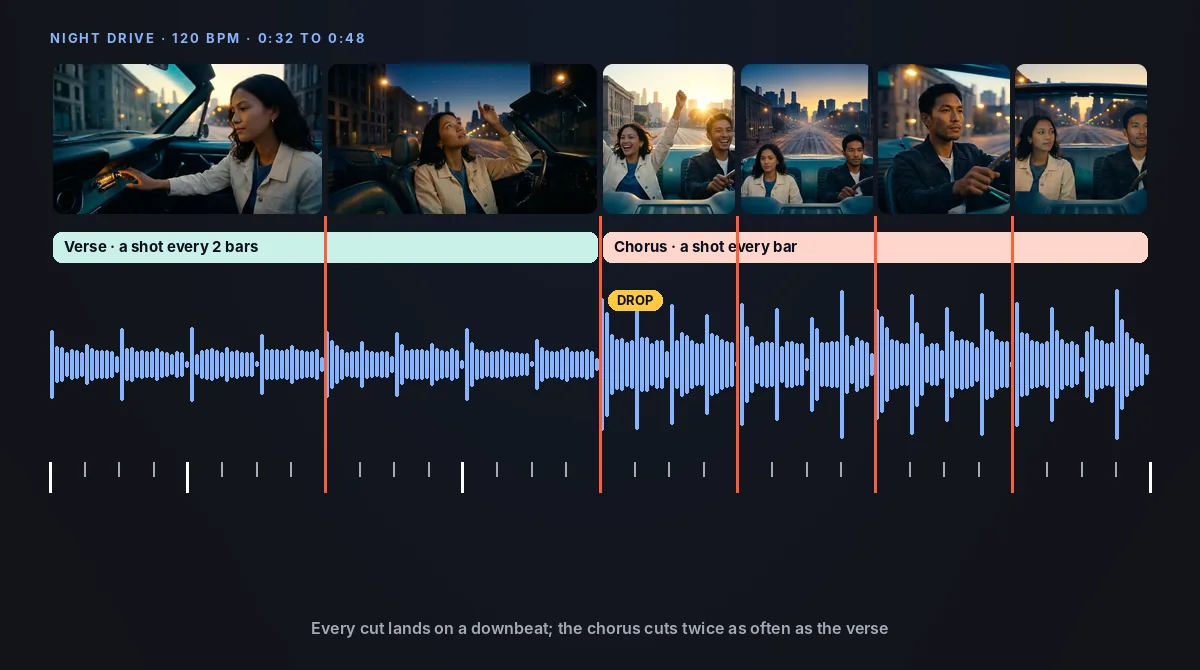
Locked in with the drums? Make the video
Once the song is mixed, upload it and Muvora maps every beat, downbeat, section change and drop, then writes a storyboard whose cuts all land on downbeats, quicker in the loud parts and longer in the quiet ones. Start from the rock look or another genre look, and describe the band in the idea box: in the Performance style your singer lip-syncs from one clear, front-facing photo with the consent box ticked, while the bassist and everyone else are drawn from your description of their instruments and clothes, not from their faces. The storyboard is free to read and rework, and the credits it costs are shown before you render.
Questions, answered
Can't find what you need? Start a free storyboard and see for yourself.
What are the notes and frequencies of a bass guitar's strings?
On a 4-string bass, from the thickest string to the thinnest: E1 at 41.20 Hz, A1 at 55 Hz, D2 at 73.42 Hz and G2 at 98 Hz, an octave below a guitar's four lowest strings. A 5-string adds B0 at 30.87 Hz under the E, and a 6-string also adds C3 at 130.81 Hz above the G. Strings are counted from the thinnest, so the E is the 4th string on a 4-string bass.
Can I tune a bass with my phone's microphone?
Yes, as long as enough of the string reaches it. A phone hears a low string's overtones better than its fundamental, and this tuner names the note from how often the whole sound repeats, which keeps the octave right. It can't read a string it can barely hear: if the input meter hardly moves, hold the phone closer, play through an amp, or switch on 12th-fret harmonics.
Why does a harmonic show up as the wrong string?
A 12th-fret harmonic sounds an octave above its open string, so the E string's harmonic is E2, which is nearer the open D string than any other open note: against the open strings it reads as the D string about 200 cents sharp. Tick 12th-fret harmonics and the tuner compares each string with its own harmonic instead.
Can I tune a bass with the harmonics at the 5th and 7th frets?
You can get close, but the method drifts. Matching one string's 5th-fret harmonic to the next string's 7th-fret harmonic tunes each pair to a pure fourth, which in theory is about 2 cents narrower than the equal-tempered fourth a tuner and a piano use, and the error adds up string by string to about 6 cents on the G of a 4-string. Tune each string to its own note, or its own 12th-fret harmonic, instead.
Does the bass tuner record or send my sound?
No. Nothing happens until you press Start tuner and allow the microphone, the sound is measured in your browser and discarded straight away, and none of it is stored or sent anywhere. Pressing Stop tuner, moving to another tab or leaving the page turns the microphone off again.
Keep exploring
Guitar tuner
Tune a guitar, bass or ukulele with your microphone: the note, the cents off and the nearest string, in standard or alternate tunings.
Open the toolUkulele tuner
Tune a soprano, concert, tenor or baritone ukulele with your microphone: high or low G, D tuning, the cents off and a reference note for each string.
Open the tool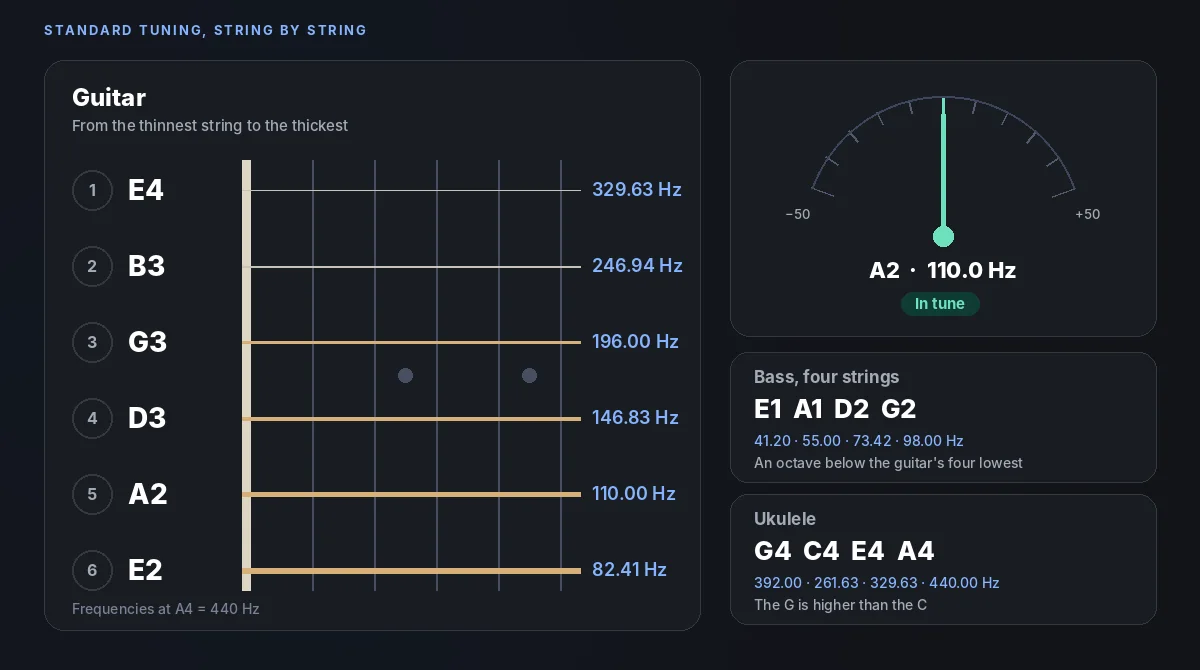
How to tune a guitar
Standard tuning's notes and frequencies, tuning with a tuner or by ear, harmonics, new strings, alternate tunings, a capo and intonation.
Read the guideNote frequency chart
Every note's frequency from C0 to C8 for any A4, with MIDI numbers and piano keys, and a converter from hertz to the nearest note.
Open the toolMetronome
A steady click from 20 to 300 BPM in seven time signatures, with accents, subdivisions, tap tempo and a tempo trainer.
Open the toolDrum machine
A 16-step drum sequencer in your browser: eight synthesized drums, grooves by genre, swing, accents and rolls, saved as a WAV loop or a MIDI file.
Open the toolClick track generator
Make a click track and download it as a WAV: any tempo and time signature, a count-in, accents, subdivisions and a length in bars or minutes.
Open the tool
Bands
The singer lip-synced from one photo, the rest of the band written into the story, every release format.
Learn moreRock music video ideas
15 concepts for bands and solo rock artists, with stage light, wardrobe and honest tips on showing instruments.
Read the guide
More free tools: beats, chords and voice
Play a piano, program a beat, name a chord, find a key on the circle of fifths, build a progression, change key, tune up and find your vocal range.
Your song deserves a music video
Upload a track and get a free beat-synced storyboard in minutes. Render it when you are ready.
No card needed to start.






