What chord is this? Pick the notes and find out
Click keys on the keyboard or type the notes, lowest first, and the finder names the chord: its symbol, root, quality, inversion and slash name, each note with its interval, and the other names the same notes go by, the likelier first. Switch to Chord to notes and type a symbol such as Am7, F#m7b5 or D/F# to see it on the keys, spelled note by note, with each of its inversions. Play either one back on a simple synthesized sound.
Free, no sign-up. Runs in your browser: nothing is uploaded.
What these notes make
Pick three or more notes on the keyboard, or type them. The lowest note is the bass.
Middle C is C4. Names follow common chord-chart practice; when notes have more than one name, the likelier one comes first and the bass usually decides. The sound is made in your browser; nothing is recorded or sent anywhere.
Song finished? Upload it and Muvora plans the whole video on its beats. The storyboard is free.
Make the videoUpload a new songHow to use the chord finder
- 01
Press the notes
Click keys anywhere from C3 to C6, or tab to the keyboard and move with the arrow keys and Space. The lowest key you press is the bass, so which octave each note sits in matters.
- 02
Or type them
Type note names with # or b, lowest first: E G C, or F#3 A3 C#4 with octaves. Notes you spell as flats stay flats wherever the chord allows it.
- 03
Read the name
See the chord symbol and its full name, the root, the quality, the inversion and the slash name, every note with its interval, and the other names those notes can take.
- 04
Go the other way
Switch to Chord to notes and type a symbol to light its notes on the keyboard, try each inversion with one click, and press Play to hear it strummed from the bass up.
How a chord gets its name
A chord is named from its root and the intervals stacked above it. A major triad is a root, a major third and a perfect fifth (C E G); lower the third and it is minor (C Eb G); add a minor seventh and C becomes C7, a major seventh and it becomes Cmaj7. Sixths, sus chords (the third swapped for a second or a fourth), add9 and the ninths, elevenths and thirteenths build on the same stack. The finder tries every note you pressed as the root, keeps the chord types that account for all of them, and lets the fifth drop out of sevenths and ninths, as players often leave it out.
- A root plus stacked intervals
- Every note tried as the root
- A missing fifth keeps the name
Inversions and slash chords
When a note other than the root is lowest, the chord is inverted: the third in the bass is the first inversion (C/E), the fifth the second (C/G), and in a seventh chord the seventh in the bass is the third inversion (C7/Bb). A slash name writes the bass note after the chord, which is how chord charts tell a bass player or a pianist's left hand what to play. A bass note that isn't in the chord at all makes the other kind of slash chord: F/G puts a G under an F major triad, a soft, suspended sound that leads back to C in a song in C.
- Third in the bass: first inversion
- Fifth: second; seventh: third
- A bass from outside the chord: F/G
One set of notes, more than one name
C E G A is C6 when C is in the bass and Am7 when A is: the same four notes doing two different jobs. The finder ranks names the way players usually read them: fewer notes left out first, then the root in the bass, then the commoner chord, and it lists the others underneath. Diminished sevenths and augmented triads divide the octave into equal steps, so any of their notes can be called the root; the bass and the key decide. Notes are spelled for the chord, so C sharp major reads C# E# G#, not C# F G#.
- C6 and Am7 share four notes
- The bass usually decides
- Spelled for the chord, sharps or flats
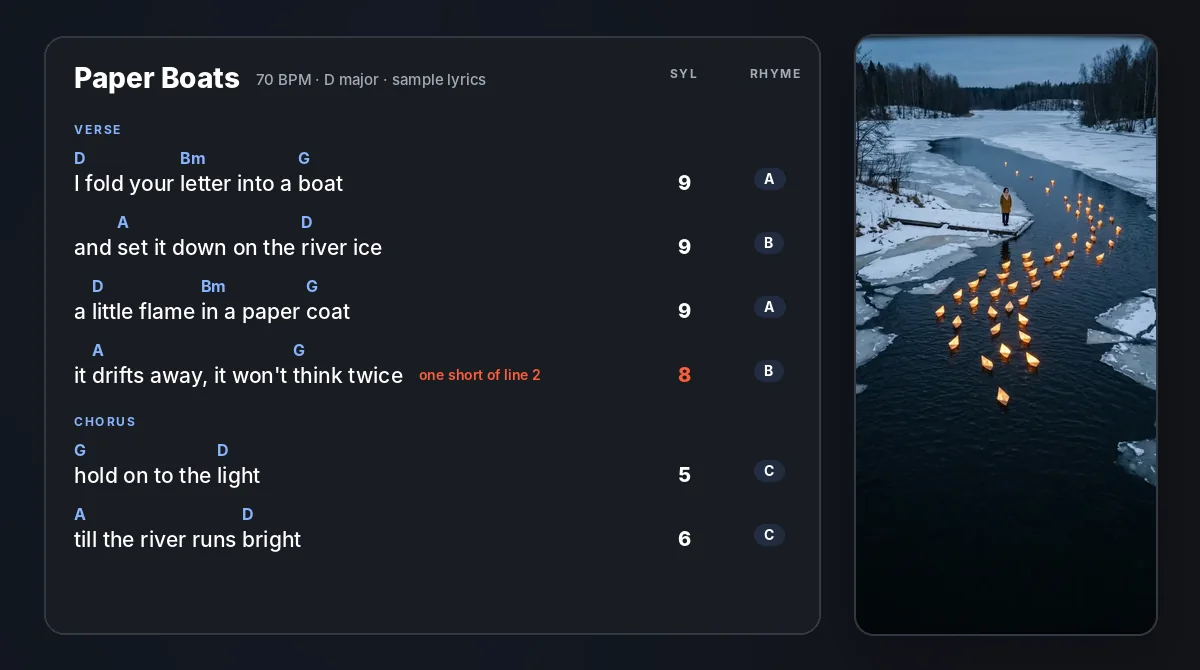
From the chords in your song to its music video
Muvora doesn't read chord charts or write music: it works from your finished recording. Once the song is mixed, upload it and Muvora measures its tempo and key, finds its sections and drops, and plans a storyboard with every cut on a downbeat, in the look you pick. Reading and editing the storyboard is free, and you see the price before you render.
Questions, answered
Can't find what you need? Start a free storyboard and see for yourself.
How do I find out what chord I'm playing?
Press the same notes on the keyboard here, or type their names with the lowest note first. On a guitar, name the note on each string you play, starting from the lowest sounding string. The finder gives the chord's name, its inversion and any other names those notes go by.
What's the difference between C6 and Am7?
Nothing in the notes: both are C, E, G and A. With C in the bass the chord is usually heard and written as C6; with A in the bass it is Am7. The finder shows both, the likelier one for your bass note first.
What is a slash chord?
A chord symbol followed by a slash and a bass note. D/F# is a D major chord with F# as its lowest note, its first inversion. F/G puts a G under an F major chord even though G isn't one of its notes. Play the note after the slash lowest.
Why does it write E# instead of F?
Chords are spelled as stacked thirds, each note on its own letter. The third above C# has to be a kind of E, and the one a major third up is E#, which sounds the same as F. Type the notes as flats, Db F Ab, and it names the chord D flat major instead.
Which chords can the chord finder name?
Major, minor, diminished and augmented triads, sus2 and sus4, power chords, sixths and 6/9, the seventh chords (dominant, major, minor, minor-major, diminished, half-diminished and augmented), add9 and add11, ninths, elevenths, thirteenths and the altered dominants 7b5, 7#5, 7b9, 7#9 and 7#11, and maj7#11. For anything else it lists the intervals instead of guessing.
Can I hear the chord?
Yes. Play strums the notes from the bass up on a simple synthesized sound made in your browser, and each key sounds as you press it unless you switch that off. Nothing is recorded, and the sound only starts when you press a key or Play.
Keep exploring
Chord progression generator
Pick a key and a mood for common chord progressions as Roman numerals and chord names, then play them, copy the chart or save a MIDI file.
Open the toolChord transposer
Paste a chord sheet and move it to any key, spelled for that key, with chords kept over the lyrics and the capo shapes to play.
Open the toolHow to write a song
From a title or hook to a finished demo: the form, the chorus, chords, melody, lyrics that fit, rhyme, the bridge and splitting it with co-writers.
Read the guideCamelot wheel
Pick a key to see its Camelot code and the keys that mix harmonically with it, on an interactive wheel.
Open the tool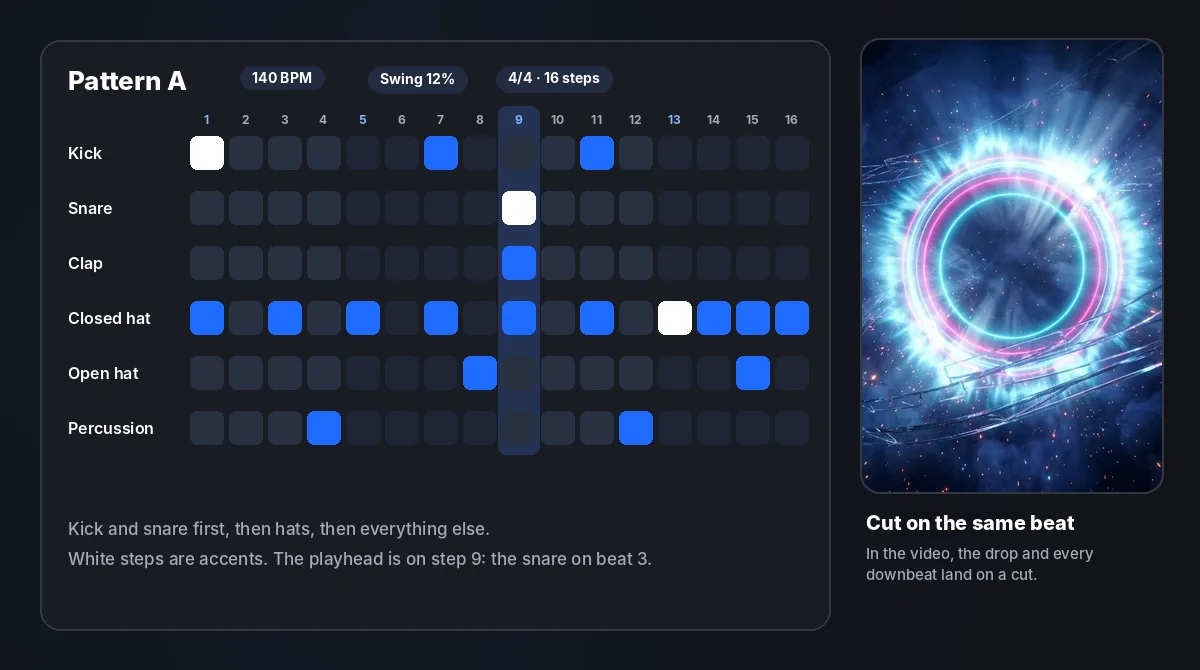
How to make a beat
Make a beat from scratch: a tempo for the style, the drums first, then bass, chords and a melody, an arrangement in bars, a quick mix, a WAV and a video.
Read the guideGuitar tuner
Tune a guitar, bass or ukulele with your microphone: the note, the cents off and the nearest string, in standard or alternate tunings.
Open the toolNote frequency chart
Every note's frequency from C0 to C8 for any A4, with MIDI numbers and piano keys, and a converter from hertz to the nearest note.
Open the toolOnline piano
Play a piano in your browser with the mouse, touch or your computer keys, with a sustain pedal, octave shift and chords and scales lit on the keys.
Open the toolCircle of fifths
An interactive circle of fifths: each key's signature and relative minor, the chords in the key with Roman numerals, and how to move to a neighboring key.
Open the toolGuitar chord chart
Any guitar chord's shapes as diagrams, open and barre, with fingers and a plucked sound, plus a printable sheet of a song's chords.
Open the toolScale finder
Any scale in any key on a keyboard and a guitar neck, played up and down, with its chords and related keys; or tick notes to find the scales that hold them.
Open the toolEar training
Name intervals up, down and together, chords from major to diminished 7th, and the degrees of a key, over four levels with a running score.
Open the toolPiano chord chart
Any chord on a piano keyboard: its notes, root position and every inversion with fingerings, a two-hand voicing, and a printable chart of a key's chords.
Open the tool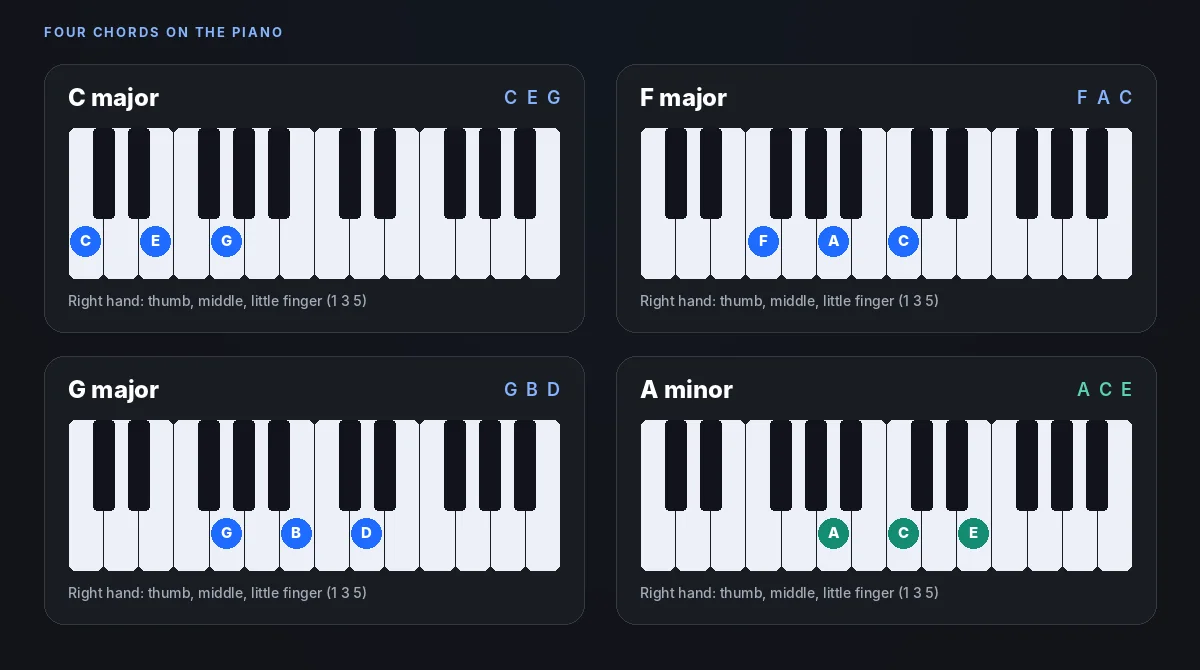
Piano chords for beginners
Find the notes, build any major or minor chord by counting keys, finger it, use inversions, loop four-chord progressions and sing along, with a two-week plan.
Read the guide
More free tools: beats, chords and voice
Play a piano, program a beat, name a chord, find a key on the circle of fifths, build a progression, change key, tune up and find your vocal range.
Your song deserves a music video
Upload a track and get a free beat-synced storyboard in minutes. Render it when you are ready.
No card needed to start.






