Tune your ukulele to G C E A with your microphone
Press Start tuner, allow the microphone and pluck one string: the tuner tells you which of the four strings you're nearest, the note it hears and how many cents sharp or flat it is. It opens on standard G C E A with the G string tuned above the C, and also tunes a low G, D tuning (A D F♯ B) and a baritone's D G B E, with A4 anywhere from 432 to 445 Hz. Prefer your ears? Tap a string to hear its note. All of it happens in your browser, and the sound is never recorded or sent.
Free, no sign-up. Runs in your browser: nothing is uploaded.
–
G C E A · A4 = 440 Hz
Press Start, then play one string.
Strings: press one to hear its note
The microphone is on only between Start and Stop, and goes off when you leave the page. The sound is analyzed in your browser and never recorded, stored or sent.
Song finished? Upload it and Muvora plans the whole video on its beats. The storyboard is free.
Make the videoUpload a new songHow to use the ukulele tuner
- 01
Pick the ukulele's tuning
Soprano, concert and tenor ukuleles usually take Standard. Choose Low G if your 4th string is the thickest one, Baritone for a D G B E instrument, or D tuning to match an older songbook.
- 02
Let the tuner listen
Press Start tuner and say yes when the browser asks for the microphone. Sit somewhere quiet, with the sound hole facing the phone or laptop a short way from it.
- 03
Pluck one string with your thumb
A ukulele's note fades fast, so pluck again whenever the reading dims. The 4th string is the G nearest your chin, and the 1st is the A nearest the floor.
- 04
Bring each string up into the green
Turn the peg until the needle holds in the green band. If a string is sharp, go a little below the note and come back up, then check all four once more.
Why the G string sits above the C
Standard ukulele tuning is re-entrant: the 4th string's G4 (392 Hz) is a fifth above the 3rd string's C4 (middle C, 261.63 Hz) instead of below it, so the line of strings drops and then climbs again through E4 (329.63 Hz) and A4 (440 Hz). The C is the lowest note an open ukulele plays, chords sit close together with that bright, ringing sound, and a scale can move across all four strings so each note keeps ringing into the next. Low G tunes the same string an octave down to G3 (196 Hz), which adds five lower notes for melodies and fuller chords but trades away some of that brightness. Choose the right one in the menu: a low G checked against standard tuning sits closest to the C string, about 500 cents flat, and a high G checked against Low G passes for the A string 200 cents flat. The note frequency chart lists every other note's pitch.
- G4 392 Hz, C4 261.63 Hz, E4 329.63 Hz, A4 440 Hz
- Low G: the 4th string at 196 Hz
- Re-entrant: the open C is the lowest note
New strings, and why a ukulele drifts flat
Ukulele strings are nylon or fluorocarbon, and both stretch far more than the steel on a guitar. A new set keeps lengthening under tension, so every string you bring up to pitch slides a little flat again within minutes, and a newly strung ukulele often needs retuning many times a session for several days of regular playing. You can speed it up: tune each string to pitch, hold it near the middle and pull it gently away from the fretboard a few times, then retune, and repeat until it stops dropping. After that, a change of room, a cold car or a dry winter can still move the tuning, so check it whenever you pick the instrument up.
- New nylon and fluorocarbon strings stretch for days
- Pull gently, retune, repeat
- Check the tuning every time you play
Tuning by ear from a single note
Get one string right and the others follow. Tap the C button here (or use a piano's middle C) and tune the 3rd string to it, then match the open 2nd string to the C string held at the 4th fret, both E, and the open 1st string to the E string at the 5th fret, both A. A high G matches the E string at the 3rd fret; a low G sounds an octave below that, so instead hold the low G at the 5th fret and match it to the open C. Listen for the wobble as two notes come close: it slows as they meet and disappears when they agree. The guitar tuner and the guide on how to tune a guitar use the same idea on six strings.
- E: the C string at the 4th fret
- A: the E string at the 5th fret
- High G: the E string at the 3rd fret

Strummed, sung and recorded? Make its music video
Upload the finished recording and Muvora finds its beats, its sections and the lines you sing, then writes a storyboard in which every cut lands on a downbeat. A gentle ukulele song often suits the lo-fi look, which holds each shot longer, or pop for something brighter; describe the rest in the idea box, from a back porch to a small kitchen late at night. Choose the Performance style, add one clear, front-facing photo of the singer and tick the consent box, and the sung parts lip-sync to the vocal. Reading and editing the storyboard costs nothing, and you see its price in credits before anything renders.
Questions, answered
Can't find what you need? Start a free storyboard and see for yourself.
What are the notes of a ukulele in standard tuning?
G, C, E and A, from the string nearest your chin to the one nearest the floor: G4 at 392 Hz, C4 (middle C) at 261.63 Hz, E4 at 329.63 Hz and A4 at 440 Hz. Because the 4th string's G is tuned higher than the C beside it, the tuning is called re-entrant. Many players remember it by singing "My dog has fleas" across the four open strings.
How can I tell if my ukulele has a high G or a low G?
Compare the 4th string with the 3rd. A high G is thinner than the C next to it and sounds higher; a low G is the thickest string on the instrument, sometimes wound with metal, and sounds lower than the C. If this tuner calls your 4th string the C string about 500 cents flat, you have a low G, so switch the menu to Low G.
Why does my new ukulele keep going out of tune?
Its strings are still stretching. Nylon and fluorocarbon lengthen for a while after they go on, so each string slips flat soon after you tune it until it settles, which often takes several days of regular playing. That isn't a fault in the instrument. If it still drifts after a couple of weeks, check that the strings are knotted firmly at the bridge and that the tuning pegs hold when you let go.
Can I tune a concert, tenor or baritone ukulele with it?
Yes. Concert and tenor ukuleles use the same G C E A as a soprano, with either a high or a low G, so pick Standard or Low G. A baritone ukulele is tuned D G B E like the four highest strings of a guitar: pick Baritone and the tuner expects D3, G3, B3 and E4.
What is D tuning on a ukulele?
A D F♯ B: every string a whole step above standard tuning, still with the 4th string above the 3rd. It appears in many older songbooks and sounds a little brighter. Chord shapes stay the same and their names move up a whole step, so the shape you know as C sounds as D.
Does the ukulele tuner record me?
No. The microphone opens only after you press Start tuner and the browser asks your permission. The sound is measured on your own device a fraction of a second at a time and then thrown away, nothing is saved or uploaded, and Stop tuner, switching tabs or closing the page shuts the microphone off.
Keep exploring
Guitar tuner
Tune a guitar, bass or ukulele with your microphone: the note, the cents off and the nearest string, in standard or alternate tunings.
Open the toolBass tuner
Tune a 4-, 5- or 6-string bass with your microphone, in standard, drop D or half step down, with a 12th-fret harmonics mode for low strings a phone hears faintly.
Open the tool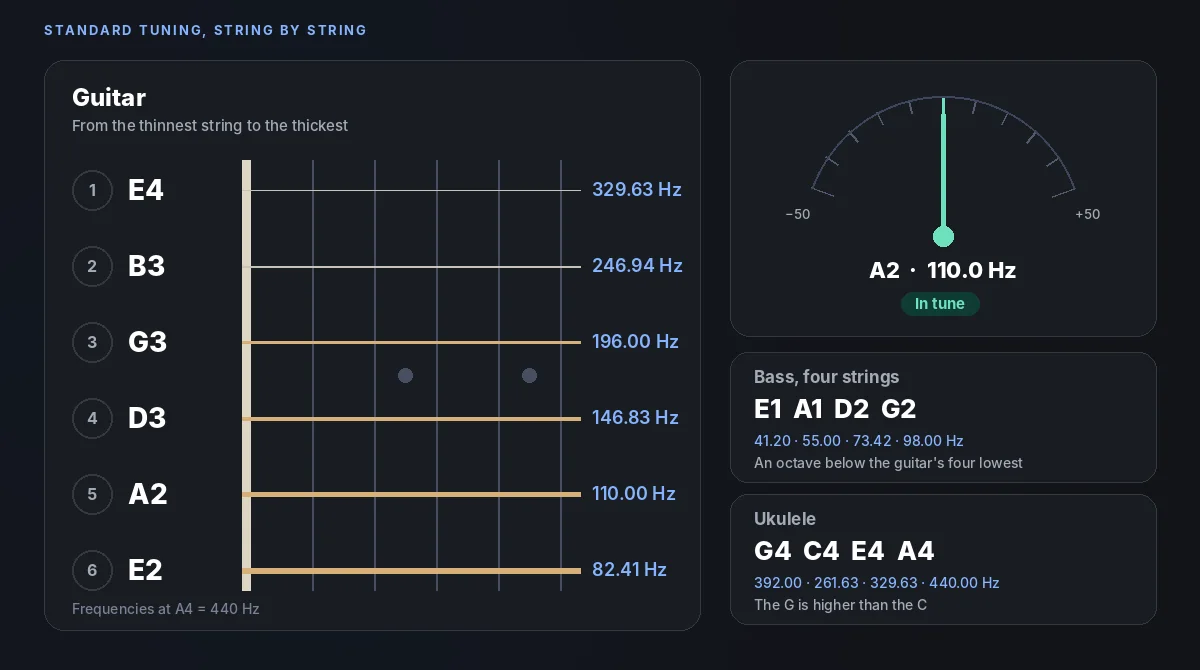
How to tune a guitar
Standard tuning's notes and frequencies, tuning with a tuner or by ear, harmonics, new strings, alternate tunings, a capo and intonation.
Read the guideNote frequency chart
Every note's frequency from C0 to C8 for any A4, with MIDI numbers and piano keys, and a converter from hertz to the nearest note.
Open the toolChord transposer
Paste a chord sheet and move it to any key, spelled for that key, with chords kept over the lyrics and the capo shapes to play.
Open the toolChord progression generator
Pick a key and a mood for common chord progressions as Roman numerals and chord names, then play them, copy the chart or save a MIDI file.
Open the toolMetronome
A steady click from 20 to 300 BPM in seven time signatures, with accents, subdivisions, tap tempo and a tempo trainer.
Open the toolSinger-songwriters
Acoustic and piano songs with the voice up front: you singing from one photo, the story in between, cuts that wait for the line.
Learn moreAcoustic music video ideas
14 concepts for a voice and a guitar or piano: one-room performances, quiet stories and lyric videos, with how to pace a slow song.
Read the guide
More free tools: beats, chords and voice
Play a piano, program a beat, name a chord, find a key on the circle of fifths, build a progression, change key, tune up and find your vocal range.
Your song deserves a music video
Upload a track and get a free beat-synced storyboard in minutes. Render it when you are ready.
No card needed to start.






