The frequency of every musical note, from C0 to C8
A chart of all 97 notes from C0 to C8 with each one's frequency in hertz to two decimals, its octave, MIDI number and piano key, and its period and wavelength, for A4 at 440 Hz or any reference from 400 to 480 Hz, with 432, 442, 443 and 444 a press away. Type a frequency to find the nearest note and how many cents off it is, or a note to get its frequency, and press any note to hear it. It all runs in your browser.
Free, no sign-up. Runs in your browser: nothing is uploaded.
A4 reference
Black keys as
Type a frequency for its nearest note and how many cents it is off.
Type a note and its octave, such as C4 (middle C), F#3 or Bb2.
Every note from C0 to C8, A4 = 440.00 Hz
| Play | Note | Frequency (Hz) | Octave | MIDI | Piano key | Period (ms) | Wavelength (m) |
|---|---|---|---|---|---|---|---|
| Octave 0 | |||||||
| C0 | 16.35 | 0 | 12 | Not on an 88-key piano | 61.156 | 20.98 | |
| C♯0/ D♭0 | 17.32 | 0 | 13 | Not on an 88-key piano | 57.724 | 19.80 | |
| D0 | 18.35 | 0 | 14 | Not on an 88-key piano | 54.484 | 18.69 | |
| D♯0/ E♭0 | 19.45 | 0 | 15 | Not on an 88-key piano | 51.426 | 17.64 | |
| E0 | 20.60 | 0 | 16 | Not on an 88-key piano | 48.540 | 16.65 | |
| F0 | 21.83 | 0 | 17 | Not on an 88-key piano | 45.815 | 15.71 | |
| F♯0/ G♭0 | 23.12 | 0 | 18 | Not on an 88-key piano | 43.244 | 14.83 | |
| G0 | 24.50 | 0 | 19 | Not on an 88-key piano | 40.817 | 14.00 | |
| G♯0/ A♭0 | 25.96 | 0 | 20 | Not on an 88-key piano | 38.526 | 13.21 | |
| A0 | 27.50 | 0 | 21 | 1 | 36.364 | 12.47 | |
| A♯0/ B♭0 | 29.14 | 0 | 22 | 2 | 34.323 | 11.77 | |
| B0 | 30.87 | 0 | 23 | 3 | 32.396 | 11.11 | |
| Octave 1 | |||||||
| C1 | 32.70 | 1 | 24 | 4 | 30.578 | 10.49 | |
| C♯1/ D♭1 | 34.65 | 1 | 25 | 5 | 28.862 | 9.900 | |
| D1 | 36.71 | 1 | 26 | 6 | 27.242 | 9.344 | |
| D♯1/ E♭1 | 38.89 | 1 | 27 | 7 | 25.713 | 8.820 | |
| E1 | 41.20 | 1 | 28 | 8 | 24.270 | 8.325 | |
| F1 | 43.65 | 1 | 29 | 9 | 22.908 | 7.857 | |
| F♯1/ G♭1 | 46.25 | 1 | 30 | 10 | 21.622 | 7.416 | |
| G1 | 49.00 | 1 | 31 | 11 | 20.408 | 7.000 | |
| G♯1/ A♭1 | 51.91 | 1 | 32 | 12 | 19.263 | 6.607 | |
| A1 | 55.00 | 1 | 33 | 13 | 18.182 | 6.236 | |
| A♯1/ B♭1 | 58.27 | 1 | 34 | 14 | 17.161 | 5.886 | |
| B1 | 61.74 | 1 | 35 | 15 | 16.198 | 5.556 | |
| Octave 2 | |||||||
| C2 | 65.41 | 2 | 36 | 16 | 15.289 | 5.244 | |
| C♯2/ D♭2 | 69.30 | 2 | 37 | 17 | 14.431 | 4.950 | |
| D2 | 73.42 | 2 | 38 | 18 | 13.621 | 4.672 | |
| D♯2/ E♭2 | 77.78 | 2 | 39 | 19 | 12.856 | 4.410 | |
| E2 | 82.41 | 2 | 40 | 20 | 12.135 | 4.162 | |
| F2 | 87.31 | 2 | 41 | 21 | 11.454 | 3.929 | |
| F♯2/ G♭2 | 92.50 | 2 | 42 | 22 | 10.811 | 3.708 | |
| G2 | 98.00 | 2 | 43 | 23 | 10.204 | 3.500 | |
| G♯2/ A♭2 | 103.83 | 2 | 44 | 24 | 9.631 | 3.304 | |
| A2 | 110.00 | 2 | 45 | 25 | 9.091 | 3.118 | |
| A♯2/ B♭2 | 116.54 | 2 | 46 | 26 | 8.581 | 2.943 | |
| B2 | 123.47 | 2 | 47 | 27 | 8.099 | 2.778 | |
| Octave 3 | |||||||
| C3 | 130.81 | 3 | 48 | 28 | 7.645 | 2.622 | |
| C♯3/ D♭3 | 138.59 | 3 | 49 | 29 | 7.215 | 2.475 | |
| D3 | 146.83 | 3 | 50 | 30 | 6.810 | 2.336 | |
| D♯3/ E♭3 | 155.56 | 3 | 51 | 31 | 6.428 | 2.205 | |
| E3 | 164.81 | 3 | 52 | 32 | 6.067 | 2.081 | |
| F3 | 174.61 | 3 | 53 | 33 | 5.727 | 1.964 | |
| F♯3/ G♭3 | 185.00 | 3 | 54 | 34 | 5.405 | 1.854 | |
| G3 | 196.00 | 3 | 55 | 35 | 5.102 | 1.750 | |
| G♯3/ A♭3 | 207.65 | 3 | 56 | 36 | 4.816 | 1.652 | |
| A3 | 220.00 | 3 | 57 | 37 | 4.545 | 1.559 | |
| A♯3/ B♭3 | 233.08 | 3 | 58 | 38 | 4.290 | 1.472 | |
| B3 | 246.94 | 3 | 59 | 39 | 4.050 | 1.389 | |
| Octave 4 | |||||||
| C4 Middle C | 261.63 | 4 | 60 | 40 | 3.822 | 1.311 | |
| C♯4/ D♭4 | 277.18 | 4 | 61 | 41 | 3.608 | 1.237 | |
| D4 | 293.66 | 4 | 62 | 42 | 3.405 | 1.168 | |
| D♯4/ E♭4 | 311.13 | 4 | 63 | 43 | 3.214 | 1.102 | |
| E4 | 329.63 | 4 | 64 | 44 | 3.034 | 1.041 | |
| F4 | 349.23 | 4 | 65 | 45 | 2.863 | 0.982 | |
| F♯4/ G♭4 | 369.99 | 4 | 66 | 46 | 2.703 | 0.927 | |
| G4 | 392.00 | 4 | 67 | 47 | 2.551 | 0.875 | |
| G♯4/ A♭4 | 415.30 | 4 | 68 | 48 | 2.408 | 0.826 | |
| A4 Reference | 440.00 | 4 | 69 | 49 | 2.273 | 0.780 | |
| A♯4/ B♭4 | 466.16 | 4 | 70 | 50 | 2.145 | 0.736 | |
| B4 | 493.88 | 4 | 71 | 51 | 2.025 | 0.694 | |
| Octave 5 | |||||||
| C5 | 523.25 | 5 | 72 | 52 | 1.911 | 0.656 | |
| C♯5/ D♭5 | 554.37 | 5 | 73 | 53 | 1.804 | 0.619 | |
| D5 | 587.33 | 5 | 74 | 54 | 1.703 | 0.584 | |
| D♯5/ E♭5 | 622.25 | 5 | 75 | 55 | 1.607 | 0.551 | |
| E5 | 659.26 | 5 | 76 | 56 | 1.517 | 0.520 | |
| F5 | 698.46 | 5 | 77 | 57 | 1.432 | 0.491 | |
| F♯5/ G♭5 | 739.99 | 5 | 78 | 58 | 1.351 | 0.464 | |
| G5 | 783.99 | 5 | 79 | 59 | 1.276 | 0.438 | |
| G♯5/ A♭5 | 830.61 | 5 | 80 | 60 | 1.204 | 0.413 | |
| A5 | 880.00 | 5 | 81 | 61 | 1.136 | 0.390 | |
| A♯5/ B♭5 | 932.33 | 5 | 82 | 62 | 1.073 | 0.368 | |
| B5 | 987.77 | 5 | 83 | 63 | 1.012 | 0.347 | |
| Octave 6 | |||||||
| C6 | 1,046.50 | 6 | 84 | 64 | 0.956 | 0.328 | |
| C♯6/ D♭6 | 1,108.73 | 6 | 85 | 65 | 0.902 | 0.309 | |
| D6 | 1,174.66 | 6 | 86 | 66 | 0.851 | 0.292 | |
| D♯6/ E♭6 | 1,244.51 | 6 | 87 | 67 | 0.804 | 0.276 | |
| E6 | 1,318.51 | 6 | 88 | 68 | 0.758 | 0.260 | |
| F6 | 1,396.91 | 6 | 89 | 69 | 0.716 | 0.246 | |
| F♯6/ G♭6 | 1,479.98 | 6 | 90 | 70 | 0.676 | 0.232 | |
| G6 | 1,567.98 | 6 | 91 | 71 | 0.638 | 0.219 | |
| G♯6/ A♭6 | 1,661.22 | 6 | 92 | 72 | 0.602 | 0.206 | |
| A6 | 1,760.00 | 6 | 93 | 73 | 0.568 | 0.195 | |
| A♯6/ B♭6 | 1,864.66 | 6 | 94 | 74 | 0.536 | 0.184 | |
| B6 | 1,975.53 | 6 | 95 | 75 | 0.506 | 0.174 | |
| Octave 7 | |||||||
| C7 | 2,093.00 | 7 | 96 | 76 | 0.478 | 0.164 | |
| C♯7/ D♭7 | 2,217.46 | 7 | 97 | 77 | 0.451 | 0.155 | |
| D7 | 2,349.32 | 7 | 98 | 78 | 0.426 | 0.146 | |
| D♯7/ E♭7 | 2,489.02 | 7 | 99 | 79 | 0.402 | 0.138 | |
| E7 | 2,637.02 | 7 | 100 | 80 | 0.379 | 0.130 | |
| F7 | 2,793.83 | 7 | 101 | 81 | 0.358 | 0.123 | |
| F♯7/ G♭7 | 2,959.96 | 7 | 102 | 82 | 0.338 | 0.116 | |
| G7 | 3,135.96 | 7 | 103 | 83 | 0.319 | 0.109 | |
| G♯7/ A♭7 | 3,322.44 | 7 | 104 | 84 | 0.301 | 0.103 | |
| A7 | 3,520.00 | 7 | 105 | 85 | 0.284 | 0.097 | |
| A♯7/ B♭7 | 3,729.31 | 7 | 106 | 86 | 0.268 | 0.092 | |
| B7 | 3,951.07 | 7 | 107 | 87 | 0.253 | 0.087 | |
| Octave 8 | |||||||
| C8 | 4,186.01 | 8 | 108 | 88 | 0.239 | 0.082 | |
Middle C is C4 here, as in scientific pitch notation; some keyboards and DAWs call it C3. Press a note to hear it for a moment: notes below about 40 Hz are hard to hear on phone and laptop speakers. Nothing is recorded or sent.
Song finished? Upload it and Muvora plans the whole video on its beats. The storyboard is free.
Make the videoUpload a new songHow to use the note frequency chart
- 01
Set the reference
Leave A4 at 440 Hz, the standard, pick 432, 442, 443 or 444, or type any reference from 400 to 480 Hz. Every frequency in the chart and the converter follows it.
- 02
Find the note in the chart
Scroll the chart or jump straight to an octave. Middle C and A4 are marked, the black keys are spelled with sharps or flats as you choose, and each row gives the MIDI number and the piano key.
- 03
Convert either way
Type a frequency, such as 300, for its nearest note and how many cents sharp or flat it is, or type a note, such as F#3 or Bb2, for its frequency in hertz.
- 04
Listen to it
Press the speaker beside any note, or Play under the converter, for a short tone at that pitch. Nothing plays until you press, and nothing is recorded.
The formula behind every row
The chart uses twelve-tone equal temperament, the tuning of pianos, fretted guitars and nearly all music software: the octave is split into 12 equal semitones, each a frequency ratio of the twelfth root of two, about 1.05946. Twelve of them double the frequency, so every A is twice the A below it. In numbers, f = 440 × 2^((n − 69) / 12), where n is the note's MIDI number and 69 is A4. Middle C is MIDI 60, nine semitones below A4, so it is 440 × 2^(−9/12) = 261.63 Hz. Distances smaller than a semitone are measured in cents, 100 to a semitone and 1,200 to an octave, which is what a guitar tuner shows when a string is a little sharp or flat.
- Each semitone is ×1.05946
- Each octave doubles the frequency
- 100 cents to a semitone
Octave numbers, middle C and the piano's range
Scientific pitch notation numbers each octave from C, so B3 is followed by C4. Middle C is C4: MIDI note 60, the 40th key of an 88-key piano, at 261.63 Hz. A4 is MIDI 69 and key 49. The piano runs from A0 at 27.50 Hz to C8 at 4,186.01 Hz, and C0, at 16.35 Hz, sits below the bottom of human hearing, which is around 20 Hz. Other conventions exist: some keyboard makers and DAWs label middle C as C3 and a few as C5, so the same key can carry a different octave number, while its MIDI number, 60, never changes. To see where your own voice sits on this chart, try the vocal range test; to name the notes of a chord, the chord finder.
- Middle C: C4, MIDI 60, 261.63 Hz
- A piano: A0 at 27.50 Hz to C8 at 4,186.01 Hz
- Some DAWs call middle C C3
Which A4: 440, 432 or 442 Hz?
A4 at 440 Hz is the international standard pitch, ISO 16, and what most recordings, keyboards and apps are tuned to. Many orchestras tune a little higher, often to 442 or 443 Hz, and some musicians prefer 432 Hz. Changing the reference moves every note by the same number of cents: 432 Hz is about 32 cents, a third of a semitone, below 440, and 442 Hz about 8 cents above it, so a band only has to agree on one number. The period and wavelength columns help in the studio and the synth: the period is one cycle's length in milliseconds, and the wavelength is 343 meters a second (the speed of sound in dry air at about 20 °C) divided by the frequency, which is why a low E2 at 82.41 Hz has a wave about 4.2 meters long and builds up in small rooms.
- 440 Hz is the ISO 16 standard
- 432 Hz is about 32 cents lower
- Wavelength = 343 m/s ÷ frequency
From the notes to a video for the song
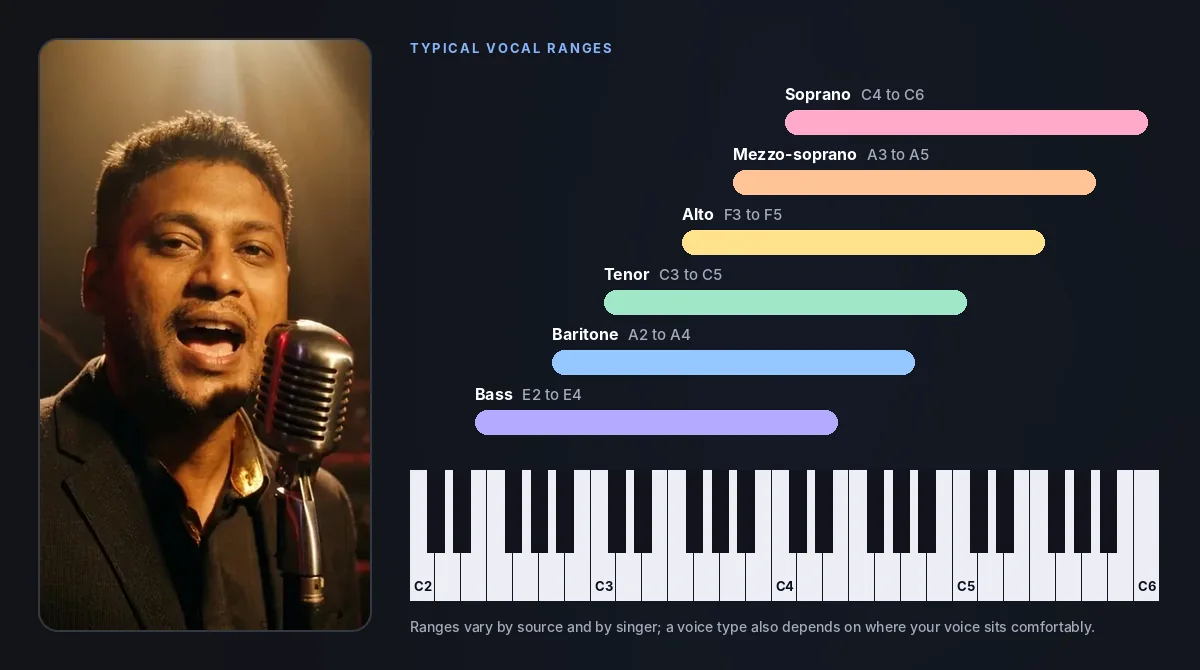
When the song is written, recorded and mixed, upload it and Muvora reads its key, tempo and sections and times the lyrics you sing, then writes a storyboard with every cut on a downbeat and every section change on screen. Each shot's prompt, framing and camera move can be changed before you pay, and the price is shown before you render. In the Performance style, one clear photo of the singer becomes shots that lip-sync to the vocal.
Questions, answered
Can't find what you need? Start a free storyboard and see for yourself.
What is the frequency of middle C?
Middle C, C4, is 261.63 Hz when A4 is tuned to 440 Hz. It is MIDI note 60 and the 40th key of an 88-key piano. With A4 at 432 Hz it falls to 256.87 Hz, and with A4 at 442 Hz it rises to 262.81 Hz.
How do you calculate the frequency of a note?
In twelve-tone equal temperament, multiply the A4 reference by 2 raised to the number of semitones from A4 divided by 12, counting down as negative. E4 is five semitones below A4, so its frequency is 440 × 2^(-5/12) = 329.63 Hz, and A5, twelve semitones up, is exactly 880 Hz.
How do I convert a frequency in Hz to a note?
Divide the frequency by 440, take the base-2 logarithm, multiply by 12 and add 69: the nearest whole number is the MIDI note, and the remainder times 100 is how many cents sharp or flat it is. For 300 Hz that gives 62.37, so D4, 37 cents sharp. The converter on this page does the sum for any A4.
What are the frequencies of the piano keys?
An 88-key piano runs from A0 at 27.50 Hz, key 1, to C8 at 4,186.01 Hz, key 88, with A4, key 49, at 440 Hz. Each key is a semitone, about 5.9% higher than the one below it, and every twelfth key doubles the frequency. Piano tuners usually stretch the octaves slightly, so a real piano's highest notes sit a little sharp of the chart and its lowest a little flat.
Is middle C C3 or C4?
Middle C is C4 in scientific pitch notation, the system this chart uses and most music theory books follow. Some keyboard makers and DAWs label it C3, and a few C5, so the octave number on a screen can differ; MIDI note 60 means middle C everywhere.
Why can't I hear the lowest notes when I press them?
Human hearing reaches down to about 20 Hz, so C0 at 16.35 Hz is felt more than heard, and phone and laptop speakers reproduce little of the lowest octaves. The chart plays each note with a few soft harmonics, which helps, but headphones or full-range speakers let you hear the bottom of the chart properly.
Keep exploring
Guitar tuner
Tune a guitar, bass or ukulele with your microphone: the note, the cents off and the nearest string, in standard or alternate tunings.
Open the toolVocal range test
Sing your lowest and highest notes into the microphone to find your vocal range in note names and the voice types whose typical ranges it fits.
Open the toolChord finder
Click notes on a piano or type them to name the chord, with its inversion and other names, or type a chord to see its notes.
Open the toolFind your vocal range
Find your lowest and highest clear notes, see where they sit among the voice types, pick song keys that suit you and put your voice in a video.
Read the guide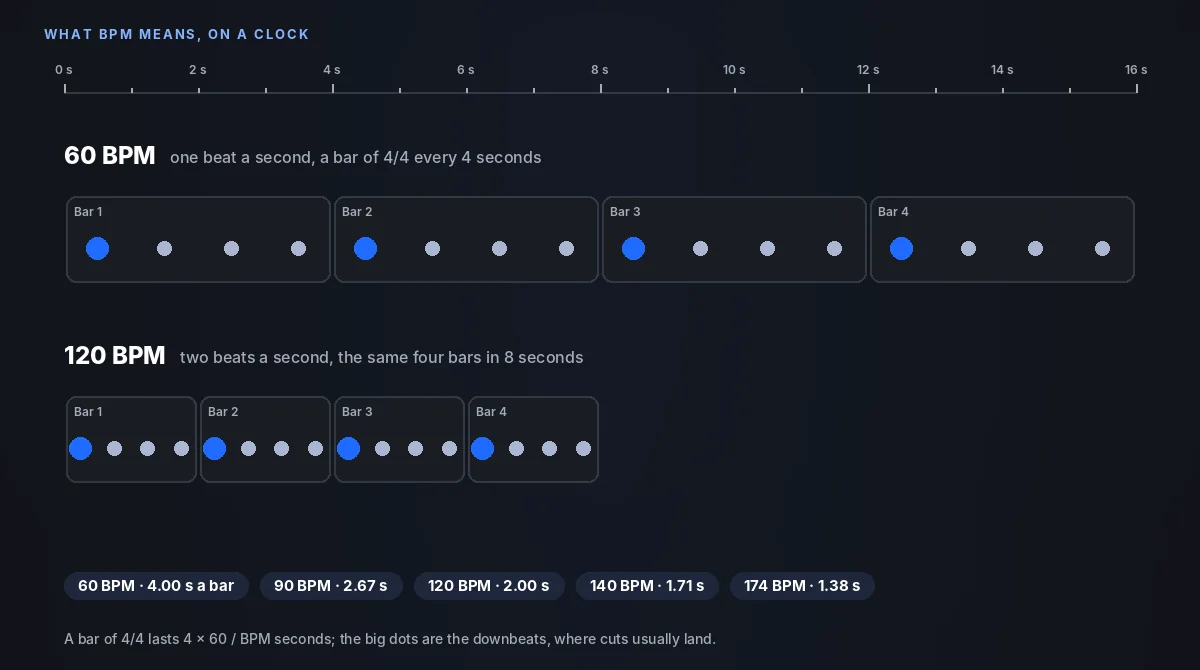
What is BPM?
Beats per minute explained: what BPM measures, how to find a song's tempo, half and double time, tempos by genre and how BPM sets a video's cuts.
Read the guideChord transposer
Paste a chord sheet and move it to any key, spelled for that key, with chords kept over the lyrics and the capo shapes to play.
Open the toolOnline piano
Play a piano in your browser with the mouse, touch or your computer keys, with a sustain pedal, octave shift and chords and scales lit on the keys.
Open the toolScale finder
Any scale in any key on a keyboard and a guitar neck, played up and down, with its chords and related keys; or tick notes to find the scales that hold them.
Open the tool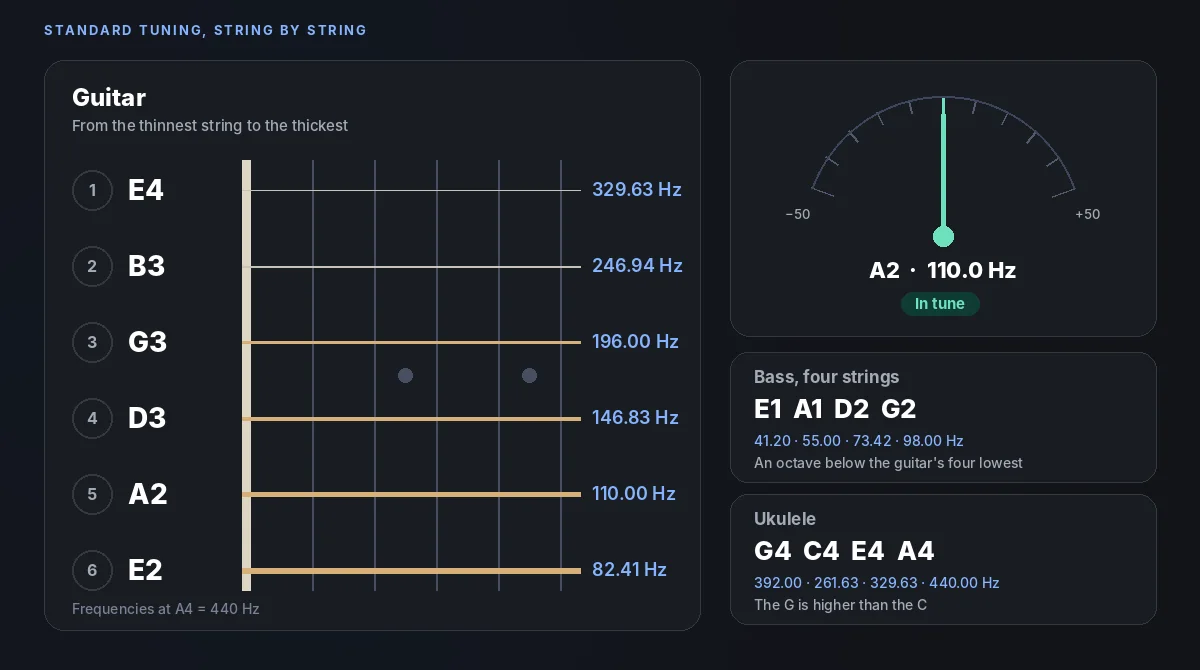
How to tune a guitar
Standard tuning's notes and frequencies, tuning with a tuner or by ear, harmonics, new strings, alternate tunings, a capo and intonation.
Read the guideSpectrogram viewer
Open a song and see its frequencies over time, with the note and level under your pointer, a playhead, and a PNG to save.
Open the tool
More free tools: beats, chords and voice
Play a piano, program a beat, name a chord, find a key on the circle of fifths, build a progression, change key, tune up and find your vocal range.
Your song deserves a music video
Upload a track and get a free beat-synced storyboard in minutes. Render it when you are ready.
No card needed to start.






