Find any scale in any key, or the scales that fit your notes
Pick a root and one of 20 scales, from major and its modes to harmonic minor, the blues scale and whole tone, and see it spelled note by note, each note on its own letter, then laid out on a piano keyboard and a guitar neck in standard tuning. Hear it played up and down, get the triads and seventh chords it holds with their Roman numerals, and jump to its relative and parallel keys. Working backwards from a riff? Tick or type its notes to see every scale and key that holds them, the closest first. It all runs in your browser, and nothing is uploaded.
Free, no sign-up. Runs in your browser: nothing is uploaded.
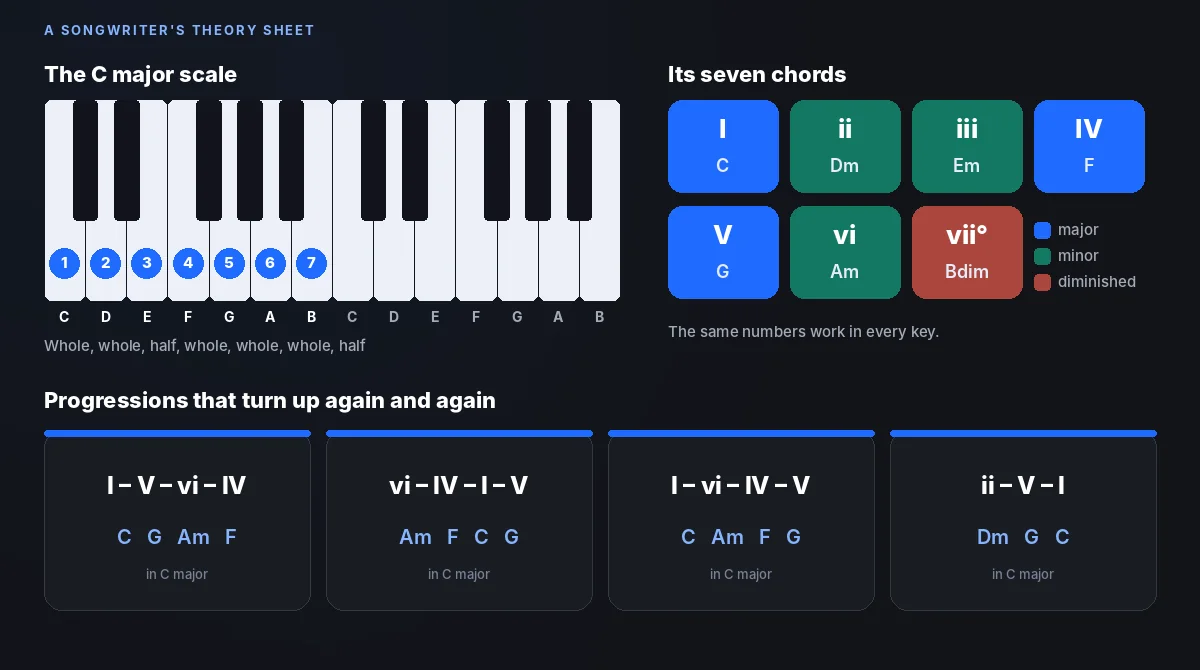
C major: C D E F G A B (1 2 3 4 5 6 7).
C major
Also called Ionian.
The home scale of most pop, rock and country songs: bright and settled, with a strong pull back to its root.
Steps: W W H W W W H (H a half step, W a whole step, W+H three half steps)Written with no sharps or flats
- Root
- Scale note
On a piano
On a guitar, standard tuning
The pattern repeats from the 12th fret, an octave up. On a phone, scroll the neck sideways.
Chords in C major
Each chord stacks every other note of the scale. Numerals count from the major scale on the same root, so ♭III sits a half step lower than major's III; minor-key textbooks often leave those flats off (III, VI, VII in natural minor).
Related keys and scales
The same seven notes, from each of them
Middle C is C4. Seven-note scales use each letter once, so some need a double sharp (𝄪) or double flat (𝄫). The sound is synthesized in your browser when you press a note, a chord or Play; nothing is recorded or sent anywhere.
Song finished? Upload it and Muvora plans the whole video on its beats. The storyboard is free.
Make the videoUpload a new songHow to use the scale finder
- 01
Pick a root and a scale
Choose the root from the 17 usual note names, each black key as both a sharp and a flat, and a scale from five groups: major and minor, the modes, pentatonic and blues, rarer seven-note scales, and whole tone and chromatic.
- 02
Read it on the keys and the neck
The notes appear spelled for the key, with their degrees, the steps between them and the sharps and flats it takes. Switch the labels between note names and degrees, and flip the guitar neck for a left-handed player.
- 03
Hear the scale and its chords
Press Play up and down to hear it climb an octave and come back, tap a note to hear it alone, and press any chord card to hear the triad or seventh built on that note of the scale.
- 04
Work backwards from your notes
Switch to Find scales from notes, tick the notes of a melody or riff on the one-octave keyboard or type them, and pick a home note if you know it. Each match shows the notes it adds to yours and the other modes that share them.
Why every scale uses each letter once
A seven-note scale names each of the letters A to G once, in order from its root, and that one rule decides every sharp and flat. D major is D E F♯ G A B C♯, never D E G♭ G A B D♭, which would use G and D twice and skip F and C. The same rule is why G♯ harmonic minor raises its seventh note to F𝄪 (F double sharp) rather than calling it G: the pitch is the same, but G would leave the scale with no F at all, and every chord built on it would be misspelled. Some keys can be written two ways with the same sounds: C♯ major takes seven sharps and D♭ major five flats, so D♭ is the usual choice, while F♯ and G♭ major tie at six and both are common. Pick either spelling here and the finder says which reads more easily. For key signatures and the order sharps and flats arrive in, open the circle of fifths.
- Seven letters, each once, from the root
- Double sharps and flats where the letters demand them
- C♯ and D♭ major: the same sounds, two spellings
Modes: the same notes from a different home
Play C major's white keys from D to D and you hear D Dorian; from G to G, G Mixolydian. Each of the seven modes keeps the notes and moves the home, and one note that differs from plain major or minor gives each its color: Dorian is minor with a natural sixth, Phrygian is minor with a flat second, Lydian is major with a sharp fourth, Mixolydian is major with a flat seventh, and Locrian's flat fifth makes its own home chord diminished. Relative keys share their notes, as C major and A minor do; parallel keys share their root, as C major and C minor do, and borrowing a chord from the parallel key, such as a minor iv in a major song, is a common move in pop writing. The finder lists both for every scale and the seven modes of any major key. Name the chords those notes make in the chord finder, or find them under your fingers on the online piano.
- Dorian: minor with a natural sixth
- Mixolydian: major with a flat seventh
- Relative keys share notes, parallel keys share a root
Pentatonic, blues and working backwards from a riff
A pentatonic scale keeps five notes of a key and drops the two that sit a half step from a neighbor (F and B in C major), so no two of its notes are a half step apart, which is why a minor pentatonic shape is often the first thing a guitarist solos with. The blues scale adds one note to it, the flat fifth, called the blue note, which players bend into or pass through on the way to the fifth. When you have a melody but not its key, work backwards: tick every note it uses, and the finder lists each scale that holds them all, the ones adding the fewest notes first. Five or six notes often narrow it to one key and its modes, and the note your melody comes to rest on usually tells you which mode it is. With the key found, the chord progression generator gives you chords to try under it, and music theory for songwriters explains why they work.
- Pentatonics leave out the half steps
- The blue note is the flat fifth
- Tick a riff's notes to find its key
From the notes on the page to a video on the beat
Muvora doesn't write melodies or chords. Once your song is recorded and mixed, upload it: Muvora reads its key, tempo and sections, lines every cut up with a downbeat, and drafts a storyboard you can edit shot by shot for free, then shows the exact price before anything renders.
Questions, answered
Can't find what you need? Start a free storyboard and see for yourself.
How do I find out what scale a song is in?
Work out the notes its melody and chords use, then look for the scale that holds them: tick or type them in the finder's reverse search and choose the note the song keeps coming home to as the home note. The same seven notes are C major if the song rests on C, A minor if it rests on A and D Dorian if it rests on D. With the recording at hand, the BPM and key finder can measure the key from the audio first.
What is the difference between relative and parallel keys?
Relative keys share their notes and key signature but start from different roots: C major and A minor both have no sharps or flats. Parallel keys share a root but not their notes: C major has no flats and C minor has three. Songs often move to the relative key for a bridge and borrow chords from the parallel key for color.
Why does the scale finder write F double sharp instead of G?
Because a seven-note scale uses each letter once. G sharp harmonic minor raises the seventh note of G sharp minor, F sharp, by a half step, which makes it F double sharp. Writing it as G would give the scale two G's and no F, and the chords built on that note would be spelled wrongly too. It sounds the same as G; only the name follows the letters.
What is the blue note in the blues scale?
In the common six-note blues scale it's the flat fifth, the note between the fourth and the fifth: E flat in A blues, which runs A, C, D, E flat, E and G. Some books write it as a sharp fourth, D sharp in A. It's usually bent, slid or passed through rather than held. The major blues scale has its own blue note, the flat third, which slides up into the major third.
What are the seven modes of the major scale?
Ionian (the major scale itself), Dorian, Phrygian, Lydian, Mixolydian, Aeolian (natural minor) and Locrian, each starting on the next note of a major scale. On C major's white keys they begin on C, D, E, F, G, A and B. Every mode keeps the same notes but a different home note, which moves where the half steps fall and changes how the scale feels.
Why do several scales come up for the same notes?
A handful of notes fits many scales. A major key's seven notes are also six other modes, and three notes such as C, E and G sit inside dozens of scales on different roots. The finder groups scales with the same notes, lists those adding the fewest notes first, and lets you choose a home note to keep only the scales built on it.
Keep exploring
Music theory for songwriters
Notes, steps and intervals, scales and keys, chords and sevenths, Roman numerals, progressions, cadences, borrowed chords, modes and meter, in C and G.
Read the guideCircle of fifths
An interactive circle of fifths: each key's signature and relative minor, the chords in the key with Roman numerals, and how to move to a neighboring key.
Open the toolChord finder
Click notes on a piano or type them to name the chord, with its inversion and other names, or type a chord to see its notes.
Open the toolOnline piano
Play a piano in your browser with the mouse, touch or your computer keys, with a sustain pedal, octave shift and chords and scales lit on the keys.
Open the toolChord progression generator
Pick a key and a mood for common chord progressions as Roman numerals and chord names, then play them, copy the chart or save a MIDI file.
Open the toolGuitar chord chart
Any guitar chord's shapes as diagrams, open and barre, with fingers and a plucked sound, plus a printable sheet of a song's chords.
Open the toolEar training
Name intervals up, down and together, chords from major to diminished 7th, and the degrees of a key, over four levels with a running score.
Open the toolPiano chord chart
Any chord on a piano keyboard: its notes, root position and every inversion with fingerings, a two-hand voicing, and a printable chart of a key's chords.
Open the tool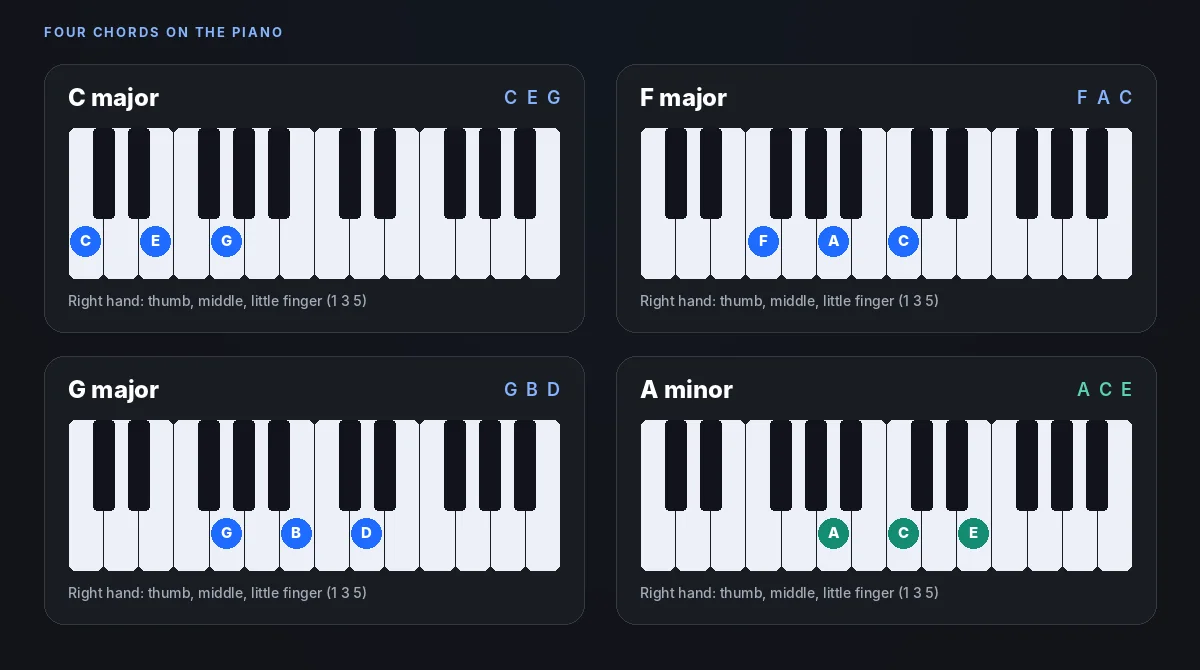
Piano chords for beginners
Find the notes, build any major or minor chord by counting keys, finger it, use inversions, loop four-chord progressions and sing along, with a two-week plan.
Read the guide
More free tools: beats, chords and voice
Play a piano, program a beat, name a chord, find a key on the circle of fifths, build a progression, change key, tune up and find your vocal range.
Your song deserves a music video
Upload a track and get a free beat-synced storyboard in minutes. Render it when you are ready.
No card needed to start.






