The short answer
Music theory for songwriters comes down to a few ideas. There are 12 notes; a key picks seven of them with a pattern of whole and half steps; stacking every other note of a key gives its seven chords, numbered I to vii; and progressions, cadences and borrowed chords describe how those chords move. Learn them in C major, then move the numbers to any key.
- Twelve notes repeat in every octave, and a key uses seven of them.
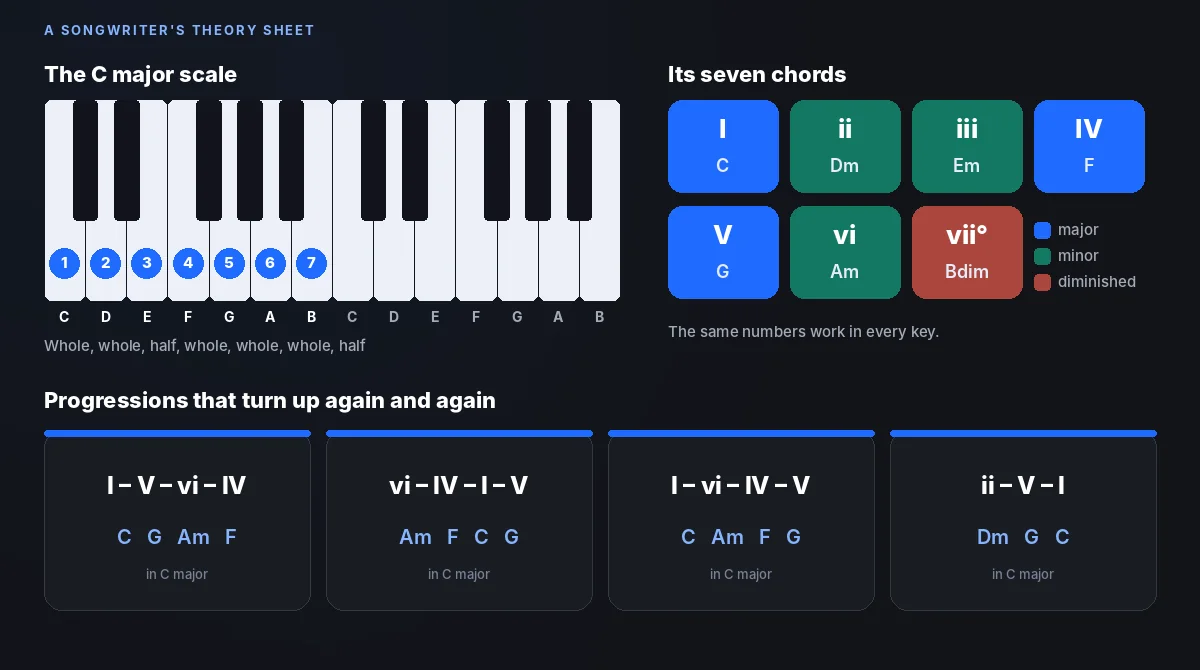
- The major scale's pattern is whole, whole, half, whole, whole, whole, half.
- A key's chords are numbered I to vii, so a progression written in numbers works in any key.
- V to I sounds like a full stop, IV to I like an amen, V to vi like a swerve.
- Borrowed chords and modes are colors you add on purpose, not rules you break.
On this page (15 sections)ShowHide
- 1.Notes, octaves, half steps and whole steps
- 2.Intervals: the distance between two notes
- 3.The major scale and keys
- 4.Minor keys: relative, parallel, harmonic and melodic
- 5.Chords: triads built from the scale
- 6.Seventh chords
- 7.Roman numerals: chords as numbers
- 8.How to work out a song's key and chords by ear
- 9.Common chord progressions
- 10.Cadences: how a phrase ends
- 11.Borrowed chords, secondary dominants and key changes
- 12.Modes as colors
- 13.Rhythm and meter
- 14.Putting it together in a song
- 15.From the chord chart to the music video
- Questions
Notes, octaves, half steps and whole steps
Western music uses 12 notes. Seven have letter names, A to G, and sit on a piano's white keys; the other five, on the black keys, are named after their neighbors with a sharp (♯, a half step up) or a flat (♭, a half step down). The black key between C and D is both C♯ and D♭: the same sound with two spellings, called enharmonic, and which one you write depends on the key you're in.
After 12 notes the letters start again, one octave higher, and the new note vibrates exactly twice as fast: A3 is 220 Hz, A4 is 440 Hz and A5 is 880 Hz. That's why two notes an octave apart sound like the same note in a different voice. Middle C is C4 in the naming most tools use, about 261.63 Hz, though some music software labels it C3.
The smallest distance between two notes is a half step (a semitone): from one key to the very next, white or black, or one fret on a guitar. Two half steps make a whole step (a tone). Between E and F, and between B and C, there's no black key, so those pairs are only a half step apart. That uneven spacing of the white keys is what gives scales and keys their shapes.
- Half step
- The smallest distance between two notes in Western music, one piano key or one guitar fret; also called a semitone.
- Whole step
- Two half steps, such as C to D or E to F♯; also called a tone.
- Octave
- The distance of 12 half steps, where the note name repeats and the frequency doubles.
- Enharmonic
- Two names for the same pitch, such as C♯ and D♭; the key decides which is written.
- Tonic
- The home note of a key, the one the music sounds finished on; C in C major, A in A minor.
Intervals: the distance between two notes
An interval is the distance from one note to another. Its number comes from counting letter names, both ends included: C up to E is a third (C, D, E), C up to G a fifth. Its quality, major, minor, perfect, augmented or diminished, comes from the exact number of half steps. Every chord and every melody is built from intervals, so these twelve are the vocabulary.
| Half steps | Interval | From C | Often heard as |
|---|---|---|---|
| 1 | Minor second | C to D♭ | A tense rub |
| 2 | Major second | C to D | A step, the start of a scale |
| 3 | Minor third | C to E♭ | The color of a minor chord |
| 4 | Major third | C to E | The color of a major chord |
| 5 | Perfect fourth | C to F | Open, lifting |
| 6 | Tritone | C to F♯ or G♭ | Unsettled, wanting to move |
| 7 | Perfect fifth | C to G | Strong and hollow, the power chord |
| 8 | Minor sixth | C to A♭ | Bittersweet |
| 9 | Major sixth | C to A | Warm, sweet |
| 10 | Minor seventh | C to B♭ | Bluesy, unfinished |
| 11 | Major seventh | C to B | Dreamy, a half step short of home |
| 12 | Octave | C to C | The same note, higher |
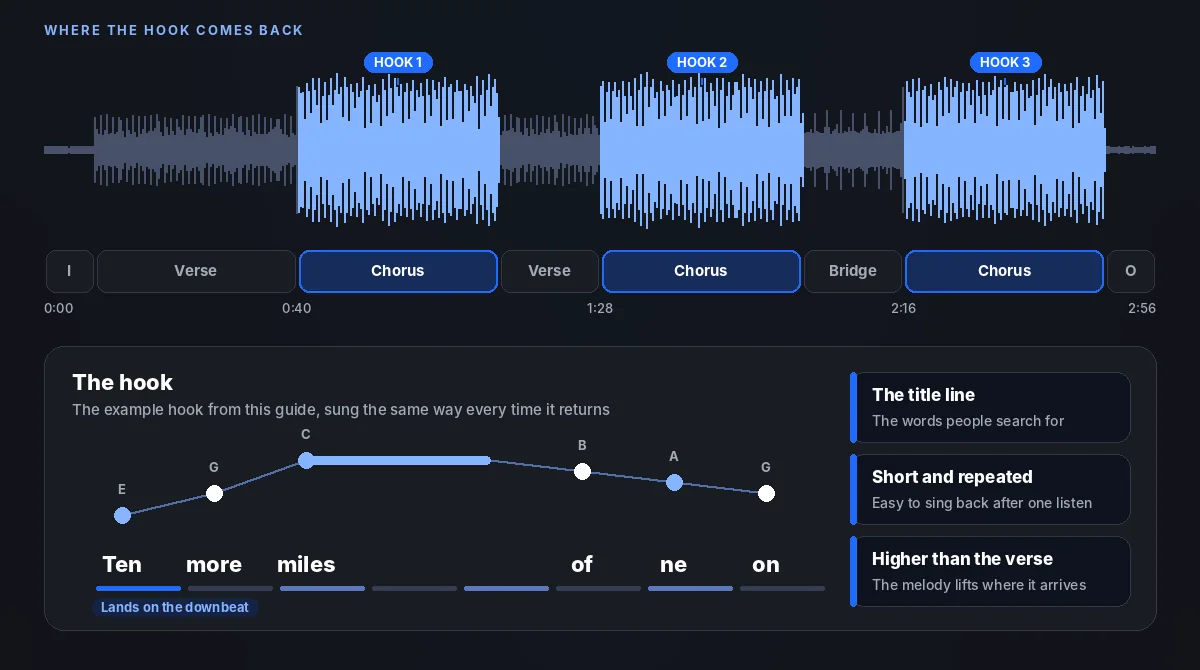
In a melody, small intervals (seconds) sound like speech and large ones (fourths, fifths, sixths) sound like a cry or a call. Most memorable melodies move mostly by step and save a leap for the word that matters, then step back in the other direction. How to write a hook shows a leap of a fourth doing exactly that on a title line.
Skip the blank page
Upload your song and Muvora's AI director plans a shot-by-shot storyboard on the beat. Edit every shot for free, and pay only if you render.
The major scale and keys
A major scale follows one pattern of steps: whole, whole, half, whole, whole, whole, half. Start on C and the pattern lands on white keys only: C D E F G A B C. Start on G and the seventh note has to be F♯ to keep the pattern: G A B C D E F♯ G. Start on F and the fourth note becomes B♭. Every major key is that same pattern from a different starting note, which is why every major key sounds alike apart from its height.
A key is a scale plus a home: the seven notes a song mostly uses, and the tonic it sounds finished on. The key signature is the list of sharps or flats that key needs, written once at the start of the staff: none for C major, one sharp (F♯) for G major, one flat (B♭) for F major. The circle of fifths arranges all twelve keys by how many sharps or flats each has.
| Degree | Name | In C major | In G major |
|---|---|---|---|
| 1 | Tonic | C | G |
| 2 | Supertonic | D | A |
| 3 | Mediant | E | B |
| 4 | Subdominant | F | C |
| 5 | Dominant | G | D |
| 6 | Submediant | A | E |
| 7 | Leading tone | B | F♯ |
Choose a song's key by singing, not by habit. The chorus's highest note should sound strong rather than strained, and the verse's lowest note should still be audible; the vocal range test tells you where your voice sits. On guitar, a capo raises everything a half step per fret, so the shapes of a song in G played with a capo on the second fret sound in A.
Scale finderShow any scale in any key on a keyboard and a guitar neck, hear it played up and down, see its chords, or tick the notes you've used to find the scales that fit them.Minor keys: relative, parallel, harmonic and melodic
The natural minor scale's pattern is whole, half, whole, whole, half, whole, whole. From A it lands on the white keys again: A B C D E F G A. So A minor and C major share all seven notes and the same key signature; they're relative keys, and the minor one's tonic is always three half steps below the major's. G major's relative minor is E minor, with the same single F♯. What makes a song in those notes sound major or minor is which note and which chord it treats as home.
The parallel minor shares the tonic instead: C minor is C D E♭ F G A♭ B♭, three flats. Switching between C major and C minor keeps the same home and changes the mood, and borrowing chords from the parallel minor is one of the most useful colors a songwriter has (see borrowed chords).
Natural minor's fifth chord is minor (Em in A minor), which pulls home only weakly. Harmonic minor raises the seventh note a half step, G to G♯ in A minor, so the fifth chord becomes E major (E G♯ B) and its G♯ leans straight up into A. Melodic minor raises the sixth as well (F♯ and G♯ in A minor) to smooth out the melody's climb; in classical music it falls back to natural minor on the way down, while jazz uses the raised form both ways.
Chords: triads built from the scale
A triad is three notes stacked in thirds: a root, the third above it and the fifth above that. The size of each third decides the chord's kind.
| Kind | Built from | Example | Written |
|---|---|---|---|
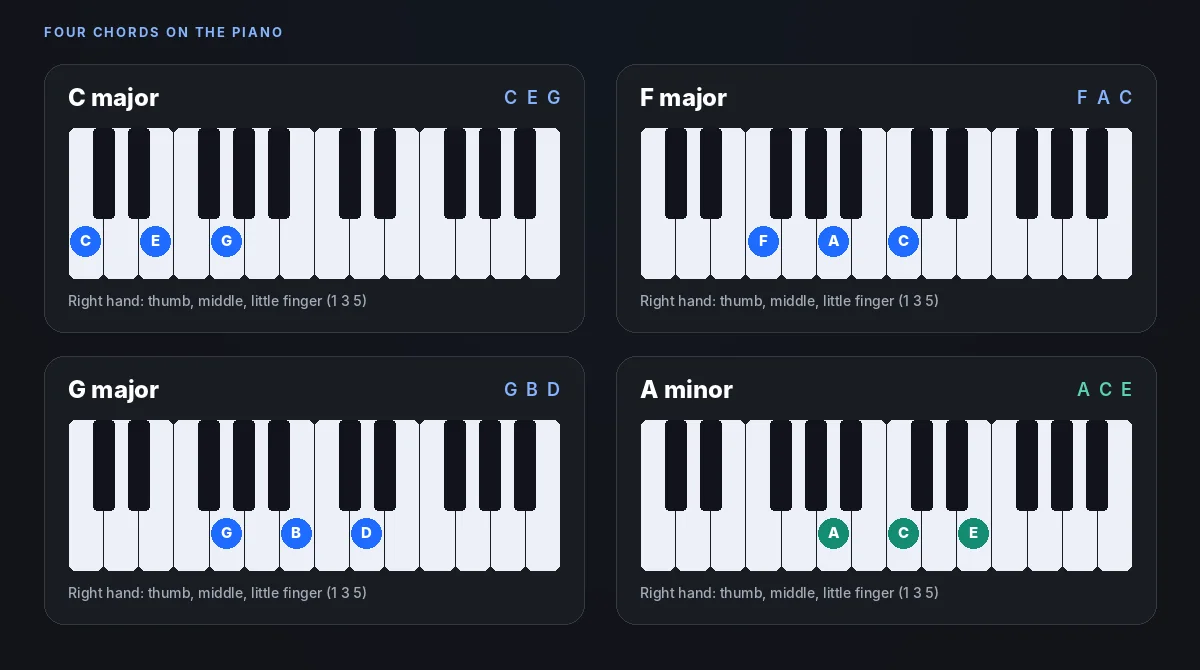
| Major | Major third, then minor third (4 + 3) | C E G | C |
| Minor | Minor third, then major third (3 + 4) | A C E | Am |
| Diminished | Two minor thirds (3 + 3) | B D F | B° or Bdim |
| Augmented | Two major thirds (4 + 4) | C E G♯ | C+ or Caug |
Build a triad on each note of a major scale, using only notes from that key, and you get the key's seven chords. The pattern is the same in every major key: major chords on degrees 1, 4 and 5, minor chords on 2, 3 and 6, and a diminished chord on 7.
| Degree | Numeral | In C major | In G major | Kind |
|---|---|---|---|---|
| 1 | I | C | G | Major |
| 2 | ii | Dm | Am | Minor |
| 3 | iii | Em | Bm | Minor |
| 4 | IV | F | C | Major |
| 5 | V | G | D | Major |
| 6 | vi | Am | Em | Minor |
| 7 | vii° | B° | F♯° | Diminished |
A chord's notes can be stacked in any order. When a note other than the root is lowest, the chord is an inversion, written as a slash chord: C/E is a C chord with E in the bass, C/G one with G in the bass. Inversions let a bass line walk by step under changing chords: C, G/B and Am put C, B and A in the bass, a falling line heard in countless ballads. To name a chord from its notes, or see the notes of any chord symbol, use the chord finder; for the shapes on a guitar, the guitar chord chart.
Seventh chords
Stack one more third on a triad and you have a seventh chord: four notes, and a richer color. Built from the notes of a major key, they come in four kinds.
| Chord | Built as | Example | Where it sits in a major key | Its sound |
|---|---|---|---|---|
| Major seventh | Major triad plus a major seventh | Cmaj7: C E G B | I and IV | Soft, warm, a little dreamy |
| Dominant seventh | Major triad plus a minor seventh | G7: G B D F | V | Restless, pulling toward I |
| Minor seventh | Minor triad plus a minor seventh | Dm7: D F A C | ii, iii and vi | Mellow and smooth |
| Half-diminished | Diminished triad plus a minor seventh | Bm7♭5: B D F A | vii | Tense and unresolved |
The dominant seventh explains why V wants to go to I. G7 contains B and F, a tritone apart; in the C chord that follows, B rises a half step to C and F falls a half step to E, and that double resolution sounds like arriving home. Genres lean on sevenths differently: R&B, neo-soul, jazz and lo-fi live on major and minor sevenths, much rock and pop stays with triads, and the blues plays a dominant seventh on almost every chord.
Roman numerals: chords as numbers
Musicians write progressions in Roman numerals because numbers travel. Upper case means a major chord, lower case minor, ° diminished and + augmented, and a 7 adds the seventh (V7, ii7). I–IV–V is C, F and G in C major, G, C and D in G major, and E, A and B in E major. Learn a progression as numbers once and you can play it in any key, or spot it in a song you've never heard.
Minor keys are numbered from their own tonic: i, ii°, III, iv, v, VI and VII. In A minor that's Am, B°, C, Dm, Em, F and G; in E minor, Em, F♯°, G, Am, Bm, C and D. When a minor song borrows harmonic minor's major V, it's written V: E in A minor, B in E minor. A ♭ or ♯ in front of a numeral marks a chord from outside the key, such as ♭VII.
Chord transposerPaste a chord chart and move it to any key, with the capo positions that keep a guitar in open shapes.How to work out a song's key and chords by ear
- 01
Find the home note
Play the song and hum the note that feels like the end of a phrase, the one the music wants to rest on. Find that note on a piano or a guitar: it's most likely the tonic.
- 02
Decide whether it's major or minor
Play a major chord and then a minor chord on that note along with the song. The one that blends in is the key's home chord: major usually sounds brighter, minor heavier.
- 03
List the key's chords
Write down the seven chords of that key with their numerals, from the tables above or a scale tool. Most of the song's chords will come from that list.
- 04
Follow the bass
Listen for the lowest note at each chord change and find it on your instrument. Pick the chord from your list built on that note, and try major or minor until it matches.
- 05
Write it down in numbers
Write the progression as numerals, such as vi–IV–I–V, so you can compare it with other songs and recognize it the next time you hear it.
- 06
Move it to your own key
Transpose the numerals into a key that suits your voice, or keep the guitar shapes and use a capo: each fret raises the whole song by a half step.
Working from a recording rather than by ear? The BPM and key finder measures a song file's key and tempo, and the Camelot wheel translates keys into the codes DJs mix with.
Common chord progressions
A handful of progressions carry a large share of popular music, because they balance home, distance and return in a few chords. Using one is not a lack of imagination: the melody, the rhythm and the words make a song its own. What you should know is which one you're using, so you can choose where to start it and where to bend it.
| Numerals | In C major or A minor | In G major or E minor | Often heard in |
|---|---|---|---|
| I–V–vi–IV | C–G–Am–F | G–D–Em–C | Pop and rock choruses |
| vi–IV–I–V | Am–F–C–G | Em–C–G–D | Ballads; the same chords from vi feel sadder |
| I–vi–IV–V | C–Am–F–G | G–Em–C–D | 1950s doo-wop and retro pop |
| I–IV–V | C–F–G | G–C–D | Rock and roll, country and folk |
| ii–V–I | Dm7–G7–Cmaj7 | Am7–D7–Gmaj7 | Jazz, R&B and lo-fi |
| i–VI–III–VII | Am–F–C–G | Em–C–G–D | Minor-key pop, rock and hip-hop loops |
| i–VII–VI–V | Am–G–F–E | Em–D–C–B | Flamenco, rock and film scores |
| 12-bar blues | C C C C, F F C C, G F C C | G G G G, C C G G, D C G G | Blues and early rock and roll |
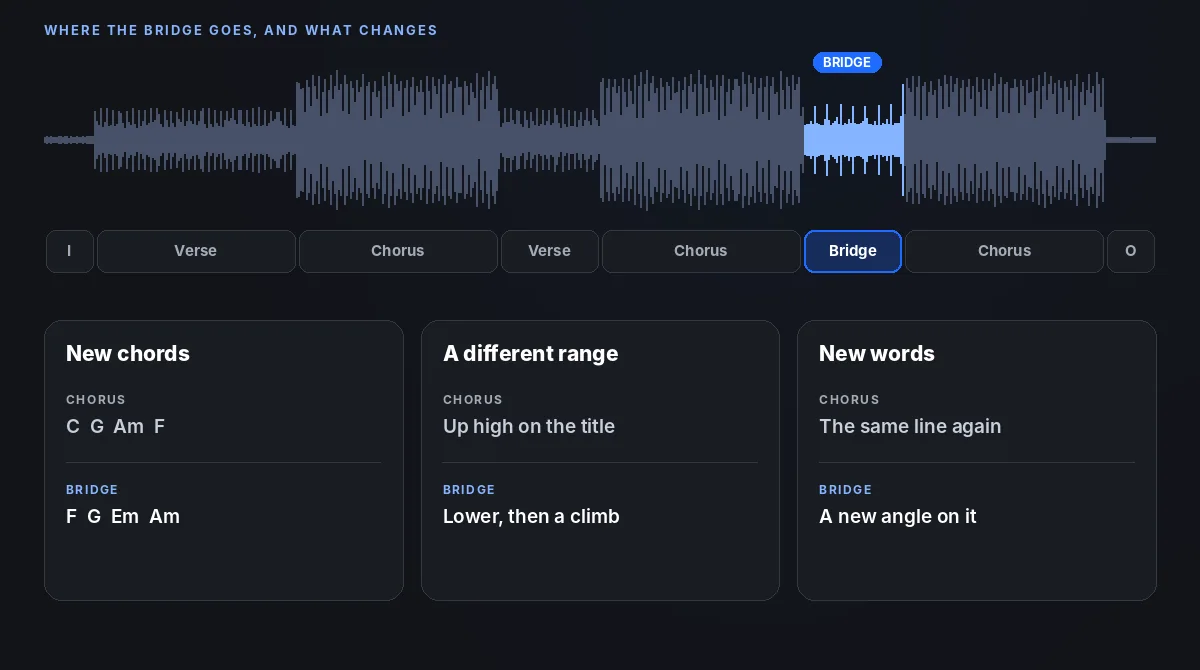
Notice that vi–IV–I–V and i–VI–III–VII are the same four chords: whether a song in them sounds major or minor depends on which chord it treats as home and where the melody rests. A common way to give each section its own feel is to start the verse away from home (on vi or IV), start the chorus on I so it lands, and open the bridge on a chord the song hasn't leaned on yet.
Chord progression generatorPick a key and a mood for common progressions as numerals and chord names, play them on a loop, and take them into your DAW as MIDI.Turned the progression into a song? Give it a video
Upload the recording, MP3, WAV, M4A, AAC or FLAC up to 8 minutes, and Muvora reads its tempo, key and sections, then writes a storyboard with a cut on every section change, each on a downbeat. Reading and editing it is free, with 5 new storyboards a month on the free plan.
Cadences: how a phrase ends
A cadence is the last two chords of a phrase, and it works like punctuation. Songwriters use cadences to decide whether a section sounds finished or leaves the listener leaning forward into the next one.
| Cadence | Chords | In C major | In G major | Sounds like |
|---|---|---|---|---|
| Authentic | V–I | G–C | D–G | A full stop |
| Plagal | IV–I | F–C | C–G | A softer close, the amen at the end of a hymn |
| Half | Any chord to V | F–G | C–D | A comma or a question |
| Deceptive | V–vi | G–Am | D–Em | A swerve: home was expected, the relative minor came |
Put them to work on purpose. A pre-chorus that ends on V (a half cadence) makes the chorus feel inevitable. A chorus that ends V–I sounds finished, which suits the last one; ending the earlier ones on a deceptive V–vi, or simply on IV, keeps the song moving. Repeating a chorus's last line over V–vi before the real V–I is an old way to stretch the final chorus.

Borrowed chords, secondary dominants and key changes
The chords outside a key aren't wrong; they're colors. The most useful come from the parallel minor, which shares the home note: in C major you can borrow iv (Fm), ♭VI (A♭), ♭VII (B♭) and ♭III (E♭); in G major, Cm, E♭, F and B♭. Each brings a shadow into a bright key without leaving it.
- IV–iv–I (F–Fm–C in C): the major four turning minor just before home, a sigh at the end of a ballad's chorus.
- I–♭VII–IV–I (C–B♭–F–C): a rock and gospel move with a bluesy, open sound.
- ♭VI–♭VII–I (A♭–B♭–C): two borrowed chords climbing into the tonic, a lift that suits a last chorus or a big ending.
- A secondary dominant: the V of a chord other than I. D or D7 in C major is the V of G, so it pushes toward G; E or E7 is the V of Am. In G major, A or A7 points at D.
- A Picardy third: a song in a minor key ending on the major tonic, A major at the end of a song in A minor, for a sudden warmth in the last chord.
A key change (modulation) moves the whole song somewhere new. The common pop move is to lift the last chorus up a half step or a whole step, C to D♭ or C to D, often with no preparation at all. A smoother route uses a pivot: a chord that belongs to both keys, such as Am, which is vi in C major and ii in G major, followed by the new key's V. The circle of fifths shows which keys sit next to each other and share the most chords.
Modes as colors
A mode is a scale's notes with a different note as home. Play only the white keys but treat D as the tonic and you get D Dorian; treat G as home and you get G Mixolydian. Each mode is a major or minor scale with one or two notes moved, and that one note gives it a color. For a songwriter the useful question isn't the name; it's which chord carries that color.
| Mode | White-key home | Compared with major or minor | Often heard as | Its color chord | In G major's notes |
|---|---|---|---|---|---|
| Ionian | C | The major scale itself | Bright, settled | I (C) | G Ionian |
| Dorian | D | Minor with a raised sixth | Minor but hopeful | A major IV (G in D Dorian) | A Dorian |
| Phrygian | E | Minor with a lowered second | Dark and tense | ♭II (F in E Phrygian) | B Phrygian |
| Lydian | F | Major with a raised fourth | Dreamy, floating | A major II (G in F Lydian) | C Lydian |
| Mixolydian | G | Major with a lowered seventh | Bluesy, rock | ♭VII (F in G Mixolydian) | D Mixolydian |
| Aeolian | A | The natural minor scale | Sad, serious | ♭VI and ♭VII (F and G) | E Aeolian |
| Locrian | B | Minor with a lowered second and fifth | Unstable, rarely a home | A diminished i (B°) | F♯ Locrian |
The quickest way to hear a mode is a two-chord loop that keeps its color chord next to the tonic: Dm to G for Dorian, Em to F for Phrygian, F to G for Lydian, G to F for Mixolydian. Moved to other keys, Dorian's loop in A is Am to D and Mixolydian's in D is D to C. Write a verse over one of these and the song takes on that color without anyone in the band needing the word.
Scale finderPick a mode and a key to see its notes on a keyboard and a guitar neck, hear it, and see its chords with their numerals.Rhythm and meter
Meter groups beats into bars. The time signature's top number says how many beats a bar has, the bottom one which note gets the beat: 4/4 means four quarter-note beats. In 4/4 a whole note lasts four beats, a half note two, a quarter note one, an eighth half a beat and a sixteenth a quarter of one. A triplet squeezes three notes into the time of two, and swing plays pairs of eighth notes long-short instead of even.
| Meter | Counted | Beats you feel | Often heard in |
|---|---|---|---|
| 4/4 | 1 2 3 4 | Four | Most pop, rock, hip-hop and dance music |
| 3/4 | 1 2 3 | Three | Waltzes, some folk and country ballads |
| 6/8 | 1 2 3 4 5 6 | Two, each split in three | Folk songs and slow rock ballads |
| 12/8 | Four groups of three | Four, each split in three | Slow blues, doo-wop and soul ballads |
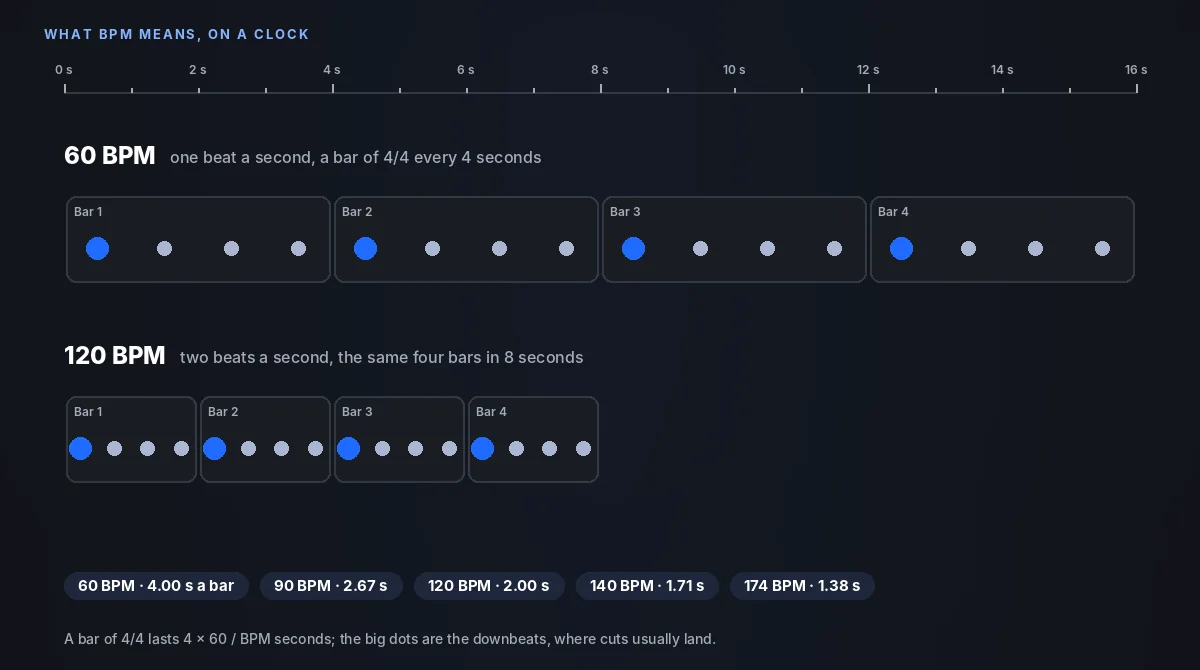
Syncopation, an accent between the beats, is what makes a rhythm feel like it's leaning: a chord that arrives on the "and" before beat one, a vocal line that starts just after the downbeat. Tempo is the speed, in beats per minute; in 4/4 a bar lasts 240 divided by the BPM, in seconds, so 2 seconds at 120 BPM. What is BPM? covers tempo in depth, and the metronome keeps any meter steady while you write.
Putting it together in a song
Here's how the pieces map onto song form, using one song in G major. Each section's chords are chosen for its job: the verse starts away from home, the pre-chorus ends on V, the chorus lands on I with the title, and the bridge borrows two chords to lift into a last chorus a whole step higher. Song sections usually run 4, 8 or 16 bars; song structure explained covers what each one is for.
| Section | Chords | Numerals | Why |
|---|---|---|---|
| Verse | Em–C–G–D | vi–IV–I–V | Starts away from home, so the verse feels unsettled |
| Pre-chorus | C–D | IV–V | Ends on V, a half cadence, so the chorus has to come |
| Chorus | G–D–Em–C | I–V–vi–IV | Lands on I on the downbeat, under the title line |
| Bridge | E♭–F–G | ♭VI–♭VII–I | Two borrowed chords climb into the tonic |
| Last chorus | A–E–F♯m–D | I–V–vi–IV in A | Up a whole step for the final lift |
- Chord tones on strong beats: over a G chord, land on G, B or D on beat one, and let other notes pass between them.
- Let tendency notes resolve: the seventh note of the scale (F♯ in G) wants to rise to the tonic, and over D7 the C wants to fall to B.
- Steps with one leap: move mostly by step and leap on the word that matters, then step back the other way.
- Range by section: keep the verse lower and the chorus higher, so the chorus sounds like an arrival.
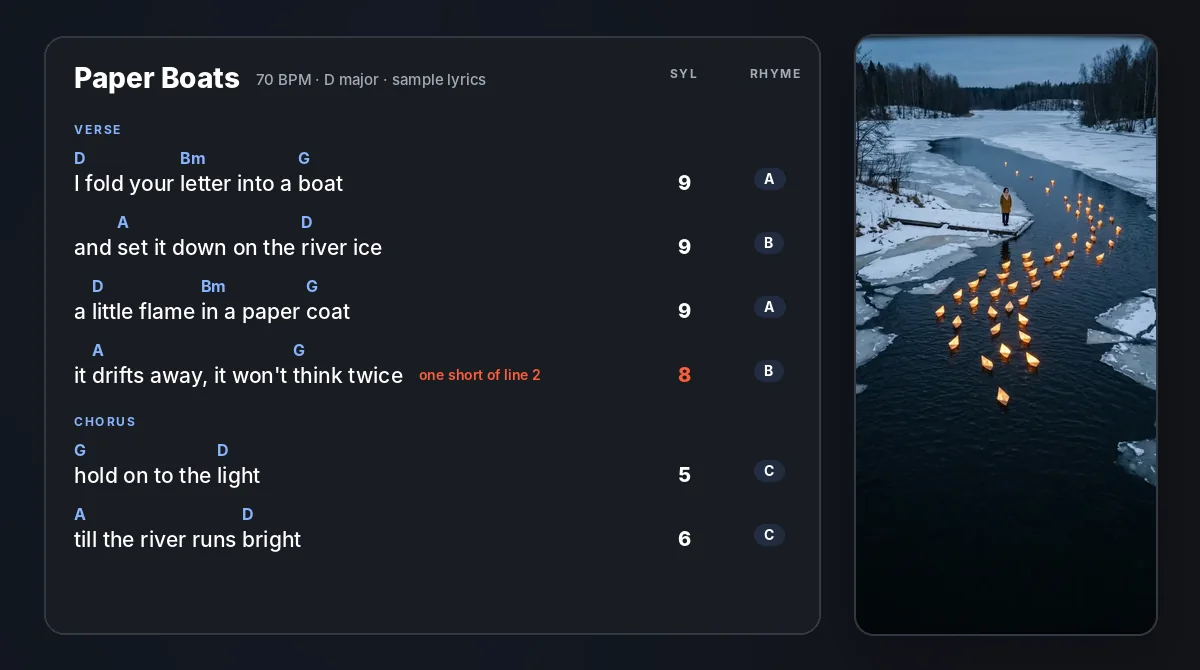
From there, the craft is in the words and the tune: how to write a song walks through the whole process, and how to write rap lyrics covers verses built on rhythm rather than melody. If you play guitar, keep it in tune first with how to tune a guitar.
From the chord chart to the music video
Once the song is recorded, Muvora makes its music video from the recording itself, not from a chart. Its free analysis reads the tempo, every beat and downbeat, the sections, the energy of every beat, the drops and the key. The shot planner then puts every cut on a downbeat and a cut at every section change, holds long shots where the song is quiet and cuts faster where it's loud, so a bridge the analysis hears as a section of its own opens on a new shot, and a loud last chorus gets the fastest cutting.
Hear the theory, then see it
Upload your song and read the storyboard for free: change any shot's prompt, framing or camera move, or drag a cut to another beat. The price shows before anything renders, and shots that fail cost nothing.
Written by the Muvora team. Last updated November 17, 2026. Spotted something out of date? Tell us at [email protected].