The short answer
To write a song, start with a title or a hook line that sums up one feeling, pick a simple form such as verse, chorus, verse, chorus, bridge, chorus, and write the chorus around the hook. Choose three or four chords, find a melody by singing over them, fit the verses' words to that melody, then record a rough demo and revise.
- Start from a title or a hook: one line that says what the song is about.
- Write the chorus first when you're stuck; it's the part people remember.
- Three or four chords are enough for a whole song.
- Keep each verse line close in syllables to the line it replaces, so it fits the same melody.
- Agree the splits with your co-writers on the day you write, not after the release.
On this page (12 sections)ShowHide
- 1.Start with a title, a hook or a feeling
- 2.How to write a song in eight steps
- 3.Choose a form: what each section does
- 4.Write the chorus first, or start at the top
- 5.Pick the chords
- 6.Find the melody and the rhythm
- 7.Write lyrics that fit the melody
- 8.Rhyme without forcing it
- 9.Write the bridge
- 10.Finish the song and record a demo
- 11.Co-writing and splitting the song
- 12.Release it, and give it a video
- Questions
Start with a title, a hook or a feeling
A blank page is hard because it has no edges. Give the song one: a title, or a single line you'd like to hear sung back to you, that holds one feeling or one situation. "Paper boats" is a better starting point than "a song about loss", because it already suggests a picture, a rhythm and a place for the words to go. Everything you write afterwards either points at that line or gets cut.
- A phrase you overheard or said yourself and wrote down. Keep a running note on your phone for these; most writers' best titles come from it.
- One specific moment: the bus stop, the kitchen at 3 a.m., the last text before you deleted the thread. Specific beats general every time.
- A chord loop or a riff that won't leave you alone. Loop it and sing nonsense syllables over it until a few real words stick.
- A beat or an instrumental you've licensed or made. Write to its sections, and read its license before you release anything on it.
- A question the song answers, such as "what if I'd stayed?" A question gives the verses something to do and the chorus something to land on.
How to write a song in eight steps
- 01
Pick the idea and the title
Write the title or hook line at the top of the page, then list five or six images, places and details that belong to it. These are the raw material for the verses.
- 02
Choose a form
Start with verse, chorus, verse, chorus, bridge, chorus, the most common shape in pop, rock and country. You can bend it later, but a known shape tells you what each part has to do.
- 03
Write the chorus
Build the chorus around the title, usually in its first or last line, and keep it short and repeatable: two to four lines that say the song's main idea plainly.
- 04
Find the chords
Pick a key that suits your voice and three or four chords to loop under the chorus. Use the same chords or a close variation for the verses, and save a new chord for the bridge.
- 05
Sing a melody over the chords
Loop the chords at a steady tempo and improvise on vowel sounds until a melody repeats itself. Record it, keep the strongest version and make the chorus sit higher or move more than the verse.
- 06
Write the verses to fit
Fill the verse melody with details from your list, one picture per line, matching the number of syllables and where the strong ones fall so the second verse fits the melody the first one made.
- 07
Add a bridge, or decide against one
After the second chorus, change something: a new chord to start on, a different melody range or a turn in the story. If the song already feels complete, a short instrumental or a repeated chorus does the job.
- 08
Finish it, demo it and revise
Record a rough demo with just your voice and one instrument, listen the next day, and fix the weakest line and the weakest melody moment first. Play it for one person before you call it done.

Skip the blank page
Upload your song and Muvora's AI director plans a shot-by-shot storyboard on the beat. Edit every shot for free, and pay only if you render.
Choose a form: what each section does
Song form is the order of the sections. You don't need an unusual one; a familiar shape lets the listener relax and follow the story, and your ideas do the surprising. What matters is knowing the job of each part, so you write each one for that job. For the full picture of forms and how many bars each section usually lasts, read song structure explained.
| Section | What it does | Typical length | How to write it |
|---|---|---|---|
| Intro | Sets the key, the tempo and the mood before the voice | 2 to 8 bars | Use the chorus chords or a riff; keep it short so the singing starts soon |
| Verse | Tells the story with details and moves it forward | 8 or 16 bars | Lower and more conversational than the chorus; new words each time |
| Pre-chorus | Builds tension and points at the chorus | 4 or 8 bars | Rising melody or a new chord; ends on something unresolved |
| Chorus | States the main idea, usually with the title | 8 bars, sometimes 16 | Simple, repeatable words over a higher or bigger melody |
| Post-chorus | Keeps the hook going after the chorus | 4 bars | A chant, a repeated word or a melody without words |
| Bridge | Gives contrast before the last chorus | 4 or 8 bars | A new chord to start on, a new angle on the story |
| Outro | Ends the song or fades it out | 2 to 8 bars | Repeat the hook, slow down or end on one held chord |
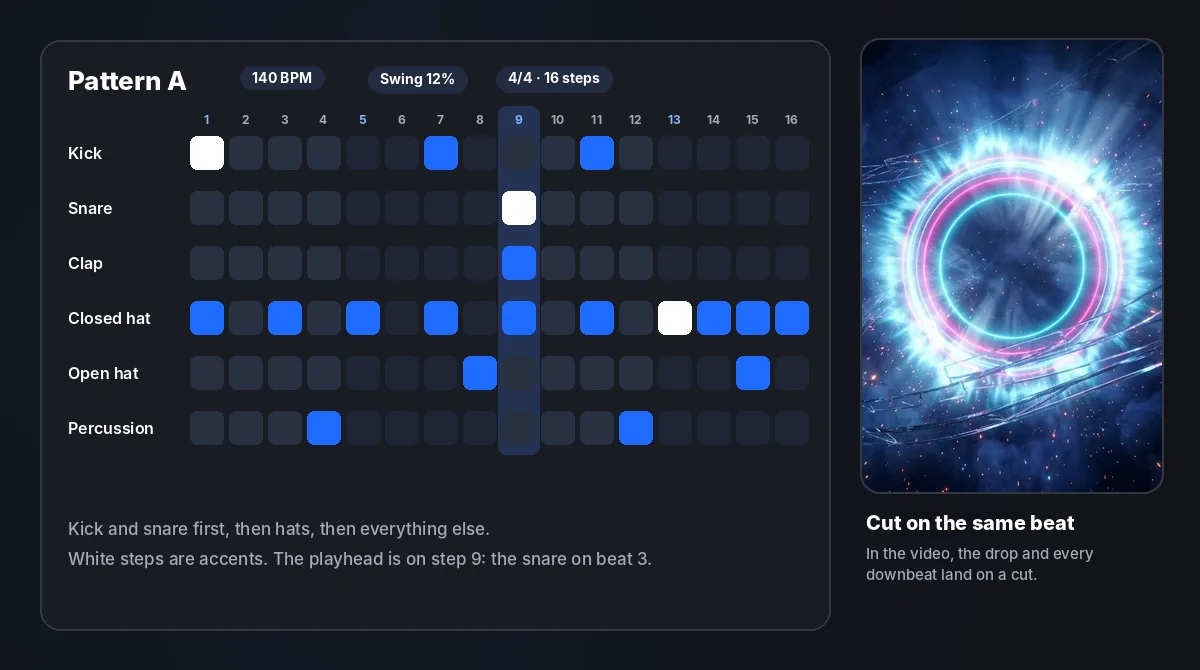
Bar height: how loud the section is. The strip under them: the shots, each cell one cut. Louder sections get more, shorter shots.
Write the chorus first, or start at the top
Writing the chorus first is the most common advice for beginners, and for good reason: the chorus carries the title and the main idea, so once it exists, every verse has a target to lead into. Writers who start from a story often begin with verse one instead and find the chorus by asking what the verse is really about. Either works; the trap is writing three verses with no chorus and hoping one appears.
- Put the title where it lands: the first or last line of the chorus, or both, on the longest or highest note.
- Say it plainly: a chorus has to be understood on first hearing over a full band. Save the clever imagery for the verses.
- Repeat on purpose: repeating the hook line twice or more in a chorus is normal, and it's what people end up singing along to.
- Leave room to breathe: shorter lines and longer notes than the verse make the chorus feel bigger without extra words.
Pick the chords
Three or four chords carry most popular songs. In a major key, the chords built on the first, fourth, fifth and sixth notes of the scale (I, IV, V and vi; C, F, G and Am in C major) sound like they belong together, and looping them in different orders gives very different moods. A minor key does the same from its own home chord. Choose the key by singing: the chorus's highest note should feel strong, not strained.
Chord progression generatorPick a key and a mood, from happy pop to sad ballad, gospel or lo-fi, for common progressions as numerals and chord names. Play them on a loop, copy the chart or take a MIDI file into your DAW.Use the same chords for verse and chorus if you like; plenty of songs do, and the melody and the arrangement make the change. If the chorus needs to lift, start it on a different chord than the verse, or add one chord the verse never uses. When the song is in the wrong key for your voice, move the whole chart with the chord transposer and it lists the capo positions that keep a guitar in open shapes.
Find the melody and the rhythm
Loop the chords at a steady tempo and sing over them on open vowels ("ooh", "ah") before you try words. You're listening for a short shape that wants to repeat: two or three notes and a rhythm. Record a few minutes of this and keep what you find yourself humming later. Then give the verse and the chorus different shapes so they never blur into each other.
- Range: keep the verse lower and narrower, then let the chorus climb. The jump between them is what makes a chorus feel like an arrival.
- Rhythm: busy, speech-like rhythms suit verses; longer held notes suit choruses. Starting a line just before the beat or just after it changes its whole feel.
- Repetition with a change: repeat a melodic phrase, then alter its last few notes the second or fourth time. Listeners like knowing what comes, with a small surprise.
- Tempo: sad ballads often sit somewhere around 60 to 80 BPM and upbeat pop often around 100 to 130, but write at the speed the words feel natural when you say them.
Write lyrics that fit the melody
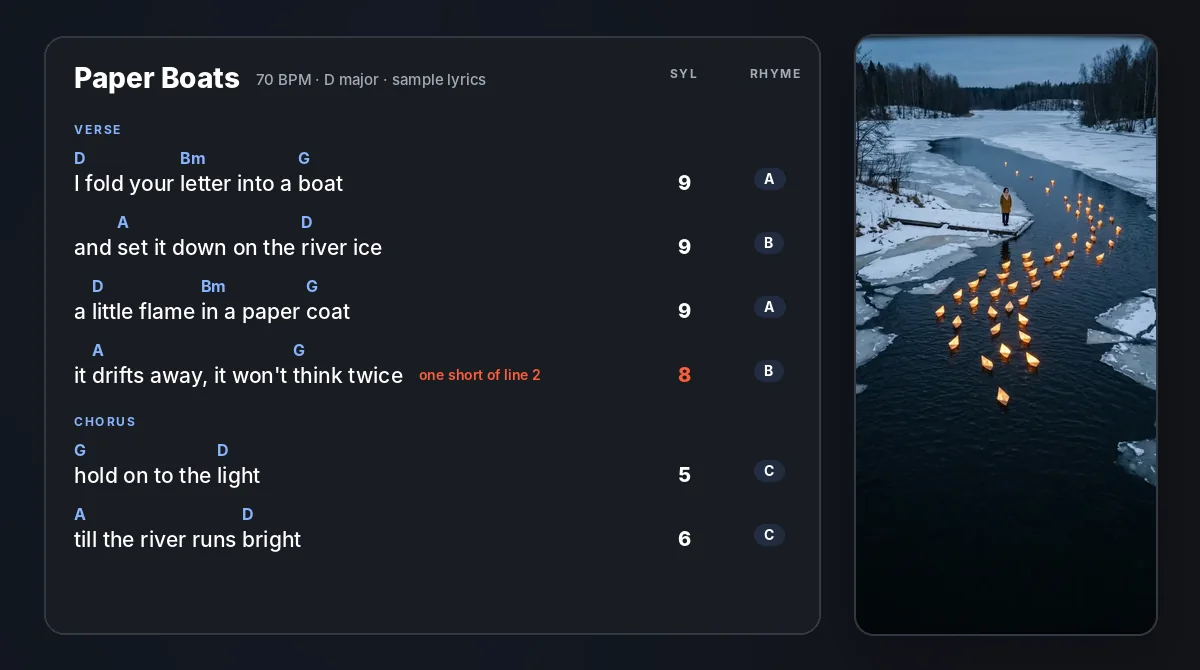
Lyrics on a page and lyrics in a melody are different things. A line can read beautifully and sing badly because it has too many syllables for the notes, or because its strong syllables fall on weak beats ("be-LIEVE" sung as "BE-lieve"). Once verse one has a melody, it becomes the template: each line in verse two should land close to the syllable count of the line it replaces, with its stresses in the same places.
- Show the picture: "the porch light you left on" does more than "I miss you". Concrete nouns and actions give the listener something to see.
- One idea per line: if a line needs a breath in the middle to make sense, split it in two.
- Verse two moves on: the second verse should tell us something new, a later moment, a consequence or the other person's side, not repeat verse one in other words.
- Sing every line out loud: cut words you trip over, and swap any word whose stress fights the beat for one that doesn't.
Rhyme without forcing it
Rhyme makes lines feel connected and easy to remember, but a forced rhyme, a word picked only because it rhymes, is the fastest way to lose a listener. Decide where you need rhymes (most often at the ends of the second and fourth lines, or in pairs) and leave the rest free. When the perfect rhyme says the wrong thing, a near rhyme that keeps the meaning usually sounds better sung than it looks written.
| Kind | Example | When to use it |
|---|---|---|
| Perfect rhyme | night / light | Choruses and hooks, where you want the click of a full rhyme |
| Slant (near) rhyme | home / alone | When the perfect rhyme would bend the meaning; common in modern pop |
| Multi-syllable rhyme | never / forever | Rap and fast verses, to make lines lock together |
| Internal rhyme | a rhyme inside the line | To add pace and glue without waiting for the line's end |
Rhyme schemes are written as letters: ABAB rhymes the first and third lines and the second and fourth; AABB rhymes in pairs; ABCB rhymes only the second and fourth, which leaves the most room for what you actually want to say. Pick one for the verses and keep it, so the verses match each other.
Write the bridge
The bridge arrives after the second chorus, when the listener has heard the main material twice. Its job is contrast, so the last chorus feels fresh. Change at least one thing: start on a chord the song hasn't leaned on yet (the IV or the vi often works), move the melody higher or lower than anything before, or turn the story with a confession, a question or a moment from later on. Four or eight bars is usually enough.
Finish the song and record a demo
A finished song beats a perfect one you never play for anyone. Once every section exists, record a demo: your voice and one instrument into a phone is enough, at a steady tempo so you can hear whether the sections flow. Listen the next day, fix the weakest line and the weakest melody moment, and stop revising when your changes start making it different rather than better.
- The title is in the chorus and lands on a strong note.
- Each verse adds something new to the story.
- Matching lines in verse one and verse two are close in syllables.
- The chorus melody sits higher or moves more than the verse.
- No line exists only to rhyme.
- You can sing it through without reading the words.
- One person has heard it and could tell you what it's about.
Recorded it? See it as a music video
Upload the demo or the finished recording, MP3, WAV, M4A, AAC or FLAC up to 8 minutes, and Muvora reads its tempo, key and sections, then writes a storyboard with every cut on a downbeat. Paste your lyrics and they're lined up with your vocal. Reading and editing the storyboard is free, with 5 new storyboards a month on the free plan.
Co-writing and splitting the song
When you write with other people, agree who owns how much of the song before everyone goes home. A split sheet records the song's title, each writer's legal name, their role and their share of the composition (the words and the music, which is what publishing royalties are paid on), signed by every writer. The recording itself, the master, is a separate agreement. Many co-writers simply split evenly, but any shares work if everyone agrees and they add up to 100%. This is general information, not legal or tax advice.
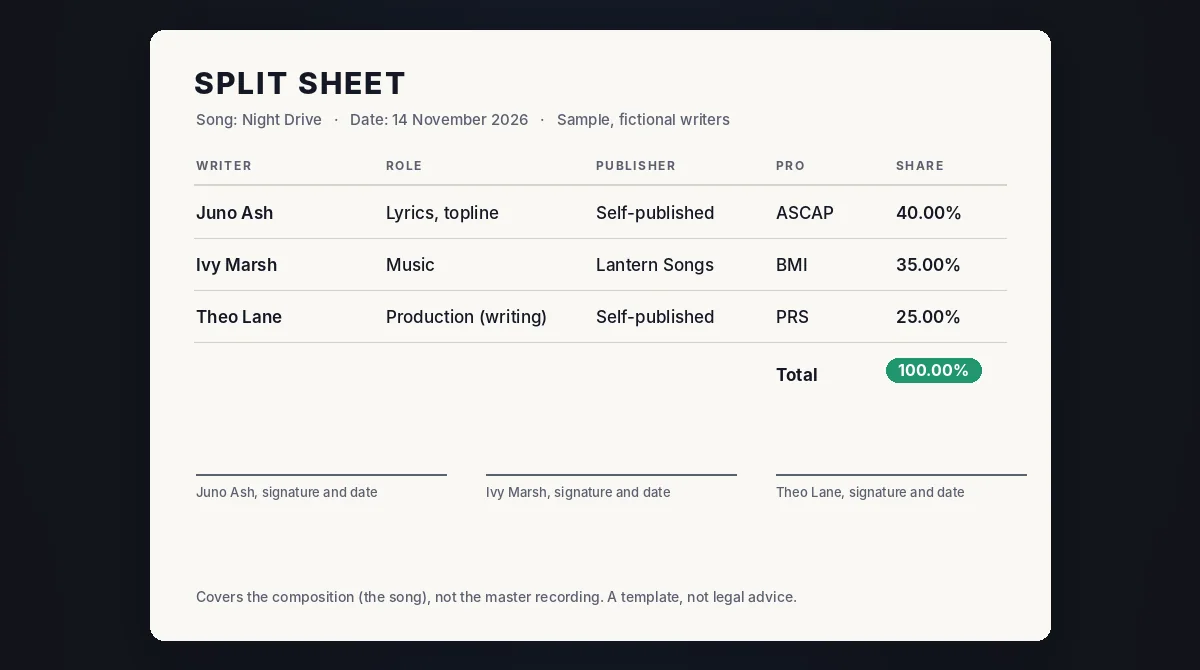
Your shares follow the song when it's registered with a performing rights organization, such as ASCAP or BMI in the US, PRS in the UK or SOCAN in Canada, and with your distributor or publisher. Read what a split sheet is for what it should include and when to sign one.
Split sheet generatorFill in the song, the writers and their shares, and print a split sheet that won't let the shares add up to anything but 100%.Release it, and give it a video
When the song is recorded, mixed and mastered, a distributor sends it to the streaming services, and a release date gives you a few weeks to pitch it and prepare its visuals. How to release music independently walks through the whole plan. Check the master's loudness against what the services do with it, explained in LUFS for streaming, before you upload.
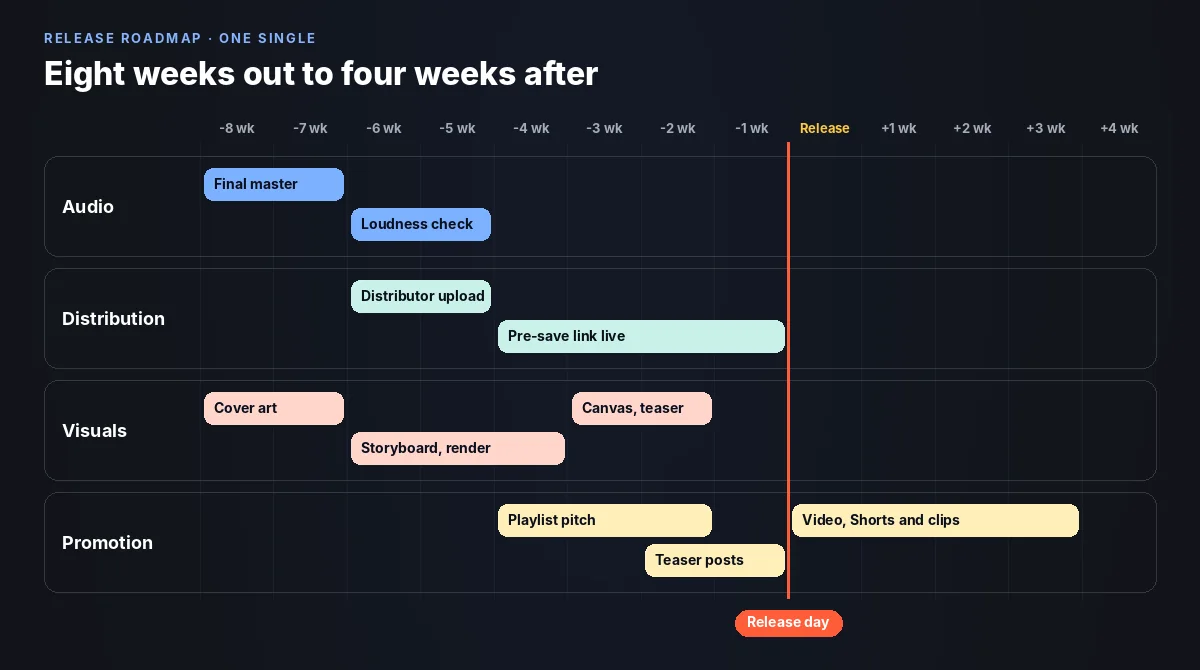
A song people can see travels further on YouTube, Reels and TikTok than one with a still image. Muvora doesn't write or make music; it makes the video for a song you already have. It plans the cuts from your recording's beats and sections, writes a storyboard you can change shot by shot, and with the Performance style, one clear photo of you becomes shots that lip-sync to your own voice. One render gives you 16:9, vertical and square versions and a Spotify Canvas loop.
Give the song you wrote a video
Upload the song and get a free storyboard timed to its beats, or choose the Lyric style and the words you wrote appear as they're sung. See music videos for singer-songwriters for how it fits a voice-and-guitar song.
Written by the Muvora team. Last updated November 14, 2026. Spotted something out of date? Tell us at [email protected].