The short answer
To sing better, practice a little every day: warm up, stand tall with a loose jaw, breathe low and let the air out steadily, and check your pitch against a tuner or a piano note. Sing slowly on vowels before adding the words, record yourself and listen back, rest your voice when it's tired, and get a teacher's ear on your technique.
- Short daily practice builds control faster than a long session once a week.
- Singing off pitch is often a matching problem rather than a hearing one, so practice matching notes.
- Sing through the vowel: it carries the note, while consonants should be quick.
- A recording shows you what you can't hear while you sing.
- Pain, or hoarseness lasting more than three weeks, is a reason to see a doctor.
On this page (10 sections)ShowHide
- 1.What singing better actually means
- 2.A 20-minute daily practice routine
- 3.Posture and breath
- 4.Singing in tune
- 5.Tone: vowels, space and volume
- 6.Rhythm and diction
- 7.Record yourself and listen back
- 8.Looking after your voice
- 9.When to see a teacher, and when to see a doctor
- 10.Your best take, in a music video
- Questions
What singing better actually means
"Sing better" covers several separate skills, and most singers are stronger at some than others. Working out which one is holding a song back tells you what to practice this week. The table lists the six that matter most for recording and performing, what you'll hear on a recording when one needs work, and a first exercise for each.
| Skill | When it needs work, you'll hear | First exercise |
|---|---|---|
| Pitch | Long notes drifting flat, notes reached by sliding up from below, a melody slightly off its key | Hold a note while watching a tuner, then sing back a piano note after it stops |
| Breath | Phrases fading at the end, gasps mid-line, a thin sound on long notes | A slow, timed hiss on one breath |
| Tone | A pinched or strained sound on high notes, breathiness you didn't choose | Sing a phrase on one vowel, then put the words back |
| Rhythm | Words late or early against the beat, fast lines rushed | Speak the lyric in time against a metronome |
| Diction | Words a listener can't make out | Sing the lyric slowly with exaggerated consonants, then relax them |
| Expression | Every line at the same volume and color | Mark one word in each line to lean on and one line to sing softer |
A 20-minute daily practice routine
- 01
Warm up (5 minutes)
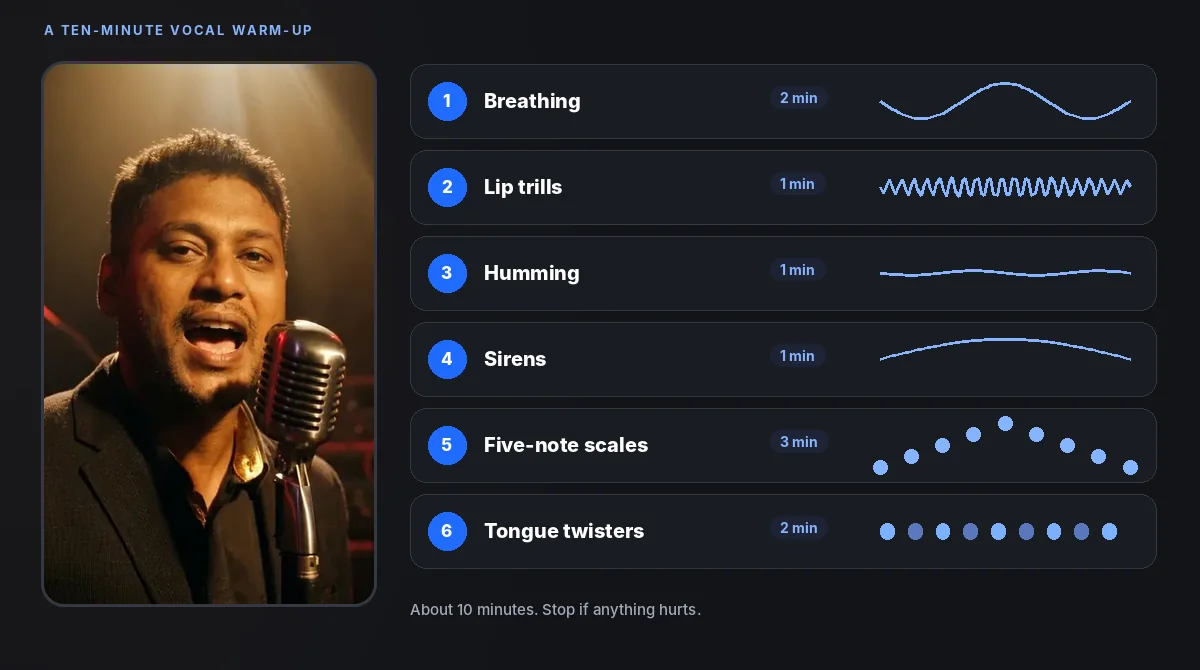
Start with lip trills, humming and gentle sirens in the middle of your range, at a moderate volume, before any full-voiced singing.
- 02
Check your posture (1 minute)
Stand with your weight even on both feet, knees soft, shoulders down and your head balanced over your spine, with the jaw loose.
- 03
Breathe (2 minutes)
Breathe in low, so the belly and lower ribs widen, then hiss out in a steady stream for as long as is comfortable, and note the time.
- 04
Match pitch (4 minutes)
Play a note on a piano or a tuner, sing it back on "ah", hold it and watch how close you stay, then repeat on five notes up and down a scale.
- 05
Work on one phrase (5 minutes)
Take one hard line from a song you're learning and sing it slowly on a single vowel, then with the words, then at full tempo.
- 06
Record and listen (2 minutes)
Record the phrase on your phone, listen back once, and note one thing that improved and one thing to work on tomorrow.
- 07
Wind down (1 minute)
Finish with a few gentle glides from high to low and some humming at speaking pitch, then give your voice a rest.
Five or six days a week is a solid rhythm, with a day off when your voice feels tired. For a fuller warm-up with the reason behind each exercise, plus longer versions for a gig or a recording session, see vocal warm-ups.
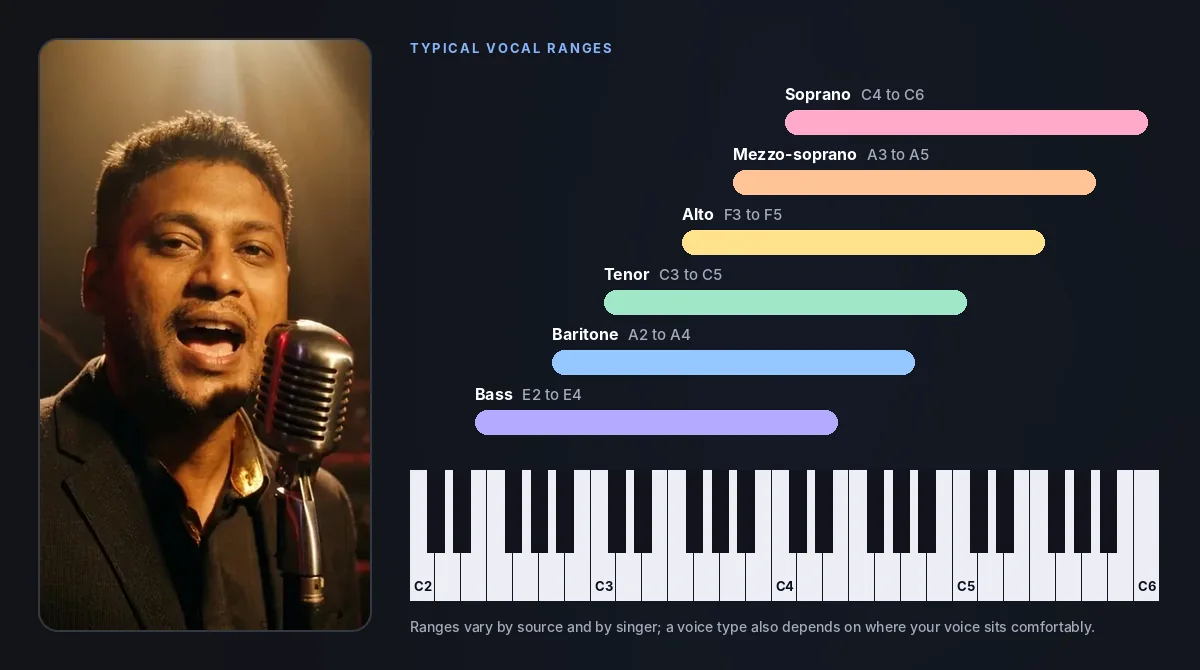
Vocal range testFind your lowest and highest steady notes before you choose which scales and songs to practice, so the routine stays inside your comfortable range.Skip the blank page
Upload your song and Muvora's AI director plans a shot-by-shot storyboard on the beat. Edit every shot for free, and pay only if you render.
Posture and breath
Your voice is the sound of the vocal folds vibrating as air passes them, so how you stand and how you use your breath decide how steady that sound can be. Good singing posture isn't stiff. It's the position in which nothing squeezes the throat or the ribs: stand as if a thread were lifting the top of your head, let the shoulders drop, keep the knees unlocked and the jaw loose enough to open easily. Sitting works too, on the front of the chair with your back away from the backrest.
For breath, the aim is a low, quiet breath in and a slow, even breath out. The US National Institute on Deafness and Other Communication Disorders (NIDCD) advises supporting the voice with deep breaths rather than relying on the throat alone, and notes that singers are often taught exercises for that kind of breath control (Taking care of your voice, updated June 2025). Three to try:
- The hiss: breathe in for four counts, then hiss out on "sss" as evenly as you can and time it. A steadier hiss matters more than a longer one.
- Hands on the ribs: rest your hands on your lower ribs at the sides and breathe so they move outward under your hands, without lifting your shoulders.
- Plan the breaths: mark a breath on your lyric sheet at the end of each phrase, so you breathe where you choose rather than where you run out.
Singing in tune
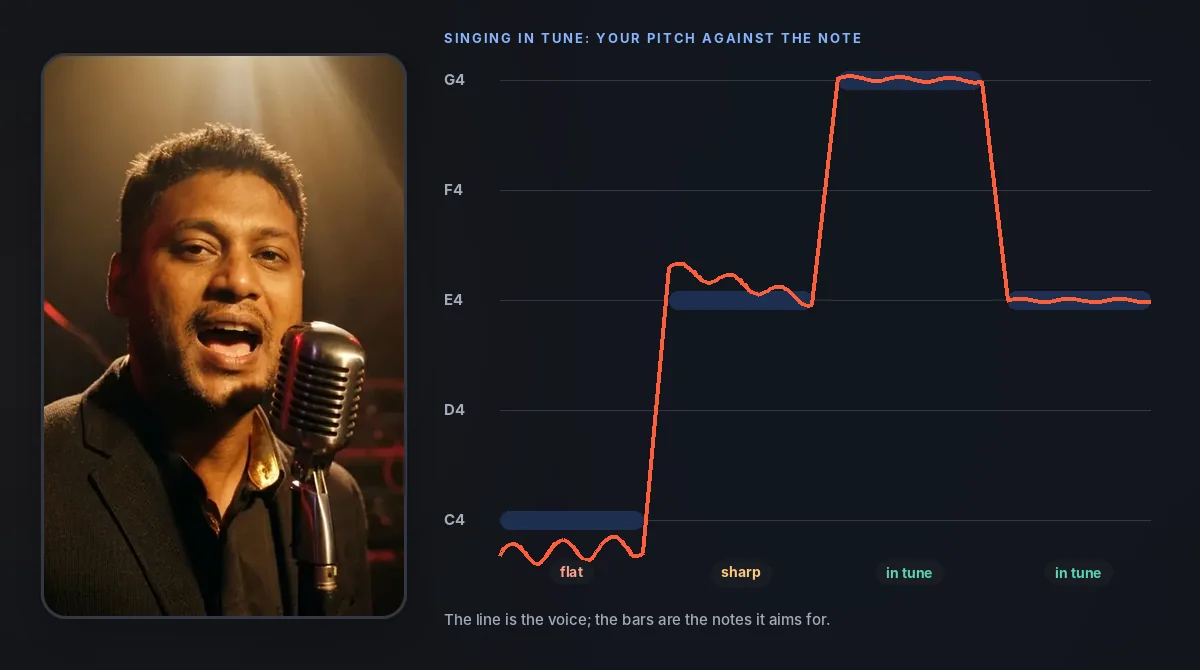
Pitch is what most singers worry about first, and for many people it isn't a hearing problem. In a 2007 study of adults with little or no musical training, 10 to 15% of participants sang short melodies back at least a semitone off, yet they told pitches apart about as well as the accurate singers did; the researchers put the problem in turning a heard pitch into a sung one, not in hearing it (Pfordresher and Brown, Music Perception). So the practice is matching: hear a note, sing it, and check how close you got.
- Use a tuner: a chromatic tuner shows the note you're singing and how many cents sharp or flat it is. Hold a note and try to keep it within a few cents of the center for four seconds.
- Match after the note stops: play a note, let it die away, sing it, then play it again to check. In the same study, singing along with the correct notes made the inaccurate singers less accurate, not more, so practice matching from memory as well as with the piano.
- Watch the ends of phrases: long notes at the end of a line often sag flat as the breath runs out. Take the breath earlier, or keep the air steady to the very end.
- Land on the note: start a note on its pitch instead of sliding up into it, unless the slide is a choice you're making.
- Train your ear: naming intervals and chords by ear helps you hear what a melody is about to do before you sing it.
Recorded a take you're proud of?
Upload the song and Muvora times a storyboard to its beats and sections before an AI director writes every shot. Reading and editing it costs nothing, with 5 new storyboards a month on the free plan.
Tone: vowels, space and volume
Much of what listeners hear as a singer's tone rides on the vowels, because a vowel is the part of a word you can hold. Consonants start and stop the sound; vowels carry the note. Singers who sound strained on high notes are often pushing more air and volume at the note instead of making room for it. The habits below are common starting points; a teacher can tell you which suit your voice.
- Stay on the vowel: on a long note, hold the vowel and add the final sounds only at the very end, so "night" is held on "ah", with the "ee" and the t tucked in as the note ends.
- Make room for high notes: let the jaw drop a little more as the melody climbs, rather than reaching up with the chin.
- Shade, don't force: on the highest notes many singers round a bright vowel slightly, letting "ee" lean toward "ih", which is easier to sustain.
- Practice quietly too: a phrase sung at half volume, in tune and steady, builds control that loud singing can hide.
- Find your own sound: a voice on a record has been through a microphone, compression and effects, so aim for your own tone, recorded well, rather than a copy.
Rhythm and diction
A singer who's slightly late on every line sounds less sure of the song than one who's slightly off pitch. Rhythm practice is simple and works without singing at all: speak the lyric in time against a metronome or the backing track, clapping on the beat, until the words fall where the melody puts them. Then sing it.
- Vowel on the beat: in sung English the vowel usually sits on the beat and the consonants before it come slightly early, so in "stay" the "st" falls just before the beat and "ay" lands on it.
- Slow the busy lines: practice a fast line at half tempo until every word is clear, then bring the metronome up in small steps.
- Keep the endings: final consonants such as t, d and k are easy to lose. Make them small but audible, especially before a rest.
- Breathe in time: take the breath in the gap the song leaves, as part of the rhythm, rather than stealing time from the next word.
Record yourself and listen back
You hear your own voice partly through your head as you sing, so it sounds different from the inside than it does to everyone else. A recording is the nearest you'll get to the listener's view, and it's the most useful practice tool you already own. A phone's voice memo app is enough: put the phone a little further away than arm's length, at mouth height, and sing at your normal volume.
- Listen the next day: straight after singing you hear what you meant; a day later you hear what you did.
- Mark the lyric sheet: draw an arrow up over a sharp word, down over a flat one, and a circle where you ran out of breath.
- Keep a weekly take: sing the same song once a week and keep the files, so you can hear a month of change in a few minutes.
- Listen two ways: headphones show pitch and breath noise; a phone's speaker shows whether the words come through.
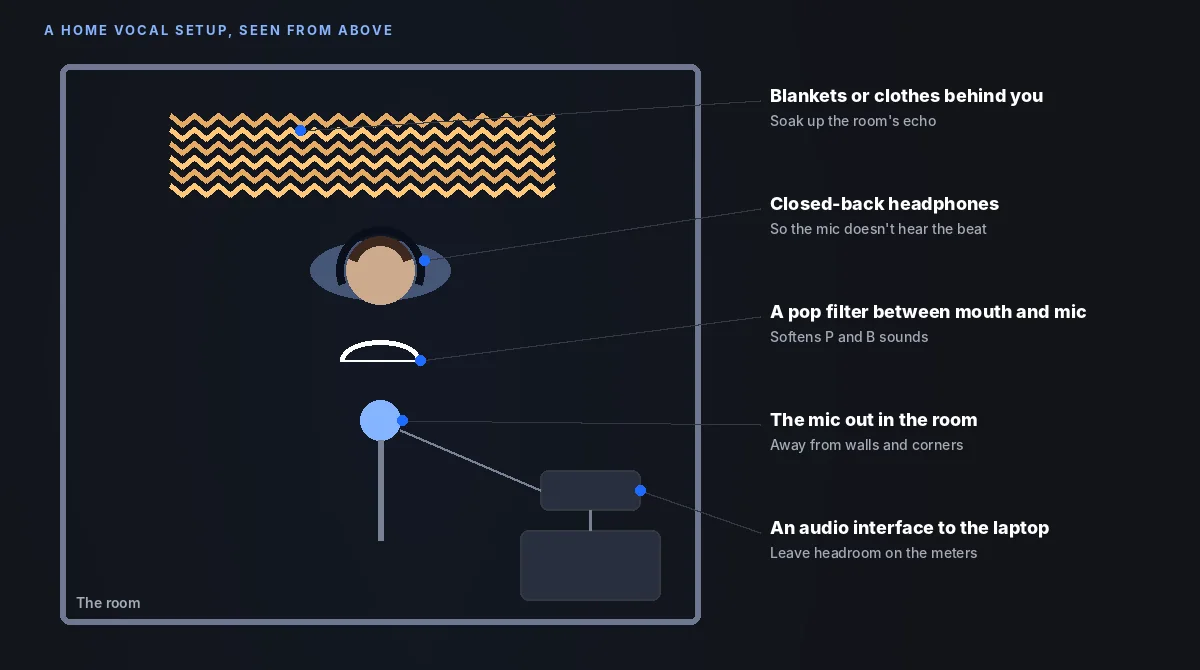
When it's time to record the vocal you'll release, the room and the levels matter as much as the singing; how to record vocals at home covers the setup step by step, and how to find your vocal range helps you pick the song's key before you start.
Looking after your voice
Better singing depends on a healthy voice, and the most reliable advice on keeping one comes from health bodies rather than singers' folklore. The NIDCD's voice care page lists habits for anyone who uses their voice a lot; these are the ones closest to a singer's week:
- Water: drink plenty, and match caffeine or alcohol with extra water.
- Vocal naps: rest the voice in short stretches through a busy day.
- Humid air: it suggests a humidifier at home, especially in winter or a dry climate, at about 30% humidity.
- Rest when tired or ill: avoid speaking or singing when your voice is hoarse or tired, and rest it when you're sick.
- Skip the extremes: screaming and whispering both strain the voice, and so does talking over loud noise.
- No smoke: smoking, and second-hand smoke, irritate the vocal folds.
- Sleep and exercise: it says physical tiredness affects the voice, and that exercise builds the stamina and muscle tone that help posture and breathing.
When to see a teacher, and when to see a doctor
A singing teacher is the quickest way past a habit you can't hear yourself, such as a tight jaw, a push on high notes or a breath that rises into the shoulders, and even a few lessons give you exercises chosen for your voice. In the US, the National Association of Teachers of Singing keeps a teacher directory; elsewhere, local music schools and choirs are good places to ask.
A teacher works on technique; a voice problem is a medical question. The NIDCD lists signs that may point to one, including a voice that has turned hoarse or raspy, high notes you can no longer reach, a voice that suddenly sounds deeper, a throat that often feels raw or strained, and clearing your throat again and again. For those, the specialist is an otolaryngologist, an ear, nose and throat doctor, who may refer you to a speech-language pathologist for voice therapy.
| Who | Helps with |
|---|---|
| A singing teacher | Technique: breath, pitch, tone, range, style and repertoire |
| An ear, nose and throat doctor (otolaryngologist) | Hoarseness that lasts, pain, a sudden loss of voice and the other warning signs above |
| A speech-language pathologist | Voice therapy, often after a doctor's referral, to change how you use your voice |
Your best take, in a music video
Once the vocal is recorded, mixed and mastered, the song is ready for a video. Muvora uses your upload as the soundtrack of every export exactly as it is: it doesn't tune, edit or replace the voice, so the take you release is the one people hear. In the Performance style you add one clear, front-facing photo of the singer, yourself or someone who gave permission, and Muvora finds where the song is sung and lip-syncs those shots to your vocal.

Put your voice in a performance video
Upload the finished song and a photo of the singer, confirm you have permission, and read the storyboard for free. Lip-synced seconds are 75 credits a second, and the full price shows before anything renders.
Written by the Muvora team. Last updated November 18, 2026. Spotted something out of date? Tell us at [email protected].