The short answer
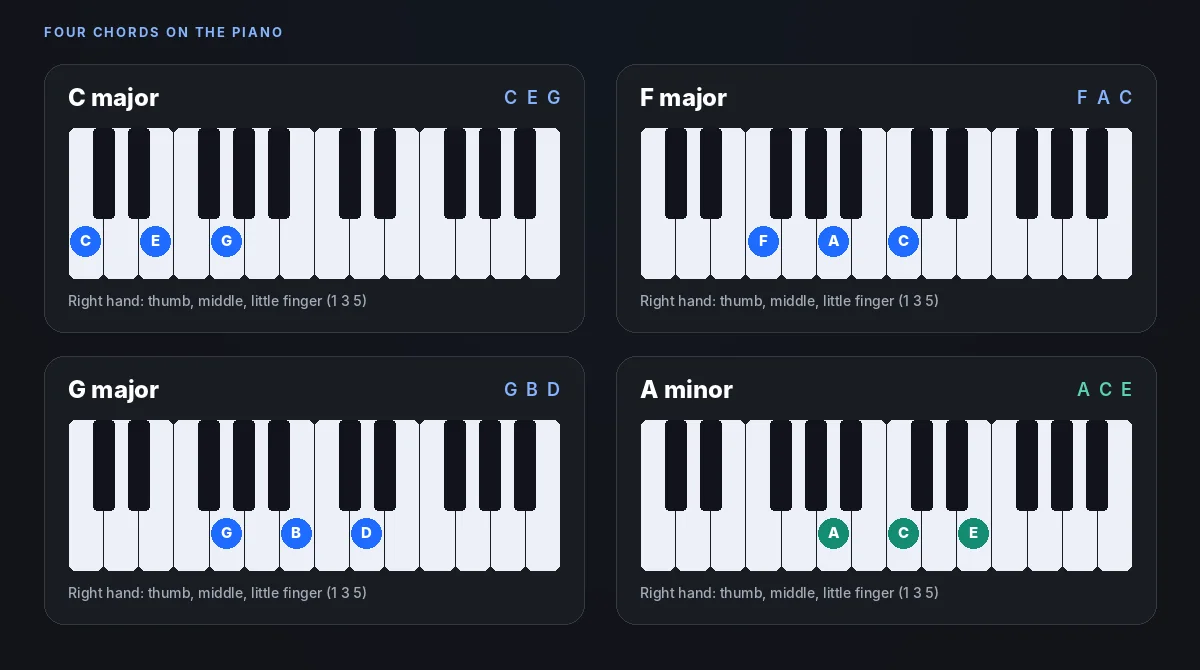
Start with C, F and G major and A minor, which use only white keys. A major chord is a root, the key four half steps above it and the key three above that; a minor chord counts three, then four. Play them with fingers 1, 3 and 5, learn their inversions so your hand barely moves, then loop C, G, Am and F and sing over it.
- Every major chord counts 4 + 3 half steps from its root; every minor chord counts 3 + 4.
- C, F, G, Dm, Em and Am use only white keys: learn those six first.
- An inversion is the same chord stacked differently, so changes need less hand movement.
- C, G, Am and F, played in different orders, carry a huge number of songs.
- Keep the right hand around middle C and give the left hand the root.
On this page (10 sections)ShowHide
- 1.Find your way around the keyboard
- 2.How to learn piano chords in seven steps
- 3.Build any major or minor chord by counting keys
- 4.Which fingers to use
- 5.Inversions: the same chord, less movement
- 6.Four chords, many songs: the progressions to learn
- 7.Voicings and patterns for singing along
- 8.The next chords to learn
- 9.A two-week practice plan
- 10.From a piano song to a music video
- Questions
Find your way around the keyboard
A piano's keys repeat in a pattern of twelve: seven white keys and five black keys, the black ones grouped in twos and threes. That grouping is the map. C is the white key just left of every group of two black keys, F is just left of every group of three, and the other white keys follow in alphabet order up to G before the letters start again at A. The C nearest the middle of the keyboard, often right in front of the maker's name, is middle C, written C4.
- Half step: from one key to the very next, black or white. E to F and B to C are half steps with no black key between them.
- Whole step: two half steps, such as C to D or E to F♯.
- Sharps and flats: a black key is named after its neighbors. The one between C and D is C♯, a half step above C, or D♭, a half step below D.
- Finger numbers: on both hands the thumb is 1, the index finger 2, the middle finger 3, the ring finger 4 and the little finger 5.
How to learn piano chords in seven steps
- 01
Find C and middle C
Locate the groups of two black keys, find the C to the left of each, and use the one nearest the middle of the keyboard as your home position.
- 02
Play the three white-key major chords
Put your right thumb on C, your middle finger on E and your little finger on G and press together for C major, then move the same shape to F (F A C) and G (G B D).
- 03
Add the three white-key minor chords
Keep the same hand shape and play D minor (D F A), E minor (E G B) and A minor (A C E), listening for the darker color the lower middle note gives.
- 04
Count half steps for every other chord
For any major chord count four half steps up from the root, then three more; for a minor chord count three, then four, and check each result against the tables in this guide.
- 05
Learn the inversions of C, F, G and Am
Play each chord with its lowest note moved to the top, then do it again, and notice which shape lets your hand stay put between chords.
- 06
Loop four chords slowly
Set a metronome to 60 BPM and play C, G, Am and F, one chord a bar, in the close shapes shown below, until every change lands on the beat without a pause.
- 07
Add the left hand, then sing
Play each chord's root with your left hand an octave or two lower, keep the loop going, and sing a song you know over it.
Skip the blank page
Upload your song and Muvora's AI director plans a shot-by-shot storyboard on the beat. Edit every shot for free, and pay only if you render.
Build any major or minor chord by counting keys
Every major chord has three notes: the root, the note it's named after; the note four half steps above the root; and the note three half steps above that. A minor chord swaps the two gaps, three half steps and then four. The outer notes are seven half steps apart in both, so the only difference between C major and C minor is the middle key, E or E♭, right next to each other. That single key is what turns a bright chord into a darker one.
| Chord | Notes | Keys, bottom to top |
|---|---|---|
| C | C E G | White, white, white |
| D♭ (same keys as C♯) | D♭ F A♭ | Black, white, black |
| D | D F♯ A | White, black, white |
| E♭ | E♭ G B♭ | Black, white, black |
| E | E G♯ B | White, black, white |
| F | F A C | White, white, white |
| F♯ (same keys as G♭) | F♯ A♯ C♯ | Black, black, black |
| G | G B D | White, white, white |
| A♭ | A♭ C E♭ | Black, white, black |
| A | A C♯ E | White, black, white |
| B♭ | B♭ D F | Black, white, white |
| B | B D♯ F♯ | White, black, black |
| Chord | Notes | Keys, bottom to top |
|---|---|---|
| Cm | C E♭ G | White, black, white |
| C♯m | C♯ E G♯ | Black, white, black |
| Dm | D F A | White, white, white |
| E♭m (same keys as D♯m) | E♭ G♭ B♭ | Black, black, black |
| Em | E G B | White, white, white |
| Fm | F A♭ C | White, black, white |
| F♯m | F♯ A C♯ | Black, white, black |
| Gm | G B♭ D | White, black, white |
| G♯m (same keys as A♭m) | G♯ B D♯ | Black, white, black |
| Am | A C E | White, white, white |
| B♭m | B♭ D♭ F | Black, black, white |
| Bm | B D F♯ | White, white, black |
Look for the patterns. Three major chords, C, F and G, and three minor ones, Dm, Em and Am, use only white keys, which is why they're the usual first six; they're also the six main chords of C major. D, E and A major put a black key in the middle, and their minor versions drop it back to white. A chord's notes always skip one letter name each time (C, E, G; D, F, A), which is why D major is written D F♯ A and never D G♭ A, even though G♭ is the same key.
Piano chord chartPick any root and chord type to see it lit on a keyboard with its notes, inversions and common fingerings, and hear it played.Chord finderFound a chord by ear? Press its keys and get its name, with inversions and slash chords recognized.Which fingers to use
Fingerings are habits that make chord changes easier, not rules, and teachers and hands differ. The ones in the table are common starting points for three-note chords. They work because in an inverted chord one gap is a fourth, wider than the other, and each fingering puts that wider gap between the fingers that stretch apart most comfortably.
| Shape | Example on C | Right hand | Left hand |
|---|---|---|---|
| Root position | C E G | 1-3-5 | 5-3-1 |
| First inversion | E G C | 1-2-5 | 5-3-1 |
| Second inversion | G C E | 1-3-5 | 5-2-1 |
- Curve the fingers: play on the pads with the fingers rounded, as if around a ball, and the wrist roughly level with the keys.
- Press together: all three notes should sound at once. If one is late or quieter than the others, slow down until they match.
- Look ahead: move your fingers over the next chord's keys before you need them, rather than lifting the hand high between chords.
- Let the arm do it: the weight of a relaxed arm sounds the chord; squeezing with the fingers tires the hand quickly.
- Keep sessions short: if your hand or wrist aches, stop and rest, and ask a teacher to look at how you're sitting and holding your hand.
Inversions: the same chord, less movement
An inversion keeps a chord's notes and changes which one is at the bottom. C major in root position is C E G. Move the C up an octave and you get E G C, the first inversion; move the E up as well and you get G C E, the second inversion. All three are still C major. On a piano, inversions solve a practical problem: played only in root position, C to F to G to C makes the right hand jump up, step up and jump back down. With inversions, most fingers stay where they are and move a key or two.
| Chord | Root position only | With inversions | What moves |
|---|---|---|---|
| C | C E G | C E G | Starting position |
| F | F A C, the hand jumps up | C F A (F/C) | E up to F and G up to A; the thumb stays on C |
| G | G B D, another move up | B D G (G/B) | Every finger steps down a key or two |
| C | C E G, back down | C E G | B up to C, D up to E, the G stays |
One thing about the names. A chord's inversion is set by the lowest note anyone hears. If your left hand plays F underneath a right hand's C F A, the chord is F in root position, whatever shape the right hand is in. The slash names in the table, F/C and G/B, apply when the right hand plays alone, or when you choose those notes for the bass on purpose, which is a sound of its own: a bass line stepping down C, B, A under C, G/B and Am.
Four chords, many songs: the progressions to learn
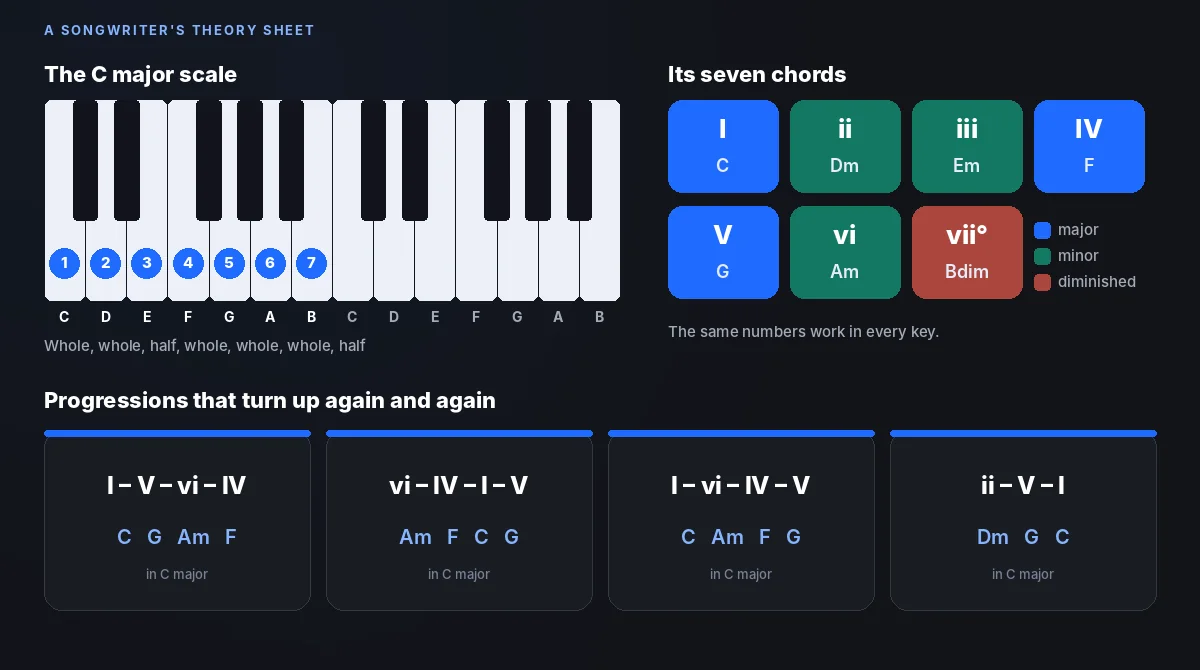
In any major key the chords built on the 1st, 4th, 5th and 6th notes of the scale, numbered I, IV, V and vi, sound like a family. In C major they're C, F, G and Am, chords you already know, and looping them in different orders gives very different moods. The table shows four common orders in C and in G, each with right-hand shapes that keep the hand in one place.
| Numerals | In C | In G | Often heard as |
|---|---|---|---|
| I–V–vi–IV | C (C E G), G (B D G), Am (C E A), F (C F A) | G (G B D), D (F♯ A D), Em (G B E), C (G C E) | Bright, open, made for singing along |
| vi–IV–I–V | Am (A C E), F (A C F), C (G C E), G (G B D) | Em (E G B), C (E G C), G (D G B), D (D F♯ A) | Starting in shadow, lifting by the end |
| I–vi–IV–V | C (C E G), Am (C E A), F (C F A), G (B D G) | G (G B D), Em (G B E), C (G C E), D (F♯ A D) | Warm and old-fashioned, a classic ballad turn |
| I–IV–V–I | C (C E G), F (C F A), G (B D G), C (C E G) | G (G B D), C (G C E), D (F♯ A D), G (G B D) | Plain and settled, common in folk, country and hymns |
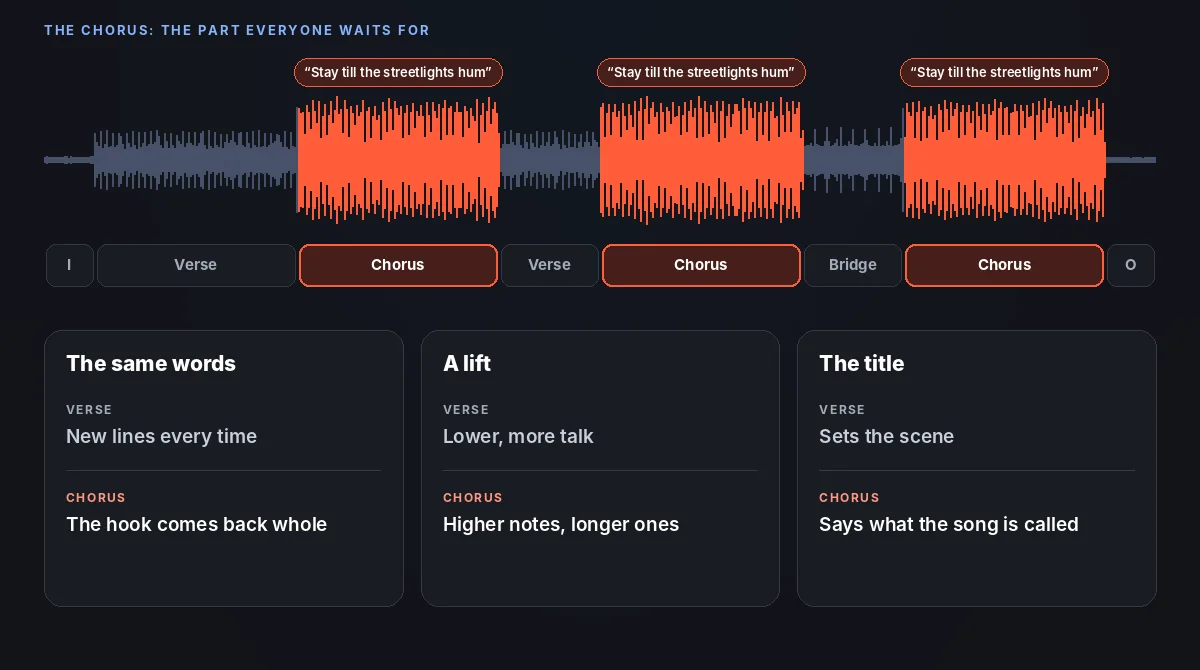
Each loop resolves differently because of where it starts and stops. Ending on V, as the second and third rows do, leaves the loop wanting to go round again, which suits a chorus that repeats; ending on I, as the last row does, sounds finished. If the key sits too high or low for your voice, move every chord by the same distance: the chord transposer does it for a whole chord chart, and music theory for songwriters explains why these four chords belong together.
Chord progression generatorChoose a key and a mood for common progressions spelled in that key, played back at your tempo, with text and a MIDI file to save.Wrote a song on these four chords?
Record it, even as a rough piano-and-voice demo, and upload it. Muvora finds its beats, sections and energy and writes a storyboard timed to them, free to read and edit before you pay to render anything.
Voicings and patterns for singing along
Accompanying your own voice is a different job from playing the chords on their own. The piano has to keep time and outline the harmony without covering the singer, so most players keep the right hand's chords in the octave around and above middle C, give the left hand the root an octave or two below, and pick a rhythm pattern to suit the song. Below the C under middle C, it's common to keep the left hand to single roots, fifths and octaves, because close chords that low tend to sound muddy.
| Pattern | Left hand | Right hand | Suits |
|---|---|---|---|
| Whole-bar chords | The root on beat 1, held | The chord on beat 1, held | Learning a song, slow ballads |
| Quarter-note pulse | The root on beat 1 | The chord on every beat, short | Steady pop and rock, keeping time while you sing |
| Eighth-note drive | The root on beats 1 and 3 | The chord on every eighth note, lightly | Upbeat songs and a chorus that builds |
| Broken left hand | Root, fifth and octave as eighth notes, such as C, G, C | The chord on beat 1, held | Ballads that need movement without volume |
| Waltz (3/4) | The root on beat 1 | The chord on beats 2 and 3 | Songs in three, folk and old-style ballads |
- The sustain pedal: lift it as you play each new chord and press it again just after, so chords connect without blurring into each other.
- Leave the tune to the voice: if your right hand's top note doubles the melody, try another inversion so the piano sits beside the voice instead of on it.
- Lift the chorus with the pattern: whole-bar chords in the verse and a pulse in the chorus make a bigger change than playing harder.

The next chords to learn
Once the 24 major and minor chords come easily, a handful of other shapes cover most of what pop, rock, worship and singer-songwriter songs ask for. Each is a small change to a chord you already play, shown here on C, and each slots into the four-chord loops above.
| Chord | Notes | How to get there | Sound |
|---|---|---|---|
| Csus2 | C D G | Move the middle note down to the key a whole step above the root | Open, unresolved |
| Csus4 | C F G | Move the middle note up a half step | Tense, wants to fall back to C |
| Cadd9 | C E G D | Add the note a whole step above the root, an octave up | Bright, a little shimmering |
| Cmaj7 | C E G B | Add the key a half step below the next C | Soft, dreamy |
| C7 | C E G B♭ | Add the key a whole step below the next C | Bluesy, leaning toward F |
| Am7 | A C E G | Add the key a whole step below the next A | Mellow, smooth |
| C/E | E in the bass, C E G above | Play E with the left hand under a C chord | Lighter, a passing chord |
The other two kinds of triad turn up less in a beginner's songs: a diminished chord counts 3 + 3 half steps (B D F) and an augmented one 4 + 4 (C E G♯). Learn them when a song asks for one. For any chord's shape on the keyboard, with its inversions, the piano chord chart draws it and plays it, and the scale finder shows which chords belong to a key.
A two-week practice plan
| Days | Practice | You're ready to move on when |
|---|---|---|
| 1 to 3 | C, F, G, Dm, Em and Am in root position, right hand, then left | You can play each one without looking at your hands |
| 4 to 6 | The other major and minor chords, counting half steps and checking the tables | You can find any of the 24 in a few seconds |
| 7 to 9 | Inversions of C, F, G and Am, and the C, F, G, C change in close shapes | The change lands on the beat at 60 BPM |
| 10 to 12 | The four progressions in C, then in G, with the left hand's root | You can loop one for two minutes without stopping |
| 13 and 14 | One accompaniment pattern under a song you know, singing | You can sing a verse and a chorus without the piano stopping |
Slow and steady beats fast and patchy. A change that's always on time at 60 BPM speeds up by itself over the following weeks, while a change that's fast but late teaches your hands to hesitate. Short daily sessions usually do more than one long one at the weekend, and a phone recording once a week lets you hear progress you can't feel while you play.
From a piano song to a music video
When the song is finished, Muvora turns the recording into a music video. It measures the tempo, beats, sections and energy of what you upload, and its AI director writes a storyboard whose cuts land on the downbeats, with shots planned for every section; the soundtrack of every export is your recording exactly as uploaded. One thing to know with piano songs: AI video doesn't play the notes you played, so a close-up of hands on the keys won't match the chords people hear. Describe the piano as part of a place in the idea box, seen wide or from across the room, rather than as a shot of fingers.

Singing at the piano?
The Performance style lip-syncs a singer from one clear, front-facing photo, yours or someone who agreed, in the shots where the song is sung, framed from the chest or waist up so the hands never need to match. Upload the song and read the storyboard for free first.
Written by the Muvora team. Last updated November 18, 2026. Spotted something out of date? Tell us at [email protected].