The short answer
To write a chorus, build it around the song's title line and put that line first, last or both. Make it contrast with the verse: a higher melody, longer notes and fewer words, and chords that arrive on the home chord. Keep the lyric to one plain idea that stays the same each time, let a pre-chorus build into it, and change one detail on the last pass.
- A chorus says the song's one idea in words that stay the same; the verses earn it.
- Put the title on the chorus's first or last line, on a strong beat and a long or high note.
- Contrast does most of the work: higher, slower and plainer than the verse.
- A pre-chorus points at the chorus and should end sounding unfinished.
- Change one detail on the last chorus so the repeat sounds like a payoff.
On this page (9 sections)ShowHide
- 1.What a chorus does
- 2.How to write a chorus in eight steps
- 3.Where the title line goes
- 4.Contrast: make the chorus different from the verse
- 5.Build to it: the pre-chorus
- 6.Writing the chorus lyric
- 7.Change it on the last pass
- 8.Why a chorus falls flat, and what to try
- 9.Make the chorus the event in the video
- Questions
What a chorus does
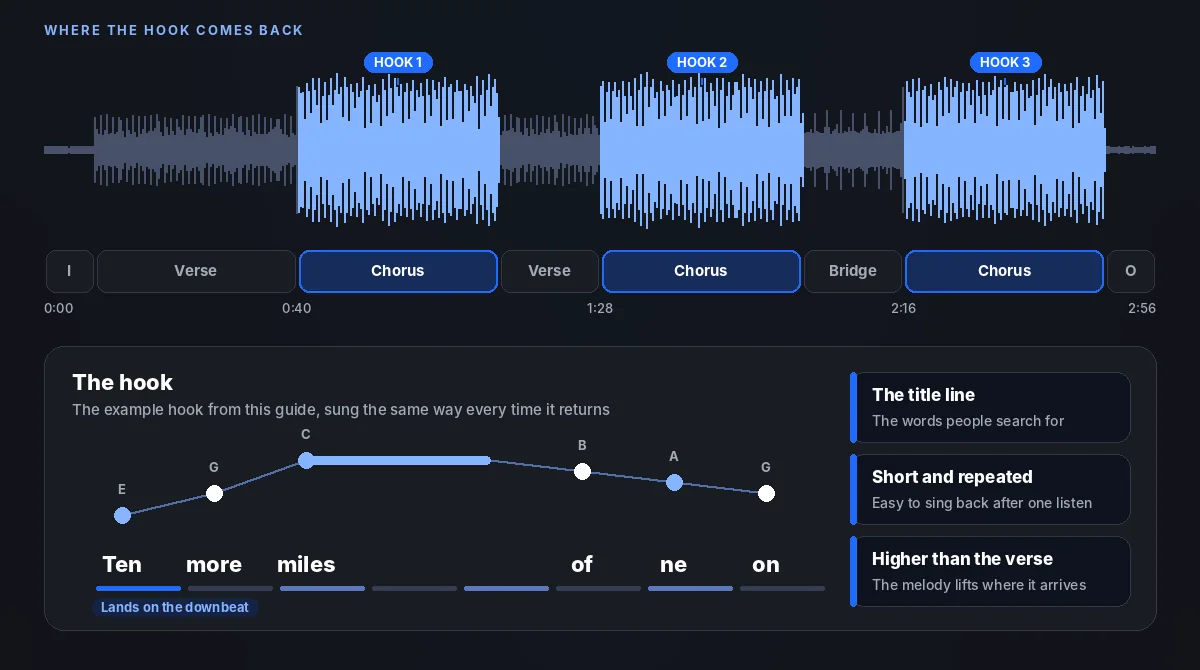
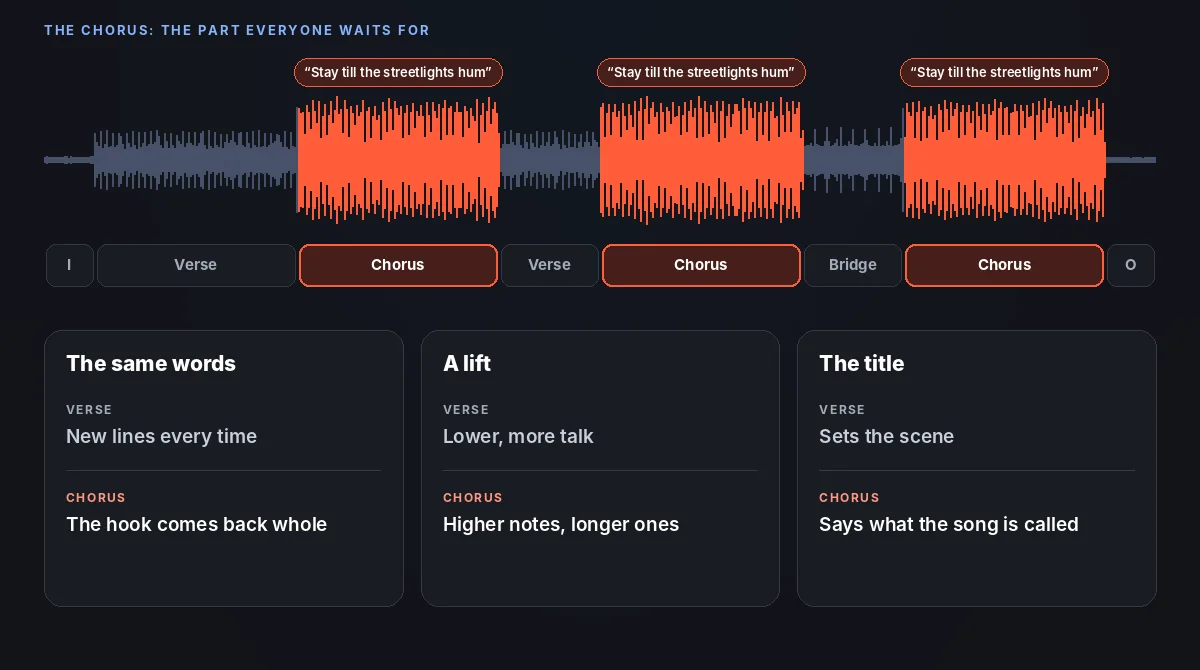
A chorus is the section of a song that comes back with the same words and the same music every time. Its jobs are few and clear: it states the song's main idea, usually in the title line; it gives the listener something to learn and sing back by the second time round; and it's where the song is loudest and fullest, the place every verse leads to. Because the chorus doesn't change, the verses around it do the changing. Each one adds a detail, so the same chorus means a little more every time it returns.
| Section | Where it sits | Words each time | Its job |
|---|---|---|---|
| Chorus | Its own section between verses, often 8 bars | The same | States the main idea and usually carries the hook |
| Refrain | A line or two at the end or start of each verse, over the verse's own music | The same | Ties the verses together in songs with no separate chorus, common in folk songs and ballads |
| Post-chorus | Straight after the chorus, often 4 bars | The same, often one word or a sung sound | Keeps the chorus ringing after it ends |
| Pre-chorus | Between the verse and the chorus, often 4 bars | Often the same | Builds tension and points at the chorus |
The hook and the chorus aren't the same thing either. The hook is the catchiest idea in the song, a line, a tune or a riff, and the chorus is the section that usually delivers it; how to write a hook covers the idea, and this guide covers the section built around it. A typical verse-chorus song has three choruses: after the first verse, after the second, and after the bridge. At 100 BPM in 4/4 an 8-bar chorus lasts 19.2 seconds, so three of them are close to a minute of the song.
How to write a chorus in eight steps
- 01
Write the title line
Sum up the song in one line of three to seven words that you'd be happy to sing a dozen times, and make it the chorus's anchor.
- 02
Choose where the title sits
Put the title on the first line, the last line, both, or every line, and settle that layout before writing the other lines, so each line knows its job.
- 03
Write one plain idea around it
Fill the remaining lines with a single feeling or statement in everyday words, saying nothing the verses haven't set up.
- 04
Lift the melody above the verse
Start the chorus higher than most of the verse sits, and give the title the highest or the longest note in the section.
- 05
Slow the words down
Use fewer syllables a bar than the verse and hold them longer, so every word in the chorus carries more weight.
- 06
Land the chords on home
Start the chorus on the key's home chord, or reach it on the title's first downbeat, especially if the verse has kept away from it.
- 07
Write the pre-chorus last
Once the chorus exists, write a short climb into it that ends on an unresolved chord, usually V or IV, so the chorus sounds like the answer.
- 08
Sing the verse straight into it
Record the verse, the pre-chorus and the chorus in one take and listen for a clear lift on the chorus's first downbeat; if it isn't obvious, change the range or the rhythm before the words.
Skip the blank page
Upload your song and Muvora's AI director plans a shot-by-shot storyboard on the beat. Edit every shot for free, and pay only if you render.
Where the title line goes
Most choruses are built around their title, and where it sits shapes the whole section. There are four common layouts. Each version below is a chorus for "Rooftop Weather", a song written for this guide about two people who climb onto a city roof when a storm empties the streets, in G major at 100 BPM, rewritten to show the layout.
| Layout | Where the title goes | Example | Use it when |
|---|---|---|---|
| Bookend | The first and last lines | "Rooftop weather, keep it coming down / we're the only two awake in this town / let the sirens and the rain drown out the sound / rooftop weather, we don't come down" | You want the title stated, explained and then landed |
| Title last | Only the last line, after lines that climb toward it | "Every window shut and the street gone grey / every forecast saying stay inside today / but we took the stairs the other way / into rooftop weather" | The lines can build like a ramp, so the title arrives as a payoff |
| Title first | The first line, then lines that open it up | "Rooftop weather is the only kind we like / the gutters roar and the antennas hum all night / nobody calls and nobody needs a light / we just watch it fall" | The title is strong enough to open on, and the rest can wander a little |
| Chant | Every line, or nearly | "Rooftop weather (hold on) / rooftop weather (hold on) / let it fall on everyone / rooftop weather" | Dance, pop and hip-hop choruses built for a crowd, where the repetition is the point |
Whichever layout you pick, put the title where the music puts its weight: on the downbeat of the chorus's first bar, or on the last long note before the next section. A title sung on a weak beat in the middle of a line gets lost even when it's repeated. Most songs keep the same layout in every chorus; changing something on the last pass is a separate tool, covered further down.
Contrast: make the chorus different from the verse
A chorus feels big mostly because of what came before it. If the verse and the chorus sit in the same range, move at the same speed and start on the same chord, the chorus has nothing to rise above, however good its words are. The table compares a verse of "Rooftop Weather" with its chorus point by point. You don't need every contrast, but two or three of them should be obvious to someone hearing the song once.
| What changes | Verse | Chorus |
|---|---|---|
| Melody range | Low and narrow, D4 to A4, mostly moving by step | Higher, G4 to D5, with the title's first word on D5 |
| Words per bar | 9 to 11 syllables, close to speech | 4 to 6 syllables, held longer |
| Rhythm | Lines start on a pickup before the beat, in quick eighth notes | Lines start on beat 1, in quarter and half notes |
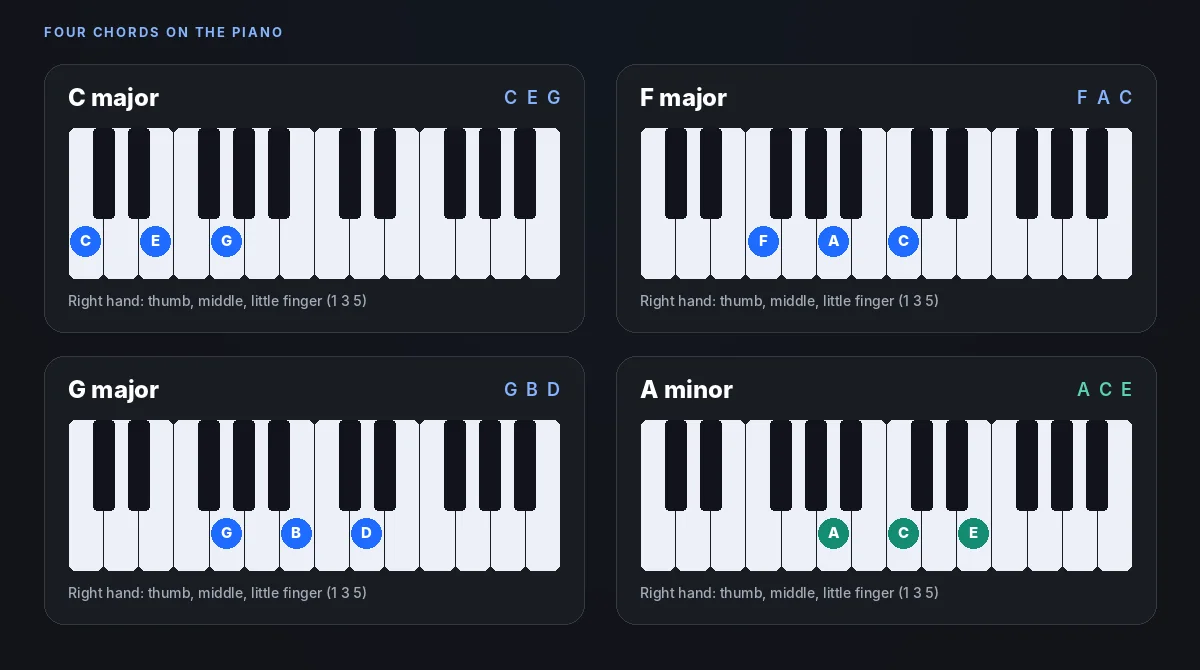
| Chords | Em–C–G–D (vi–IV–I–V): starts away from home | G–D–Em–C (I–V–vi–IV): starts on the home chord |
| Lyric | Details: a landlord's notice taped to the door, laundry on the fire escape | One feeling: the two of them above it all |
| Arrangement | Bass and a muted guitar, drums on the hi-hat only | Full drums, an open guitar and a backing vocal on the title |
Here is the verse those rows describe: "Landlord's notice taped to the door again, laundry dripping off the fire escape rail, you say the forecast's calling for a week of grey, I say we climb up and see it for ourselves." Sing that low and quick, then sing "Rooftop weather, keep it coming down" with "roof" held on D5, an octave above the verse's lowest note, and the difference is the chorus's whole effect. The chords hardly change at all. Both sections use the same four, but the verse starts on E minor and the chorus starts on G, the home chord, straight after a pre-chorus that holds D.
Build to it: the pre-chorus
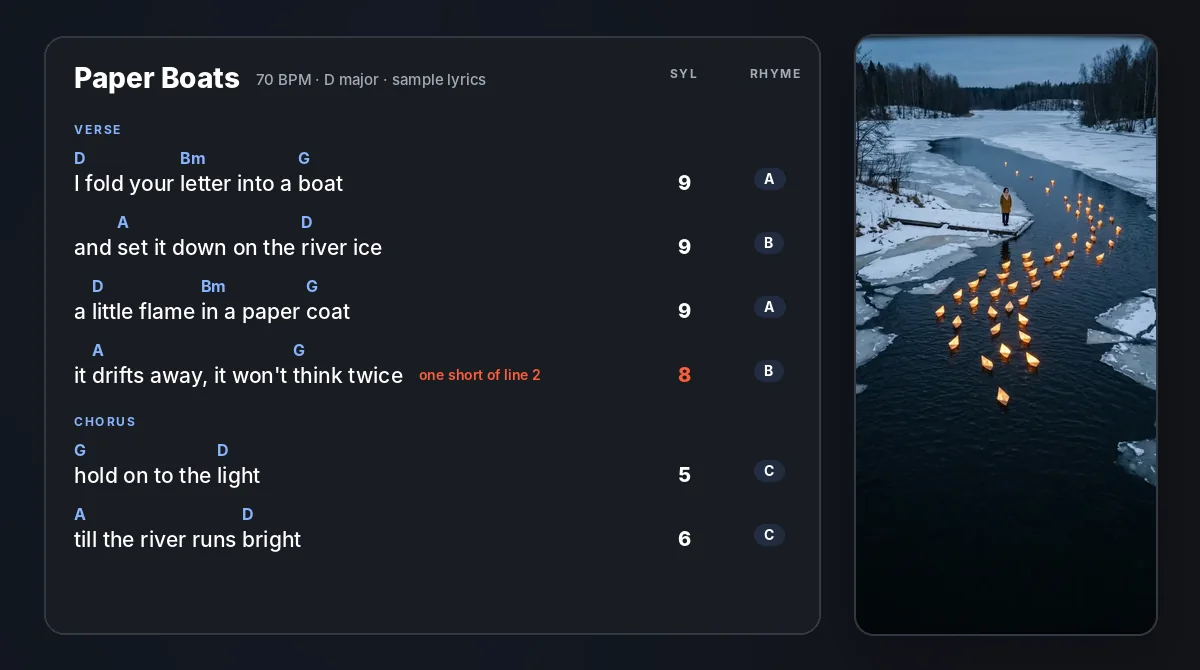
The pre-chorus is the ramp. It usually runs 4 bars, sometimes 8, and it exists to make the chorus's first downbeat feel inevitable. It raises tension without releasing any: the melody climbs, the lines get shorter or quicker, the drums build or drop away, and the last chord leaves a question open. In "Rooftop Weather" the pre-chorus runs Am–C–D (ii–IV–V) and holds the D for a full bar before the chorus lands on G.
- End unresolved: finish on V, D in G major, or on IV, so the chorus's home chord sounds like an answer.
- Climb, but stop short: let the melody rise by step and stop just under the chorus's first note, leaving the peak to the chorus.
- Change the word rate: shorter lines in a quicker rhythm, or the opposite, a few long words, so the verse's pattern breaks.
- Set up the answer: a pre-chorus lyric that raises the doubt the chorus settles, or takes the step the chorus completes.
- Leave a gap: a beat of silence, or one audible breath, before the chorus gives its first word more impact.
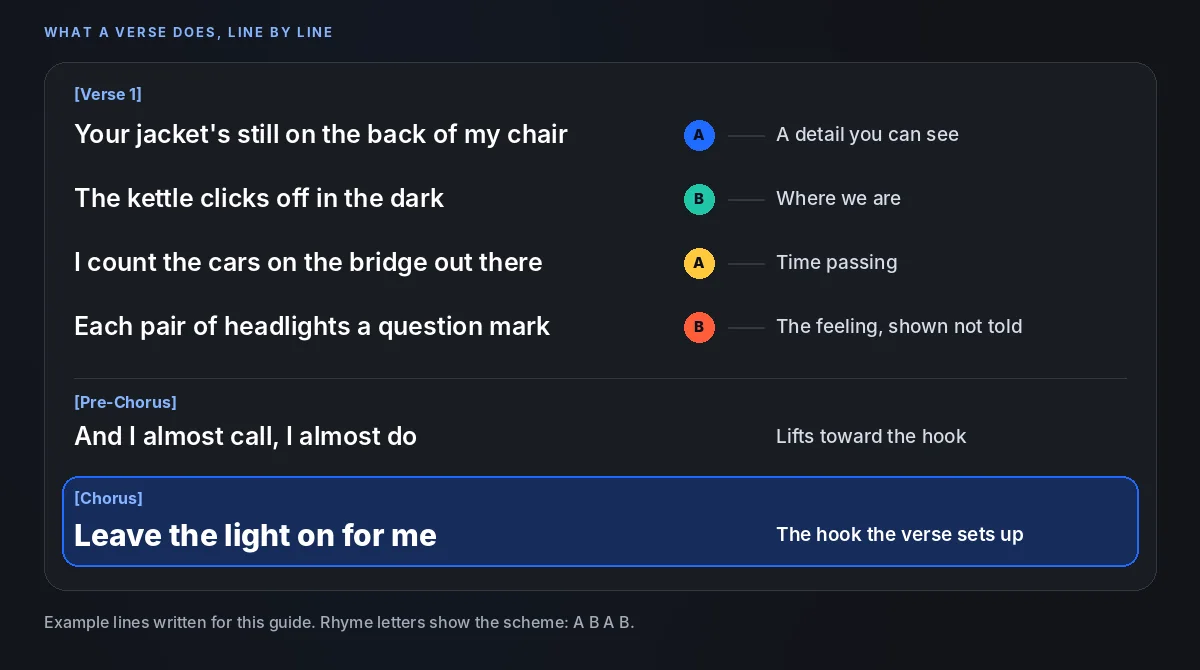
The example pre-chorus, written for this guide: "Every window on the block is shut / every radio turned down low / but the air is getting heavy on the stairs / and you already know." Four short lines over three chords, climbing from A4 to C5, and the chorus takes it up to D5. Not every song needs one. A verse whose last line lifts can do the same job, and many hip-hop and dance songs go straight from the verse into the hook. Try the song both ways: if the chorus sounds like an arrival without a pre-chorus, leave it out.
Got a demo with its choruses in place?
Upload the song and Muvora finds its verses, choruses and energy before an AI director writes a storyboard that builds each chorus bigger than the one before. Reading and editing the storyboard is free, with 5 new storyboards a month on the free plan.
Writing the chorus lyric
Verse lyrics show; chorus lyrics sum up. The verse is where the specific, surprising details go, the landlord's notice and the dripping laundry, and the chorus says what those details add up to in words anyone could use. A chorus that brings in new information each time isn't working as a chorus; it's another verse, and the song loses the one place a listener can rest.
- One idea: if you can't say what the chorus means in one sentence, it's carrying two choruses' worth of lyric.
- Plain words, short lines: the chorus is heard over the fullest part of the arrangement, so every word has to land on first hearing. Lines of five to eight syllables are common.
- Rhyme on sounds you can hold: chorus rhymes often fall on long notes, so open sounds such as "down", "town" and "sound" carry better than clipped ones.
- Repeat on purpose: repeating the title or a whole line within the chorus is normal; decide the pattern, such as lines one and four the same, and keep it.
- Four lines, two bars each: that's the most common shape, and it fills an 8-bar chorus exactly.
- Same point of view: keep the chorus in the same voice as the verses, I to you or we, unless the shift is the point of the song.
Change it on the last pass
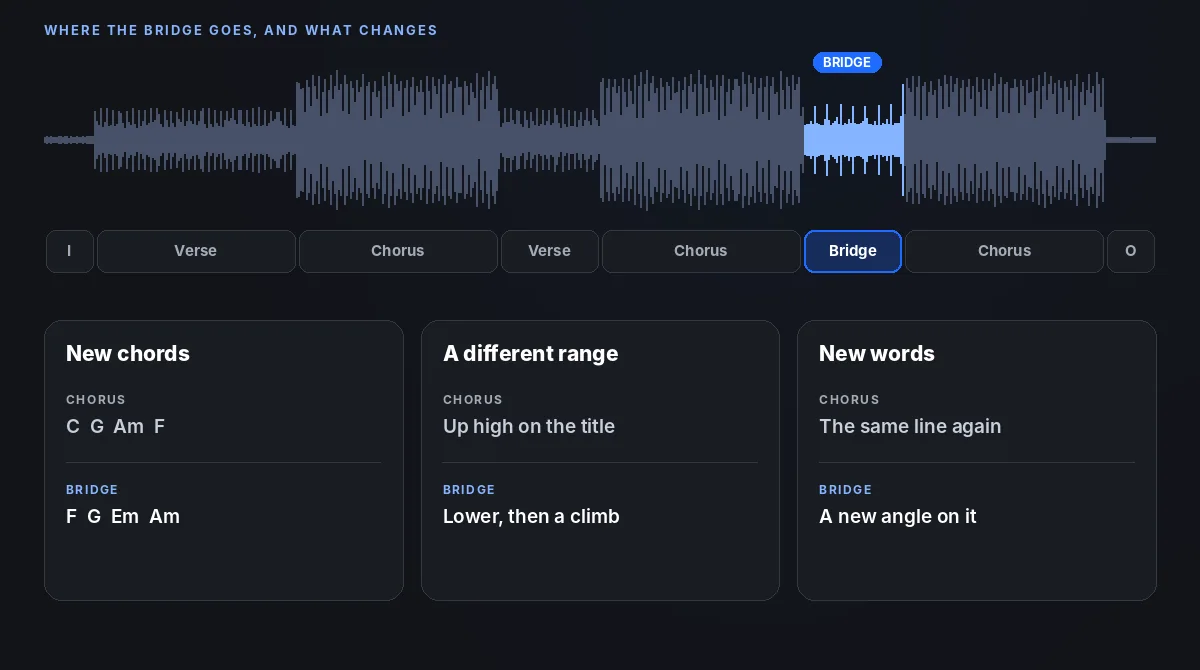
By the last chorus the listener has heard it twice, and a third identical pass can sound like the song running out of ideas. Most songs change one thing, small or large, so the repeat sounds like a payoff. A bridge often sets that up, as how to write a bridge explains. These are the options on the chorus's side, each written for "Rooftop Weather", with the one the song uses first.
| Change | How | In the example |
|---|---|---|
| A new last line | Keep the words until the final line, then turn it | "rooftop weather, we don't come down" becomes "rooftop weather, and we never came down" |
| A double chorus | Play the chorus twice, the first time stripped back | Voice and the muted guitar for 8 bars, then the full band for 8 |
| A tag | Repeat the last line two or three times to end | "we don't come down" sung three times, the last over C before a final G |
| An answer line | Add a second voice that replies between the lines | A backing vocal answers each line with "let it rain" |
| A key lift | Move the whole chorus up a half or a whole step | From G major up to A major for the last 8 bars |
| Same words, new meaning | Let the last verse change what the chorus means | The last verse reveals one of them moves away tomorrow, so "we don't come down" now sounds like a wish |
Pick one or two. Stacking a key lift, a double chorus, a new line and a tag at once can sound like an ending that doesn't trust itself. The quietest change, the same words heard differently, often lands hardest, because the story is doing the work rather than the arrangement.
Why a chorus falls flat, and what to try
| Problem | How you notice | Try |
|---|---|---|
| Same range as the verse | The chorus starts and nobody can tell | Move its first note up a third or a fourth, or move the verse lower |
| Too many words | You run out of breath, or listeners can't catch the title | Cut a third of the syllables and hold the rest longer |
| The title is buried | People call the song by a different line | Move the title to the first or last line, on a downbeat |
| New information | Each chorus has different words | Move the new lines into the verses and keep the chorus fixed |
| No home chord | The chorus never feels like it arrives | Start it on I, or reach I on the title's first downbeat |
| A late arrival | The first chorus starts long after the song does | Shorten the intro or the first verse, or open with a short preview of the chorus |
The quickest test is one a listener runs without knowing it. Play the demo for someone once, then ask them to sing any part of it back. If what comes back is the chorus, it's working. If it's a verse line, that line may be your real chorus, and it's worth asking why it stuck.
Make the chorus the event in the video
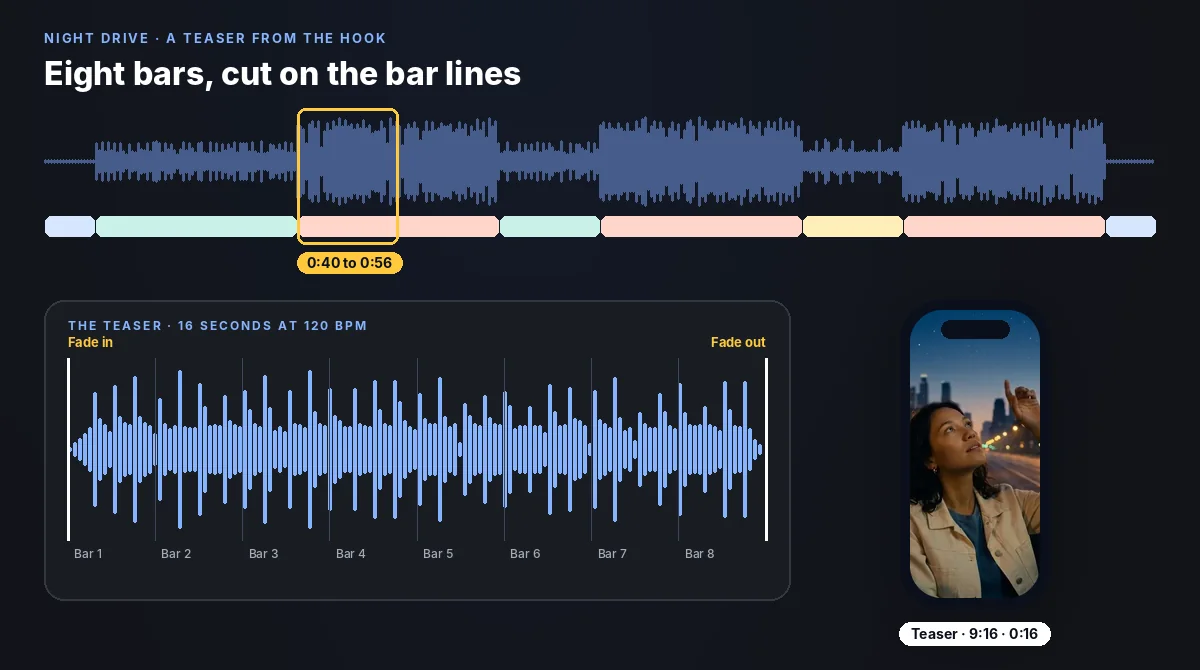
A music video should treat the chorus the way the song does, as the moment everything builds to. Muvora plans that from your recording. Its analysis finds the song's verses, choruses and their energy; its shot planner puts a cut on every section change and cuts faster where the song is loudest, which is usually the chorus; and the AI director writes a treatment by section in which the chorus gets bigger each time it returns, so the third one looks like the payoff the song makes it.

The chorus also travels furthest after release. Every render includes an 8-second Spotify Canvas loop cut from the strongest chorus moment, and a widescreen render gives you 16:9, 9:16 and 1:1 files, so a chorus clip for Shorts or Reels starts on a clean cut. Paste your lyrics and turn captions on, and the chorus appears on screen as it's sung; the lyric video maker shows the Lyric style built around the words.
Give your chorus its moment
Upload the finished song, read the storyboard and change any shot before you pay. The price shows before the video renders, and shots that fail cost nothing.
Written by the Muvora team. Last updated November 18, 2026. Spotted something out of date? Tell us at [email protected].