The short answer
To find your vocal range, warm up, then sing the lowest note you can hold clearly and climb note by note to the highest note you can hold without straining. Name both notes with a piano, a tuner app or a free vocal range test, for example E2 to G4. Compare that span with the typical voice type ranges, then choose song keys that fit inside it.
- Your range runs from the lowest to the highest note you can hold clearly, not the lowest growl or highest squeak.
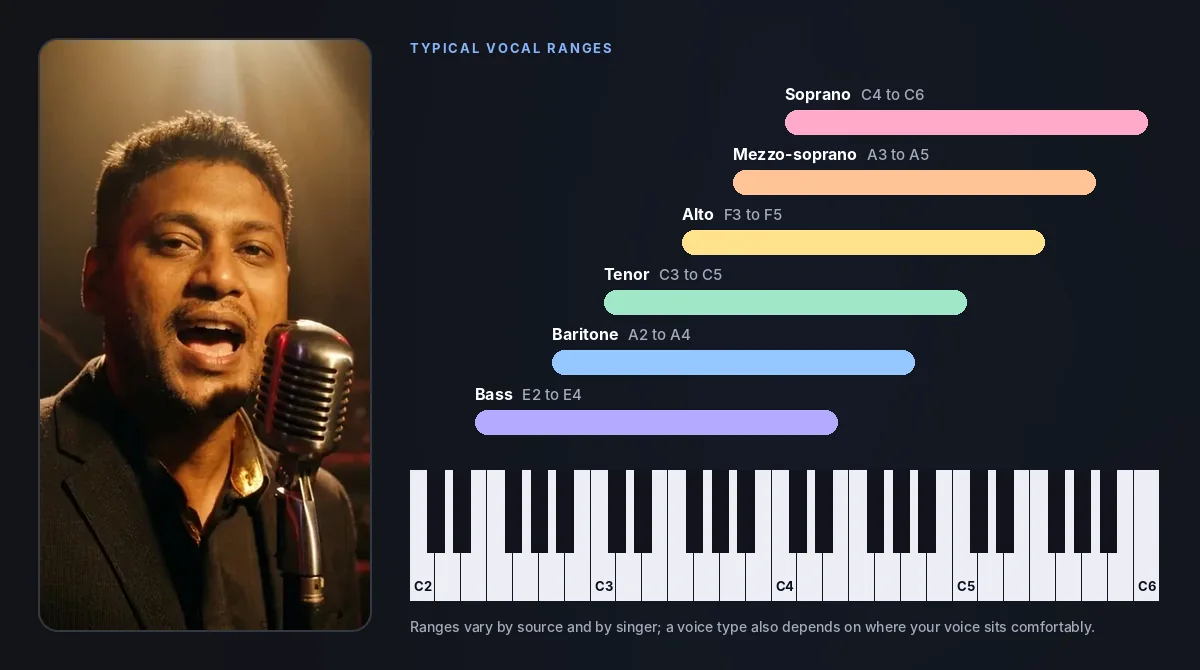
- Each voice type has a typical range of about two octaves, from bass (E2 to E4) to soprano (C4 to C6).
- Range is one clue: where your voice is comfortable (tessitura) and its color matter as much.
- Pick a song's key so its highest and lowest notes sit inside your comfortable range.
- Warm up, grow your range a little at a time and stop if anything hurts.
On this page (8 sections)ShowHide
- 1.What a vocal range is, and how notes are named
- 2.How to find your vocal range in six steps
- 3.Voice types and their typical ranges
- 4.Why your range alone doesn't decide your voice type
- 5.Chest voice, head voice and mixed voice
- 6.How to pick a song's key for your range
- 7.How to grow your range safely
- 8.From your range to a performance video
- Questions
What a vocal range is, and how notes are named
A vocal range is written as two notes, the lowest and the highest you can sing with a clear, steady tone, such as E2 to G4. The letter is the note and the number is its octave in scientific pitch notation: every octave starts on C, and middle C is C4, the C near the middle of a piano keyboard. So E2 is the E nearly two octaves below middle C, and G4 is the G just above it.
The distance between the two notes is counted in semitones, the step from one piano key to the very next one (black keys included). Twelve semitones make an octave, so E2 to G4 is 27 semitones, or two octaves and three semitones. Each note also has a frequency: A4 is 440 Hz, and every octave up doubles it, so A3 is 220 Hz and A5 is 880 Hz.
- Total range: every note you can make, including the weak, breathy or croaky ones at the very ends. Interesting, but not what you sing songs with.
- Usable range: the notes you can sing clearly and hold. This is the number a range test should give you, and the one this guide means by your range.
- Comfortable range (tessitura): the narrower stretch where your voice sounds best for a whole song. Keys are chosen by this one.
How to find your vocal range in six steps
- 01
Warm up for five to ten minutes
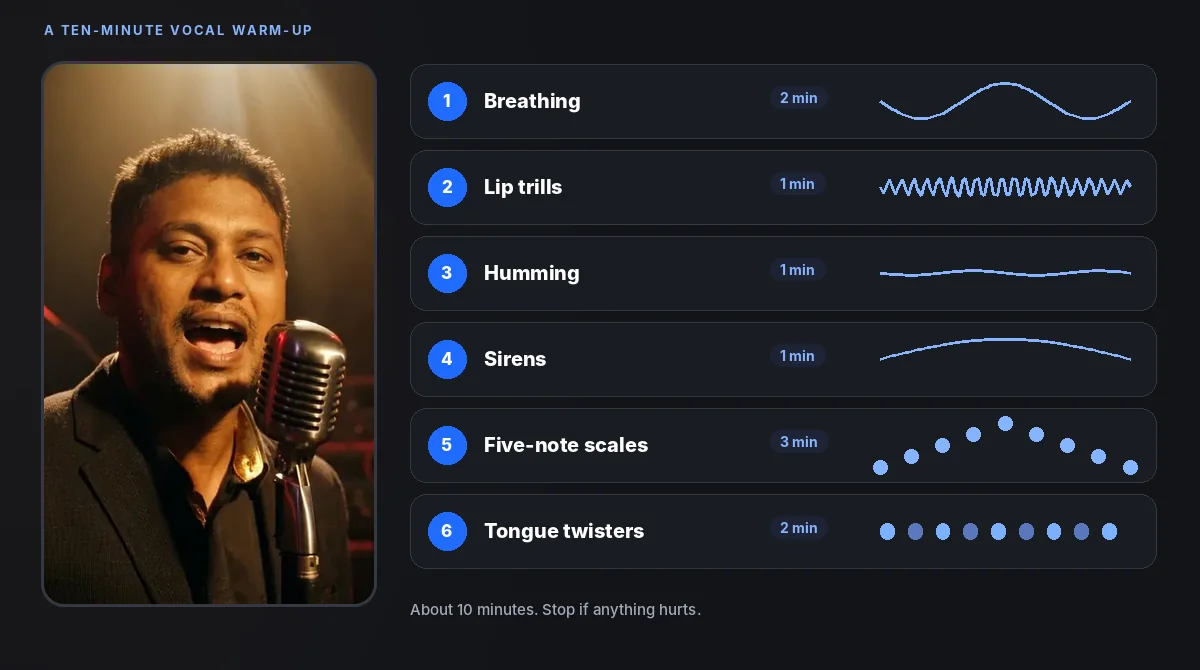
Hum a few easy notes, do lip trills (blow through closed lips so they buzz while you slide the pitch up and down) and gentle slides on "ng". A cold voice usually loses a few notes at each end, so testing straight out of bed gives a low reading.
- 02
Find a quiet room and something that names notes
Turn off music and fans, and open a vocal range test, a tuner app or a piano app on your phone. Stand or sit an arm's length from the microphone, upright, with your shoulders loose.
- 03
Start on a comfortable note
Sing an easy note on an open vowel such as "ah", at the volume you'd use to talk across a table, and hold it for a second or two. This is your home base: you'll come back to it between reaches.
- 04
Step down to your lowest clear note
Go lower a note or two at a time, holding each one, until the sound turns to a growl, a rattle or a whisper. The last note you could hold with a steady, clear tone is the bottom of your range.
- 05
Step up to your highest clear note
Return to your home note and climb the same way, letting your voice lighten into head voice or falsetto as it goes. Stop at the last note you can hold without squeezing, shouting or cracking.
- 06
Write it down and test again another day
Note both ends, such as A2 to F4, and the span in semitones. Ranges move a note or two with sleep, colds and how much you've used your voice, so repeat the test on two or three days and keep the result that comes up most.
No app at hand? The chromatic mode of the guitar tuner names any note you sing, and a guitar or keyboard works if you match each note by ear, playing it and singing it back until the two sound like one.
Skip the blank page
Upload your song and Muvora's AI director plans a shot-by-shot storyboard on the beat. Edit every shot for free, and pay only if you render.
Voice types and their typical ranges
Classical and choral music sort voices into types, and music references give each one a typical range of about two octaves. Sources move these by a note or two, and good singers of every type reach beyond them, so read the table as typical rather than as a test you pass or fail. Find the rows your lowest and highest notes fall inside: the type whose range most overlaps yours is a sensible first guess.
| Voice type | Typical range | In hertz (about) | Where it sits |
|---|---|---|---|
| Bass | E2 to E4 | 82 to 330 Hz | The lowest part in a choir |
| Baritone | A2 to A4 | 110 to 440 Hz | Between bass and tenor |
| Tenor | C3 to C5 | 131 to 523 Hz | The higher of the two lower choir parts |
| Countertenor | E3 to E5 | 165 to 659 Hz | The alto range, sung mostly in head voice |
| Alto | F3 to F5 | 175 to 698 Hz | The lower of the two upper choir parts; contralto in opera |
| Mezzo-soprano | A3 to A5 | 220 to 880 Hz | Between alto and soprano |
| Soprano | C4 to C6 | 262 to 1,047 Hz | The highest part in a choir |
Bass, baritone and tenor are usually men's voices and alto, mezzo-soprano and soprano usually women's, but the names describe a voice, not a person. Countertenors are usually men singing the alto range in head voice, and plenty of singers sit comfortably in a range their gender isn't expected to. Pop, rock and rap singers rarely use these labels at all; they're still a handy shorthand when you talk to a teacher, a producer or a choir director.

Why your range alone doesn't decide your voice type
Two singers can both reach from A2 to A4 and still be different voice types. Ranges overlap heavily (a baritone and a tenor share most of their notes), so teachers listen for three more things before they put a name on a voice.
- Tessitura: where the voice is comfortable for a whole song. A tenor can sing A2, but a song that sits around A2 and C3 will sound dull and tire them; a baritone can reach A4, but not for a whole chorus.
- Passaggio: where the voice changes gear between registers, often heard as a crack or a sudden change of color in untrained voices. It sits roughly between C4 and G4 in lower voices (lower for a bass, higher for a tenor), and higher voices usually have one around E4 to F♯4 and another near F5. Where yours falls is one of the strongest clues to your type.
- Timbre: the color and weight of the sound. A dark, heavy voice and a bright, light one can cover the same notes, and the difference is audible in a single phrase.
Chest voice, head voice and mixed voice
As you climb from your lowest note to your highest, your voice moves through registers: stretches of notes that are produced in a similar way and share a similar sound. Knowing their names helps you describe what happens at each end of your range, and why the top of a range test feels so different from the bottom.
- Chest voice
- The lower, fuller register most people speak in. It's called chest voice because the vibration is felt in the chest, though the sound is made at the vocal folds like every other note.
- Head voice
- The higher, lighter register above chest voice, felt more in the face and head. Trained singers keep it full and connected rather than breathy.
- Mixed voice
- A blend that carries some of chest voice's strength up into higher notes so the change between registers is hard to hear. Much pop, rock and musical theater singing above the speaking range relies on it.
- Falsetto
- A light, airy upper register in which the vocal folds stay thin and don't close fully. Many male singers use it for their highest notes; it usually counts toward your usable range when it's clear and steady.
- Vocal fry
- The creaky, rattling sound below the bottom of the singing range. Notes in fry are a useful effect but aren't usually counted as part of a vocal range.
- Whistle register
- The highest register, above head voice, reached by some voices, most often sopranos. Its notes can go well past C6.
- Passaggio
- The area where a voice passes from one register to the next. Untrained voices often crack or change color there; training smooths it out.
- Tessitura
- The part of your range where your voice is most comfortable and sounds best for long stretches. The word also describes the range a song's melody mostly sits in.
When a range test reads a higher note than you expected, it's often because your voice flipped into falsetto or head voice. That's fine: those notes count if you can sing them clearly. What matters for a song is whether you can get there smoothly and hold the note at the volume the song needs.
How to pick a song's key for your range
Knowing your range pays off most when you choose keys. A song is in the right key when its highest and lowest melody notes both sit inside your comfortable range, with a note or two to spare at the top for the nights your voice is tired. Moving a song to another key is called transposing, and it moves every note and chord by the same number of semitones.
- Find the melody's highest and lowest notes in the original key: sing along with the recording and name them with a tuner or range test, or read them off the sheet music.
- Compare them with your comfortable range, not your extreme one. If the top note is above your comfortable top, count the semitones between them.
- Move the song down by that many semitones, or up if the bottom notes are too low and there's room at the top.
- Check the other end after the move. If the song's span is wider than your comfortable range, favor the chorus's high notes and sing a low verse line up an octave, or ask whoever wrote it whether a phrase can change.
- Transpose the chords to the new key, and try a capo on guitar so you keep open shapes.
| Lowest note | Highest note | Key | |
|---|---|---|---|
| The song as written | B2 | E4 | G major |
| Your comfortable range | G2 | C4 | The one to find |
| Moved down 4 semitones | G2 | C4 | E♭ major (capo 1 with D shapes, or capo 3 with C shapes) |
A song written for a much higher or lower voice can often be sung an octave down or up and then moved a few semitones to fit. If you write your own songs, set the key while you write: sing the chorus's top line at full voice before you record anything, and see how to write a song for the rest of the process.
Recorded in your key? Make the video
Upload the finished song, MP3, WAV, M4A, AAC or FLAC up to 8 minutes, and Muvora reads its tempo, key, sections and the words you sing, then writes a storyboard with every cut on a downbeat. Pick the Performance style and one photo of you becomes shots that lip-sync to your own vocal.
How to grow your range safely
Most voices can use a few more notes with regular practice, mostly at the top, as breath and technique improve. Expect it to happen slowly, over weeks and months, and think of it as making the notes at the edges clearer and steadier rather than forcing new ones out.
- Warm up before you sing: hums, lip trills and slides on "ng" or through a drinking straw.
- Practice little and often, such as 15 to 20 minutes a day, rather than one long session a week.
- Slide through the passaggio slowly on "oo" or "ng" so the change between registers gets smoother.
- Sing near the top of your range lightly and quietly first; volume comes later.
- Keep water nearby, and rest your voice after a long day of talking or a late night.
- Record yourself now and then, and listen for tone at the edges, not only for the notes.
From your range to a performance video
Once the song sits well in your voice, the next thing most singers want is to be seen singing it. If you film yourself, play the track loud enough to hear over your own voice and sing out loud along with it at full voice rather than mouthing the words: your breath, neck and face move the way they did in the recording, and the lip sync reads as real. Light your face from the front with a window or a soft lamp, keep the phone at eye level and shoot each section a few times.

If you'd rather not film, Muvora's Performance style works from one clear, front-facing photo of you, or of a drawn character, confirmed with a consent box. It separates your vocal from the uploaded song, finds where it's sung and makes those shots lip-sync to your own voice; the performer can appear in other shots too, between story shots planned around the song. Lip-synced seconds cost 75 credits a second, and you see the full price before you render. The AI lip sync guide explains how the singing shots are made, and photo to music video shows what makes a photo work.
Turn your voice into a performance video
Upload your song and get a free storyboard with the singing shots placed where your vocal is, every cut on the beat. Edit any shot for free, with 5 new storyboards a month on the free plan. See AI lip sync music videos for how the performance shots look.
Written by the Muvora team. Last updated November 15, 2026. Spotted something out of date? Tell us at [email protected].