The short answer
A hook is the short, repeated idea a listener remembers: a lyric, a melody, a rhythm or an instrumental riff, usually a few seconds long. To write one, start from a title phrase that's easy to say, set it to a simple rhythm with short words, give it a melody that lifts away from the verse, repeat it, and check that someone else can sing it back.
- A hook is an idea; a chorus is a section. The hook usually lives in the chorus, but it doesn't have to.
- Build the hook on the title, in the chorus's first or last line.
- Contrast sells it: if the verse is low and busy, make the hook higher and sparser.
- Short words, long vowels and stresses on the beat make a line easy to sing back.
- A hook passes when someone who has never heard it can sing it back after two listens.
On this page (8 sections)ShowHide
What a hook is
A hook is the piece of a song built to be remembered. It's short, usually a few seconds and rarely more than a couple of bars, and it comes back often enough that by the end of the song the listener already knows it. Most songs have one main hook and a few smaller ones working beside it: a sung line, the tune it's sung to, a rhythm the drums keep stamping, a riff in the intro. They come in four kinds, and the strongest hooks are often two at once, a line that is also a melody.
| Kind | What it is | How to spot it | Example |
|---|---|---|---|
| Lyrical | A phrase, usually the title | The words you'd type to search for the song | "Ten more miles of neon", sung four times in each chorus |
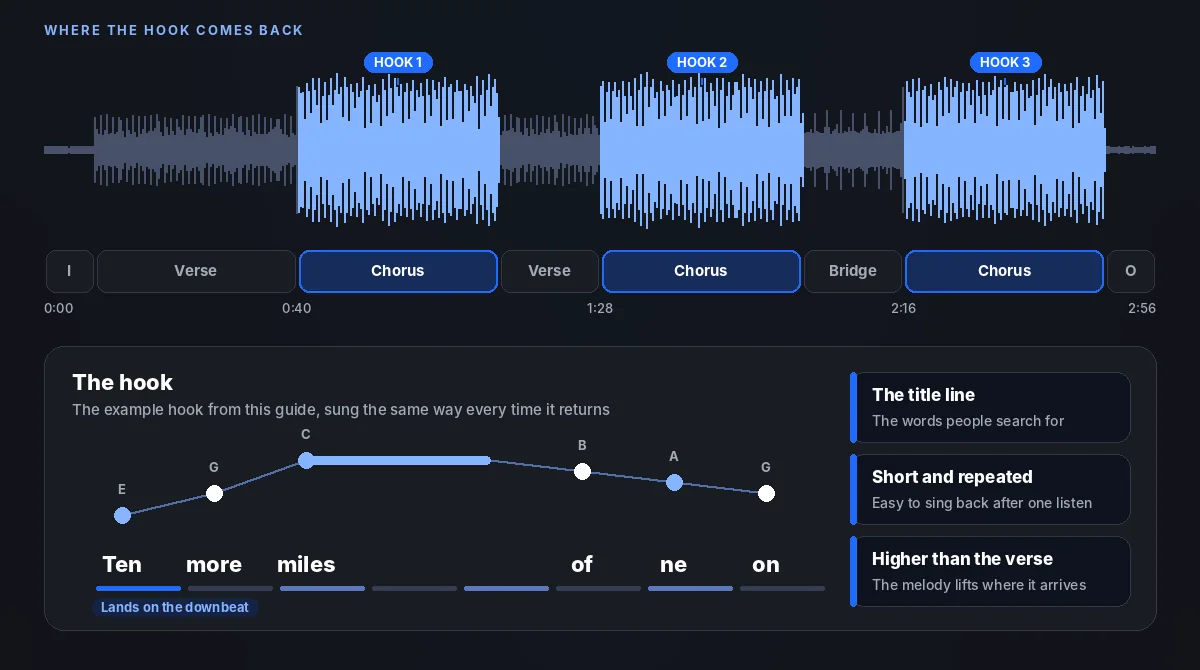
| Melodic | A short tune, often carrying the title | You can hum it with no words | In C major the line climbs E, G, then leaps up to a held C on "miles" and steps back down to G |
| Rhythmic | A pattern of stresses, claps or repeated syllables | You can tap it on a table | Short, short, long: ten more MILES, ten more MILES, as a chant after the chorus |
| Instrumental | A riff, a synth line, a vocal chop or a drum figure | You know the song from it in a second | A four-note synth line that answers each title line |
The hook isn't the cleverest line in the song. Clever lines belong in the verses, where the listener is paying attention to the story. The hook is the simplest line, the one that still makes sense when someone hears it through a wall, in a shop, or as a ten-second clip with no context.
Hook vs chorus: the idea and the section
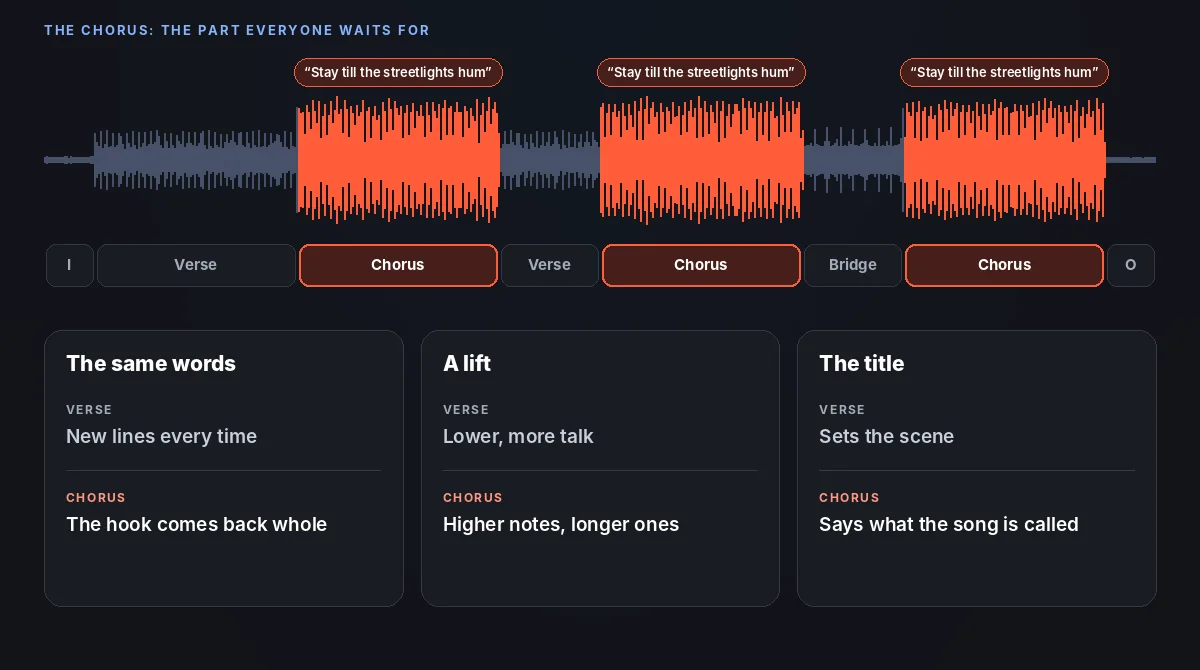
A chorus is a section of the song, a block of bars that comes back with the same words each time. A hook is an idea that can live anywhere. Most of the time the main hook sits inside the chorus, which is why the words get mixed up, but a song can have a hook in its intro riff, a second one in a chant after the chorus, and a chorus that's mostly there to deliver them. In hip-hop the word means something else again: "the hook" is the name for the chorus itself, the section between verses.
| Question | Hook | Chorus |
|---|---|---|
| What is it? | An idea: a line, a tune, a rhythm or a riff | A section that comes back with the same words |
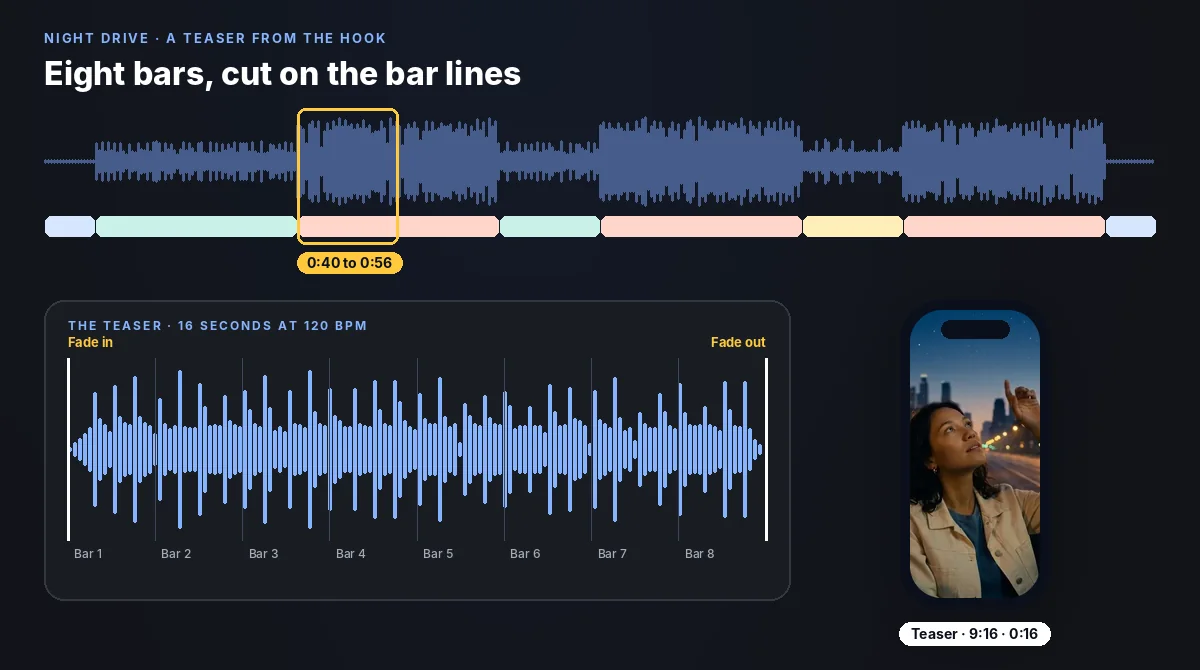
| How long? | A phrase, usually a few seconds | Often 8 bars, about 16 seconds at 120 BPM |
| Where does it sit? | Anywhere: chorus, intro, post-chorus, under a verse | Between the verses, often after a pre-chorus |
| How many in a song? | Often two or three working together | One, sung the same each time with small changes |
| In hip-hop? | Any catchy line, riff or ad-lib | Usually called the hook |
The difference matters when you write. A chorus with no hook is a section that repeats without anyone remembering it. A hook with no chorus to frame it can work too, especially in dance music, where the drop and its synth line do the job a sung chorus would. Song structure explained shows where every section sits in the common forms.
Skip the blank page
Upload your song and Muvora's AI director plans a shot-by-shot storyboard on the beat. Edit every shot for free, and pay only if you render.
Where hooks sit in a song
- In the chorus: the main hook usually opens or closes the chorus, often both, and the title is usually the hook line. A listener should be able to name the song from it.
- After the chorus: a post-chorus repeats a fragment of the hook, a single word, a chant or a melody without words, so it rings on after the chorus ends.
- In the intro: an instrumental hook in the first few seconds tells the listener which song this is before a word is sung, and comes back later under the chorus.
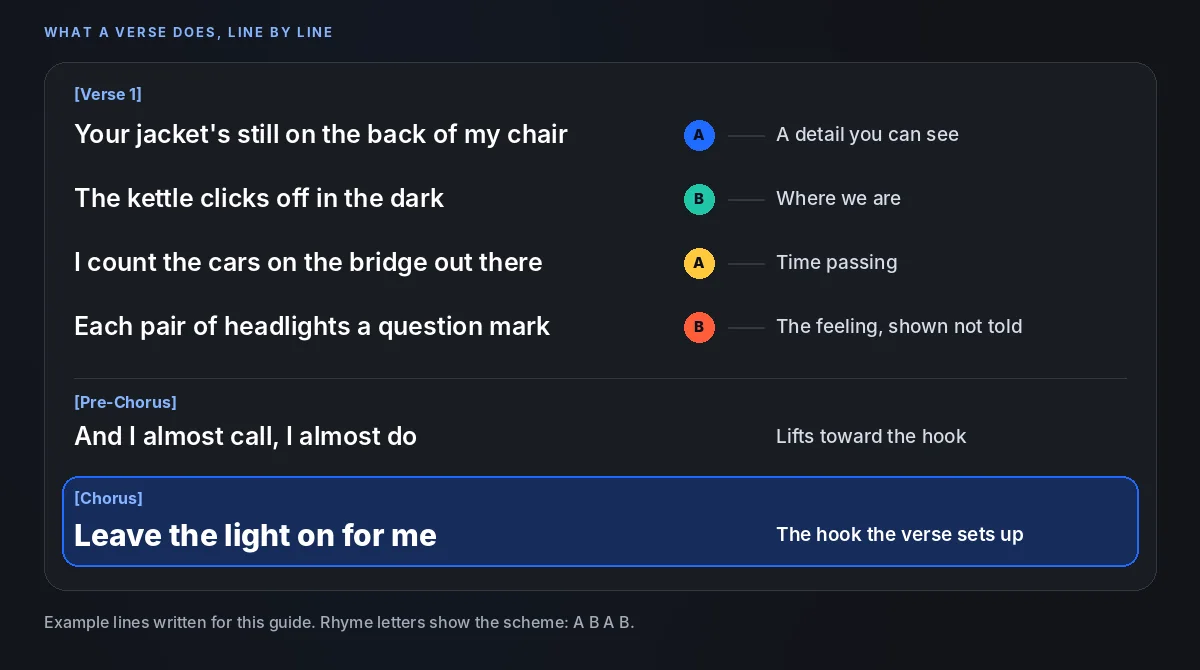
- Before the chorus: a pre-chorus doesn't carry the hook; it points at it, with a rising line and a chord that wants to resolve, so the hook arrives like a release.
- Under the verses: a riff or a sound from the hook kept quietly in the verse keeps it in the listener's ear between choruses.
- At the end: the outro often strips the hook back to one voice or repeats it until the fade, the last thing someone hears before the next track.
Many writers now bring the hook in early, either with a short intro or by starting on the chorus itself, so a listener who skips around a song still hears it fast. You don't have to; a song that holds its hook back for a full verse can make it land harder. Just make that choice on purpose, and if the first chorus arrives after a minute, give the intro or the verse something catchy of its own.
How to write a hook in seven steps
- 01
Find the title phrase
Pick a phrase of two to six words that sums up the song and is fun to say out loud. Concrete and a little unusual beats abstract: a picture or a situation gives the melody and the video something to hold on to.
- 02
Say it until it has a rhythm
Repeat the phrase at talking speed and notice where your voice puts the stress. Set the strongest stress on a strong beat, ideally the first beat of a bar, and let the light syllables fall between beats.
- 03
Sing it over the chorus chords
Loop the chords and sing the phrase a dozen different ways: starting high, starting low, leaping up on the stressed word, holding the last note. Record every pass and keep the one you catch yourself humming later.
- 04
Set it against the verse
Sing the verse melody, then the hook. If the verse sits low and moves in small steps, lift the hook higher, slow its rhythm and give its main word a long note, so the change is obvious.
- 05
Decide how it repeats
Choose a pattern for the chorus's lines, such as the hook on lines one, two and four with a different line three. Planned repetition sounds like a chorus; random repetition sounds like a placeholder.
- 06
Give it an answer
Write a short reply that fills the gap after the hook: a riff, a backing vocal or an ad-lib. Call and response turns one hook into two, and the answer is often what people sing along to.
- 07
Test it and change one thing at a time
Run the tests further down this guide. When the hook fails one, change one thing, the words, then the rhythm, then the melody, and test again, so you know which change fixed it.
What makes a hook stick
- Repetition: a hook repeats inside the chorus and in every chorus. Saying the title two to four times in a chorus is common, and the repeats are what people learn on the first listen.
- The title line: a hook that is also the title gets remembered and searched for. Put it on the first or last line of the chorus, where the ear expects something important.
- Contrast with the verse: a hook stands out by being different: higher or lower, sparser or busier, on a new chord. If the verse is a rush of words, the hook can be four.
- Short words and long vowels: one-syllable words are easy to catch at full volume, and long, open vowel sounds such as the ones in "night", "go" and "stay" can be held on a long note. Words ending in hard stops like "-ick" cut a held note short.
- Stress on the beat: the words' natural stresses should land on strong beats. A hook that makes you sing "to-NIGHT" as "TO-night" sounds wrong even to people who couldn't say why.
- A melody that lifts: a leap up of a fourth or more onto the main word, or the song's highest note on the title, makes that word the peak of the line.
- Space around it: a short rest before or after the hook gives the listener a moment to take it in. A hook buried in a wall of words disappears.
| Choice | In the example | Why it helps |
|---|---|---|
| Short words | Five words, six syllables | Easy to catch and sing back on one listen |
| Stresses on the beat | TEN, MILES and NE- fall on the beats | The words' natural rhythm and the music's agree |
| A long vowel on the held note | "Miles" held across the beat | An open sound carries a held note; a clipped one wouldn't |
| A leap | G up to C on "miles", a fourth | The stressed word becomes the top of the line |
| An open ending | The line steps down and stops on G | Ending away from the home note C makes it want to come round again |
| Repetition with a change | Lines one, two and four of the chorus, a new line three | The repeats teach it; the one new line keeps it from wearing thin |
Here is that chorus as a whole: "Ten more miles of neon / ten more miles of neon / I don't need to know where we are going / ten more miles of neon." Against it, a verse line from the same song runs longer and lower: "Gas station coffee and a map we never folded, your feet on the dash and the radio low." The verse is busy and spoken; the hook is short, sung and high, and that difference is most of what makes the chorus feel like an arrival. To try the chords under it, the chord progression generator plays common progressions in any key.
Recorded a demo? See where the hook lands
Upload the song and Muvora finds its verses, choruses and drops, then writes a storyboard that builds each chorus bigger than the last and cuts fastest where the song is loudest. Before you pay anything you see style frames, including the chorus's hero shot, so you know how the hook will look.
Hooks across genres
Every genre uses all four kinds of hook, but each leans on some more than others. Knowing where a genre usually puts its weight helps you decide what to work hardest on.
| Genre | Where the hook often lives | What it often leans on |
|---|---|---|
| Pop | The chorus title line, then a post-chorus | Melody and repetition, a title line that rises |
| Hip-hop and trap | The hook section between verses, plus ad-libs | Rhythm and a chantable phrase; the beat's loop as the instrumental hook |
| EDM and dance | The drop | A synth line or vocal chop, with the build pointing at it |
| Rock | The opening riff and the chorus | A guitar riff that returns, and a line a crowd can shout |
| R&B | The chorus, with room for the voice | Melody, and a phrase that leaves space for runs |
| Country | The title line in the chorus | Wordplay: a phrase whose meaning turns by the last chorus |
Writing a rap hook works the same way with a different balance: rhythm first, then the words, then whatever melody the delivery suggests. How to write rap lyrics covers the verses that lead into it, and its section on bars shows how long an 8-bar hook lasts at each tempo.
How to test a hook before you record it
You can't judge your own hook the day you write it, because you've heard it fifty times. These tests use time and other people's ears instead. Run them on a rough voice memo before you spend money on a studio, a mix or a video.
- The next-morning test: don't play the memo; try to sing the hook when you wake up. If you can't remember your own hook, nobody else will.
- The sing-back test: play it twice for someone who has never heard it, then ask them to sing it. Half a line back is a pass for a first draft; a blank look means it needs work.
- The no-band test: sing it with no chords at all. A hook that holds up on one voice will hold up in a full mix.
- The title test: ask a listener what they think the song is called. If they name the hook line, it's doing its job.
- The swap test: sing the verse melody where the hook should go. If it doesn't sound like a step down, the hook isn't contrasting enough yet.
- The clip test: cut eight bars around the hook and play them on a phone as if they were a short video. Does the clip make sense with no song around it?
When a hook passes, write the rest of the song around it. How to write a song walks through the verses, the chords, the bridge and the demo, and the syllable counter checks that a second verse still fits the melody the first one set.
Give the hook its moment in the video
A music video should treat the hook the way the song does: as the event. In a filmed video that means the chorus gets the biggest location, the widest shots and the fastest cutting. Muvora works the same way from the recording. Its shot planner cuts on downbeats, puts a cut at every section change and cuts faster in the loudest parts, which is usually the chorus, and its AI director writes each chorus bigger than the last.

The hook is also the clip that travels. One widescreen render gives you the video, a vertical version, a square version and an 8-second Spotify Canvas loop cut from the strongest moment of a chorus. Every section starts on a cut on a downbeat, so trimming the vertical file at the first chorus gives you a hook clip that opens cleanly. Turn captions on and paste your lyrics, and the hook appears on screen word by word as it's sung; the Lyric style builds the pictures around the words as well, as the lyric video maker page shows.
Put your hook on screen
Upload the song, read the storyboard for free and change any shot before you pay. The price shows before the video renders, and shots that fail cost nothing.
Written by the Muvora team. Last updated November 17, 2026. Spotted something out of date? Tell us at [email protected].