The short answer
To write rap lyrics, loop the beat, find its tempo and count it in bars: in most rap, one line fills one bar of four beats. Hum a flow before you have words, put a rhyme on the last stressed syllable of each bar, add rhymes inside the bars, build to a punchline every few lines, then cut filler and rap it aloud until every syllable fits.
- A bar is one measure of the beat, and in most rap one line fills one bar.
- Verses often run 16 bars and hooks 8; count yours against the beat, not the page.
- Write the flow before the words: hum the rhythm, then fill it.
- Rhyme on sounds, not spelling, and save the densest rhymes for the end of the verse.
- Rap every draft out loud over the beat, because the page can't tell you what fits.
On this page (9 sections)ShowHide
- 1.What a bar is, and how to count one over a beat
- 2.How to write a rap verse in eight steps
- 3.The 16-bar verse, the 8-bar hook and the shape of a rap song
- 4.Flow and cadence: where the syllables sit
- 5.Rhyme schemes: end, internal, multisyllable and slant
- 6.Punchlines, wordplay and double meanings
- 7.Telling a story in sixteen bars
- 8.Edit the verse, then rap it out loud
- 9.From the verse to the video
- Questions
What a bar is, and how to count one over a beat
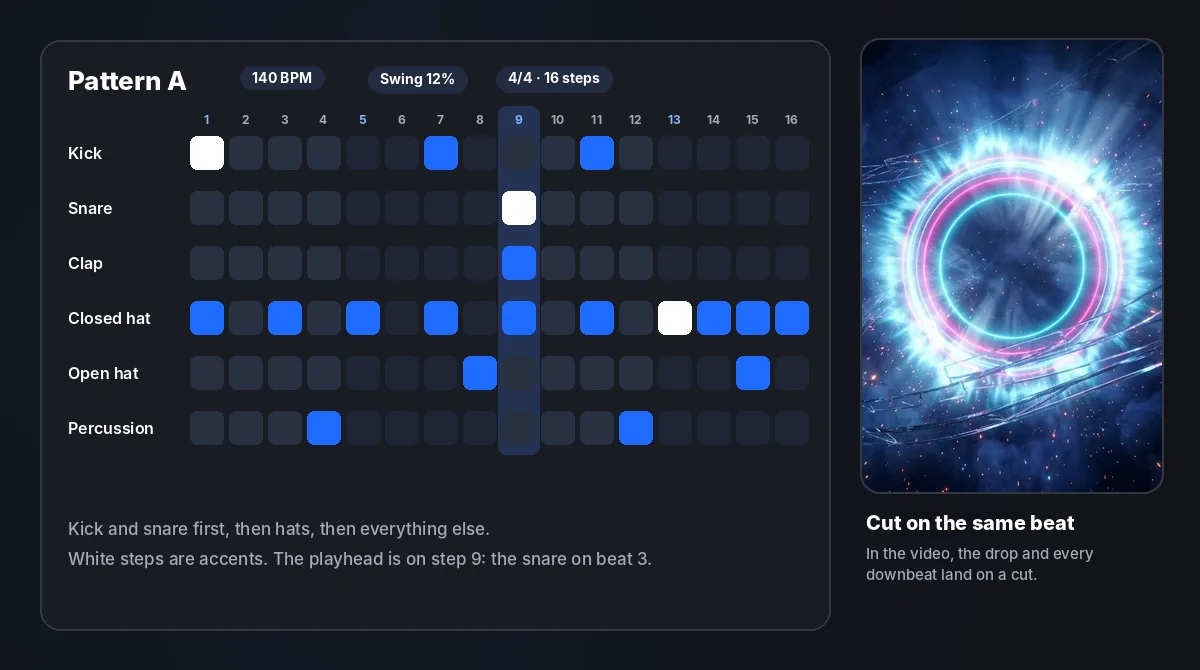
A bar (or measure) is one cycle of the beat's count. Nearly all rap is in 4/4, so a bar holds four beats: count "one, two, three, four" with the one on the strongest hit, usually a kick. In most boom bap and plenty of other hip-hop, the snare or clap lands on two and four, so a bar sounds like kick, snare, kick, snare. When rappers say "bars" they mean lines, because the habit is one line of lyrics to one bar of music. Two bars that rhyme make a couplet, and a verse is built out of couplets.
Trap beats, and many drill beats, confuse the count, because their main snare often hits only once a bar, on beat three, which gives them a half-time feel. A beat a producer calls 140 BPM then feels like 70. Both counts describe the same music: at 140 a bar lasts 1.7 seconds and holds one snare, at 70 it lasts 3.4 seconds and holds two. Ask what tempo the beat was made at, or pick the count that matches how you'd split your lines, and keep it for the whole song so your bar counts agree with your collaborators'.
Bar 1
Bar 2
Bar 3
Bar 4
| Tempo | One bar | 4 bars | 8-bar hook | 16-bar verse |
|---|---|---|---|---|
| 70 BPM | 3.4 s | 13.7 s | 27.4 s | 54.9 s |
| 90 BPM | 2.7 s | 10.7 s | 21.3 s | 42.7 s |
| 100 BPM | 2.4 s | 9.6 s | 19.2 s | 38.4 s |
| 140 BPM | 1.7 s | 6.9 s | 13.7 s | 27.4 s |
| 160 BPM | 1.5 s | 6.0 s | 12.0 s | 24.0 s |
How to write a rap verse in eight steps
- 01
Loop the beat and find its tempo
Play the beat on a loop, tap its tempo and count four beats to a bar. Note where the beat changes, usually every 4 or 8 bars, because those are the places your verse can change with it.
- 02
Pick one idea and your angle on it
Write one sentence that says what the verse is about and where you stand: a place, a night, a claim you can back up. A verse about one evening at a bus stop beats a verse about everything you've been through.
- 03
Hum the flow before the words
Rap nonsense syllables over four bars until a rhythm sticks, and record it on your phone. That scratch flow is the mould: it tells you how many syllables each bar wants and where the stresses go.
- 04
Collect rhymes and pictures
List the images, names, numbers and phrases that belong to your idea, then find rhyme families for the strongest words, grouped by their vowel sounds rather than their spelling.
- 05
Write in couplets
Write two bars at a time: a setup line and a line that answers it, with the rhyme on the last stressed syllable of each. Rap every couplet over the beat before you write the next one.
- 06
Shape the sixteen
Order the couplets so the verse builds: place the listener in the first four bars, move the story or the argument in the middle, and save the hardest punchline or the densest rhymes for bars 13 to 16.
- 07
Cut filler and fix the stresses
Count the syllables in every bar, cut words that are only there to fill time, and swap any word whose natural stress fights the snare. Read it through with the beat muted to hear the weak lines.
- 08
Record a rough take and revise
Rap the verse into your phone over the beat, listen the next day and fix the bar you stumble on first. Mark where you breathe, and leave ad-libs and doubles until the words are settled.
Skip the blank page
Upload your song and Muvora's AI director plans a shot-by-shot storyboard on the beat. Edit every shot for free, and pay only if you render.
The 16-bar verse, the 8-bar hook and the shape of a rap song
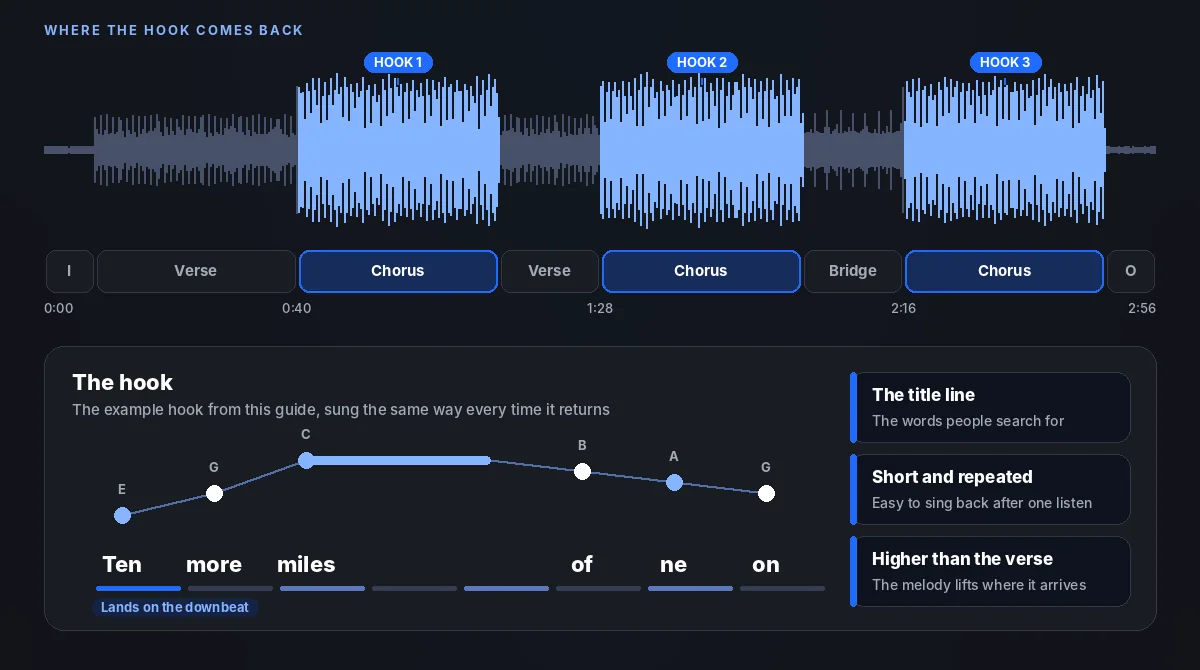
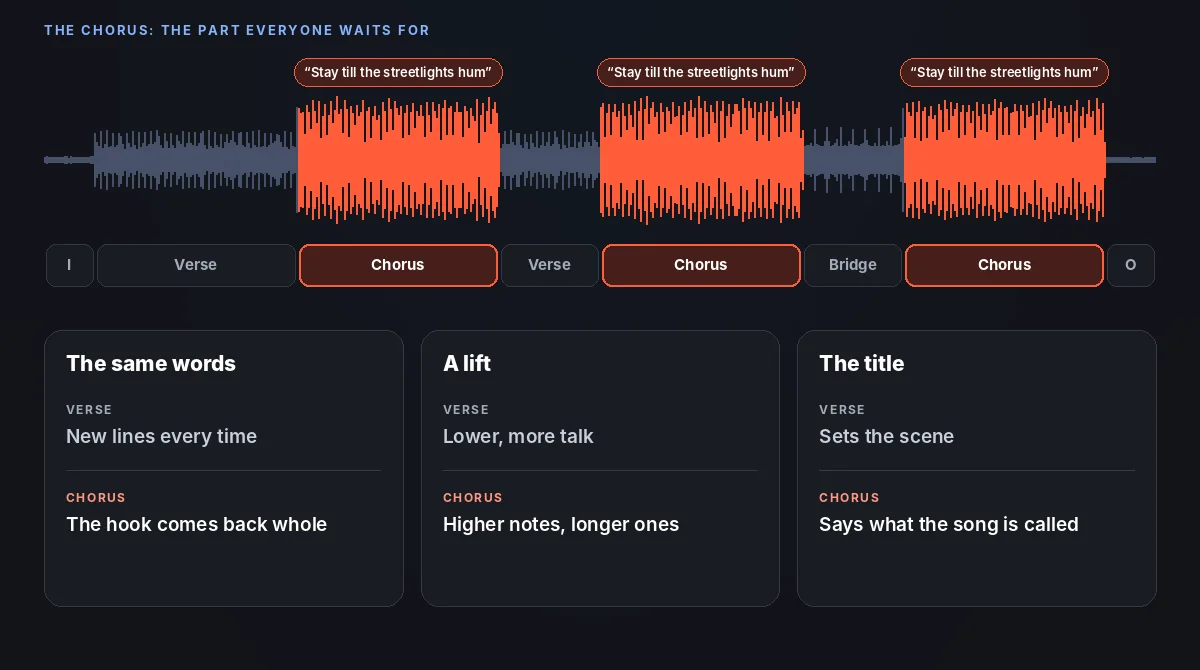
A rap song often follows the same plan: a short intro, an 8-bar hook, a 16-bar verse, the hook again, a second verse, the hook, and maybe a third verse or a shorter bridge before a last hook. Sixteen bars is common enough that a verse is often just called "a sixteen". None of it is a rule: features are often 8 or 12 bars, story songs stretch to 24 or 32, and plenty of hooks are 4 bars sung twice. What stays true is that sections change on multiples of four bars, because that's where the beat changes too.
| Section | Bars | At 90 BPM | Its job |
|---|---|---|---|
| Intro | 4 | 10.7 s | Sets the beat; a tag, an ad-lib or a line of the hook |
| Hook | 8 | 21.3 s | The phrase people repeat, often the title |
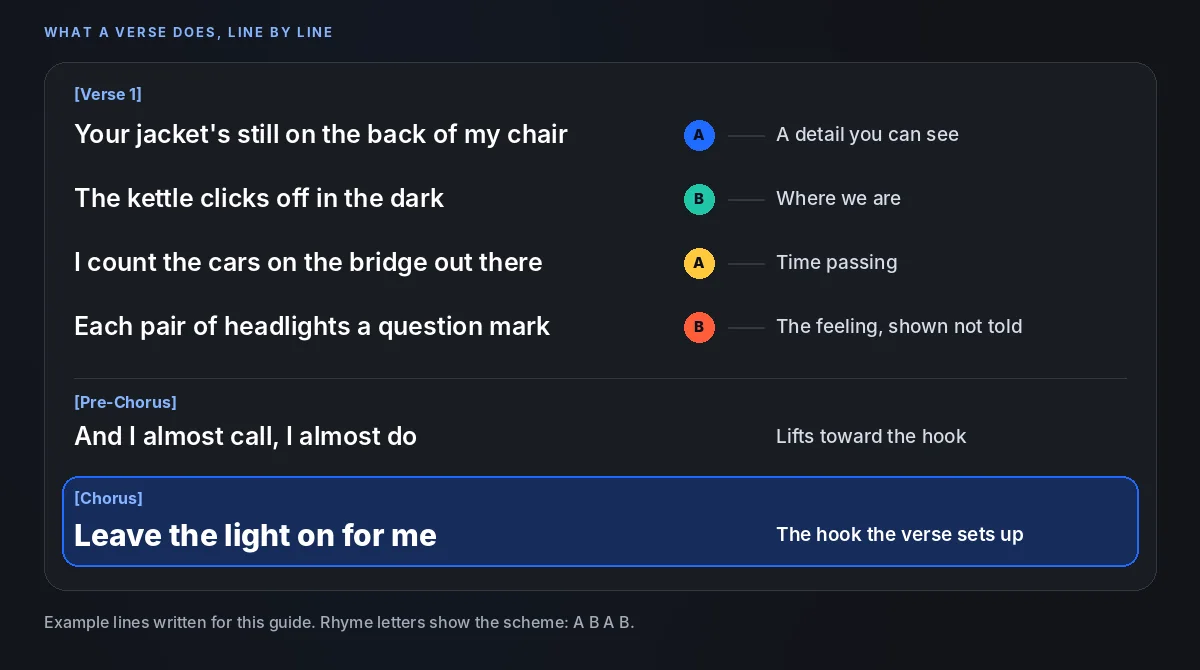
| Verse 1 | 16 | 42.7 s | Who you are, where we are, what you want |
| Hook | 8 | 21.3 s | Same words; an ad-lib or a double can change |
| Verse 2 | 16 | 42.7 s | What changed since verse one; the sharper bars |
| Hook | 8 | 21.3 s | The hook again, often fuller |
| Bridge or short verse | 8 | 21.3 s | A switch: a new flow, or the beat drops out |
| Hook | 8 | 21.3 s | The last and biggest hook |
| Outro | 4 | 10.7 s | The tag, a fade or one last line |
Write the hook early if you can. Once it exists, every verse knows what it's leading into, and you'll catch a verse that wanders away from the song's point. How to write a hook covers what makes one stick, and song structure explained has the forms other genres use. To lay your own plan out with timestamps before you write, use the song structure builder.
Flow and cadence: where the syllables sit
Flow is the rhythm your syllables make against the beat: how many there are, where they start and stop, and which ones lean on the drums. Cadence is the shape of your delivery inside that rhythm, where your voice rises, falls, speeds up and puts its weight. Two rappers can say the same words over the same beat and sound nothing alike because of these two things alone. A good test of flow is to rap a bar on one note in a whisper: if it still grooves, the rhythm is doing its job.
Each beat of a 4/4 bar can be split into smaller slots, and a syllable usually takes one slot or a few. The grid you choose sets how dense the bar feels and how many words you can fit, which is why the same sixteen bars can be a laid-back verse or a breathless one.
| Grid | Slots in a bar | At 90 BPM | At 140 BPM | How it feels |
|---|---|---|---|---|
| Quarter notes | 4 | 1.5 a second | 2.3 a second | Chanted, every word a hit; common in hooks |
| Eighth notes | 8 | 3 a second | 4.7 a second | Conversational and relaxed |
| Eighth-note triplets | 12 | 4.5 a second | 7 a second | Rolling, three to a beat |
| Sixteenth notes | 16 | 6 a second | 9.3 a second | Dense, double-time pressure |
- Rests are part of the flow: leaving the first beat of a bar empty, or ending a line early, gives the next line more punch than filling every slot.
- Start off the downbeat: a line that begins on the "and" before beat one, or just after it, sounds less like reading and more like talking.
- Land the rhyme on the snare: a rhyming word on beat two or four, or on beat three of a half-time beat, hits harder than one between the drums.
- Switch it up on purpose: change the grid or the rhythm every 4 or 8 bars, often where the beat changes, so the verse has chapters instead of one long run.
- Plan your breaths: at six syllables a second there's nowhere to hide a gasp. Mark breaths at the ends of couplets and write a short line or a rest before a long run.
Rhyme schemes: end, internal, multisyllable and slant
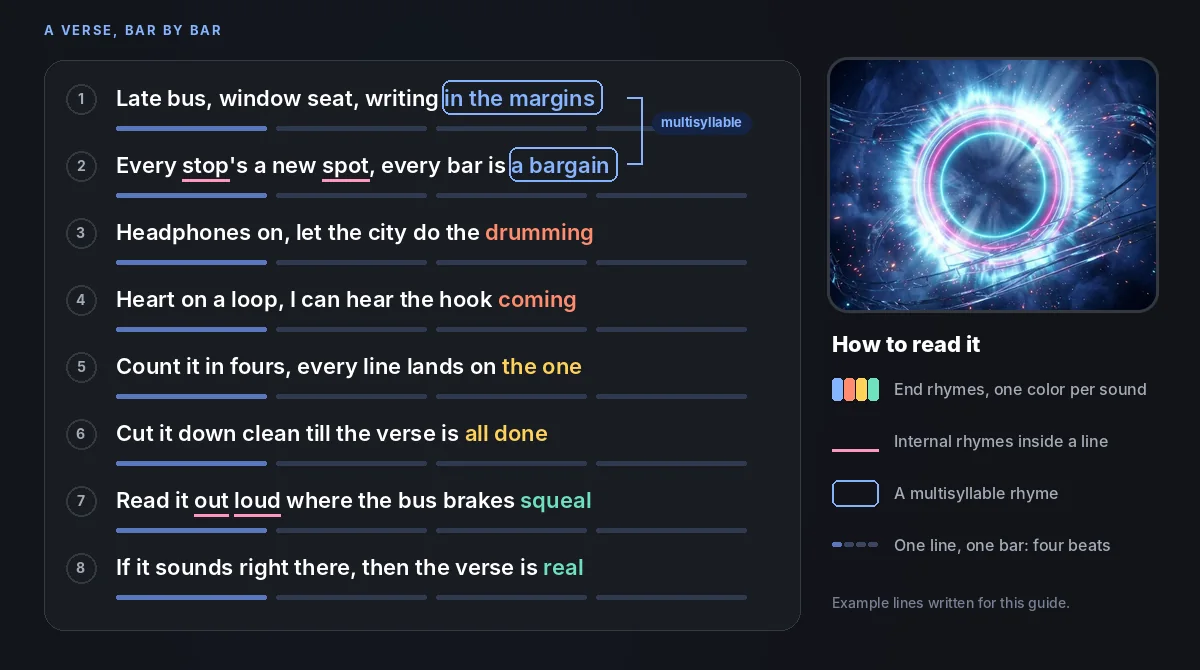
Rap rhymes by sound, and mostly by vowels. Two words rhyme when their last stressed vowel and everything after it match, but a verse can also lock together on vowels alone while the consonants change. Rhyme schemes are written as letters, AABB for couplets or ABAB for alternating lines, and rap often goes further: one rhyme sound can run for four or eight bars before it changes, usually where the beat does.
| Kind | What it is | Example |
|---|---|---|
| End rhyme | The last stressed syllables of two bars rhyme | I counted every coin in a jar by the bed / now the jar's on the shelf and the rent's paid ahead |
| Internal rhyme | Rhymes inside the bar as well as at its end | Late shift, the weight lifts when the gate clicks at eight |
| Multisyllable rhyme | Two or more vowel sounds matched in a row | We grew up on the stoop through every golden hour / now the whole street's watching who is holding power |
| Slant rhyme | Close vowels, different consonants | Learned my patience in the basement, counting all the days since |
| Rhyme run | One rhyme sound carried across four bars or more | Four lines in a row ending wake, break, ache and stake |
Here's how the pieces work together in four bars, each about fifteen syllables, so they sit on the same rhythm:
- Six a.m., the corner's quiet, I'm the only one awake
- counting dollars in a notebook, every margin, every break
- mama asking what I'm building, I just tell her give it time
- 'cause the patience in the basement's gonna pay the rent in rhyme
Awake and break close the first couplet, time and rhyme the second (AABB). Inside the lines, dollars and margin share their first vowel, and patience and basement make a slant rhyme in the middle of bar four, which keeps the last bar the busiest. Notice too that the lines read like speech: rhymes that bend the grammar sound forced the moment you rap them.
Rhyme generatorType a word or a short phrase to see its perfect, near and multisyllable rhymes, grouped by syllable count and found by sound rather than spelling.Got a finished track? Storyboard it on the beat
Upload the song, MP3, WAV, M4A, AAC or FLAC up to 8 minutes, and Muvora maps its beats, bars and sections, then writes a storyboard with every cut on a downbeat, coming faster where the song is loudest. Paste your lyrics and they're lined up with your vocal word by word. The storyboard is free to read and edit, with 5 new storyboards a month on the free plan.
Punchlines, wordplay and double meanings
A punchline is a payoff: one bar sets up an expectation, the next one breaks it, and the word that breaks it lands on the last strong beat. The setup has to be plain enough to follow on a first listen, because a listener only hears it once at full speed. If a line needs a footnote to make sense, it isn't a punchline yet.
- The reversal: "They said I'd never get off this block / fair enough: I bought it." The setup reads as a put-down; the answer takes it literally and wins.
- The double meaning: "Keep my circle small and my margins wide." Circle means the people you trust; margins means both the space at the edge of a notebook page and the profit on a sale, and both readings point the same way.
- The homophone: "They clocked the hours, we kept what's ours." In many accents hours and ours sound the same, so the line rhymes with itself and flips its meaning in one breath.
- The extended metaphor: "Forecast says it's cloudy with a chance of doubt / by the second hook the sun is coming out." One picture, here the weather, carried through four or eight bars, gives a verse a spine.
- The callback: a phrase from verse one comes back changed in verse two, so the listener hears how far the story moved.
Telling a story in sixteen bars
A story verse needs the same things as any story: someone, somewhere, something they want and something that changes. Sixteen bars is short, so every line has to do work. First person and present tense put the listener in the room; specific details, a street name, a time, the weather, a sound, make it feel true; a line of dialogue can do the work of four lines of description.
| Bars | What happens | Example line |
|---|---|---|
| 1 to 4 | Place us: who, where, when | Ten past two, the laundromat's the only window lit |
| 5 to 8 | The want or the problem | Demo on a cracked phone and a dollar for the spin |
| 9 to 12 | The turn: something happens | Then the owner hears the hook and turns the dryers off to listen |
| 13 to 16 | The payoff, or a cliffhanger into the hook | By the morning half the block knew every word I'd written |
Across a whole song, the verses can be the before, the during and the after, with the hook commenting on all three. Verse two shouldn't repeat verse one in new words: move the clock forward, show the cost, or tell the same night from another side. If you write the hook first, check that every verse earns its way back to it.
Edit the verse, then rap it out loud
Most first drafts are too long and too general. Editing a verse is mostly cutting: the word that's only there to fill a slot, the bar that says what the last bar already said, the rhyme you chose because it rhymed rather than because it was true. Then rap it, out loud, over the beat, at full speed, because a line that reads fine on the page can trip your tongue on the third syllable.
- Every bar fits the beat when you rap it at full speed, breaths included.
- No word is there only to rhyme or to fill a slot.
- The same end word doesn't close two couplets in a row.
- Each couplet says something the one before it didn't.
- Names, places, times and numbers are specific.
- The strongest punchline sits in the last four bars.
- You can rap it through without reading it.
Record a rough take on your phone and listen the next day with fresh ears. Fix the bar you stumble on first, then the bar that bores you. When the words are settled, record properly: how to record vocals at home covers the room, the mic and the gain. Still looking for a beat to write on? How to make a beat starts from an empty drum grid.
From the verse to the video
Once the song is recorded and mixed, it needs something to watch on YouTube, Reels and TikTok. Muvora makes the music video from the finished track: it reads the beats, bars and sections, its shot planner puts every cut on a downbeat, and an AI director writes the storyboard shot by shot. Pick the hip-hop look and the cuts come at a driving pace, fastest in the loudest parts, usually the hook. Your lyrics can be explicit, and pasted lyrics appear in the captions as you wrote them; the pictures never show real people, so describe your city and your story rather than another artist.
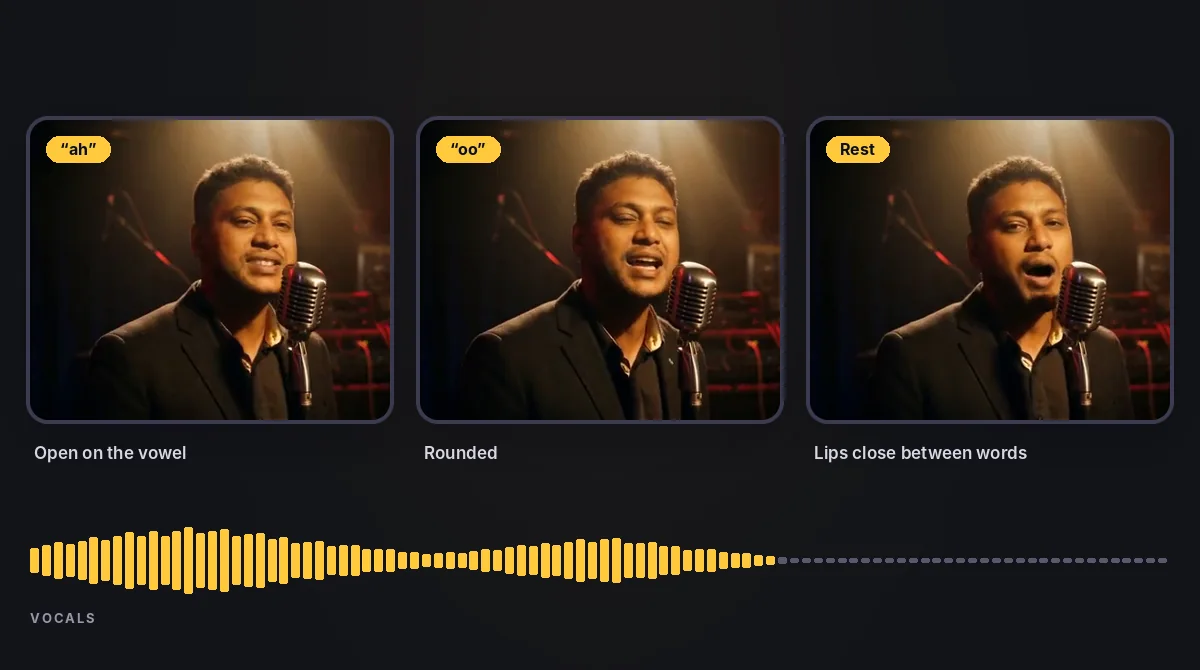
Choose the Performance style and one clear, front-facing photo of you, with the consent box ticked, becomes shots that lip-sync to your own vocal, rapped or sung, where your voice carries the song. A double-time verse moves the mouth fast, so use a photo in even light with your mouth in full view; if your fastest verse would still read as a blur, the Story style keeps the whole song in story shots. With captions on, each word lights up as you say it. Music videos for rappers explains how the shots are chosen, and rap music video ideas has concepts to put in the idea box.
Finished the verse? Put your face on the bars
Upload the track and a photo, and read the storyboard before you pay anything: every shot can be rewritten, every cut moved to another beat. The price shows before it renders, and shots that fail cost nothing.
Written by the Muvora team. Last updated November 17, 2026. Spotted something out of date? Tell us at [email protected].