The short answer
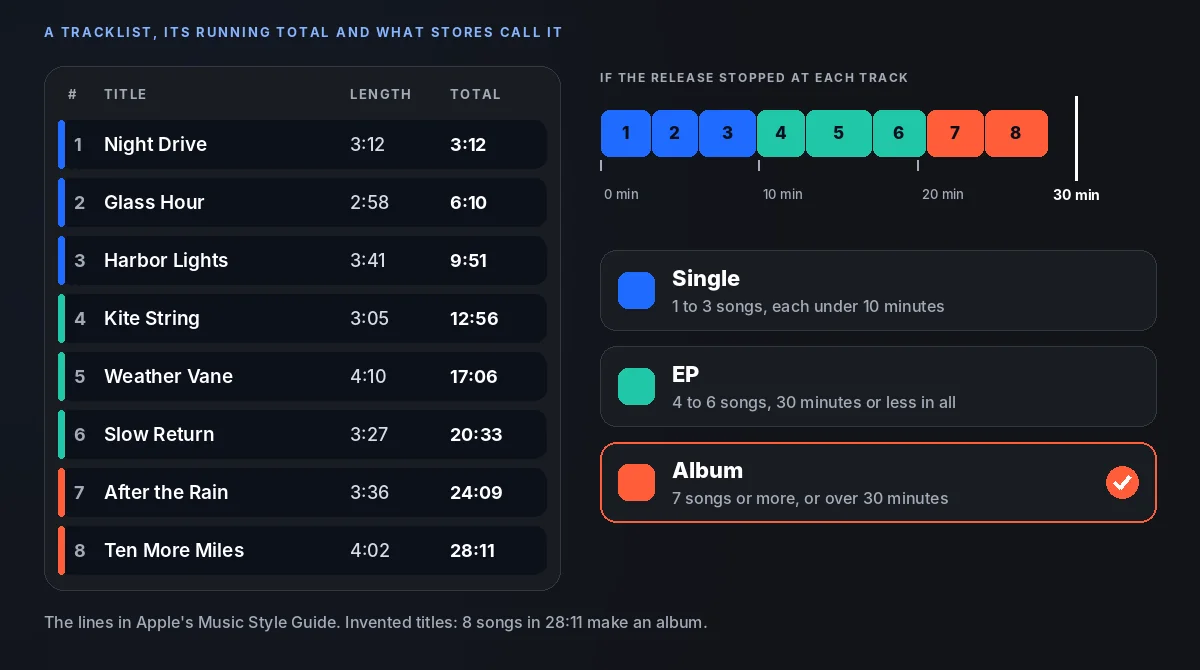
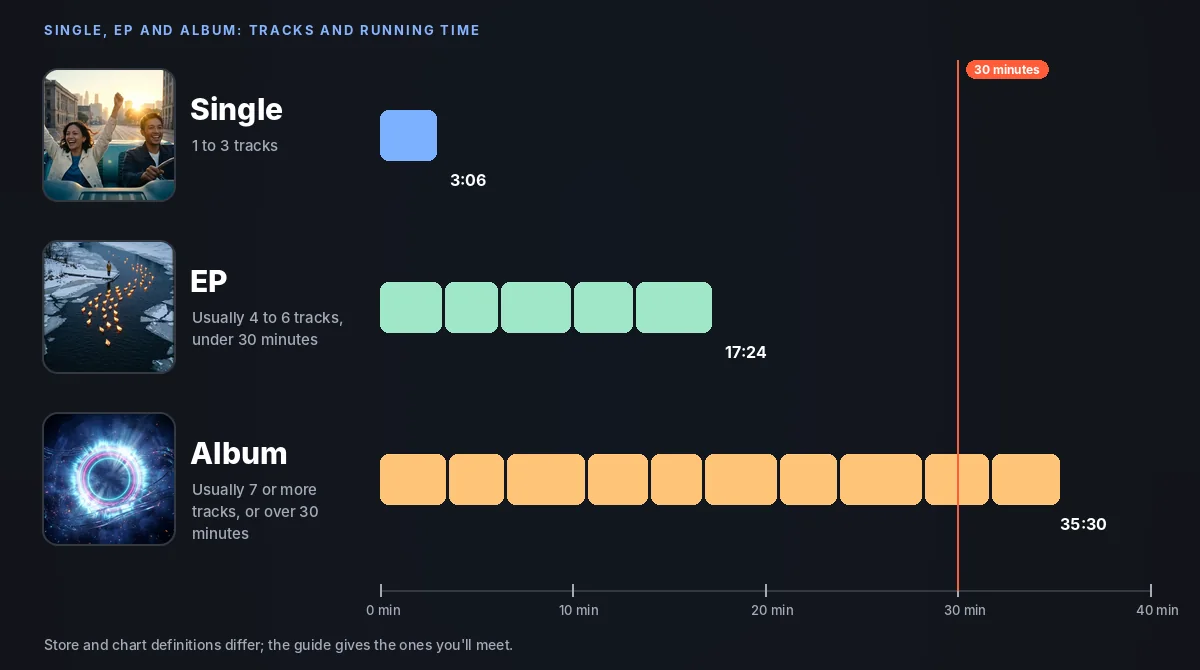
An EP (extended play) is a release longer than a single and shorter than an album, usually four to six songs lasting under 30 minutes. Apple's style guide, which distributors follow when they deliver to Apple Music, calls a release an EP when it has four to six songs totaling 30 minutes or less, or up to three songs with one at least 10 minutes long.
- Usually four to six songs and under 30 minutes in all.
- Stores sort releases by track count and length: seven or more songs, or over 30 minutes, is an album.
- Charts and awards draw their own lines, so an EP can count as an album there.
- Lead with the strongest song and give the focus tracks the full music videos.
- Every track still needs a visual: a visualizer, a Canvas loop or clips for the rest.
On this page (8 sections)ShowHide
What an EP is
EP stands for extended play. The name comes from vinyl, where an extended play record held more music than a single but far less than a long-playing album (the LP). On streaming services the format has nothing to do with records any more: an EP is simply a release with more songs than a single and fewer than an album, sold or streamed as one unit with one title, one cover and one release date.
- Single
- A release built around one song, sometimes with one or two more (a B-side, a remix or an instrumental): one to three tracks under 10 minutes each, by Apple's definition.
- EP
- Extended play: usually four to six songs and under 30 minutes, released as one product with its own title and cover.
- Album
- Also called an LP: the full-length release, usually seven songs or more, or a running time over 30 minutes.
- Focus track
- The song on an EP or album that the artist and their team push hardest: the one pitched, promoted and given the music video.
- UPC
- The barcode that identifies a release as a product. An EP gets its own, while each recording on it keeps its own ISRC.
The lines between the three aren't set by law or by one industry body. Each store files a release by its track count and length, each chart and each awards body writes its own rules, and they don't all agree. What follows is how the ones you'll meet most often draw those lines.
How stores, charts and awards define an EP
Apple's Music Style Guide is the definition distributors quote most. As of November 2026 it says a release must be identified as a single if it has one to three songs under 10 minutes each, and as an EP if it has four to six songs with a total running time of 30 minutes or less, or one to three songs where one runs at least 10 minutes and the whole is 30 minutes or less. "- Single" or "- EP" goes at the end of the title, and Apple adds it automatically if it's missing. Videos don't count as songs.
| Source | Single | EP | Album |
|---|---|---|---|
| Apple Music style guide | 1 to 3 songs, each under 10 minutes | 4 to 6 songs, 30 minutes or less in all; or 1 to 3 songs with one of 10 minutes or more | Anything larger |
| Stores in general (Amuse's summary) | 1 to 3 tracks (unless one runs over 10 minutes) | 4 to 6 tracks (unless the total passes 30 minutes) | 7 tracks or more, or over 30 minutes |
| Spotify (Amuse's summary) | Under 30 minutes and 5 tracks or fewer: single or EP | The same | 6 tracks or more |
| UK Official Charts | Formats of up to 4 songs and 25 minutes | No category of its own | More than 4 songs, or over 25 minutes |
| Grammy Awards | No definition | No definition | At least 5 tracks and 15 minutes, or any number of tracks running 30 minutes or more |
Sources: Amuse's help on singles, EPs and albums, which says the rules "differ a bit on Spotify"; the Official Charts Company's album chart rules, which count a release of more than four songs or over 25 minutes as an album where it doesn't qualify as a single format; and the Recording Academy's rulebook for the 69th Grammy Awards, which defines an album by tracks and playing time. Spotify's own data doesn't separate the two shorter formats: its Web API gives every release one of three types, album, single or compilation, so an EP travels with the singles there.
Skip the blank page
Upload your song and Muvora's AI director plans a shot-by-shot storyboard on the beat. Edit every shot for free, and pay only if you render.
Single, EP or album: why release an EP
Singles keep you in front of listeners often, and each one gets its own release day, its own pitch and its own push. An album is a statement that takes the most time, money and attention to make and to promote. An EP sits in between, and it earns its place when you have a handful of songs that belong together and want them heard as a set.
| Format | What it does well | What it asks of you | A good fit when |
|---|---|---|---|
| Single | One song at a time, each with its own release day and pitch | A steady stream of finished songs and visuals | You're building an audience and finishing songs one by one |
| EP | A short body of work that shows range, with one or two songs leading it | Four to six songs that hold together, sequenced and mastered as a set | You have a group of songs with one mood, story or sound |
| Album | A full statement, often the release press and fans take most seriously | The most songs, time and promotion; a long campaign around it | You have an audience waiting and a reason to say something at length |
- It shows range in one place. A booker, a curator or a journalist can hear four or five songs in one sitting and know what you do. Pair it with a one-page press kit from the EPK generator.
- It collects singles. Songs released one by one can come back together on the EP, each keeping its ISRC, so the EP launches with songs people already know.
- It's finishable. Five songs mixed, mastered, sequenced and given artwork and visuals is a project you can complete in one season.
- It sets up the next one. An EP that finds an audience tells you which of your sounds to build an album around.
How to put out an EP, step by step
- 01
Choose the songs
Pick four to six songs that sound like they belong on one record and keep the total under 30 minutes, so every store files it as an EP.
- 02
Pick one or two focus tracks
Choose the songs that hook a new listener fastest. They become the singles before release day, the song you pitch to playlist editors and the ones that get full music videos.
- 03
Sequence the EP and master it as a set
Put the songs in their final order, then master them together so the loudness and tone hold from track to track, and listen in order on a phone and in a car.
- 04
Prepare the metadata and the artwork
Give the EP one title, one cover and one UPC, keep each recording's ISRC (a single already released keeps its own), and have credits, splits and lyrics ready for every track.
- 05
Set the dates
Choose a release day, release one or two focus tracks as singles in the weeks before it, and deliver the whole EP to your distributor at least four weeks ahead.
- 06
Make a visual for every track
Plan a full music video for each focus track, then a visualizer, a lyric video or a Canvas loop for the others, and cut vertical clips from all of them.
- 07
Pitch, launch and keep going
Pitch the focus track to Spotify's editors at least 7 days before release, premiere the video on release day, then post a clip from a different track every few days for a month.
Spotify lets you pitch one unreleased song at a time, so pick the track that best represents the EP; how to get on Spotify playlists covers the pitch itself. Choosing who delivers the EP is its own decision: how to choose a music distributor compares what they offer. The rest of the release, from mastering to registrations, is in how to release music independently.
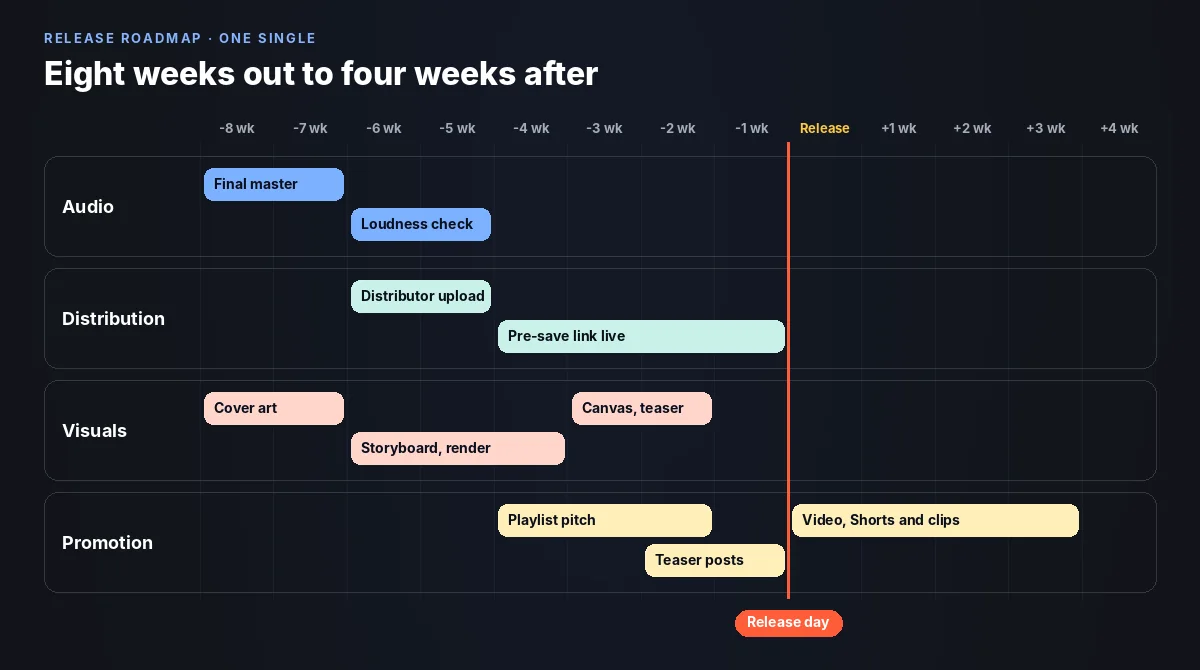
- 01
6 weeks out
- · Song mastered
- · Pick the visual idea
- · Storyboard drafted
- 02
4 weeks out
- · Pitch the song
- · Render the video
- · Cover art final
- 03
2 weeks out
- · Canvas uploaded
- · Vertical teasers cut
- · Lyric video ready
- 04
Release week
- · Premiere the video
- · Post a clip a day
- · Chapters and links set
How to sequence an EP
Sequencing is the order of the songs, and on a short release every slot matters. Not every listener reaches the last track, so the first two songs have to do most of the work, and the last one decides how the EP is remembered. Think of the running order the way you'd think of a song's structure: an opening that hooks, a middle that varies, a turn, and an ending.
| Slot | Its job | What to listen for | Visual |
|---|---|---|---|
| 1. Opener | Say what the EP sounds like in the first seconds | A short intro; the hook arrives early | A Canvas loop and a vertical teaser |
| 2. Focus track | The strongest hook, for new listeners | The song you'd play someone first | The full music video |
| 3. Contrast | Change the pace so the set doesn't blur | A different tempo, key or texture | A visualizer |
| 4. Second focus | Show another side of you | A different mood with the same identity | A music video or a lyric video |
| 5. Closer | Leave the listener somewhere | An ending that feels finished, not faded out early | A visualizer, or a performance clip |
- Don't put two songs of the same tempo and key next to each other. Read each song's BPM and key with the BPM and key finder, and step between them the way a DJ would.
- Mind the joins. Listen to the last bar of each song into the first bar of the next; a gap that's too long or too short is easy to fix before you deliver.
- Match the loudness. A song mastered much quieter than its neighbors sounds weaker in sequence than it does alone. Measure each one with the LUFS meter.
- Play it in order on a phone. That's how most people will hear it, and it's where a weak transition shows up.
A video for every track
Each song on an EP is played on its own as often as in order, and on YouTube, TikTok and Instagram it's always on its own. So every track needs something to be seen with, even if only the focus tracks get a full music video. A practical plan: a music video for the focus track (or both), a visualizer or lyric video for each of the others, a Canvas loop on every track for Spotify, and vertical clips cut from all of them for the weeks around release.
Keep the set looking like one record. Use the same palette, the same kind of places and the same wardrobe across the videos, so a viewer who sees a clip of track three recognizes the world of track two. The cover art is the anchor: pull its two or three main colors into every video's look. The album visualizer page covers making visuals for a whole release, and visualizer vs lyric video vs music video explains which suits which song.
Storyboard the focus track first
Upload the focus track and get a free storyboard cut on its beats, with the look, the characters and every shot written for the song. You pay only to render, and the exact price shows before you do.
Making an EP's videos with Muvora
In Muvora each song is its own upload. The song gets its own analysis (tempo, beats, sections, drops and timed lyrics), its own storyboard and its own render, priced by its length: 6,840 credits for a 3-minute Visualizer video, 10,800 at Standard and 19,800 at Cinematic. Visualizer, at 38 credits a finished second, is the most affordable way to give every track on an EP a full video, and you might keep Standard or Cinematic for the focus track. The free plan includes 5 new storyboards a month, so you can read what the director writes for your songs before you decide which to render.
Each video gets its own brief and character sheet, and there's no saved look shared between videos, so write the EP's look into the idea box for every song: the palette, the places, the wardrobe and a recurring motif in the same words each time. A 16:9 render gives every shape a release needs: the widescreen video for YouTube, a vertical and a square version, and an 8-second Canvas loop with no sound.
Give every track on the EP a video
Upload each song and read its free storyboard, then render the ones you want: a full video for the focus track, Visualizer for the rest, each in every shape from one widescreen render.
EP release checklist
- Four to six songs, under 30 minutes in all
- Running order final, with every join listened to
- Every song mastered together, loudness checked track by track
- One title, one square cover and one UPC for the EP
- Each recording's ISRC, keeping the codes of singles already out
- Credits, splits and lyrics for every track
- One or two focus tracks released as singles before release day
- Delivered to the distributor at least four weeks before release
- A music video for each focus track; a visualizer, lyric video or Canvas for every other track
- Vertical clips from every track, scheduled for the month after release
The general release list, week by week, is in the music release checklist. If the EP is going to Apple Music, how to get your music on Apple Music covers what Apple's side of the release needs.
Written by the Muvora team. Last updated November 17, 2026. Spotted something out of date? Tell us at [email protected].