The short answer
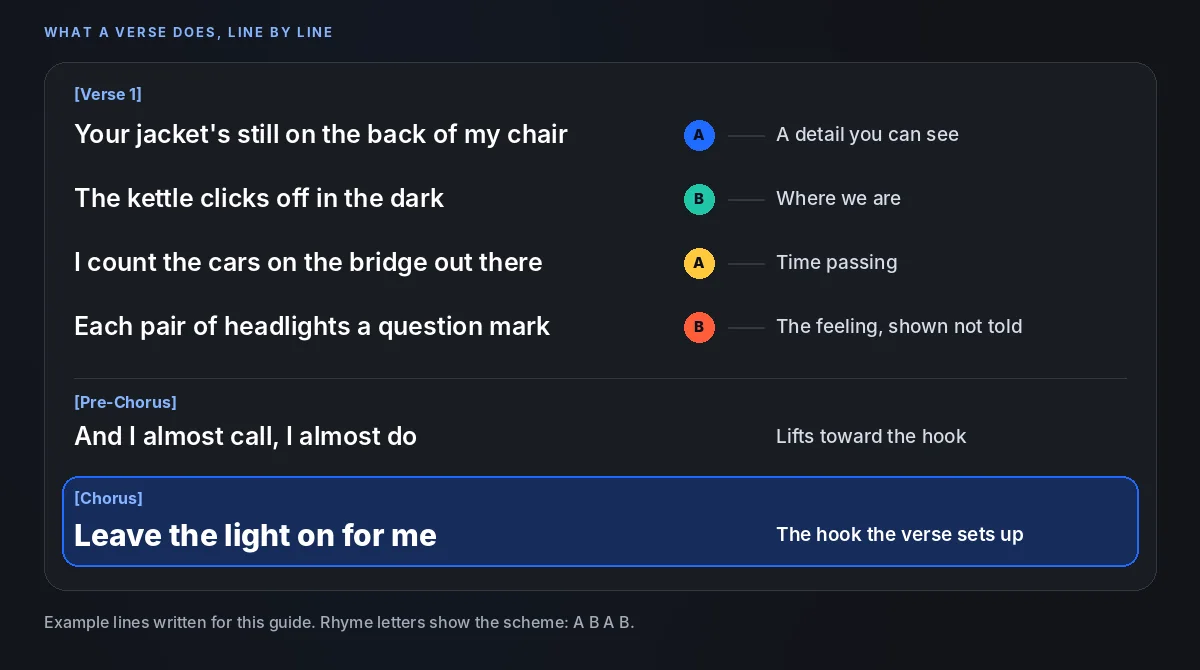
To write a verse, choose one scene and show it in concrete details a camera could film: who is there, where it is and what happens. Give each line one picture, fit its syllables and stresses to the melody, pick a rhyme scheme such as ABCB, and aim the last line at the chorus. Then make the second verse move the story on.
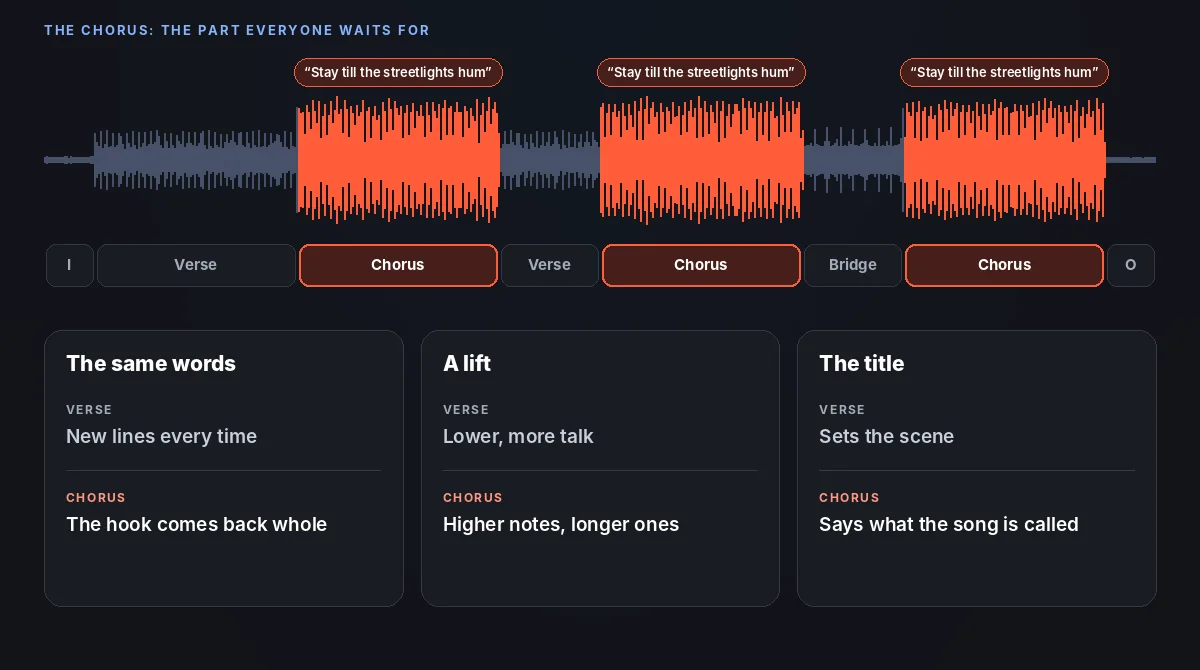
- The chorus says what the song means; the verses show why, in details.
- One scene per verse and one picture per line.
- Match verse two to verse one line by line, in syllables and in stresses.
- ABCB rhymes leave room for the exact word; an unrhymed last line pushes into the chorus.
- Verse two moves time, changes the situation or shows the other side.
On this page (10 sections)ShowHide
- 1.What a verse does that the chorus can't
- 2.How to write a verse in eight steps
- 3.Show the scene: details a camera could film
- 4.First lines: start inside the moment
- 5.Rhythm, syllables and line length
- 6.Rhyme schemes for verses
- 7.The second verse: move the story on
- 8.The last line: hand the song to the chorus
- 9.Why a verse falls flat, and what to try
- 10.Verses in the music video
- Questions
What a verse does that the chorus can't
A verse is the part of a song whose words change each time its music comes back. That's its whole advantage. The chorus repeats, so it has to be general enough to sing three times; the verse is heard once, so it can be as specific as a receipt. Its job is to give the listener a place, a person and a moment, and to make the chorus feel earned when it arrives. When a chorus sounds empty, the problem is often the verse before it, which explained the feeling instead of showing what caused it.
| What it carries | Verse | Chorus |
|---|---|---|
| Words each time | New in every verse | The same, or almost |
| What the listener gets | A scene: who, where, when and what happens | The feeling the scene adds up to |
| Kind of words | Nouns and verbs a camera could film | Plain, singable statements |
| Line length | Longer lines, closer to speech | Shorter lines, held notes |
| Example line | "two machines are turning, one is mine" | "laundromat moon, you're the only light on" |
"Laundromat Moon" is about someone who does their washing at a 24-hour laundromat every Sunday night, where the same stranger in a green jacket comes in at midnight. It's in D major at 96 BPM, so one bar of 4/4 lasts 2.5 seconds and an 8-line verse of two bars a line runs 40 seconds. The verses carry all of the story; the chorus only names the glowing dryer window as a moon. Rap verses follow the same principle with a different unit, the bar, and how to write rap lyrics covers the 16-bar verse, flow and multisyllable rhyme.
How to write a verse in eight steps
- 01
Know what the chorus says
Write the chorus's idea in one sentence before the verse, even if the chorus itself isn't finished, so the verse knows what it's setting up.
- 02
Pick one scene
Decide who is there, where it is and when it happens, and keep the whole verse in that one place and moment.
- 03
List what a camera could film
Write down eight to ten concrete details of the scene, the objects, actions, sounds and light, and keep the ones that are most specific to this story.
- 04
Open in the middle
Start the first line inside the scene at a particular moment, with a place, an action or a line of dialogue, rather than with a summary of how you feel.
- 05
Give each line one picture
Set one detail on each line, in the rhythm of the melody, with the stressed syllables of the words on the strong beats of the bar.
- 06
Choose a rhyme scheme
Rhyme the second and fourth lines (ABCB) for a natural, conversational verse, or alternate rhymes (ABAB) for a tighter one, and keep the same scheme in the second verse.
- 07
Aim the last line at the chorus
End the verse on a line that raises a question, breaks the rhyme or climbs in the melody, so the pre-chorus or the chorus sounds like its answer.
- 08
Write the second verse to move
Jump forward in time, show a consequence or switch to the other person's side, matching the first verse line by line in syllables and stresses so it fits the same melody.
Skip the blank page
Upload your song and Muvora's AI director plans a shot-by-shot storyboard on the beat. Edit every shot for free, and pay only if you render.
Show the scene: details a camera could film
The most useful test for a verse line is whether a camera could film it. "I was lonely in the city" can't be filmed; "two machines are turning, one is mine" can, and it says the same thing more sharply, because the listener works the loneliness out for themselves. Specific nouns (a paperback, twelve quarters, a green jacket), active verbs and a time of day do most of the work. Feelings belong in the verse too, but as things people do: someone who folds their shirts slowly to stay longer has told you how they feel without saying it.
| Telling | Showing | What changed |
|---|---|---|
| "I was lonely in the city" | "two machines are turning, one is mine" | A count of objects implies the empty room |
| "It was late and the place was empty" | "Sunday night and the sign says open" | A day, a sign and an hour in one line |
| "I liked them more than I'd admit" | "but I fold my shirts slow, slow, slow" | An action that gives the feeling away |
| "She was nervous about the message" | "she reads the text three times before she sends it" | A habit the listener recognizes |
| "Time went by and we got close" | "now we share a dryer and the quarters" | A change you can see |
- Use the senses beyond sight: the hum of a dryer, warm towels, a buzzing strip light. One sound or texture in a verse makes the place feel real.
- Prefer the odd detail to the expected one: every laundromat has machines; this one has a paperback folded down at page ninety-nine.
- Keep brand names and slang to a minimum unless they're the point. They date a lyric quickly and can distract from the story.
- One scene per verse. A verse that visits three places gives the listener nowhere to stand; save the move for the second verse or the bridge.

First lines: start inside the moment
The first line of a song is the only line every listener hears, so it has to put them somewhere at once. Openings that summarize ("Let me tell you about a girl I knew") spend a line before anything happens. Starting inside the moment, with a place, an action or a voice, gets the scene moving on the first downbeat. These six kinds of opening each work; the examples were written for this guide.
| Opening | Example | Why it works |
|---|---|---|
| A place and a time | "Sunday night and the sign says open" | The listener knows where and when in one breath |
| An action already happening | "Dad's truck coughs twice before it catches" | Movement, a character and a sound at once |
| A line of dialogue | "'Leave the porch light on,' you said" | A second person in the scene, and a reason to listen |
| One specific object | "There's a parking ticket on the windshield, still" | A detail with a story behind it |
| A question | "What do you do with a key to a house that's sold?" | The song now owes the listener an answer |
| A confession | "I said I'd call when I landed. I didn't." | Stakes and a narrator's flaw in two short sentences |
Rhythm, syllables and line length
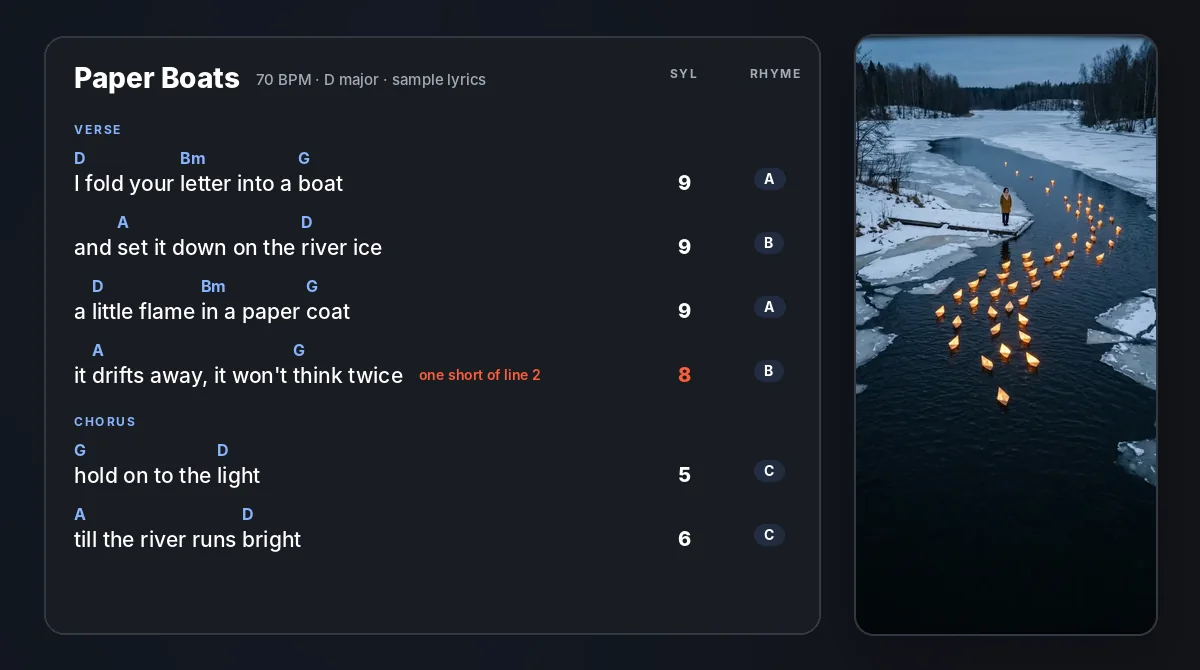
A verse line has to sing before it can mean anything. Its natural stresses should land on the melody's strong beats, so "page NINE-ty-NINE" sits well when "nine" falls on a beat, and badly when a long, high note lands on "-ty". Sung verses are usually more crowded than choruses but less than rap: at 96 BPM a two-bar line comfortably holds 8 to 10 syllables. Matching matters even more than the number. Because verse two reuses verse one's melody, each of its lines should come within a syllable or two of the line it replaces, with the stresses in the same places.
| Line | Verse one | Syllables | Verse two | Syllables |
|---|---|---|---|---|
| 1 | "Sunday night and the sign says open" | 9 | "Third week of rain and the jacket's soaking" | 10 |
| 2 | "two machines are turning, one is mine" | 9 | "holds the paperback out like a key" | 9 |
| 3 | "somebody's paperback left on the bench" | 10 | "says, 'You've been reading over my shoulder'" | 10 |
| 4 | "folded down at page ninety-nine" | 8 | "says, 'Page a hundred's better, you'll see'" | 9 |
| Tempo | 8 bars | 16 bars |
|---|---|---|
| 70 BPM | 27.4 s | 54.9 s |
| 96 BPM | 20 s | 40 s |
| 120 BPM | 16 s | 32 s |
| 140 BPM | 13.7 s | 27.4 s |
Rhyme schemes for verses
A rhyme scheme is written as letters, one per line end, with matching letters for lines that rhyme. In a verse, the scheme sets how settled or restless the section feels. Fewer rhymes leave more room to choose the exact word a story needs, and an unrhymed or unexpected last line makes the verse feel unfinished, which is useful right before a chorus. The examples below are written around the opening of "Laundromat Moon".
| Scheme | Feels | Example |
|---|---|---|
| ABCB (second and fourth lines rhyme) | Conversational, roomy; the most common in story verses | "Sunday night and the sign says open / two machines are turning, one is mine / somebody's paperback left on the bench / folded down at page ninety-nine" |
| ABAB (alternate lines rhyme) | Tight and balanced, a little formal | "Sunday night and the sign glows blue / two machines are turning, one is mine / I count my quarters, the stranger counts too / folded down at page ninety-nine" |
| AABB (rhyming pairs) | Punchy and quick, close to a chant | "Sunday night and the sign glows blue / two machines are turning, one for you / a paperback is waiting on the chair / folded down to show that someone's there" |
| AAAX (three rhymes, then a break) | Builds, then tips forward into the next section | "the dryer drums, the windows hum / the change machine eats every other one / the jacket's here before I've even come / and I still don't know their name" |
- Near rhymes are fine in verses. "Sheets" and "week" share a vowel without matching exactly, and a near rhyme that keeps the right word beats a perfect rhyme that forces the wrong one.
- Watch for twisted grammar. "To the laundromat went I" exists only to rhyme. If a line's word order changes to reach the rhyme, rewrite the line or change the rhyming word.
- Keep verse two's scheme. The melody has already taught the listener where rhymes land; verse two sounds wrong if they move.
- Internal rhymes add speed: "the dryer drums, the windows hum" rhymes inside the line, which tightens a fast verse without changing the scheme.
Turn the finished song into a storyboard
Once the verses are recorded, upload the song: Muvora finds its verses, choruses, energy and the timing of every sung word, then an AI director writes a shot-by-shot storyboard in which the verses move the story and the choruses get bigger. Reading and editing it is free, with 5 new storyboards a month.
The second verse: move the story on
The second verse is where many songs stall. The first verse set the scene and the chorus summed it up; if verse two describes the same scene in other words, the song has nowhere to go and the second chorus means exactly what the first did. The fix is to change something the listener can track: the time, the situation, the narrator's knowledge or whose side we hear. When the chorus comes round again, the same words should mean a little more.
| Move | What changes | Verse two could open |
|---|---|---|
| Jump in time | Weeks, years or a season later | "Third week of rain and the jacket's soaking" |
| Show a consequence | What the first verse led to | "Now we share a dryer and the quarters" |
| Switch sides | The other person's view of the same scene | "I've watched you count your quarters since May" |
| Zoom in | From the room to one object or gesture | "Your hand stops halfway to the soap" |
| Raise the stakes | Something is now at risk | "There's a notice on the door: closing in June" |
| Reveal | A fact that changes the first verse | "The paperback was yours the whole time" |
"Laundromat Moon" uses the first two moves. Its second verse: "Third week of rain and the jacket's soaking, / holds the paperback out like a key, / says, 'You've been reading over my shoulder,' / says, 'Page a hundred's better, you'll see.' / Now we share a dryer and the quarters, / argue over who should fold the sheets, / somewhere in the spin of a Sunday / I stopped counting down the week." Time has moved three weeks, the stranger finally speaks, and the page number answers a detail from verse one. The chorus that follows, "laundromat moon, you're the only light on", no longer describes loneliness. It describes the place where something started, without a word of it changing.

The last line: hand the song to the chorus
The end of a verse is a launch, not a landing. If its last line resolves everything, rhymed, complete and resting on the home chord, the chorus has nothing left to answer. Leave something open instead, and let a pre-chorus build from it if the song has one. How to write a chorus covers the pre-chorus and the chorus itself; on the verse's side, these are the moves that point at them.
- End on an action that isn't finished: "but I fold my shirts slow, slow, slow" leaves the narrator waiting, and the chorus explains why.
- Break the rhyme pattern on the last line: in an AAAX verse the unrhymed fourth line sounds like a door left open.
- Lift the melody on the last line so it ends higher, or on a held note over a chord that wants to move, often the V or the IV.
- Set up the title's meaning: the last verse line can name the thing the chorus title will turn into an image, as the hum and the dryer glass set up "laundromat moon".
- Shorten the last line when the next section starts on the downbeat, and leave a breath before the chorus's first word.
Here is the hand-off in "Laundromat Moon". The verse ends "we've never traded more than a nod, / but I fold my shirts slow, slow, slow." The pre-chorus climbs, "and the hum gets louder when the lights go low, / and the whole street's sleeping but I don't want to go," and the chorus lands on the title: "laundromat moon, you're the only light on, / turning my week till the colors are gone." Read the verse alone and it's a scene; read it into the chorus and the chorus becomes its reason.
Why a verse falls flat, and what to try
| Problem | How you notice | Try |
|---|---|---|
| It sounds like a chorus | Lines like "I feel so lost" that could be in any song | Swap each general line for a detail from your scene list |
| Verse two repeats verse one | You could swap the verses and nothing would change | Jump in time or switch sides, then rewrite |
| Lines won't fit the melody | You rush some lines and stretch others | Match each line's syllable count and stresses to its partner in verse one |
| Forced rhymes | Odd word order or a word you'd never say | Use a near rhyme, or move a different word to the end of the line |
| Too many ideas | Three places and two timelines in eight lines | Keep one scene and move the rest to verse two or the bridge |
| The chorus arrives late | More than a minute before the first chorus | Cut the verse to 8 bars, or shorten the intro |
Two quick checks find most of these. Read the verse aloud without the melody: if it sounds like something a person might say, the words are natural. Then underline every noun: if there are fewer than four, the verse is probably telling rather than showing.
Lyrics formatterPaste a draft to clean it up: chords, timestamps and stray spaces out, sections labeled, with line, word and syllable counts and very long lines flagged.Verses in the music video
In a music video the verses are where the story happens, and the choruses are where it peaks. Muvora plans that from your recording. Its analysis finds each verse and chorus, their energy and the timing of every sung word, and its shot planner holds shots longer in the quieter verses and cuts faster in the louder choruses. The AI director writes a treatment by section, in which the intro hooks, the verses move the story and each chorus gets bigger, and it uses the lyrics for their meaning rather than illustrating them line by line. Concrete verses give it more to work with, and the idea box (up to 600 characters) can name the places and props your verses describe.
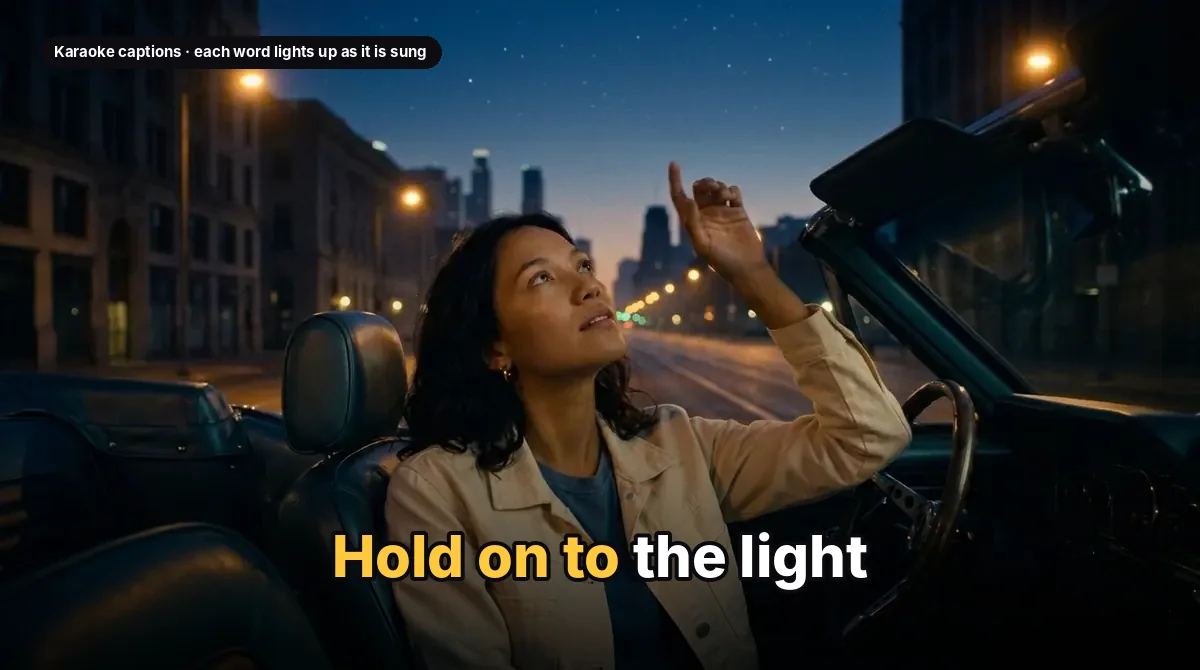
Paste your lyrics when you upload and Muvora aligns them to the vocal, so karaoke-style captions can light up each word as it's sung (otherwise it transcribes the vocal). Clean the text first with the lyrics formatter so chord lines and timestamps don't reach the captions. The lyric video maker shows the Lyric style, built around the words.
Give your verses pictures
Upload the finished song, paste the lyrics and read the storyboard before you pay. The price shows before you render, and shots that fail cost nothing.
Written by the Muvora team. Last updated November 18, 2026. Spotted something out of date? Tell us at [email protected].