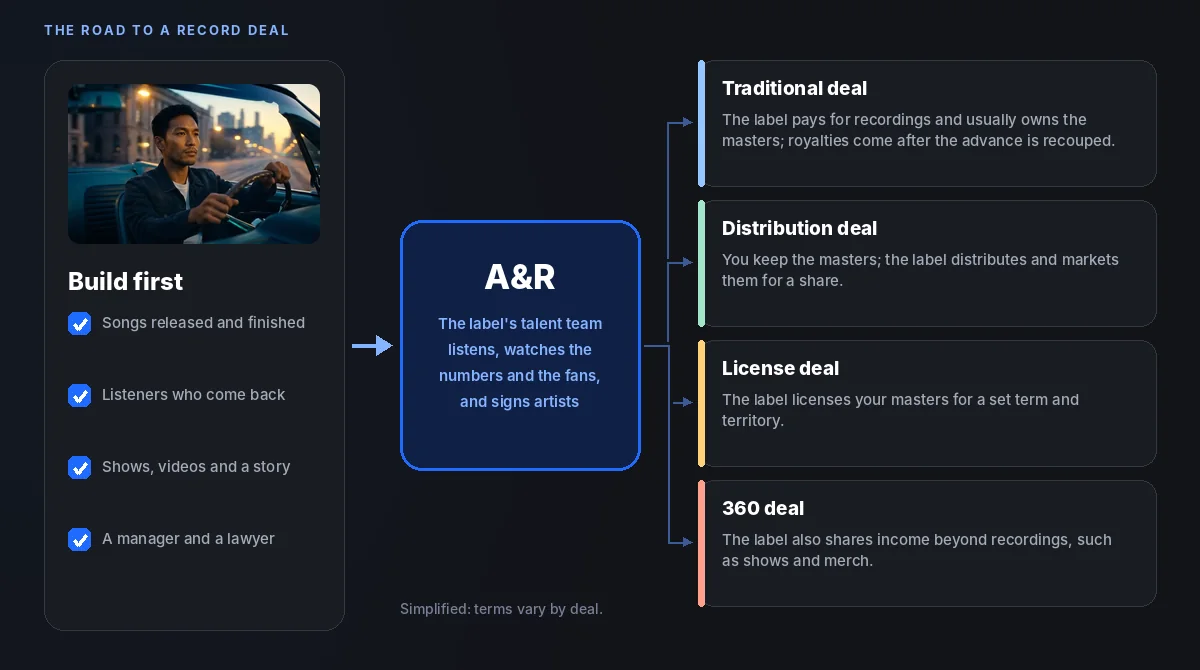
The short answer
To get a music manager, first build something worth managing: regular releases, a growing audience, live shows and more business than you can handle alone. Then look for managers who work with artists at your level, get introduced through people you both know, and pitch with a short note and links. Expect a commission, commonly 15 to 20% of earnings, and have a music lawyer read the contract.
- A manager runs the business of your career and builds your team, usually for a share of your income.
- You're ready when business work is crowding out the music and there's income worth sharing.
- Managers often find artists through people they trust, so build relationships before you pitch.
- Commission is commonly reported at 15 to 20%, and what it's taken from matters as much as the rate.
- Read the term, the sunset clause and the key-person clause with a lawyer, and be wary of anyone who wants paying up front.
On this page (7 sections)ShowHide
What a music manager does
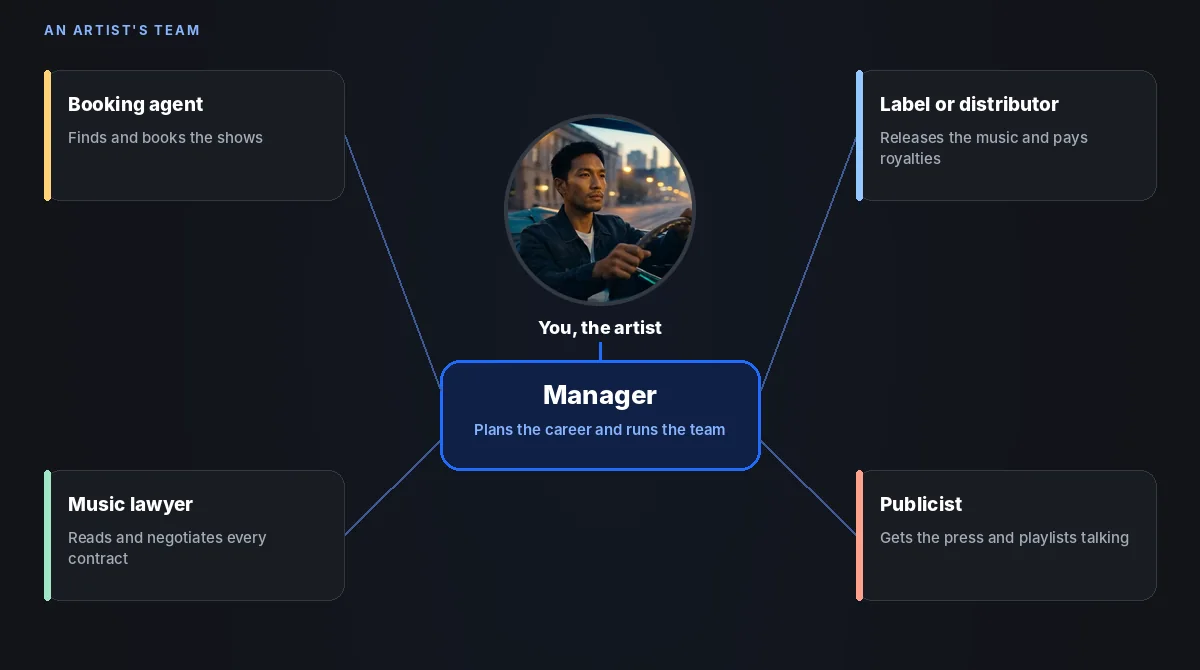
There's no fixed job description, which is the first thing to know. A New York law firm, Romano Law, notes in its guide to management contracts (November 2024) that there is no industry standard or definition for a manager's role, so the contract should spell it out. Typically, it says, managers handle business decisions, social media, promotion, touring agreements and sponsorships, and hire and act as the main contact for the rest of the team, from booking agents and producers to lawyers and accountants.
The UK's Music Managers Forum (MMF), in an article written with AWAL, adds that managers now take on much broader responsibilities, often acting as label, accountant, tour manager, sync agent and booker in the early days, and that no two managers are alike: some bring creative and A&R instincts, others logistics and data, others negotiation. In the US, it notes, the work is often split between a personal manager, who runs the career, and a business manager, who handles the money.
| Role | What they do | How they work with the manager |
|---|---|---|
| Manager | Plans the career, judges offers, runs the release calendar and builds the team | The center: the person everyone else reports to |
| Booking agent | Finds and negotiates shows and tours | Agrees routing and fees with the manager |
| Music lawyer | Negotiates and reviews contracts, including the management agreement itself | Works for the artist, not the manager |
| Accountant or business manager | Receives income, pays bills and commissions, handles tax and royalty statements | Pays the manager's commission on the artist's instruction |
| Label or distributor | Releases the music and, with a label, funds and markets it | The manager negotiates the deal and runs the relationship |
| Publicist | Press, radio and media for a release or a tour | Hired per campaign, briefed by the manager |
| Publisher or publishing administrator | Collects and grows the songwriting income | The manager helps choose and negotiate with them |
When you need a manager, and when it's too early
The MMF's test in the AWAL article is plain: hire a manager when it's worth paying someone a percentage of your income to do those jobs for you, that is, when you can no longer juggle everything and need to delegate. Until your business is running, it points out, you're asking someone to work for free, perhaps for years. A manager on commission earns from what you earn, so early on they're investing their time in a bet; that's why most want to see momentum first.
- You release music on a schedule and have a plan for the next twelve months.
- Offers arrive that you don't know how to judge: shows, brand deals, sync requests, a label's interest.
- Income comes from several places (streams, shows, merch, sync), and tracking it takes real time.
- Emails, calls and admin take more hours of your week than writing and rehearsing.
- Your audience is growing in numbers you can show, month over month.
- You know which lawyer you'd call, or know you need one.
- Too early: no finished songs out yet, no income to share, and a hope that a manager will create the audience for you.
- About right: releases out, a small but growing audience, a live show and more offers than time.
- Overdue: deals stalled because nobody followed up, shows booked badly, or a release that came out with no plan.
Skip the blank page
Upload your song and Muvora's AI director plans a shot-by-shot storyboard on the beat. Edit every shot for free, and pay only if you render.
How to get a music manager, step by step
- 01
Build something worth managing
Release finished songs on a schedule, play live, and grow an audience you can measure, so a manager can see where your career is going before they spend time on it.
- 02
Write down what you need
List the jobs taking your time and the decisions you can't judge alone, so you look for a manager whose strengths match them rather than the first one who answers.
- 03
Make a one-page press kit
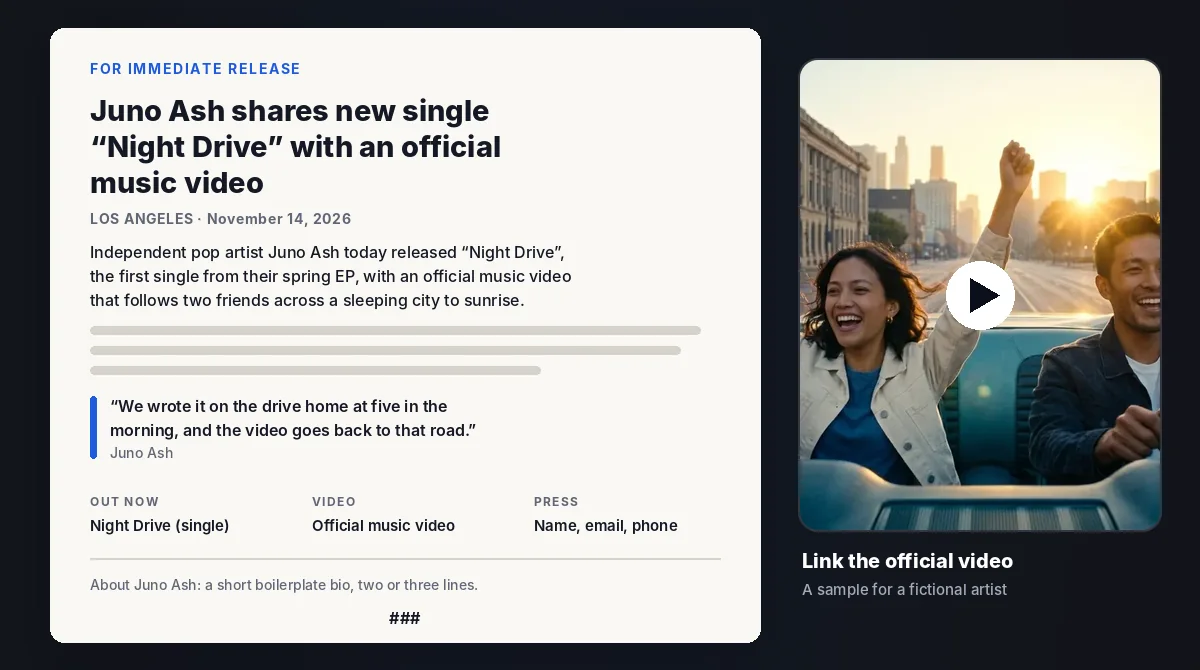
Put your bio, two or three songs, the latest music video, your numbers with dates, live dates and a contact on one page you can link in any message.
- 04
List managers who fit
Find who manages artists a step or two ahead of you in your genre through release credits, management companies' rosters and people in your scene, and keep a short list.
- 05
Get introduced
Ask producers, engineers, booking agents, lawyers and other artists who know a manager on your list to introduce you, since a warm introduction gets read first.
- 06
Pitch briefly and personally
Write a short message that says who you are, why this manager, and what you need, with links rather than attachments, and follow up once if you hear nothing.
- 07
Check them out
Talk to artists they manage or used to manage, confirm the connections they mention, and make sure they have heard your music and seen you play.
- 08
Agree the role, then sign with a lawyer
Spend a few weeks agreeing what they'll do and the plan for the next year, then put it in a written agreement your own music lawyer has read.
In the UK, the MMF runs an Artist Seeking Manager form: it doesn't match artists with managers, but what you submit is shown in its members' portal, where managers looking for new acts can contact you directly. The same AWAL article advises approaching managers personally, after researching that your music fits theirs, and says a mass email with links to your music is not the way.
- One line on who you are: genre, where you're based and what makes you different.
- Why them: an artist they manage whose path you'd like to follow.
- What you need: the job description, in a sentence.
- The evidence: two or three songs, the latest video and your numbers over the last few months.
- What's next: the next release and any shows booked.
- The ask: a short call, not a contract.

Put a music video at the top of your press kit
A manager judges the whole release, not just the audio. Upload your latest single and Muvora writes a free storyboard on its beats, then renders the music video, a vertical cut, a square post and a Canvas loop from one widescreen render, priced before you pay. How to make an EPK shows where it goes.
How music managers are paid
Most managers are paid a commission: a percentage of what the artist earns. Romano Law puts it at typically 15% to 20% of the artist's gross earnings, varying from contract to contract, and gives the example of a rate that starts at 20% and falls to 15% after a period or once the artist reaches a certain level. In the UK, Pete Bott of the law firm Sound Advice, writing for Leeds Conservatoire in 2020, calls 20% of the artist's earnings in the entertainment industry the industry norm, and Music Week's report on the MMF's Management Deals Guide (November 2024) describes the default as typically around 20% of artist income, plus sunset clauses.
| Source | Where | What it says |
|---|---|---|
| Romano Law, November 2024 | US | Typically 15% to 20% of gross earnings, varying by contract; a rate may start at 20% and fall to 15% later |
| Pete Bott (Sound Advice) for Leeds Conservatoire, November 2020 | UK | 20% as the industry norm; income other than live usually commissioned on gross with negotiated deductions, live income on net |
| Music Week on the MMF's Management Deals Guide, November 2024 | UK | Typically around 20% of artist income, plus sunset clauses, with other deal models growing |
What the percentage is taken from matters as much as the percentage. Say a short tour brings in 100 and costs 80 in travel, crew and production. A 20% commission on gross is 20, the tour's whole profit; on net it's 4. That's why Bott describes live earnings in the UK as usually commissioned on net, and why Romano Law calls the deductions one of the critical points to negotiate, with some agreements reducing or cancelling the commission on a tour that loses money.
- Recording costs and payments to producers
- Co-writers' shares of song income
- Tour support a record company pays to cover touring losses
- Sound and lights for shows, and payments to opening acts
- The cost of making merchandise
- Income from outside entertainment
Those are the deductions from gross that Romano Law lists as common. Commission isn't the only model either: the MMF's Management Deals Guide explores alternatives its members use, which Music Week lists as higher commissions with longer sunset clauses for long development periods, gross commission on live income, fixed minimum fees, co-management, consultancies and retainers, joint ventures and development deals in which a manager provides a label's early services, and management and booking hybrids.
The contract terms to understand
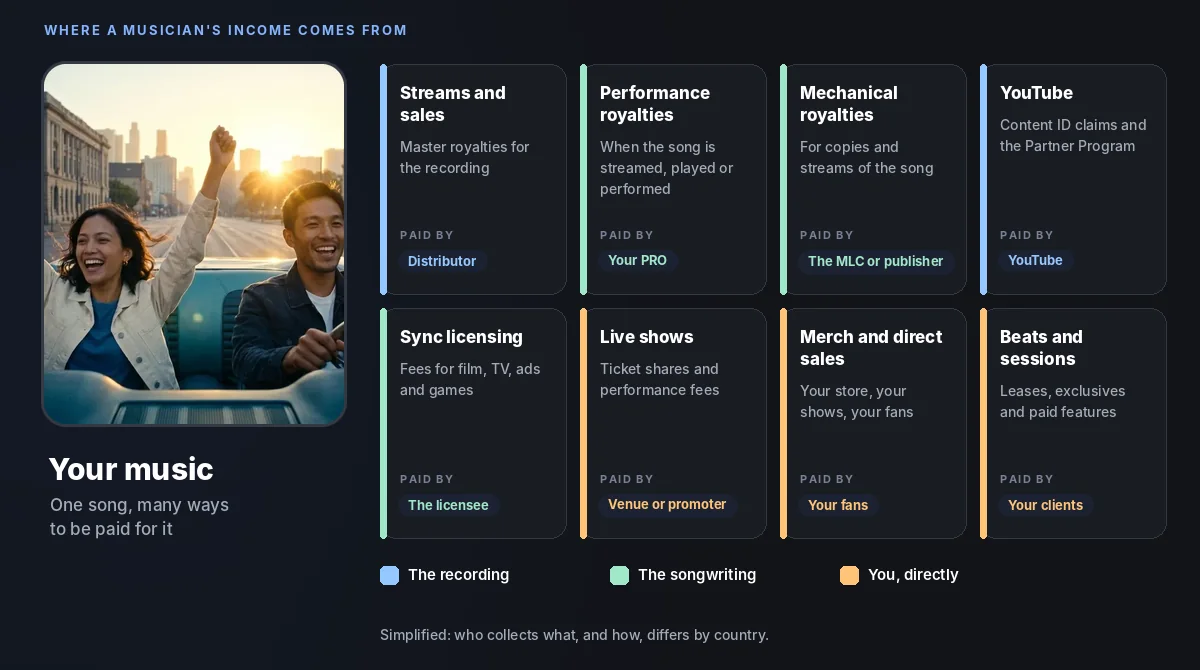
This is general information, not legal advice. A management agreement is often the first long contract an artist signs, and it shapes every deal that follows, because the manager commissions those deals. These are the terms that matter, described as the two law-firm sources describe them; your own lawyer will know how they apply where you live.
- Term
- How long the agreement lasts. Bott writes that in the UK an initial fixed term of three to five years is generally accepted, after which it usually rolls on, often ending on three months' written notice.
- Performance outs
- Ways to end the agreement if targets aren't met. Romano Law describes terms tied to earnings or milestones: if the artist hasn't earned a set amount, isn't touring or isn't signed by a date, often 18 months to two years after signing, the artist can end it.
- Commission rate
- The manager's percentage of the artist's earnings, sometimes stepping down as the career grows, or differing by income type.
- Commission base
- What the percentage is taken from: gross income, net income, or gross less a negotiated list of deductions. Live and non-live income are often treated differently.
- Sunset clause
- Commission paid after the agreement ends on work done during it, reducing over time. Romano Law says it typically reduces to zero over three to five years; Bott gives an example of the full rate for five years, then half for five more, then nothing.
- Key-person clause
- A clause that ties the agreement to the individual manager who signed you. Romano Law recommends one when the manager works for a larger company, so you keep working with that person.
- Exclusivity
- Bott notes most management agreements are exclusive, usually worldwide, with common exceptions for a separate career such as acting, or a sub-manager for one territory who reports to the main manager.
- Expenses
- What the manager may spend on your behalf and recover from your earnings. Bott recommends limiting them to costs directly related to the artist, with spending limits and approval above a set amount.
- Who collects the money
- Romano Law writes that most agreements have the artist's income paid to the manager first, who takes the commission and passes on the rest; Bott writes that it's customary in the UK to appoint a music-industry accountant instead and advises artists to avoid arrangements where the manager handles their finances.
- Accounting and audit rights
- Statements of what was earned and commissioned, and the right to inspect the books behind them.
- Power of attorney
- The manager's right to sign documents for you. Romano Law suggests limiting which kinds of document it covers.
Red flags in a manager
Berklee Online's list of warning signs (February 2019) names six: pressure to sign quickly (it says to beware of anyone who wants a signature in less than a week), no written contract, a fee-for-service model, connections you can't find evidence of, someone who hasn't heard your music or seen you play, and a client list of artists nobody knows. The money-related flags deserve the most attention.
- A fee before any work: a signing fee, a development fee or a monthly charge for vague promises
- Promises of followers, playlists, radio or a label deal in exchange for payment
- Pressure to sign within days, or reluctance to let your own lawyer read the agreement
- No written agreement, or one too vague to say what the manager will actually do
- Connections and past clients you can't verify
- A long term with no way out if nothing happens
- Full commission forever after the term, or on work you start after it ends
- Control of your bank account, or a power of attorney with no limits
- A manager who also wants to be your label, publisher or agent without separate agreements your lawyer has read
Not every fee is a scam. Berklee's article calls fee-for-service a tricky one rather than an automatic no, and suggests a trial period or a short-term contract if you go ahead, and the MMF's guide treats fixed fees and retainers as legitimate in some arrangements. The warning sign is paying for promises: money up front with nothing specific delivered in return.
Managing yourself until then
Most artists manage themselves for years before a manager arrives, and the ones who do it well are easier to manage later, because the plan, the numbers and the materials already exist. Treat it as a few hours a week of business with its own calendar, and keep everything in one place a future manager could pick up.
| Job | How to do it yourself | Free help |
|---|---|---|
| Release planning | A dated plan for each single, eight weeks out | Release timeline planner |
| Press kit | One page with bio, songs, video, numbers and contact | EPK generator |
| Announcements | A short release for each single, sent to the right writers | Music press release generator |
| Bios | One-line, short and long versions kept up to date | Artist bio generator |
| Splits | Agree songwriting shares on the day the song is written | Split sheet generator |
| Shows | A set list with keys, tempos and timings for every gig | Setlist maker |
| Contracts | A music lawyer for each deal, paid per job | A lawyer, never a template alone |
For UK artists, the MMF's Artist Seeking Manager page points self-managing artists to CMU:DIY's resources and workshops, and artists in general to the Featured Artists Coalition. Beyond that, read how to release music independently for the release plan, how to get signed to a record label if a label is the goal, and how to write a music press release for the announcement.
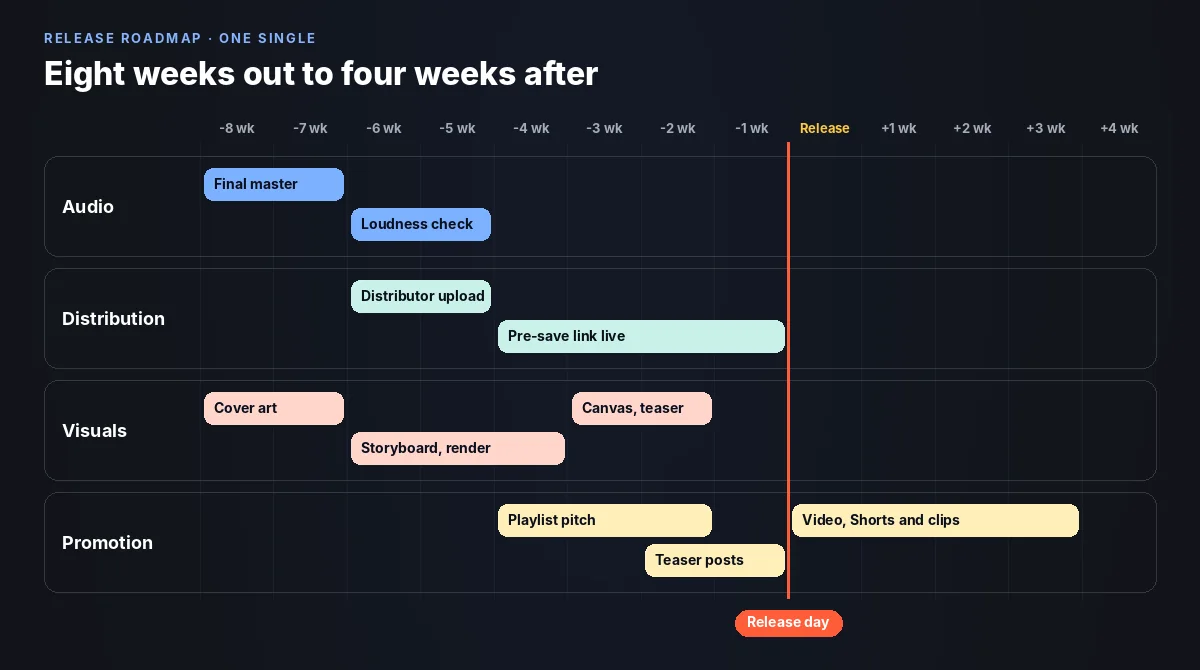
The visuals lane is where self-managed releases most often fall short, and a manager or label will look at it first. Muvora makes a music video from the song itself: it reads the beats, sections and drops, an AI director writes a storyboard you edit for free, and one widescreen render gives the 16:9 video, a 9:16 cut, a square post and an 8-second Canvas, with your master as the untouched soundtrack. Rendering costs from 38 credits a second, shown before you generate, and music videos for record labels explains how a team with many releases uses it.
Give your next release its video
Upload the single you're releasing next. The storyboard is free (5 new storyboards a month on the free plan), so you can read it, change any shot and see the price before you render.
Written by the Muvora team. Last updated November 18, 2026. Spotted something out of date? Tell us at [email protected].