The short answer
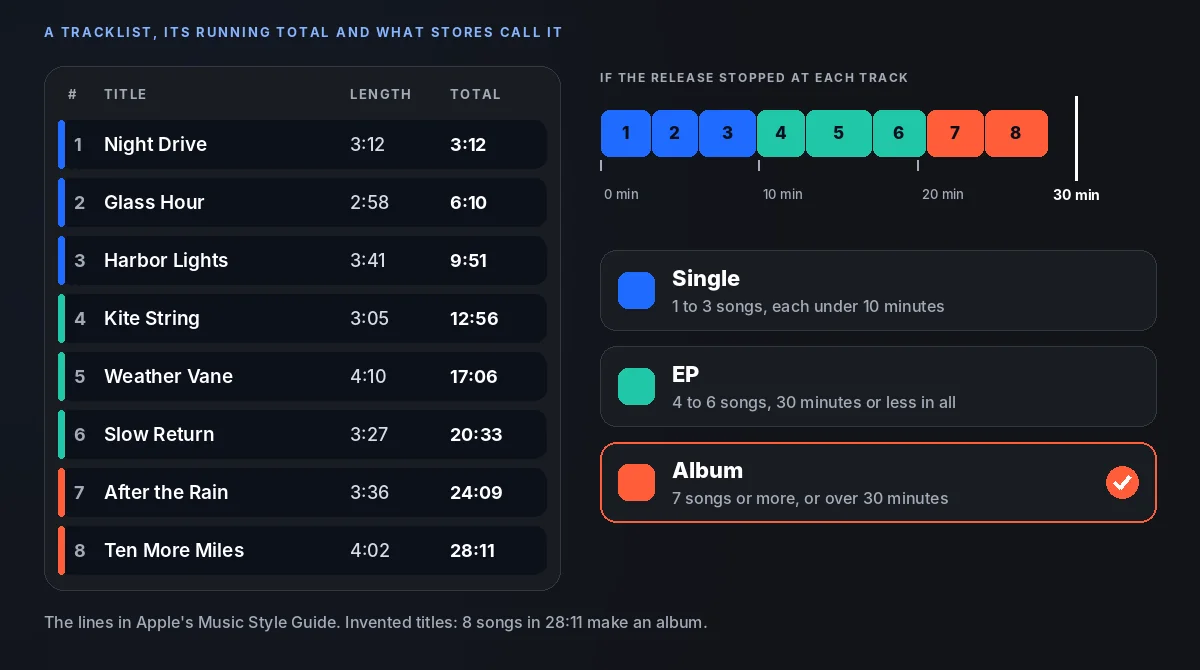
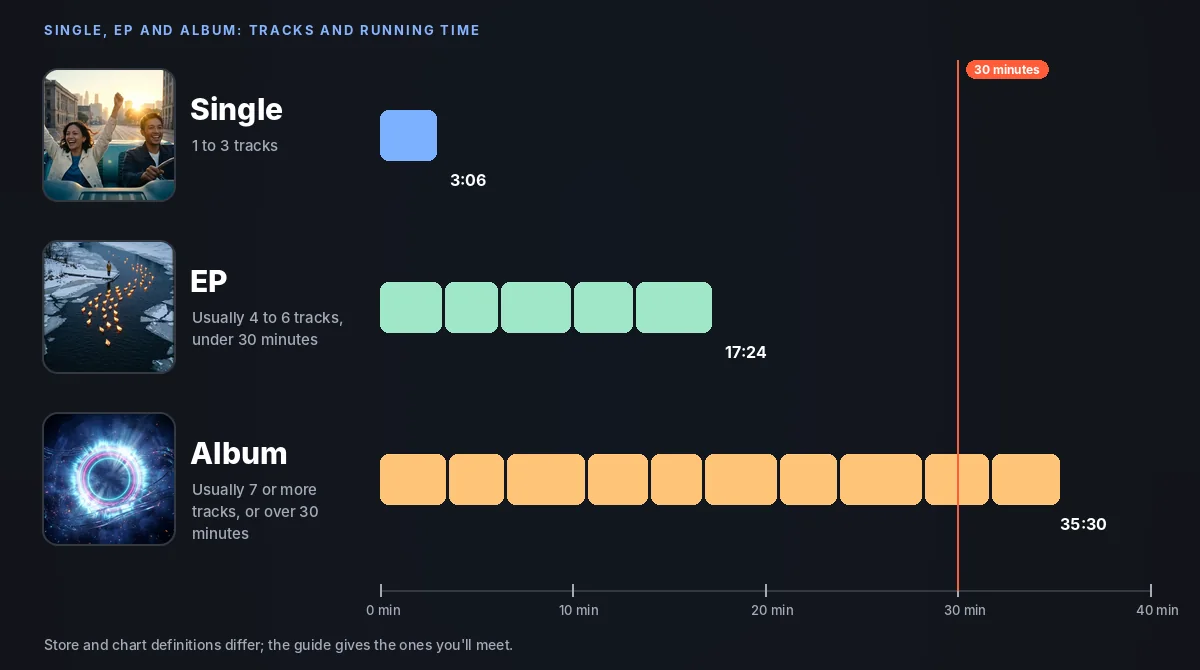
Most stores call a release an album once it has seven or more tracks or runs longer than 30 minutes, and Spotify, as distributors summarize its rules, counts six tracks or more as an album. Beyond that floor there's no fixed number: many albums hold around 8 to 14 songs and run 30 to 60 minutes, and one 12-inch vinyl LP holds about 36 to 44 minutes.
- Seven tracks or more, or over 30 minutes, is an album at most stores; Spotify's line is six tracks.
- One to three short songs is a single, and four to six under 30 minutes is an EP.
- Past the store's floor there's no right number: cut every song that doesn't earn its place.
- Vinyl holds about 18 to 22 minutes a side and a CD up to about 80 minutes.
- Release two or three singles first, each with its own video, before the album lands.
On this page (7 sections)ShowHide
When a release counts as an album
Streaming stores don't ask what you call your record. They count the tracks and add up the running time, and your distributor files the release by the result. Apple's Music Style Guide defines a single and an EP, so anything bigger is an album on Apple Music. The summary distributors give of the other stores' rules, such as Amuse's help on singles, EPs and albums (dated September 9, 2026), draws the album line at seven tracks or 30 minutes, and Spotify's at six tracks. The line between a single and an EP, and how charts and awards count, is in what is an EP.
| Release | Apple Music style guide | Stores in general (Amuse) | Spotify (Amuse's summary) |
|---|---|---|---|
| 1 song, 3:20 | Single | Single | Single or EP |
| 3 songs, 11 minutes | Single | Single | Single or EP |
| 2 songs, one of 12 minutes, 17 in all | EP | EP | Single or EP |
| 5 songs, 19 minutes | EP | EP | Single or EP |
| 6 songs, 24 minutes | EP | EP | Album (6 tracks or more) |
| 5 songs, 34 minutes | Album (over 30 minutes) | Album (over 30 minutes) | Not a single or EP (over 30 minutes) |
| 7 songs, 26 minutes | Album | Album | Album |
| 12 songs, 41 minutes | Album | Album | Album |
How many songs albums usually have
Above the stores' floor the number is a creative decision, and it moves with genre and era more than with any rule. The two sides of a vinyl record are one reason so many albums from the LP years run about 35 to 45 minutes; the CD made room for up to about 80; streaming removed the ceiling altogether. The shapes below are a rough map, not a target.
| Shape | Often | Suits | Watch out for |
|---|---|---|---|
| Short and tight | 7 to 9 songs, 25 to 35 minutes | Debuts, punk and hardcore, a strong concept with nothing to spare | Under seven tracks and 30 minutes, only Spotify's rules can make it an album |
| Classic length | 10 to 12 songs, 35 to 50 minutes | Most pop, rock, R&B and singer-songwriter records; fits one LP | A weak song mid-album loses listeners before the best ones |
| Long | 13 to 20 songs, 50 to 75 minutes | Hip-hop with skits and features, concept records, double albums | Needs two records on vinyl, and every extra song needs its own push |
| Deluxe edition | The original album plus a few new or bonus tracks | A second release moment months later | Keep the original recordings' ISRCs for the songs already out |
If you're unsure, go shorter. Someone who reaches the end of 38 minutes wanting more is worth more to you than someone who skips through 70. Ten songs you'd defend one by one make a stronger album than fourteen where four are filler, and the four you cut can come out later as singles, B-sides or part of a deluxe edition.
Skip the blank page
Upload your song and Muvora's AI director plans a shot-by-shot storyboard on the beat. Edit every shot for free, and pay only if you render.
How to choose the songs, step by step
- 01
List everything that's finished
Write down every song that's mixed or nearly mixed, with its length, tempo and key, so you choose from facts rather than from memory.
- 02
Score each song honestly
Rate every song on its hook, how finished it sounds and whether it fits the record's mood, and ask one or two trusted listeners to rate them without seeing your scores.
- 03
Cut to the strongest
Keep the songs that score well on all three and set the rest aside, even favorites, which can still come out as singles, B-sides or bonus tracks.
- 04
Check the count and the running time
Add up the tracks and the minutes against the store rules, and against vinyl's two sides if you plan a record, before you commit to the list.
- 05
Sequence it
Open with a song that says what the album sounds like, put the strongest single early, vary tempo and key from track to track, and end on a song that feels like an ending.
- 06
Choose the singles and the videos
Pick two or three songs to release first, decide which get full music videos, and give every other track a visualizer, a lyric video or a Canvas loop.
- 07
Lock the metadata and deliver
Fix the titles and the order, keep each released single's ISRC, get one UPC for the album, and deliver it to your distributor weeks before release day.
Read each song's tempo and key with the BPM and key finder, see which keys sit well next to each other on the Camelot wheel, and keep the loudness even across the record with the LUFS meter. Before delivery, how to export a song covers the bounce settings and trimming the silence at the start of each file.
Why most albums arrive after a run of singles
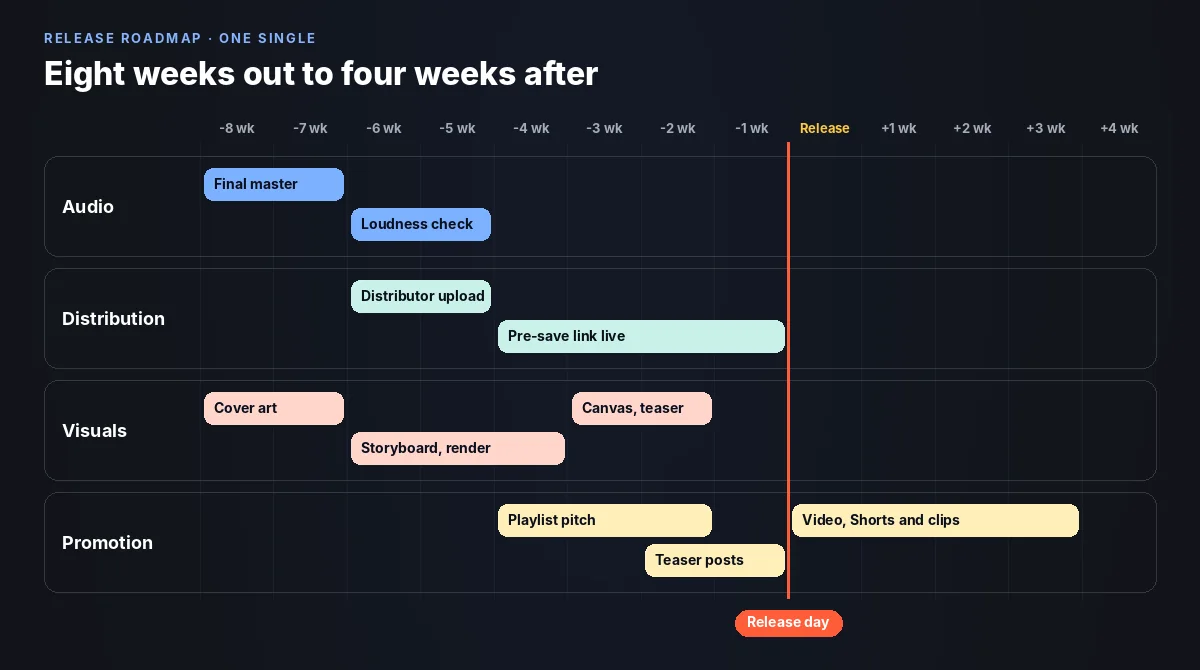
An album released all at once gets one release day, one round of pitching and one week of attention. Released as a run of singles first, the same songs get several. Spotify lets you pitch one unreleased song at a time to its playlist editors, so each single is a fresh chance at playlists and at your followers' new-release feeds, and each can have its own video, Canvas and clips. How to get on Spotify playlists covers the pitch, and each single is also a new sound on TikTok when your distributor delivers there, as how to get your music on TikTok explains.
When the album arrives, the singles go on it with the same ISRCs they were released with, so their streams and playlist placements stay with the recording, while the album gets a UPC of its own. Some distributors support a waterfall release, where each new single goes out as a new product that also holds the earlier ones until the whole album is out: SoundOn's help center describes it as a series of new products, each with a new UPC and the same ISRCs. Ask your distributor how it handles songs that are already out.
| When | What comes out | Its visual |
|---|---|---|
| About 12 weeks before the album | Single 1, the strongest hook | The full music video, a Canvas and vertical clips |
| About 8 weeks before | Single 2, another side of the record | A second music video or a lyric video |
| About 4 weeks before | Single 3, or a focus track ahead of the album | A visualizer and clips, with the album pre-save live |
| Album release day | The whole album, singles included | A visualizer or Canvas for every remaining track |
| The weeks after | Nothing new; the album's other songs get their turn | Clips from each track, one every few days |
How much fits on vinyl and CD
Physical formats are where an album's length stops being only a creative choice. On vinyl, more minutes on a side means narrower, shallower grooves, so a long side has to be cut quieter and with less bass. A CD has a hard ceiling. If you plan either, check the album's running time against them before you sequence it.
| Format | About how much fits | In practice |
|---|---|---|
| 12-inch LP at 33⅓ rpm | 18 minutes a side is ideal, 20 still good, 22 may cause problems | About 36 to 44 minutes on one record |
| 12-inch at 45 rpm | 12 minutes a side is ideal, 14 acceptable | Often chosen for EPs and club singles, for the extra fidelity |
| 7-inch single at 45 rpm | About 4.5 minutes a side | One song a side |
| Double LP | Four sides of about 18 to 22 minutes | About 72 to 88 minutes |
| Audio CD | 79 minutes 59 seconds at most, about 78 recommended | Nearly any album fits on one disc |
Sources: Gotta Groove Records' FAQ for vinyl, which stresses that a quiet ballad and a bright, heavy guitar track fit very differently and asks you to talk to them past about 22 minutes a side, and Disc Makers' help for CDs. So a 50-minute album fits a CD with room to spare but overflows one LP: either a double LP or a tighter tracklist. On vinyl, balance the two sides too, so each runs a similar length and each ends on a song that works as a pause, since the listener has to get up and turn the record over.
Which songs get a music video
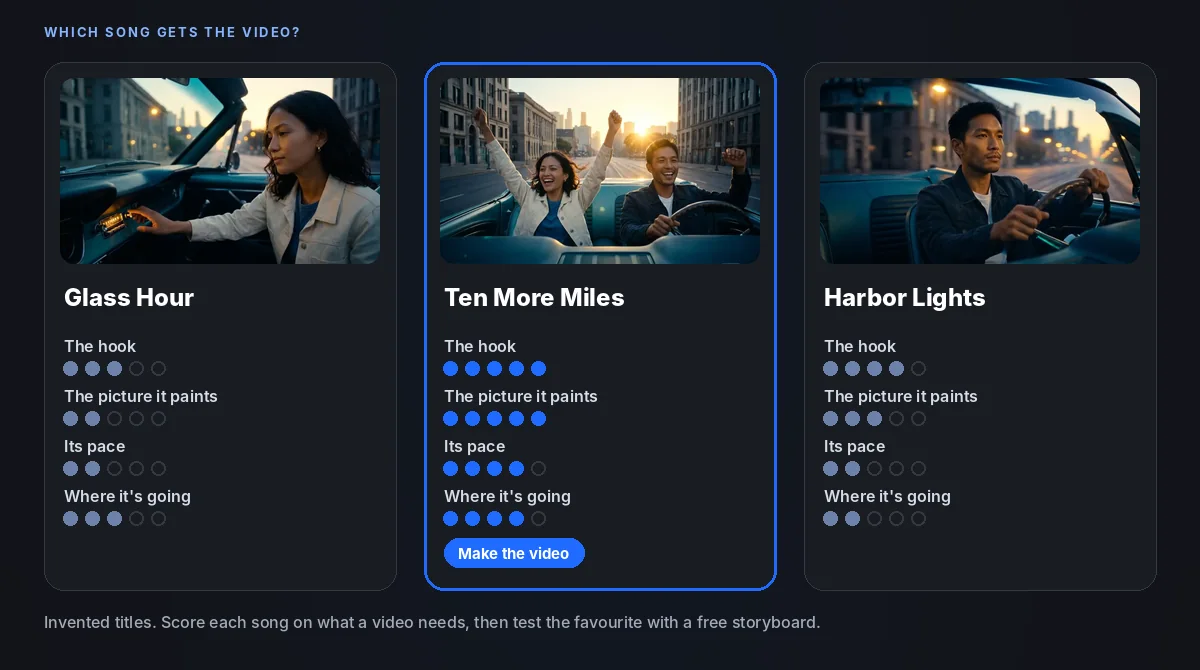
An album can hold twelve songs, but it rarely gets twelve full music videos, and it doesn't need them. Each single needs a video of its own, because it's released and shared on its own. The other tracks need something to be seen with: a visualizer, a lyric video, a Canvas loop or a few vertical clips. Which song should get a music video walks through picking the songs that earn the full treatment.
Make the album look like one record. Carry the cover's colors, places and wardrobe through every video, so a clip of track seven is recognizably from the same world as the single. The album visualizer page covers visuals for every track of a release, and visualizer vs lyric video vs music video explains which kind suits which song.
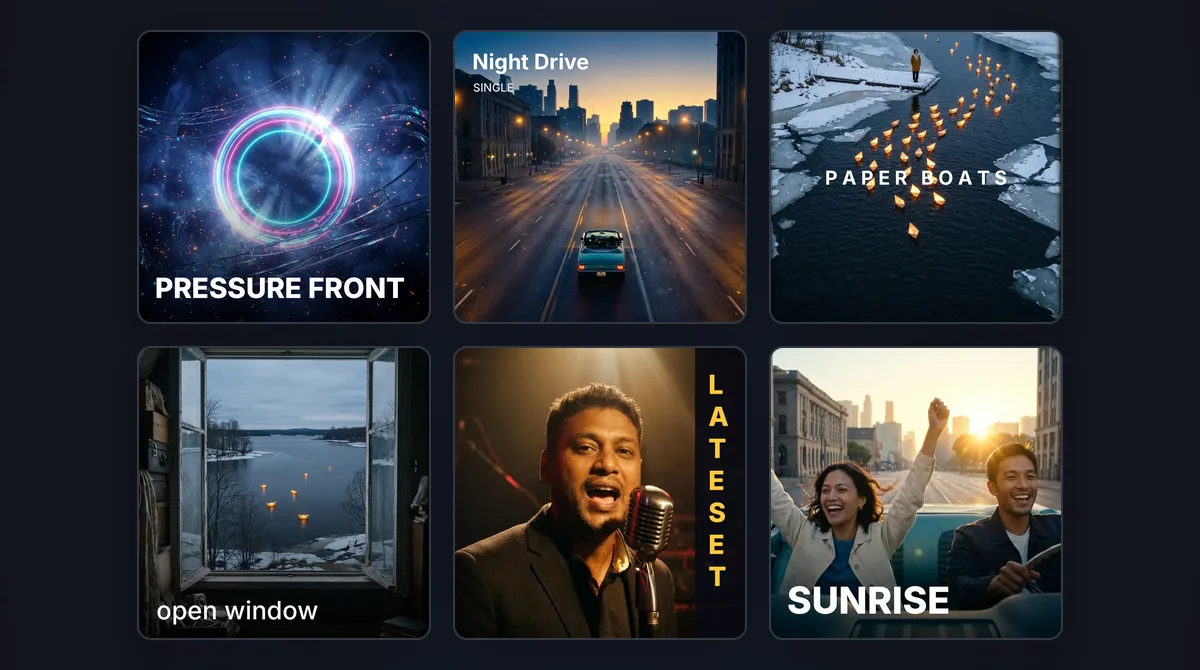
In Muvora each song is its own upload, up to 8 minutes, with its own analysis, storyboard and render priced by its length. Visualizer quality, at 38 credits a finished second, is the most affordable way to give every album track a full video, with Standard or Cinematic kept for the singles. The free plan's 5 storyboards a month let you read what the AI director writes for several songs before you choose which to render, and writing the album's palette, places and wardrobe into the idea box each time keeps the videos in one world.
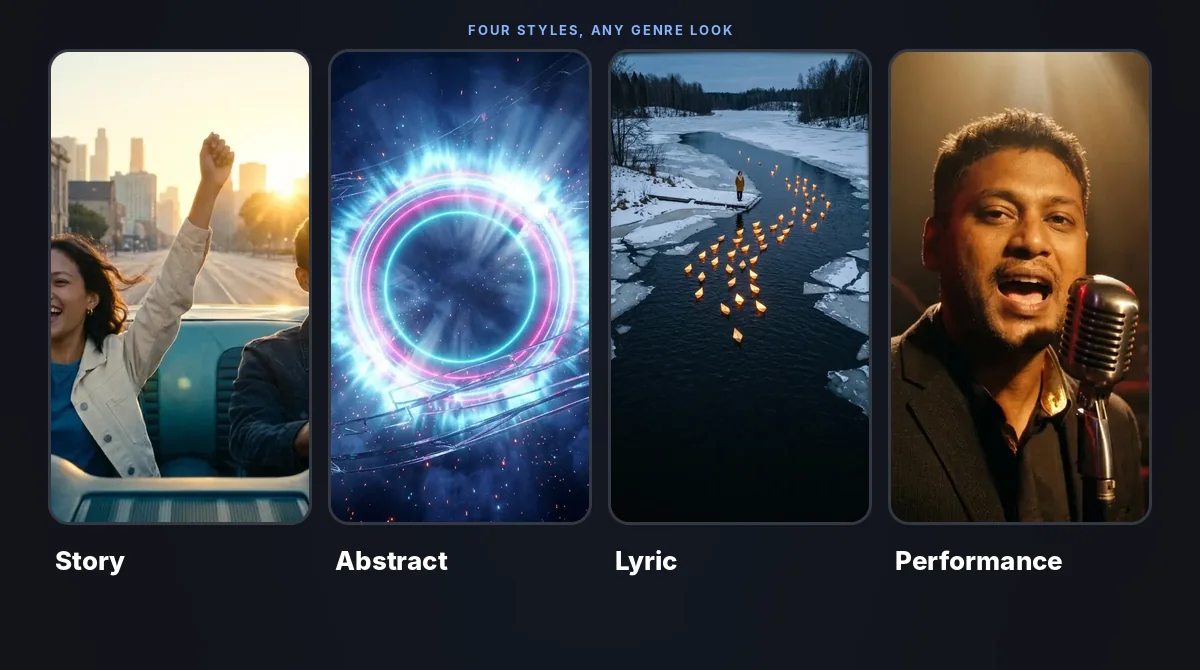
Storyboard the album's first single
Upload the song you'll release first and get a free storyboard cut on its beats, with the look and every shot written for it. Render it when it's right, then give the other tracks Visualizer videos from their own uploads.
Album tracklist checklist
- Every song finished, mixed and mastered together as one set
- Seven tracks or more, or over 30 minutes, if you want every store to file it as an album
- The running time checked against two vinyl sides and the CD limit if you're pressing either
- A running order that opens strong, varies tempo and key, and ends like an ending
- Two or three singles chosen, each with a release date and a video
- Released singles keeping their ISRCs, and one UPC for the album
- Credits, splits and lyrics ready for every track
- A visualizer, lyric video or Canvas planned for every song without a full video
- The album delivered to your distributor weeks before release day
The week-by-week release list is in the music release checklist, and the rest of an independent release, from distribution to registrations, is in how to release music independently.
Give every track something to be seen with
Upload each song and read its free storyboard, written for its own sections and beats. A widescreen render gives the YouTube video, vertical and square versions and an 8-second Canvas loop, so every track on the album has something to post.
Written by the Muvora team. Last updated November 18, 2026. Spotted something out of date? Tell us at [email protected].