The short answer
To write an artist bio, open with your name, what you make and where you're from, then add one detail only you could write, the latest release and two or three highlights a reader could check. End with what's next. Use the third person for press, keep every fact true and current, and keep four lengths: one line, about 75 words, about 150 and about 300.
- Keep four lengths: one line, 50 to 80 words, 120 to 160 words and 250 to 300 words.
- Open with your name, what you make and where you're from: that sentence gets copied the most.
- Write in the third person for press kits and listings, the first person for socials and your own site.
- Replace every adjective with a fact: a place, a year, an instrument, a named show.
- Update every version with each release, and never add a quote or a number you can't show.
On this page (8 sections)ShowHide
The four bios every artist needs
One bio can't do every job. A social profile has room for a sentence, a streaming profile for a paragraph and a press kit for most of a page. Write the long version first, because it holds every fact, then cut it down: each shorter version is the long one with its least important sentences taken out, not a new piece of writing.
| Length | Words | Where it goes | What it keeps |
|---|---|---|---|
| One line | Up to 25 | Social profiles, the first line of a pitch or a booking email, show listings | The name, what you make, where you're from and one hook: the release or a highlight |
| Short | 50 to 80 | Streaming profiles, festival programs, the opening of a press release | The one line plus the sound, the latest release and one or two highlights |
| Medium | 120 to 160 | Your website, press releases, radio and blog submissions | Adds how you started, the lineup, influences and what's next |
| Long | 250 to 300 | An electronic press kit, your about page, background for interviews | The whole story: the start, the release in your words, every highlight and a quote |
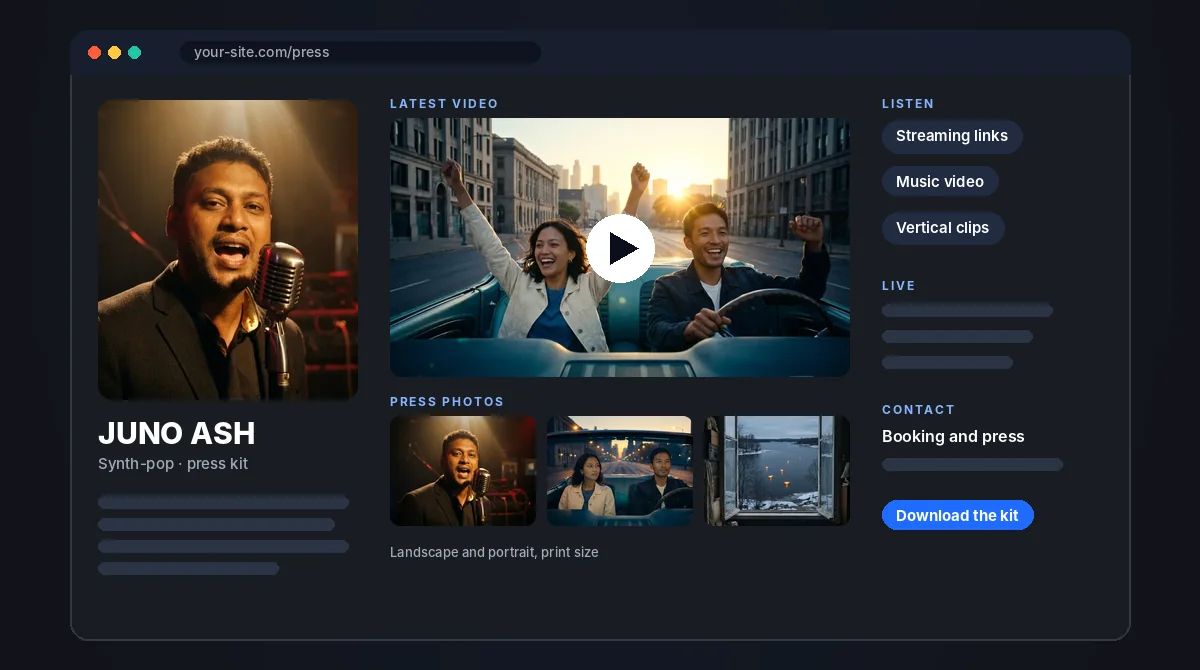
Each platform sets its own limit and changes it now and then, so check the counter in the edit screen before you paste. Spotify's help page on writing your artist bio allows up to 1,500 characters and lets you tag artists, albums, playlists and tracks with @, which fits the medium version with room to spare. The long bio belongs in your electronic press kit, where the reader has already decided to find out more.
How to write an artist bio in six steps
- 01
List the facts before writing a sentence
Note your name as it appears on the streaming services, your hometown and where you're based, the year you started, the genre in your own words, the latest release with its date, and the three best things that have happened. Only list what you could show someone.
- 02
Write the first sentence
Put the name, what you make and where you're from into one sentence, such as “Lena Moss is a folk singer-songwriter from Cork, now based in London.” Listings and round-ups often print that sentence alone, so it has to work by itself.
- 03
Add the detail only you could write
Give one concrete fact about how the music is made or where it comes from: the borrowed upright piano, the voice memos from night shifts, the rehearsal room under a launderette. That's the line a writer quotes.
- 04
Bring in the release and the highlights
Name the latest release, say whether it's a single, an EP or an album, and when it came out or comes out. Then add up to three highlights a reader could check, such as a named venue, a festival slot or a radio session.
- 05
End with what's next, then cut it down
Finish on the next release, tour or show so the bio points somewhere. Then make the shorter versions by removing the least important sentence, one at a time, until each fits its length.
- 06
Read it aloud and check every fact
Read each version out loud, ask someone who knows the music whether it sounds like you, and check every name, date and venue against something you could link to.
Skip the blank page
Upload your song and Muvora's AI director plans a shot-by-shot storyboard on the beat. Edit every shot for free, and pay only if you render.
What to put first, and in what order
Plenty of readers stop after two sentences, and many of the places that print a bio cut it there too. So the order matters more than the wording: the facts someone needs to place you go first, and the story comes after them.
- Who and what: the name, the genre in your words and what you do (singer-songwriter, producer, a four-piece band).
- Where: the hometown and, if it's different, where you're based now. Local press and promoters look for acts by city.
- The sound: one phrase a listener would recognize, built from instruments and textures rather than praise.
- The latest release: its title, whether it's a single, an EP or an album, and the date.
- Proof: two or three highlights, each specific enough to look up.
- What's next: a release, a tour or a show, so the reader knows where to go.
Third person or first person?
The third person (“Lena Moss writes…”) is the convention for anything other people publish, because a journalist or a promoter can paste it without rewriting a word. The first person (“I write…”) reads warmer where you're talking to fans directly. Most artists keep both, written from the same facts.
| Where | Voice | Why |
|---|---|---|
| Press kit, press release, festival program | Third person | Other people quote and print it as it stands |
| Streaming profiles | Either; the third person is more common | New listeners read it as a neutral introduction |
| Instagram, TikTok and YouTube profiles | First person | You're speaking to fans in your own space |
| Your website's about page | Either, as long as you pick one | Two voices on one page read like two writers |
Use the pronoun the artist uses: ask rather than guess from a name, and give “they” plural verbs (“they are”, “they play”). For a band, agree on whether the name takes “is” or “are”; American writers usually give a singular-sounding name “is” and a plural one “are” (Glass Harbor is, The Paper Moths are). Whatever you choose, keep it the same in every version.
Specifics beat adjectives
Words like “unique”, “soulful”, “genre-bending” and “raw” turn up in so many bios that they tell a reader nothing. A fact does the same job better: it lets the reader reach the conclusion on their own, and it gives a writer something to quote. Treat every adjective in a draft as a note to go and find the fact behind it.
| Instead of | Write something like |
|---|---|
| A genre-defying sound unlike anything else | Fingerpicked guitar over a drum machine, with a cello where the second verse would be |
| A rising star of the local scene | Headlined the Harbor Room in Port Calder after a year of opening slots there |
| Deeply personal, heartfelt lyrics | Songs written from voice memos recorded on breaks during night shifts at a care home |
| Influenced by everything from jazz to punk | Learned drums from a stack of old jazz records, then joined a punk band at sixteen |
| Making waves online | Leave it out, or give the real number, where it was counted and when |
Artist bio examples (fictional artists)
These samples are for two made-up acts, so the places, venues and shows are invented as well. Read them for the order and the kind of fact, then swap in your own.
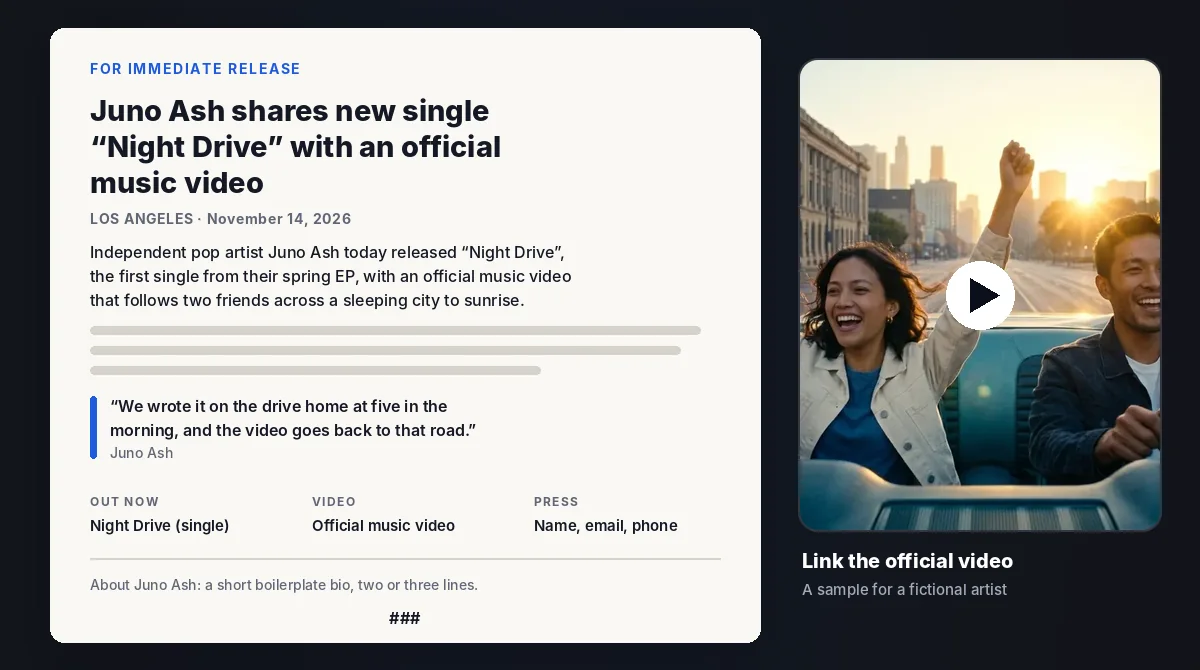
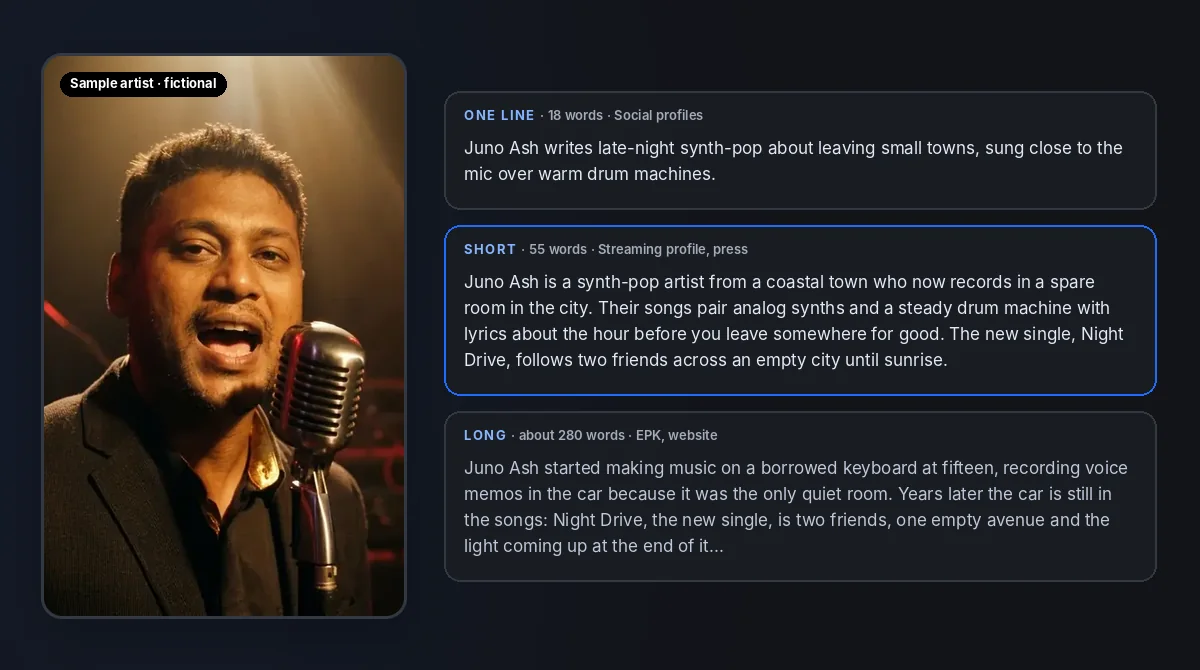
One line, third person: Juno Ash is a synth-pop singer and producer from Port Calder, now based in Manchester, whose latest single “Night Drive” came out in October 2026.
Short, third person: Juno Ash is a synth-pop singer and producer from Port Calder, now based in Manchester. Their songs are slow and nocturnal, built on analog synths, a steady drum machine and vocals sung close to the mic. The latest single, “Night Drive,” follows two friends across an empty city until sunrise. Juno has headlined the Harbor Room and played the late-night tent at the Lanternfield festival.
Short, a band in the first person: We're Glass Harbor, a four-piece indie folk band from Duluth: Maya Ortiz (vocals, guitar), Sam Reed (bass), Theo Lin (drums) and Izzy Park (keys). We met at an open mic in a bowling alley where nobody else turned up, so we played every song we knew together. Our first EP, “Low Tide,” was recorded live in a church hall over one long weekend.
The opening of a long bio, third person: Juno started writing on a borrowed keyboard at fifteen and recorded vocals in a parked car, the only quiet room they had. The songs went online under another name and stayed there until a friend played one at a house party and someone asked who it was. The next one went out as Juno Ash.

Give the bio something to play
A good bio makes someone curious, and the next click should play something. Upload your song and Muvora plans a music video on its beats in a storyboard you can edit for free, with you in it from one photo if you choose the Performance style.
Mistakes that get a bio skipped
- Starting with childhood. “Music was always her first love” delays the facts and says nothing new. Start with who you are now.
- A pile of adjectives. Three descriptions of the sound in a row read as filler, while one specific phrase does the work.
- Every show you've ever played. Pick the two or three a stranger would know or could look up, and keep the full list for the press kit's live section.
- Comparisons without a source. “Influenced by” is fine. “Compared to” needs the outlet that said it, and “shared a stage with” needs the date and the venue.
- Stale facts. A bio that calls a two-year-old single “new” tells a booker nobody is looking after the project.
- A different bio everywhere. When the hometown or the lineup changes between your streaming profile and your website, readers can't tell which one is true.
- No next step. End with the next release or show, and keep a link to the music right beside the bio.
The bio is one part of a release. The music release checklist lists the other files a release needs, from the artwork to the credits, and the Spotify pitch generator helps with the playlist pitch that goes in alongside it.
Keeping your bio current
A bio is never finished. Change it whenever one of its facts changes, and let every release remind you to reread all four versions. Keep them in one file with the date you last edited them, so you can paste the right one in seconds when a promoter asks.
- A release is announced: add its title, type and date to every version
- The release comes out: change “is out on” to “came out in”
- A new highlight beats an old one: replace the weakest and keep three at most
- The lineup, the city or the pronoun changes: update all four versions on the same day
- Every few months: reread the four versions and test the links beside them
New release, new bio, new video
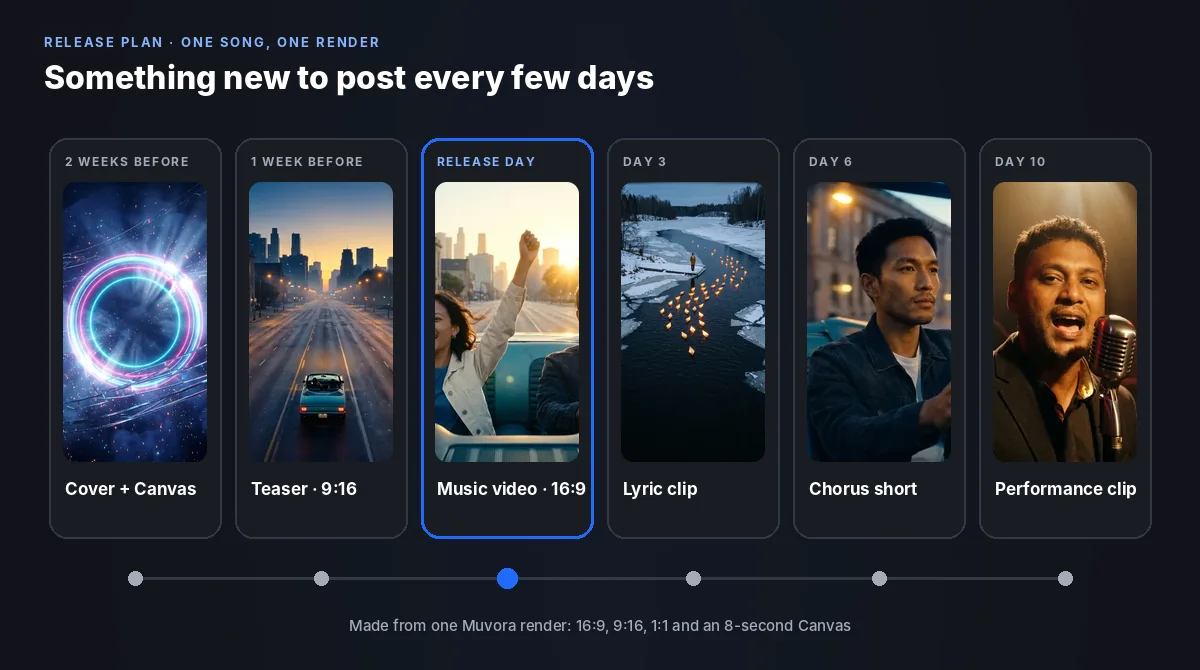
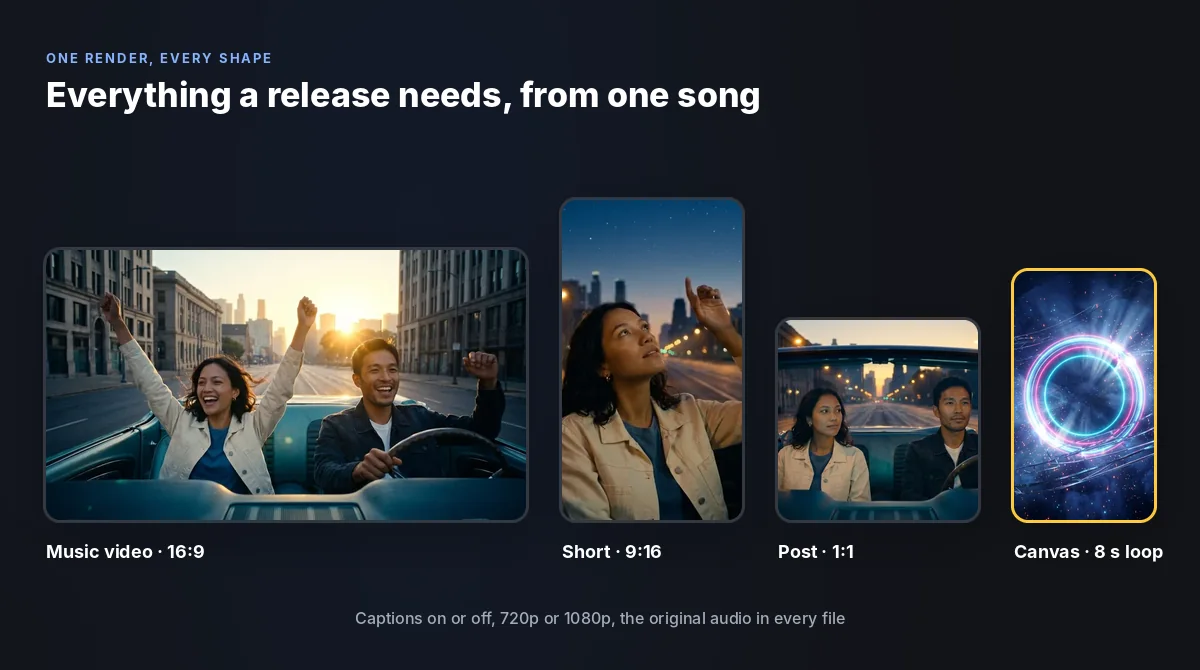
The bio will point to your latest release, so give that release a video. Upload the song for a free storyboard timed to its beats; choose 16:9 and one render gives you the widescreen video, a vertical cut for Reels, TikTok and Shorts, a square post and a Spotify Canvas loop. The free plan includes 5 new storyboards a month.
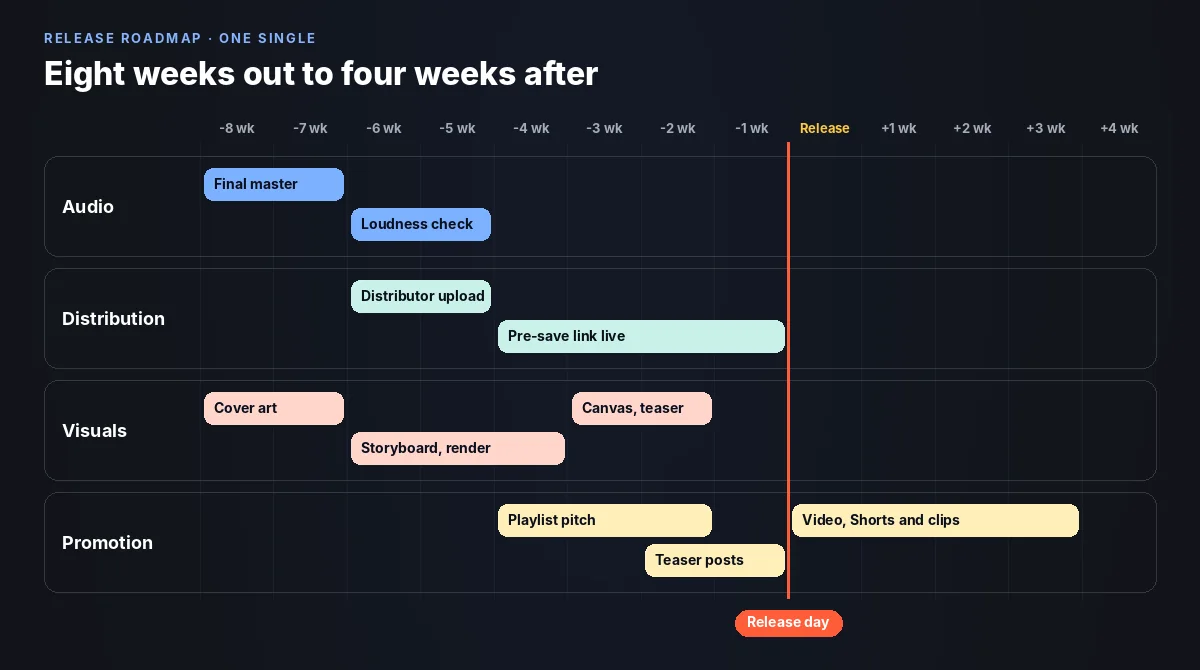
When the bio is done, it goes into the press kit and the release plan: how to release music independently covers the rest of the launch, and how to promote your music puts the bio to work across a campaign.
Written by the Muvora team. Last updated November 14, 2026. Spotted something out of date? Tell us at [email protected].