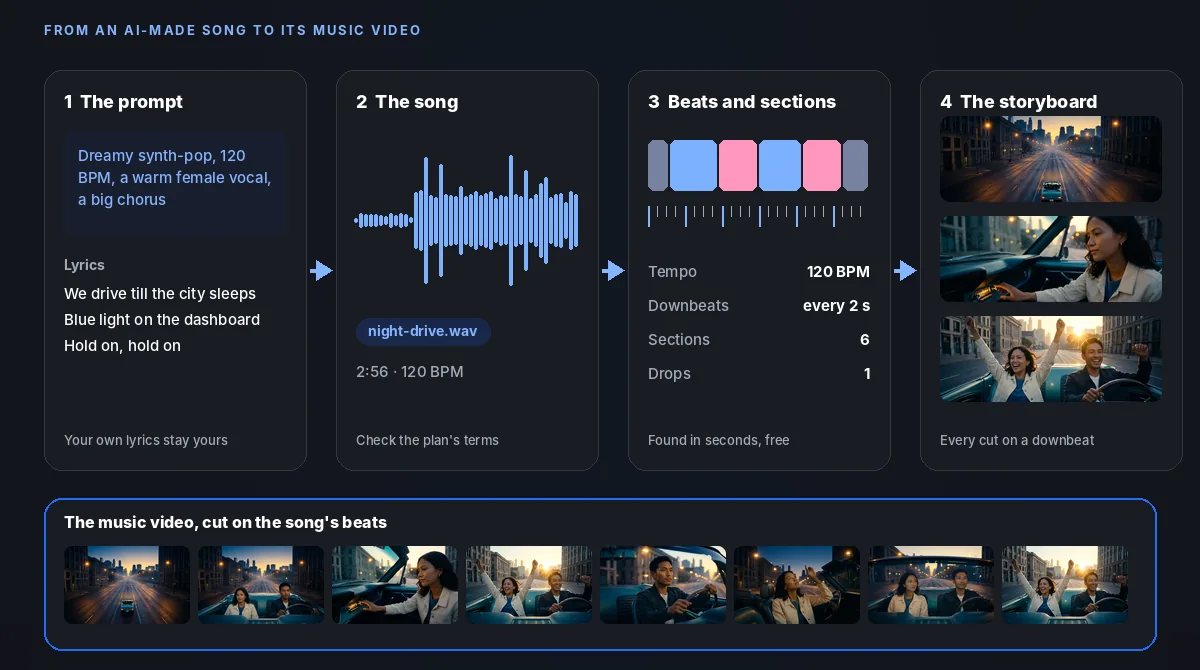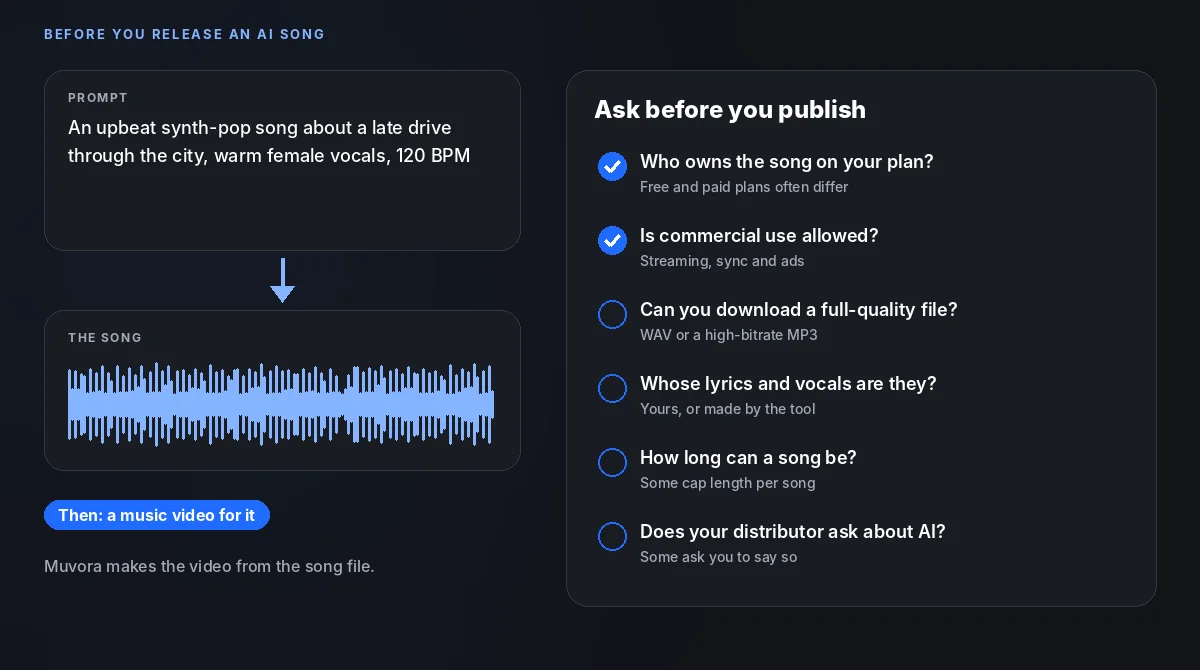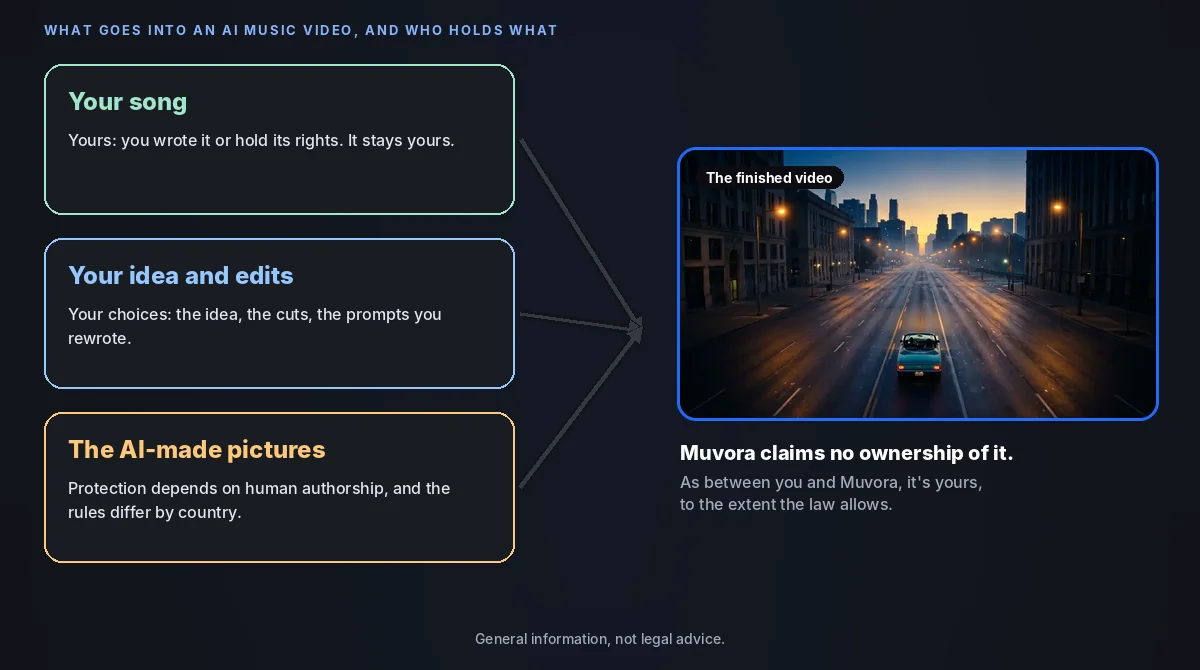
The short answer
The song keeps its owners: its writers and whoever owns the recording. As between you and Muvora, the video is yours to use, commercially included. Whether anyone holds a copyright in the AI-made pictures is less certain: in the US, material generated from prompts alone has no human author, while your own lyrics and artwork, and your creative selection, arrangement and edits, can be protected.
- The song keeps its own copyrights, held by its writers and the recording's owner.
- In the US, material generated from prompts alone has no human author and isn't protected.
- Your own inputs, and your creative selection, arrangement and edits, can be, case by case.
- Muvora claims no ownership of your videos and lets you use them commercially.
- The UK and China have taken other positions, so the answer depends on where you are.
On this page (7 sections)ShowHide
- 1.Who owns an AI music video: the parts and their owners
- 2.What the US Copyright Office says about AI-made material
- 3.Where your choices show up in an AI music video
- 4.What Muvora's terms say about your video
- 5.Outside the US, the answer can differ
- 6.What it means for the video you post
- 7.How to protect your part, step by step
- Questions
Who owns an AI music video: the parts and their owners
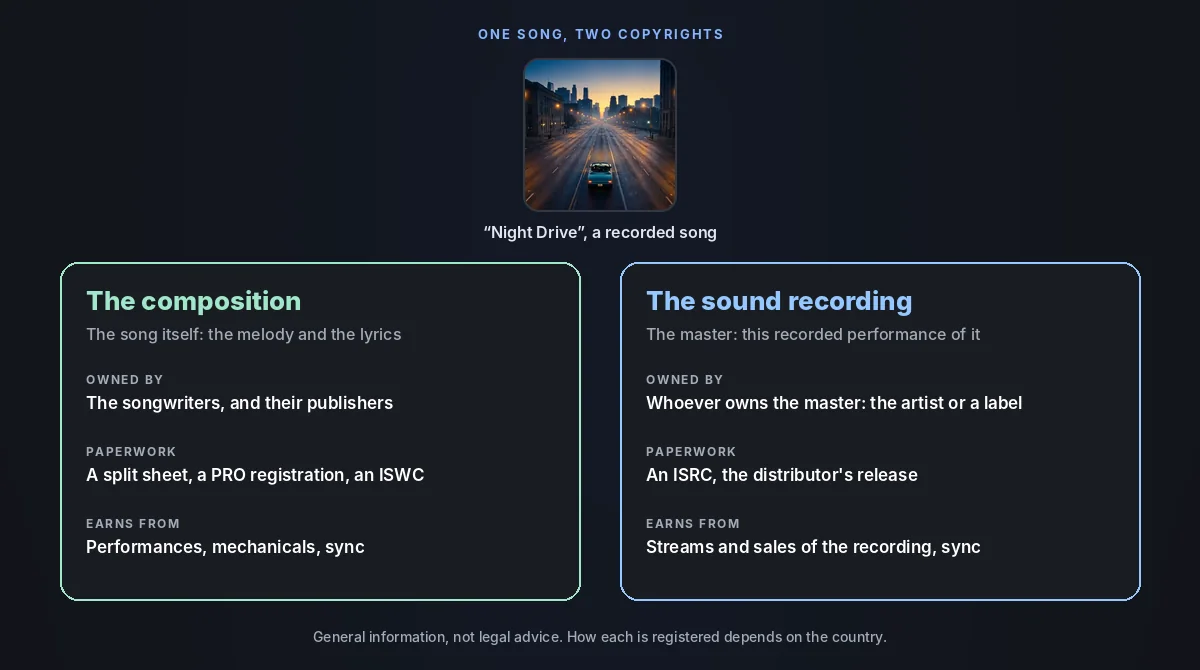
A finished AI music video isn't one thing in copyright's eyes. It's a song, which has owners before the video exists; material you brought to it, such as lyrics or a drawing; choices you made about what to keep and where it goes; pictures an AI model generated; and the video file itself, which a contract between you and the service lets you use. Each has its own answer.
| Part of the video | Who holds it | Why |
|---|---|---|
| The song: composition and recording | Its writers and the recording's owner, as before | Putting a song in a video doesn't change who owns it |
| Your own material: lyrics, a photo you took, a character you drew | You | Your work stays yours when it shows up in the output |
| Your creative choices: what you kept, cut, swapped and arranged | You, where they're creative enough | Selection, arrangement and modification can be authorship, judged case by case |
| The AI-generated pictures themselves | In the US, possibly no one | Copyright needs a human author, and prompts alone don't make one |
| The video as a file you may use | You, as between you and Muvora | Muvora's terms claim no ownership and allow commercial use |
What the US Copyright Office says about AI-made material
The fullest statement is the Copyright Office's report Copyright and Artificial Intelligence, Part 2: Copyrightability, published on January 29, 2025. Its announcement and summaries such as the Copyright Alliance's set out the conclusions musicians need. Using AI to assist in making a work, or including AI-generated material in a larger human work, doesn't stop the work being protected. Material generated purely by AI, or where a human had too little control over its expressive elements, isn't protected. And with the technology generally available, prompts alone don't give a user enough control to be the author of what a model makes.
- Expressive inputs. When your own protected work goes in, such as a drawing, and it's still perceptible in the output, you're the author of that part of the output.
- Selection, coordination and arrangement. Choosing and ordering AI-generated material creatively can be authorship of the whole you put together, though not of each generated piece.
- Creative modifications. Changing an output enough, in ways that are your own expression, can be protected as your contribution.
- Case by case. The Office says whether the human part is enough has to be judged work by work, so there is no line you can measure in advance.
Two of the Office's decisions show where the line has fallen. For the comic book Zarya of the Dawn, its February 2023 letter narrowed the registration to the author's text and her selection, coordination and arrangement of the text and images, but excluded the images Midjourney generated. In January 2025 it registered "A Single Piece of American Cheese", an image built by repeatedly inpainting parts of an AI-generated picture, for the selection, coordination and arrangement of those parts, again not for the individual AI-made pieces, as PetaPixel reported.
The courts have backed the requirement of a human author. In March 2026 the US Supreme Court declined to hear Thaler v. Perlmutter, leaving in place a 2025 appeals court ruling that a work credited to an AI system alone, with no human author, can't be registered (Morgan Lewis). Thaler had disclaimed any human input, so the case didn't settle how much human involvement is enough; that question is still being argued.
If you do register a work with AI-generated material in it, the Office's 2023 registration guidance applies: say that the work contains AI-generated material, leave anything more than a small amount of it out of the claim, and describe briefly what the human author contributed. The steps for registering the song itself are in how to copyright a song.
Skip the blank page
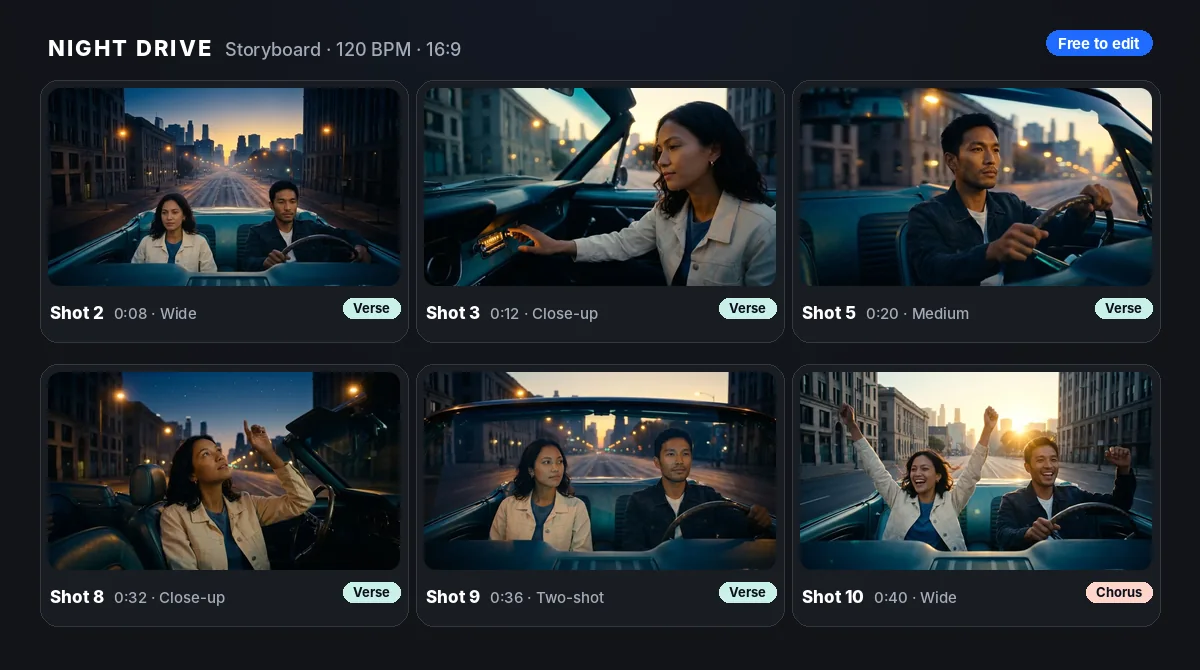
Upload your song and Muvora's AI director plans a shot-by-shot storyboard on the beat. Edit every shot for free, and pay only if you render.
Where your choices show up in an AI music video
Apply the Office's reasoning to the way an AI music video gets made and the parts sort themselves out. The table below follows a video through Muvora, but the same split applies to any AI video tool: some things you do are clearly yours, some are instructions to a model, and some are choices whose weight nobody can measure in advance.
| What you do | What copyright makes of it | Likely to count? |
|---|---|---|
| Write and record the song | A composition and a sound recording | Yes, fully, whatever happens to the video |
| Type a concept into the idea box | An idea; copyright protects how ideas are expressed, not ideas | Not on its own |
| Rewrite a shot's prompt, or ask AI to rewrite it | A more detailed instruction to the model | Not on its own, by the Office's 2025 view |
| Add a character you drew, or a photo you took, as the performer | Your own work, visible in the output | Your drawing or photo stays protected; its traces in the output may count |
| Drag cuts, split and merge shots, swap them, choose which re-rolls to keep | Selection and arrangement | Possibly, case by case |
| Edit the exported video or its frames in your own editor | Modification | Possibly, if the changes are creative and yours |
The idea row has a source of its own: the Copyright Office's FAQ says copyright doesn't protect ideas, though it may protect the way they're expressed. A great concept in the idea box is worth having, but it isn't property.
- 1. UploadMP3, WAV, M4A or FLAC
- 2. AnalysisTempo, beats, sections
- 3. StoryboardFree, every shot editable
- 4. RenderKeyframes, then video
- 5. Export16:9, 9:16, 1:1, Canvas
Steps 1 to 3 are free. You pay credits at step 4, and see the exact price before you do.
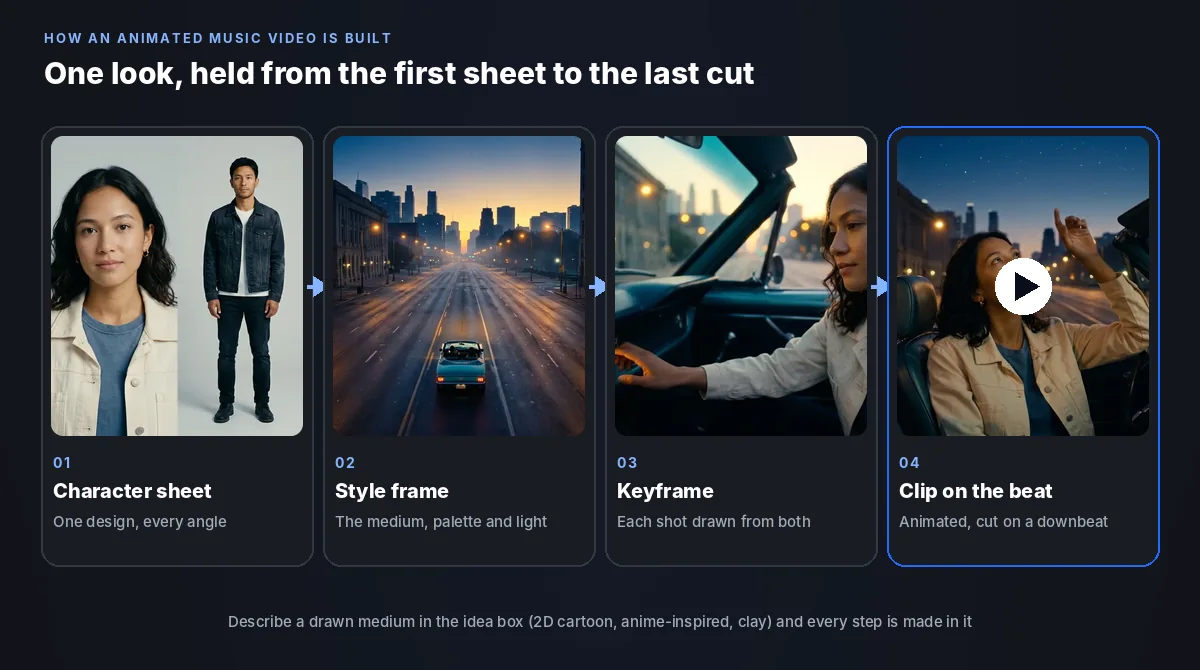
Be honest with yourself about the middle. In a Muvora video, code places the cuts on the downbeats, an AI director writes the brief and every shot's prompts, and AI models draw and animate the shots; you choose the song, the idea, the look, and what to change, keep, swap or re-roll. That's a real hand in the video you end up with, and often the difference between a good one and a generic one. Whether it adds up to authorship of the pictures is a question no tool, and no guide, can answer for you in advance.
What Muvora's terms say about your video
Copyright law decides whether anyone can stop others copying the pictures. The contract between you and the service decides something else: what each of you may do with the video. Muvora's terms answer that part plainly.
- Muvora claims no ownership. The storyboards, images and videos you make belong to you as between you and Muvora, as far as the law allows, and you may use them for any lawful purpose, commercial ones included.
- The song isn't part of it. Your rights in a video never include rights in the song or anything else you uploaded; those stay with their owners.
- No promise of copyright. Because AI-made material may not be protected in some countries, Muvora doesn't promise that anyone holds a copyright in a video, or that you can stop others copying it.
- Lookalikes can happen. AI models can produce similar results for different people, so another user may end up with pictures that resemble yours.
- Your uploads stay yours too. You keep every right in what you upload, Muvora's license to it covers running the service, and Muvora doesn't train AI models on your uploads or videos.
One practical consequence: the terms are an agreement with whoever holds the account. If a manager, a label assistant or a friend makes the video in their own account for your song, put in writing who holds the video, or make it in the artist's account from the start. The same goes for a photo of a performer that a photographer took: the person in it agreeing to appear isn't the photographer agreeing to its use.
Make the video in your own account
Upload the song you own, tick the rights box and get a free storyboard you can rewrite, re-cut and re-plan before rendering. Every change you make is your choice, not a template's. More on turning an AI song into a video if the song came from an AI music tool.
Outside the US, the answer can differ
Copyright is national, and countries haven't all landed in the same place on AI-made material. Two well-known positions show how far apart they can be, and neither may match the law where you live.
| Where | Position | Source |
|---|---|---|
| United States | No protection without a human author; prompts alone aren't enough; human selection, arrangement and modification judged case by case | Copyright Office, Part 2 |
| United Kingdom | A rule for computer-generated works names as author the person who made the arrangements for the work's creation; the government proposed removing it in March 2026 | CDPA section 9, HSF Kramer |
| China | A Beijing court found copyright in an AI image whose user chose, ordered and adjusted many prompts and settings | Kluwer Copyright Blog |
The UK rule is section 9(3) of the Copyright, Designs and Patents Act 1988: for a literary, dramatic, musical or artistic work generated by computer with no human author, the author is taken to be the person by whom the arrangements necessary for its creation were undertaken. UK commentators say it's unclear whether typing a prompt counts as making those arrangements, and the government's report on copyright and AI in March 2026 proposed removing the protection unless evidence shows it still has value, as Herbert Smith Freehills Kramer summarized it. Check whether it still stands before you rely on it.
In China, the Beijing Internet Court decided in November 2023 that an image made with Stable Diffusion was protected, because its user had chosen and ordered his prompts, set the parameters and kept adjusting both until the picture matched what he wanted, as the Kluwer Copyright Blog reported. The court said later cases would be judged on their own facts. Muvora's terms speak of "some countries" for this reason: the same video can be treated differently depending on where someone tries to enforce it.
What it means for the video you post
For most musicians, the uncertainty about the pictures matters less than it sounds, because the valuable thing in a music video is usually the song, and the song's protection is complete. Here's how it plays out day to day:
- You can publish, monetize and license the video. Commercial use depends on the rights to everything in it, starting with the song, not on a copyright in the pictures.
- A reupload still carries your song. If someone reposts your video, the soundtrack is your recording, so the song's rights and your distributor's Content ID still apply to it.
- The pictures alone may be hard to defend. If someone lifts frames or clips without the song, a copyright claim over AI-generated pictures may be hard to make in the US, so don't build a business on the exclusivity of an AI-made look.
- Similar pictures can turn up elsewhere. The same models can make comparable images for other people, so your strongest identity is the song, the performer and the choices around them.
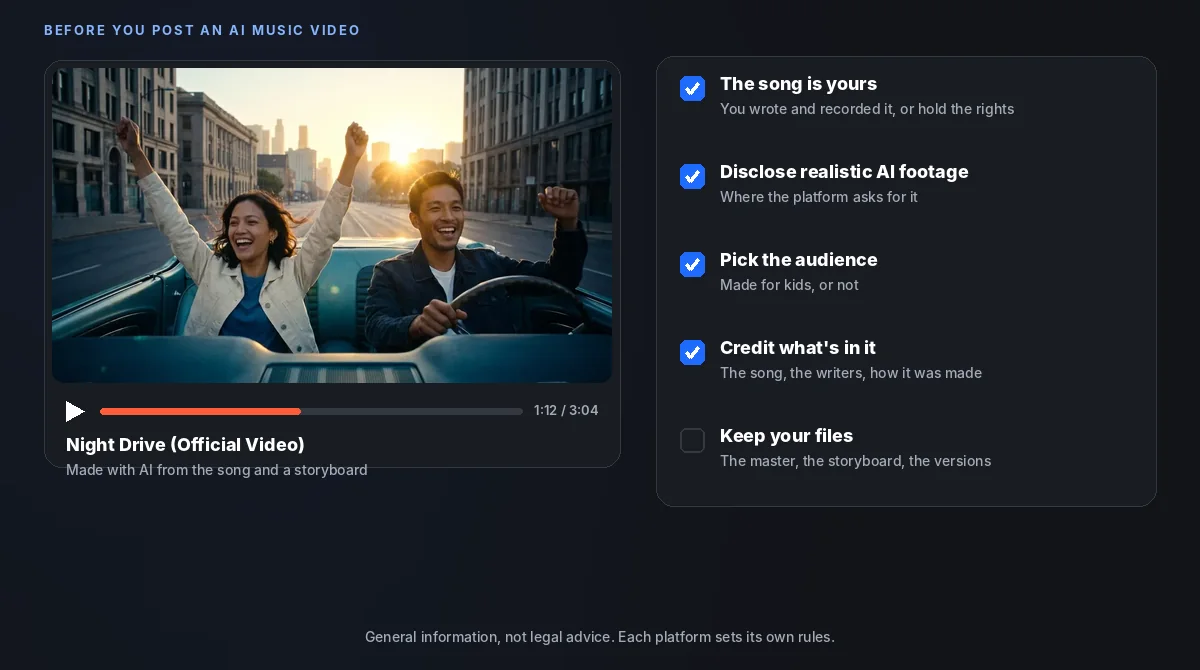
- Platforms ask their own questions. YouTube's AI disclosure, for one, is about how realistic the video looks, not who owns it; AI music videos on YouTube covers it.
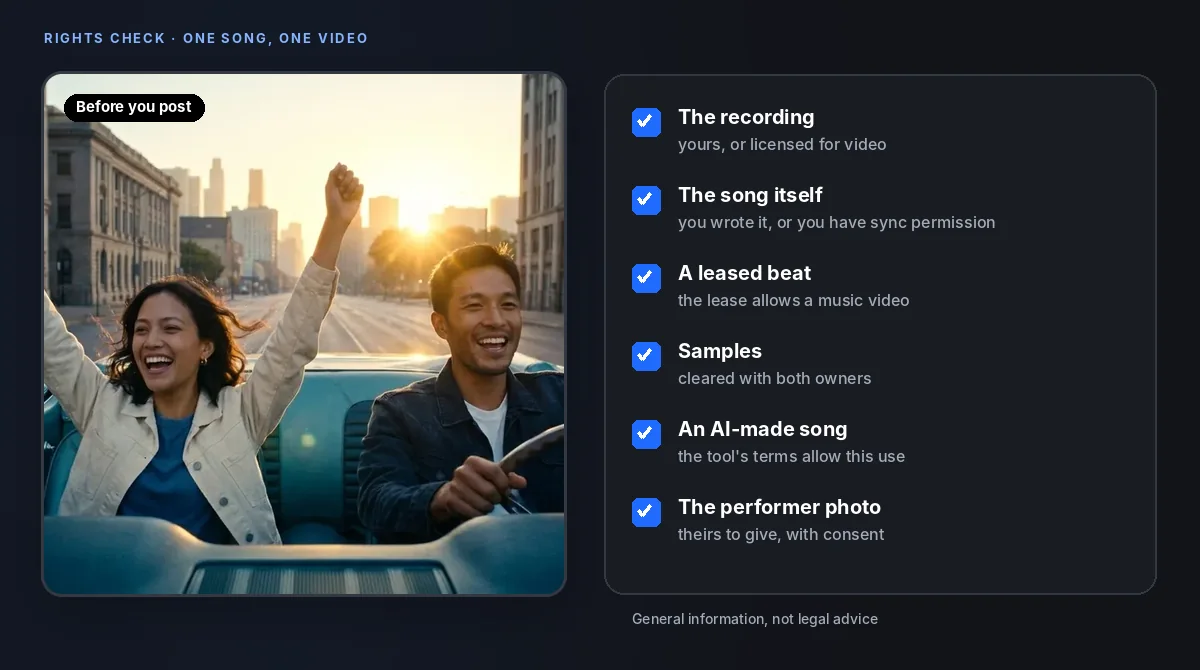
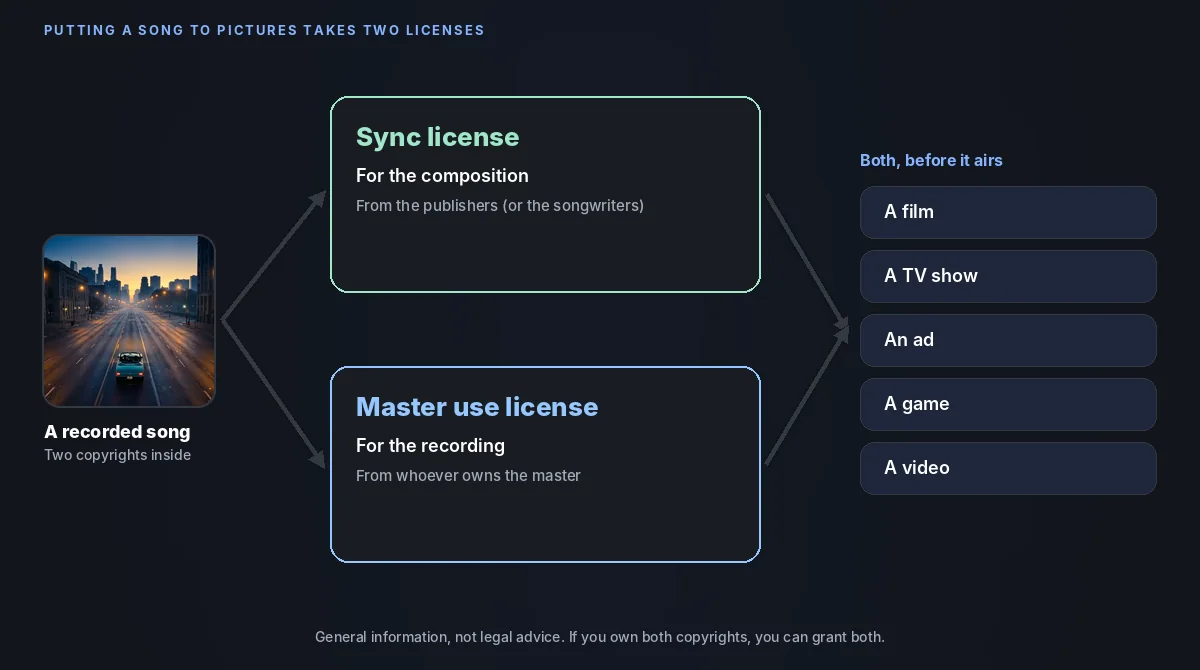
Clearing the song is a separate job from all this, and it's the one that can stop a video. Covers, samples, leased beats and AI-made songs each bring their own license, which music video copyright goes through case by case; putting someone else's song in a video needs a sync license from its publisher.
How to protect your part, step by step
You can't make AI-generated pictures protectable by paperwork, but you can make sure everything that is yours is provable, and that nobody else can claim the parts you made. Seven steps, most of them done once per release:
- 01
Register the song
The song is the part with the clearest protection. In the US, registering the composition and the recording is what lets you take an infringer to court and, done in time, claim statutory damages, so do it for every release.
- 02
Keep your own inputs, dated
Save the lyric sheet, the session files, and any photo or drawing you used as the performer, with their dates, in one folder beside the master.
- 03
Keep a record of your choices
Save the text you typed in the idea box, the prompts you rewrote, and screenshots of the storyboard after your edits, with a line on why you changed what you changed.
- 04
Download every version
Muvora keeps every version of a video available to download, but deletes a video's working files 30 days after it is finished or last changed, so download each version you make and keep it.
- 05
Put ownership in writing when others help
Sign a split sheet with your co-writers, get the performer's written consent, and agree who holds the video if someone else made it in their account.
- 06
Credit the song's owners
Name the writers, the producer and anyone sampled in the video's description, so viewers, publishers and distributors can match the song to its owners.
- 07
Disclose the AI part where you're asked
When you register a work with AI-made material, identify it and leave it out of the claim; when you post, answer the platform's AI question for how realistic the video looks.
Start with a song that's yours
Upload it (MP3, WAV, M4A, AAC or FLAC, up to 8 minutes) and Muvora maps its beats, sections and lyrics, then writes a storyboard for you to shape. The free plan gives you 5 new storyboards a month, and you see the price before you render.
Written by the Muvora team. Last updated November 16, 2026. Spotted something out of date? Tell us at [email protected].