The short answer
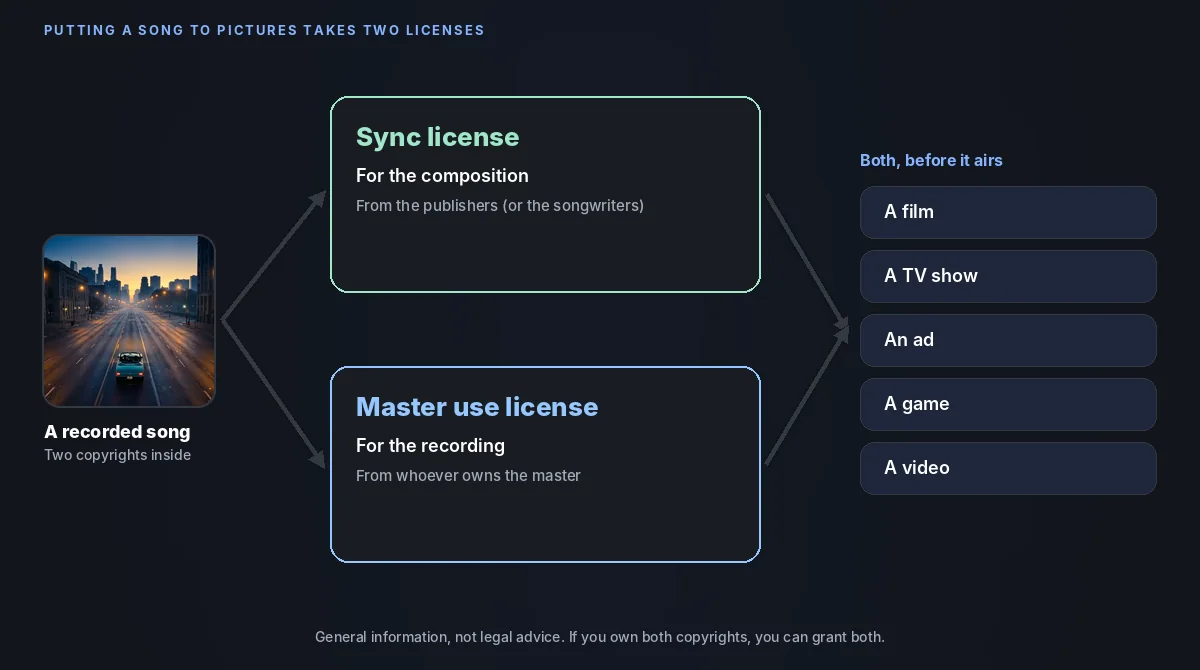
A sync license is permission from whoever controls a song's composition, usually its publisher, to use it in timed relation with moving pictures: a film, a TV show, an ad, a game or an online video. Using an existing recording also takes a master use license from the recording's owner. An artist who controls both sides can license their own songs in one deal.
- A sync license covers the composition and comes from its publisher or a self-published writer.
- An existing recording also needs a master use license from whoever owns it.
- In the US no compulsory license covers video: each owner can set its terms or say no.
- Songs you control on both sides (one-stop) are the easiest for a production to clear.
- Crediting the artist, or a disclaimer, is never a license.
On this page (7 sections)ShowHide
What a sync license is
"Sync" is short for synchronization: setting music in timed relation with pictures, so a chorus lands on a kiss or a drop on a car pulling away. A sync license is the permission to do that with a particular song. Publishing administrator Songtrust's help page puts it simply: a sync license is needed when music is paired with a visual work, and it's granted by the work's owner or composer. In practice that's the song's publisher, or the songwriter where they publish themselves.
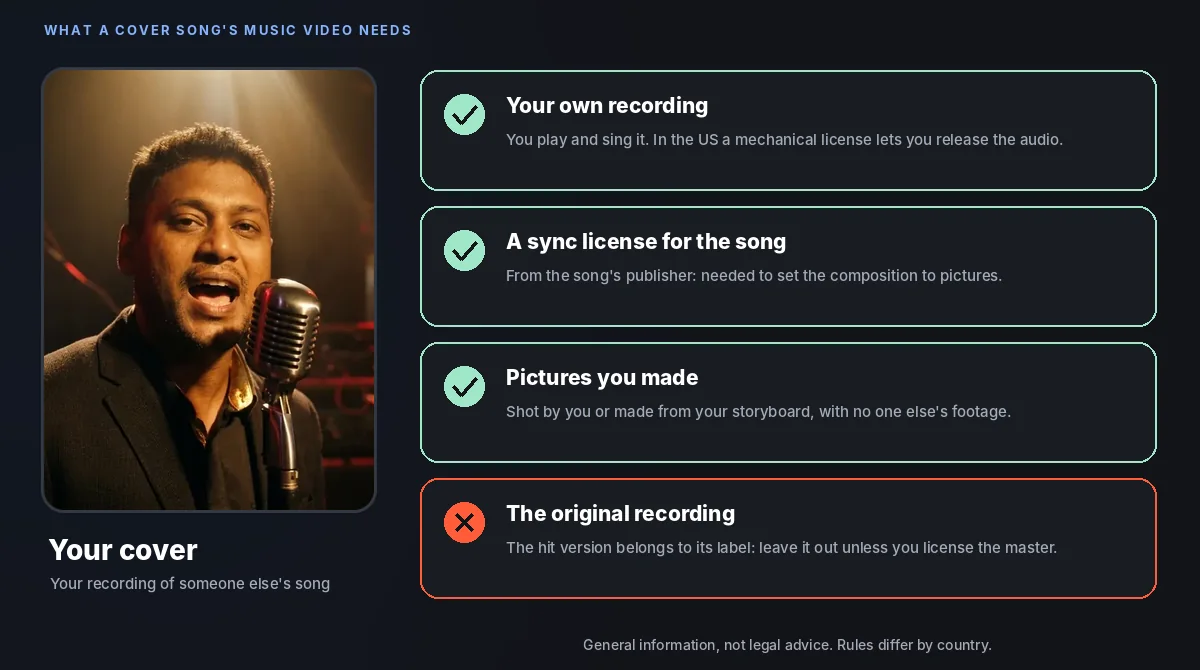
A sync license covers the composition only: the melody, the harmony as written and the lyrics. To use a particular recording of the song, a production also needs a master use license from whoever owns that recording, usually the label or the artist. Re-record the song and you need only the sync side, because your new recording is your own master. In the US, neither license can be forced: the Harry Fox Agency's Songfile, which issues mechanical licenses for covers, licenses only physical products, permanent downloads, ringtones and interactive streams, so a license to set the song to pictures has to come from its publisher or administrator.
- Sync license
- Permission from the composition's owner, usually its publisher, to set a song in timed relation with pictures in a named project.
- Master use license
- Permission from a recording's owner, usually a label or the artist, to use that particular recording in the project.
- One-stop
- A song whose composition and recording are controlled by one party, so a production clears both in one deal.
- Music supervisor
- The person who chooses and clears the music for a film, a series, an ad or a game.
- Cue sheet
- The list of every piece of music in a production, with its timings, writers and publishers, that performing rights organizations use to pay broadcast royalties.
- Production music
- Music written to be licensed for use in productions, cleared through a library at published rates rather than negotiated song by song.
- Most favored nations
- A clause promising one rights holder terms no worse than another's; in sync it can tie the master fee and the sync fee to each other.
When you need a sync license
Any time a song you don't fully control plays under pictures that are published, you need both owners' permission, whatever the size of the project. The table covers the uses musicians and creators run into most.
| Use | Sync license (composition) | Master use license (recording) |
|---|---|---|
| A film, a TV series or a documentary | Yes | Yes, for an existing recording |
| An ad, or a brand's social video | Yes, unless a platform's commercial library covers that use | Yes, unless a platform's commercial library covers that use |
| A YouTube video, a vlog or a wedding film | Yes | Yes, for an existing recording |
| A video game or an app | Yes | Yes, for an existing recording |
| A video of your own cover of someone's song | Yes, from the song's publisher | No: your recording is your own master |
| A music video for a song you wrote and recorded alone | No: you hold it | No: you hold it |
| A song you co-wrote, or recorded under a label deal | The co-writers or their publishers have a say | The recording's owner has a say |
| The song playing in a venue or on the radio | No: that's a public performance, licensed through performing rights organizations | No |
Some platforms clear part of this for use on their own app. TikTok describes its Commercial Music Library as pre-cleared for commercial use, so businesses don't have to obtain licenses on their own for those tracks (TikTok for Business). Outside a library like that, a song in a brand's video, or in anything you post outside the platform, needs both licenses from its owners. The detail for covers, samples and leased beats is in music video copyright.
Skip the blank page
Upload your song and Muvora's AI director plans a shot-by-shot storyboard on the beat. Edit every shot for free, and pay only if you render.
How to get a sync license for someone else's song
Clearing a commercial song is a negotiation with two owners, and it takes time, so start before you edit around the song rather than after. The usual order:
- 01
Find who controls the composition
Search the song in Songview on ASCAP's or BMI's website, or in your own country's performing rights organization's repertory, to see its writers, their publishers, each one's share and a publisher contact.
- 02
Find who owns the recording
Check the release's credits for the sound recording line (the ℗ notice) to see the label or artist that owns the master, and contact its licensing department.
- 03
Describe the use exactly
Write down the project, the scene, how many seconds of the song play, whether it's featured or in the background, and where, for how long and in which media the project will be shown.
- 04
Ask each owner for a quote
Send the same description to every publisher with a share and to the master owner. In the UK, ask PRS for Music's MCPS whether it handles the composition side for that publisher.
- 05
Get every license in writing
Each license should name the song, the recording, the project, the use, the media, the territory, the term, the fee and how the credit reads. Don't publish until every share is signed.
- 06
File the music in the project's records
Keep the licenses with the project, and list the song on the cue sheet if the project will be broadcast, so the writers' performance royalties reach them.
Songview, the joint ASCAP and BMI database, shows a song's writers, publishers, ownership shares and publisher contacts, but its FAQ warns that shares may not add up to 100% when owners haven't filed or their filings conflict, so a missing share means another owner to find. In the UK, PRS for Music says its MCPS commercial sync service licenses specific released works on behalf of many publisher and composer members, and points you to the right contact when it doesn't.
If the owners say no, or the budget isn't there, production music is the usual way out. PRS for Music describes it as music written for use in productions, cleared online at published rates with no copyright owner's permission to obtain; a UK film hub's guide puts the difference plainly: production music is cleared at once when you know the rate, while commercial sync is a negotiation that can take time (Watershed). Commissioning a composer, or writing the music yourself, is the other.
What decides the fee, and how a placement pays
Songtrust's page on sync fees describes them as payments for using copyrighted music in audiovisual productions such as TV shows, films, ads and video games. There's no set price for one: with no compulsory license for video, each owner quotes for the use in front of it, and can refuse. What moves the figure is the shape of the use:
| Term | What it means | How it moves the quote |
|---|---|---|
| Media | Where the project is shown: festival, streaming, broadcast, cinema, online ads, a game | Wider and more commercial media cost more |
| Territory | The countries the license covers | Worldwide costs more than one country |
| Term | How long the license lasts | Perpetual costs more than a year or a campaign |
| Duration | How many seconds of the song play | A full chorus costs more than a few bars |
| Prominence | Featured on screen, under dialogue in the background, or over the titles | Featured and title uses cost more than background |
| Exclusivity | Whether the owner may license the song to anyone else meanwhile | Exclusivity costs much more, if it's offered at all |
| Version | The original recording or a re-record | A re-record needs only the sync side, so one fee instead of two |
Two fees usually come with one placement, one for each side, and a most favored nations clause can tie them together: if the label is paid more, the publisher's fee rises to match. When one artist controls both sides, the production deals with one person and one fee, which is the whole appeal of one-stop music.
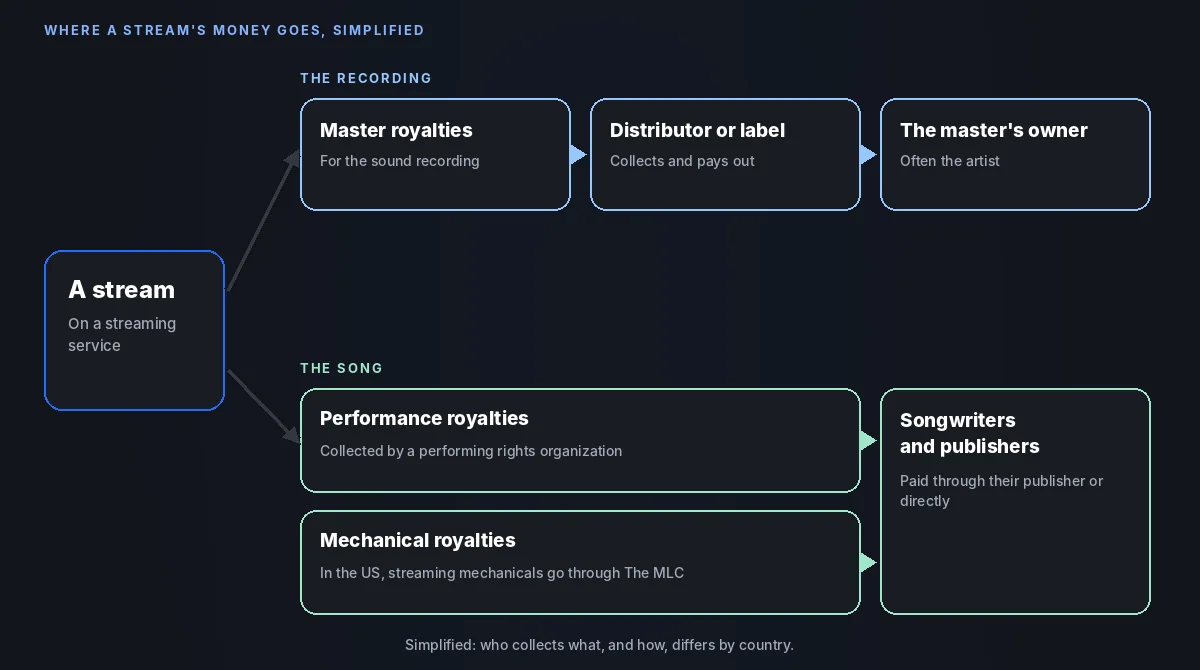
The fee isn't always the end of the money. When a film or a show is broadcast, the composition can earn performance royalties as well, and that depends on paperwork. BMI's page on cue sheets calls them the primary means by which performing rights organizations track music in film and TV, and its royalty calculations depend on them being accurate. A writer who isn't registered with a performing rights organization, or whose song is missing from the cue sheet, can miss that income. How the different royalties fit together is in how music royalties work.
How independent artists get their music placed
The other direction starts with the people who buy. The UK and European Guild of Music Supervisors describes a music supervisor as a professional who oversees everything to do with music in film, television, advertising, video games and other visual media. Supervisors choose songs against deadlines and budgets, and they favor music they can clear quickly and without surprises. Independent artists reach them in four main ways:
| Route | How it works | What to watch |
|---|---|---|
| Pitching supervisors yourself | You send a short, targeted email with a private link to the songs that fit their projects | Time, and a catalog that's cleared and tagged before you pitch |
| A sync agent or agency | They pitch your catalog to supervisors and agencies for a commission on the fees | The commission, the term and whether the deal is exclusive |
| A music library | The library licenses your tracks to productions, often at set rates | Exclusive or non-exclusive, retitling, and whether it takes a share of your publishing |
| A distributor's or publisher's sync program | Your existing partner offers your releases for sync alongside its other services | Whether it's included, an add-on or commission-based, and what it may sign on your behalf |
Library deals need the closest reading. CD Baby's guide to signing with a music library explains that an exclusive library is the only company allowed to represent the track for sync, a non-exclusive one leaves you free to place it elsewhere too, and a retitling library represents music you have elsewhere only under a new title of its own. Retitled and non-exclusive copies of one recording can collide later: YouTube's Content ID eligibility page requires exclusive rights to the reference audio, and lists material licensed non-exclusively from a third party as ineligible, so think before you register a track you've also placed non-exclusively.
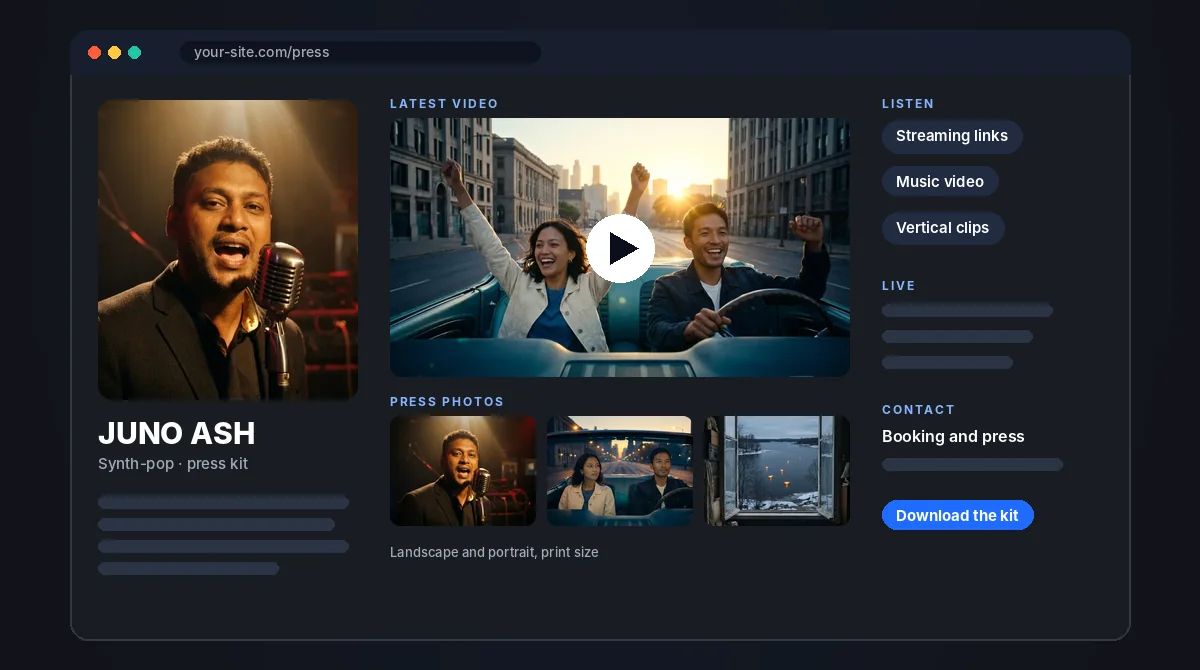
Whichever route you take, the pitch itself stays short: a line on who you are, two or three songs chosen for the supervisor's actual projects, a private streaming link, and a statement that you control both sides or who does. The EPK guide covers the page they'll click through to.
Make your songs ready to license
A supervisor who loves a song and can't clear it by Friday picks another. Most of what makes a song easy to license is admin you can finish before anyone asks. Distributors' sync guides, such as Symphonic's, ask for the same things: versions without vocals and without explicit lyrics, and metadata naming the writers, the publishers, the master owner and a licensing contact. Being one-stop matters most of all: as Hypebot's guide to sync licensing puts it, when one party owns 100% of both the recording and the publishing, the sync is a much simpler transaction with one price.
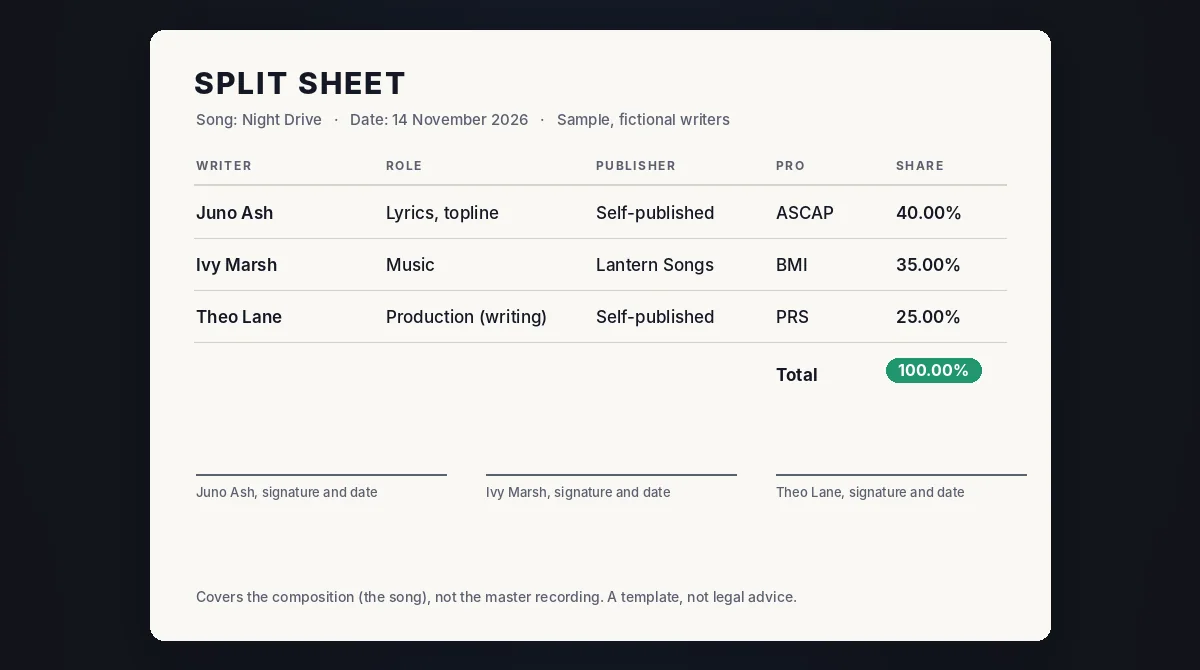
- Every co-writer has signed a split sheet with the shares adding up to 100%
- I control the master, or the master's owner agrees to pre-clear it with me
- Each song is registered with a performing rights organization, with every writer and publisher listed
- Each recording has its ISRC and each song its ISWC where one has been assigned
- There's an instrumental and a clean version of each song, mastered like the main mix
- Stems are exported and ready to send
- The files carry their title, writers, publishers, BPM, key, mood and a contact
- I have a private streaming link and full-quality WAVs ready to send the same day
The paperwork has guides of its own: what a split sheet is for the shares, and what an ISRC code is for the recording's ID, which also sets out how a music video can carry its own.
Give the song a picture of its own
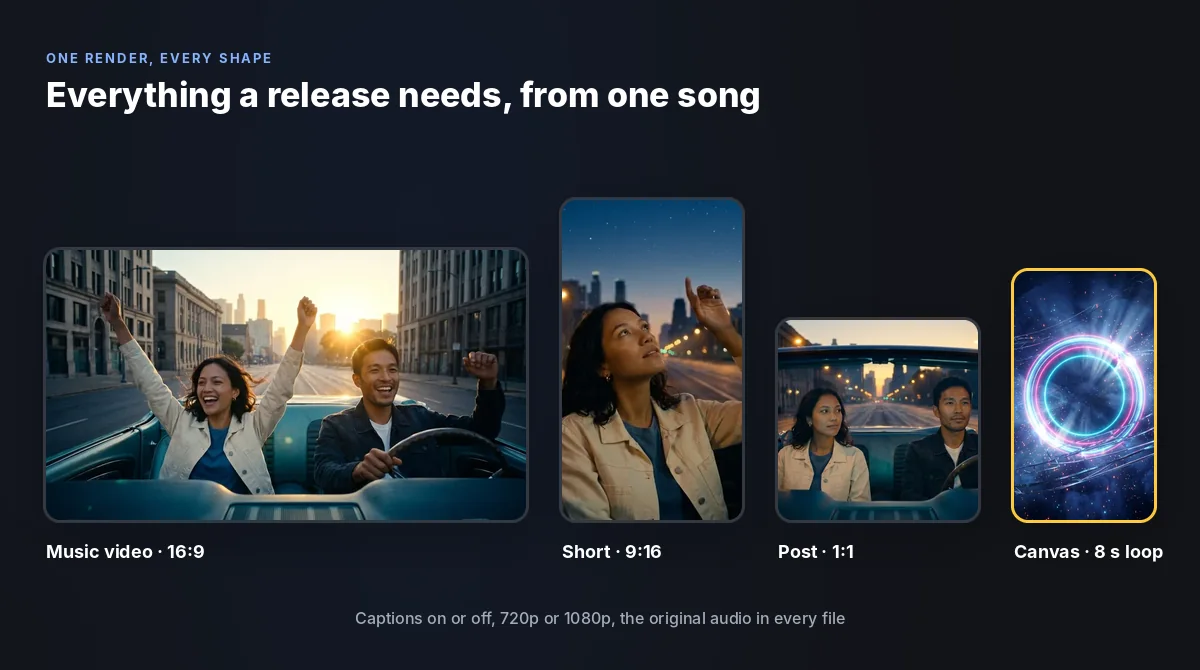
A supervisor licenses the audio, but a song with a video has more places to be found before anyone pitches it. Upload the master and get a free storyboard planned on its beats; one render gives the video, a vertical cut and a Canvas loop.
Music videos, Muvora and sync
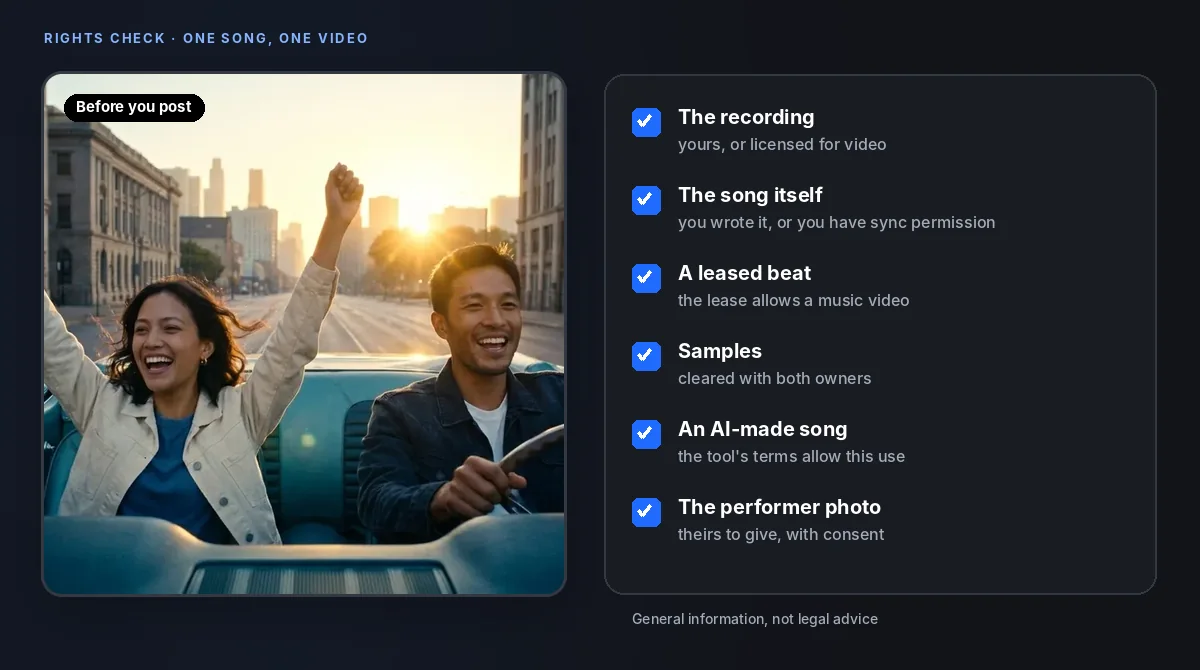
A music video is a sync too: your song set to pictures. When you wrote and recorded the song yourself, you're both owners, and there's nobody to ask. When it's a cover, a co-write you don't control, or someone else's recording, the video needs the same licenses as a film would. That's why Muvora asks you to confirm, every time you upload a song, that you own it or have the rights to use it in a video.
Sometimes a buyer wants the video as well as the song: a brand that likes your video for its campaign, say. Then three things are being licensed, the composition, the recording and the video. Muvora's terms make no ownership claim on videos you make and let you use them commercially when you have the rights to the song, the pictures never show real people other than a performer who agreed, and Muvora asks its models to leave out logos and lettering (look through the frames before a brand deal all the same). Tell the buyer the pictures are AI-made, though, because copyright in AI-generated material is uncertain; who owns an AI music video explains why.
Own the song? Make its video
Upload it (MP3, WAV, M4A, AAC or FLAC, up to 8 minutes), tick the rights box and Muvora plans every cut on the beat in a storyboard you edit for free. The independent artists' page shows how it fits a release.
Written by the Muvora team. Last updated November 16, 2026. Spotted something out of date? Tell us at [email protected].