Speed up your song, higher or in the same key
Open a song from your device and play it anywhere from 1.05x to 1.5x faster. Choose whether the pitch climbs with the speed, the bright sound nightcore and most sped-up edits have, with the change shown in semitones, or stays in the song's key while only the tempo rises. Add a touch of reverb or a bass boost if you want them, compare the result with the original at the same spot, and save a 16 or 24-bit WAV at the file's own sample rate. Your browser does all of it, and the song is never uploaded.
Free, no sign-up. Runs in your browser: nothing is uploaded.
Choose how it speeds up
Speed
3.86 semitones higher · 25% faster · 20% shorter
Type it to see the new tempo
Extras (optional)
Both are off to begin with. A sped-up edit usually wants little or no reverb, since a long tail blurs its quicker hits.
Everything runs in this page and nothing is uploaded. “Higher” plays the song faster, so its pitch rises with the tempo; “Same key” stretches it with a phase vocoder instead. A sped-up copy of someone else's recording is still theirs: post it only with the rights holders' permission, and each platform's rules on sped-up versions are its own.
Song finished? Upload it and Muvora plans the whole video on its beats. The storyboard is free.
Make the videoUpload a new songHow to use the sped up song maker
- 01
Open your song
Pick an MP3, WAV, M4A, AAC or FLAC up to 10 minutes long: a song you made, or one whose owners have said you can rework it. Your browser decodes it at the file's own sample rate and keeps it in this tab.
- 02
Pick higher or same key
Higher plays the song faster, so it climbs in pitch the way a record spun too fast does. Same key stretches it with a phase vocoder, so only the tempo changes. Set the speed with the slider, the minus and plus buttons or one of the common values from 1.1x to 1.4x.
- 03
Listen against the original
Choose a start point and press play. The higher version follows the controls while it plays; the same-key version builds 15 seconds first. Switch to the original at the same spot to compare the two.
- 04
Save the WAV
Choose 16 or 24-bit and make the file. If the speed-up, the reverb or the bass would push it past full scale, it's brought down to a -1 dBFS peak (untick that to keep the level), and the file name records the edit and the speed.
Higher or same key: what each one does to the song
Speeding a song up the simple way shrinks every cycle of the waveform, so the whole recording rises by 12 × log2 of the speed in semitones: 1.1x lifts it about 1.65 semitones, 1.2x about 3.16, 1.3x about 4.54 and 1.5x a fraction over seven, almost a perfect fifth. Voices go up with everything else, and because the resonances of the singer's throat and mouth rise too, they come out thinner and younger, the chipmunk edge people know from nightcore. Same key leaves every note where it was and only packs the music into less time: the phase vocoder reads the song in overlapping slices of about 46 ms and lays them back down closer together. The singer keeps their own voice and the song keeps its key, so it still mixes with the original; the price is a slight softening of sharp drum hits that grows toward 1.5x. Either way the song gets shorter by the same amount: a 3:00 track lasts 2:24 at 1.25x and 2:00 at 1.5x. To move the key on its own, or slow a song down without lowering it, use the pitch shifter.
- 1.25x higher: 3.86 semitones up
- Same key: only the tempo moves
- 3:00 at 1.25x lasts 2:24
Choosing a speed and the extras
Sped-up edits are often made between 1.2x and 1.35x. Under about 1.1x the change is subtle, more a nudge than a new version, and past about 1.4x many vocals get hard to follow. A song that's already quick needs less: 150 BPM at 1.2x is already 180. Type the BPM to read the new tempo, or measure it first with the BPM and key finder. When the pitch rises, ticking whole semitones snaps the speed to 1.06x, 1.12x, 1.19x, 1.26x, 1.33x, 1.41x or 1.5x, so the result lands in a real key (1.25x sits 14 cents short of four semitones) and can be mixed or played along with. The extras are light on purpose: a small room generated on your device with a 1.2-second decay, mixed in at 5 to 30%, and a bass shelf at 100 Hz of up to 6 dB, since a faster song leaves less space between hits for a long tail to fill. Both add level, which is why the peak is checked before the file is written. For the big, far-away room of a slowed edit, the slowed and reverb generator has the full set of controls.
- Often 1.2x to 1.35x
- Whole semitones land it in a key
- Reverb from 5 to 30% wet
Your songs, other people's songs, and where sped-up versions go
A sped-up version still carries the original recording and the composition underneath it, so making one from somebody else's track and posting it needs permission from whoever owns those rights, usually a label and a publisher. Each platform also sets its own rules on sped-up uploads of other artists' music and enforces them its own way, so nothing here can say what any of them will allow. When the song is yours, or every co-owner agrees, a faster version can be a short clip, a teaser or a release of its own. Released through a distributor, it counts as a separate recording with its own code (the ISRC guide explains why), and if your distributor registers your music with Content ID, have your channel allowlisted before the clip goes up, as the music video copyright guide describes. The slowed and reverb video maker page shows how a faster version gets a video of its own.
- Your own songs, or ones you have permission for
- Each platform sets its own rules
- A sped-up release gets its own ISRC

Then give the sped-up version its own video
Muvora never speeds a song up: every video's soundtrack is the file you upload, from its first sample. So upload the sped-up WAV as a song of its own (as FLAC or MP3 if it passes 60 MB). Its analysis reads the faster tempo and the shorter bars, so the shots are timed to the new beat and every cut still lands on a downbeat. Sped-up versions mostly live as vertical clips, so this page's button starts a 9:16 video, which also gives you a square cut and an 8-second Canvas loop; pick 16:9 instead if you want a widescreen video as well. The storyboard is free to read and edit, and you see the price before anything renders.
Questions, answered
Can't find what you need? Start a free storyboard and see for yourself.
How do I speed up a song without changing the pitch?
Choose Same key, set the speed and make the WAV. The tool stretches the song with a phase vocoder, which shortens it while every note keeps its frequency, so a song in A minor at 1.2x is still in A minor and lasts five sixths as long. Expect drum hits to lose a little bite at the fastest settings.
How much does a nightcore-style speed-up raise the pitch?
It depends on the speed: the rise in semitones is 12 times the base-2 logarithm of the speed. Nightcore-style edits often sit around 1.25x to 1.35x, which lifts a song roughly 3.9 to 5.2 semitones. At 1.33x with whole semitones ticked it is exactly five semitones, a perfect fourth up.
Why does the speed stop at 1.5x?
At 1.5x a song is a little over seven semitones higher in the higher mode and two thirds of its original length, which is further than sped-up and nightcore edits usually go. Past it, words smear when the pitch rises, and the same-key stretch's side effects, softer drum hits and a faint swirl, keep growing. For bigger tempo changes in the same key, the pitch shifter on this site goes up to double speed.
Can I add reverb or a bass boost to a sped-up song?
Yes, and both start switched off. The reverb is a small room generated on your device with a 1.2-second decay, mixed in at 5 to 30%; the bass boost is a low shelf at 100 Hz of up to 6 dB. For a big, washed-out reverb with its own room size and decay, the slowed and reverb generator on this site has one.
Can I post a sped-up version of someone else's song?
Only with permission from the people who own the recording and the song. Speeding a track up doesn't make it a new work, and each platform decides for itself what it does about sped-up uploads of other artists' music. Use this tool on your own songs, or on ones whose owners have cleared you to rework them.
Does the song leave my device?
No. The song is decoded in this tab, the same-key stretch runs in a background worker on your device, and the WAV is saved straight from the page's memory. That is also why songs are limited to 10 minutes: the decoded song and the sped-up copy both sit in memory while the file is made.
Keep exploring
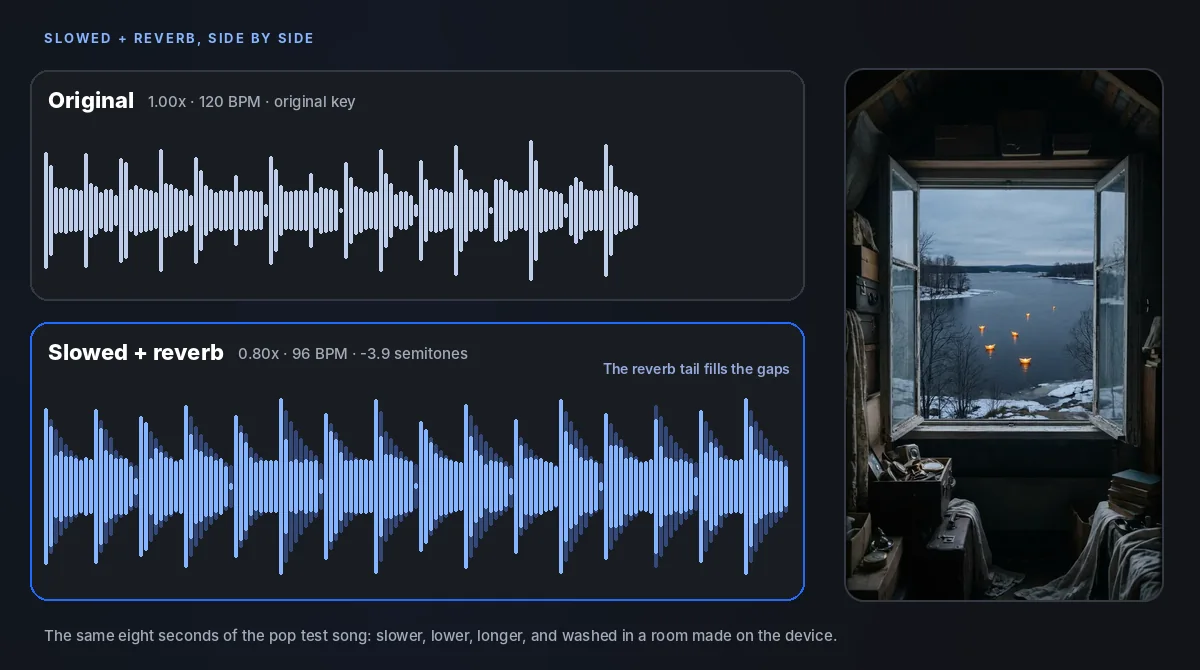
Make a slowed and reverb song
What slowed and reverb, sped up and nightcore do to a song, the settings most edits use, how to make one, and whose songs you can use.
Read the guideSlowed and reverb generator
Make a slowed and reverb, sped up or nightcore version of your own song, hear every change as you make it and save a WAV.
Open the toolPitch shifter
Move a song up or down by semitones and keep its tempo, or change its tempo and keep its key. Hear 15 seconds first, then save a WAV.
Open the toolSlowed and reverb videos
A video for the slowed and reverb or sped up version of your song, cut to its own new tempo.
Learn moreBPM and key finder
The tempo and musical key of any song, with its Camelot code for mixing.
Open the toolAudio cutter
Cut a 15 to 60 second clip from a song that starts and ends on a bar line, add fades and save it as a WAV.
Open the tool
More free tools: loudness and audio
Check and normalize loudness, change the key, make a slowed and reverb or reversed version, join files, convert to WAV, cut a snippet and make waveform art.
Your song deserves a music video
Upload a track and get a free beat-synced storyboard in minutes. Render it when you are ready.
No card needed to start.






