The short answer
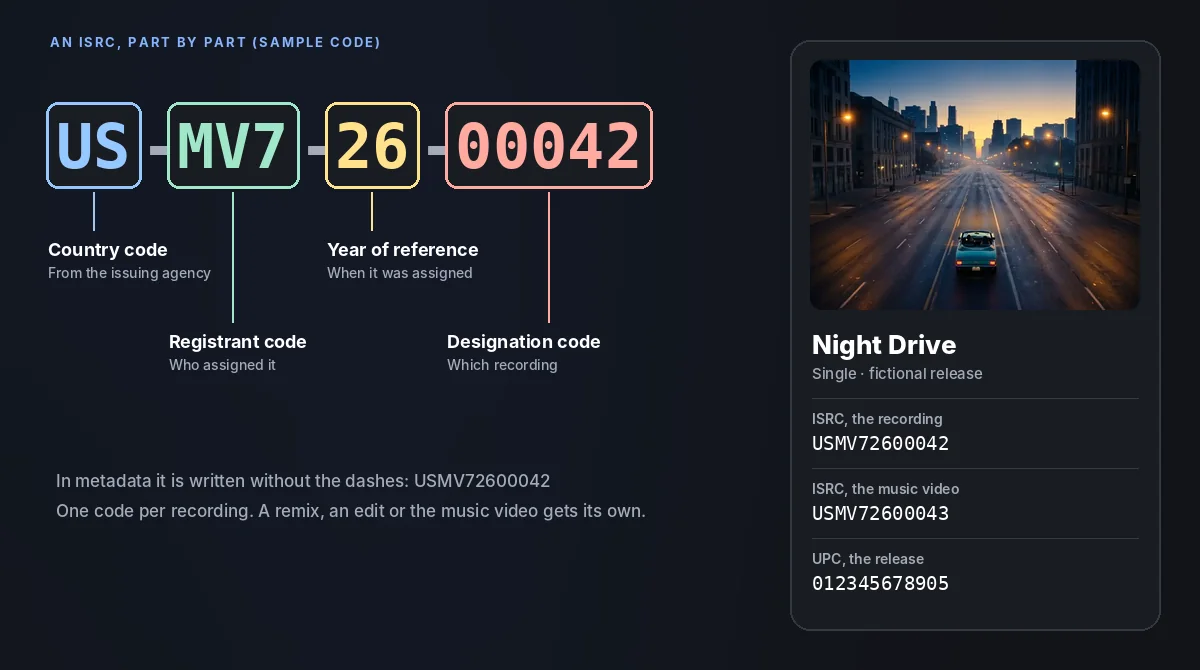
An ISRC (International Standard Recording Code) is a 12-character code that identifies one recording, not the song or the release. It has four parts: a country code, a registrant code, a two-digit year of reference and a five-digit designation code. Each new recording, edit, remix or music video gets its own, and most distributors assign ISRCs for you when you upload.
- An ISRC identifies a recording; the ISWC identifies the song, and the UPC the release.
- Twelve characters: country code, registrant code, year of reference and designation code.
- A remix, an edit, a live version and the music video each need their own ISRC.
- The same master on a later release keeps the ISRC it already has.
- Your distributor usually assigns them; your national ISRC agency can make you a registrant.
On this page (9 sections)ShowHide
What an ISRC is
ISRC stands for International Standard Recording Code. It's an international standard, ISO 3901, run by the International ISRC Registration Authority at IFPI, with national agencies in many countries. It gives each sound recording, and each music video recording, a code of its own, so that a stream, a download or a radio play can be matched to exactly that recording when the money is counted.
The code belongs to the recording, not to whoever sells it. The ISRC agency's FAQ says an ISRC stays permanently tied to the recording it was assigned to, whatever happens to the ownership afterwards, and that the recording's first owner normally assigns it, before release. That's why one recording keeps one code for life, and why a new code for the same master causes more trouble than it solves.
The four parts of an ISRC
An ISRC is 12 characters long, letters A to Z and digits only. The ISRC agency's structure page groups the first five characters as the prefix code, which identifies who assigned the code; the rest say when it was assigned and which recording it is. Hyphens and the letters “ISRC” in front are only for reading: systems store the 12 characters alone.
| Part | Characters | In the sample | What it means |
|---|---|---|---|
| Country code | 2 letters | US | The country code of the registrant, given out with the prefix |
| Registrant code | 3 letters or digits | MV7 | Who assigned the code; it only identifies them together with the country code |
| Year of reference | 2 digits | 26 | The last two digits of the year the code was assigned, which isn't always the year it was recorded |
| Designation code | 5 digits | 00042 | The recording's own number, given by the registrant and never repeated within the same year |
Two practical points follow from that. The year in the code tells you when the code was made, so a song recorded in 2024 and released in 2026 can carry 26; the recording year belongs in the release's metadata, not the code. And because the designation code only has to be new within its year, a registrant's codes are easy to keep in order: the year, then a counter.
Skip the blank page
Upload your song and Muvora's AI director plans a shot-by-shot storyboard on the beat. Edit every shot for free, and pay only if you render.
ISRC vs ISWC vs UPC
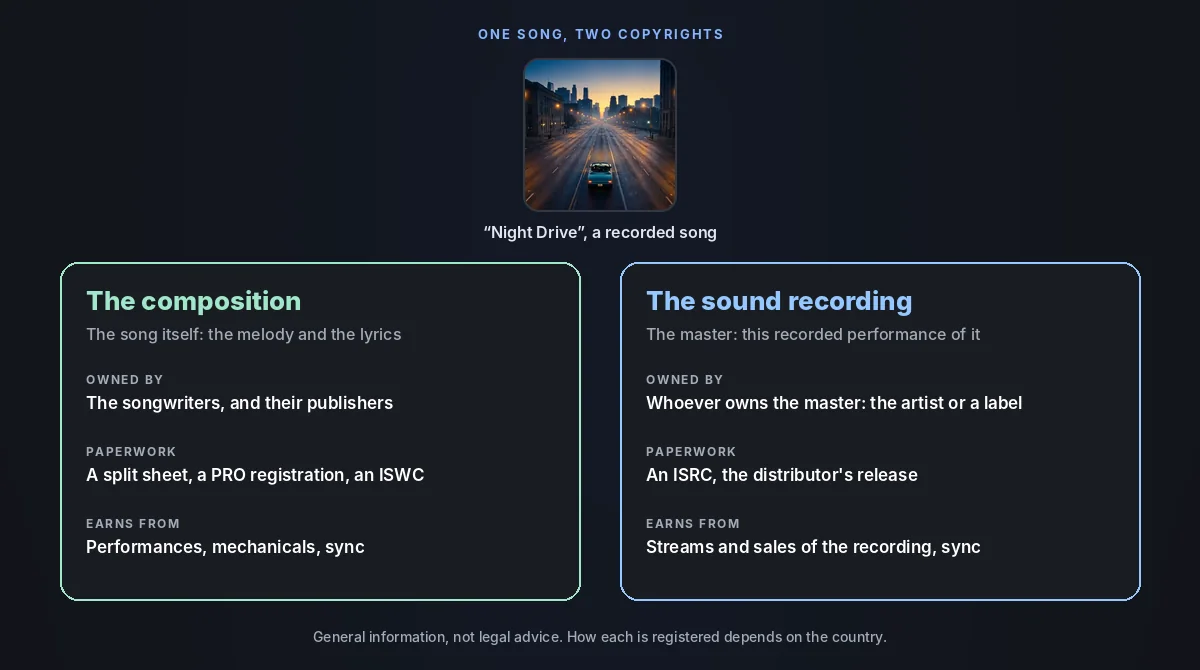
A release involves three things that can be owned and paid for separately: the song, the recording of it, and the product the recording is sold as. Each has its own code, and mixing them up is the most common reason a form gets rejected.
| Code | Identifies | Who issues it | Stays the same when |
|---|---|---|---|
| ISRC | One recording (or one music video recording) | The recording's owner as a registrant, or a distributor for them | The same master appears on a single, then an album |
| ISWC | The song as written: the musical work, its melody and words | An ISWC agency, usually a collecting society, when the work is registered | Another artist records a cover of it |
| UPC or EAN | The product: the single, EP or album as a whole | Your distributor, or you with your own barcode prefix | Never: a deluxe edition is a new product with a new barcode |
The ISWC is the song's code, issued by agencies in the CISAC network of collecting societies when the work is registered; the MLC describes it as 11 characters, and notes that a song's original recording and a cover share its ISWC while each has its own ISRC. The UPC (12 digits, used mostly in North America) and the EAN (13 digits) are both GTINs, the barcodes GS1 gives to products, and on a digital release the barcode identifies the single, EP or album as a whole.
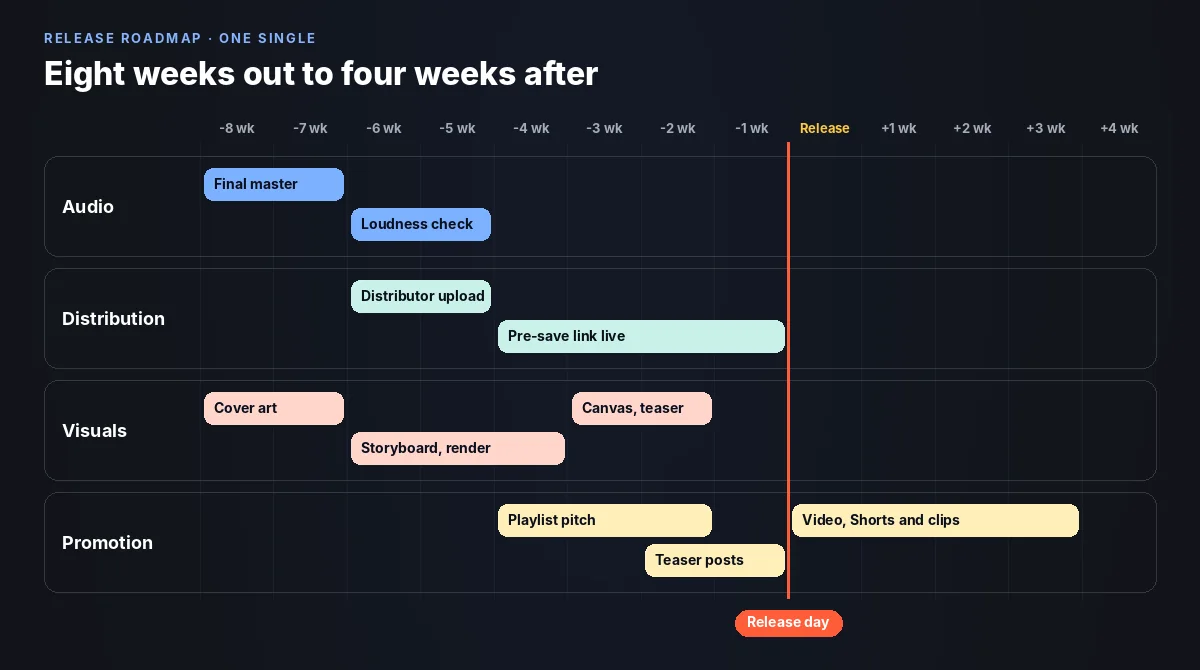
So a fictional band's single “Paper Boats” has one ISWC for the song, one ISRC for the studio recording and one UPC for the single. When the same recording comes back on the band's EP, it keeps its ISRC and the EP gets a new UPC. If another band covers the song, their recording gets a new ISRC and the song keeps its ISWC.
When a recording needs a new ISRC
The ISRC agency's rule of thumb, on its page about when to assign a code, is that a change involving new artistic input makes a new recording, and a new recording gets a new ISRC. A recording that comes back unchanged, on another release or in another format, keeps the code it has. The ISRC Handbook works through the cases one by one; these are the ones musicians meet most.
| The version | New ISRC? | Why |
|---|---|---|
| The same master on a later single, EP, album or compilation | No, keep the existing one | It's the same recording on a new product, so only the product gets a new barcode |
| A remix | Yes | Remixing is new artistic input |
| A radio edit, a shortened edit or a clean version | Yes, when the audio changes | An edited version is a different recording from the full one |
| A live recording, an acoustic take or a re-recording | Yes | A new performance is a new recording |
| A remaster | Only with significant new creative input | The ISRC FAQ treats a routine remaster as the same recording |
| A different mix, such as an immersive one | Yes | A different audio mix is a different recording |
| The music video | Yes, separate from the audio's | A music video is a different recording, even with the same audio in it |
| The same video at HD and at 4K | No | A change of picture resolution alone isn't a reason for a new code |
| The same release through a new distributor | No, give them the existing codes | The code stays with the recording, whoever delivers it |
The music video and resolution rows come from the agency's page on music videos and its 2022 bulletin on immersive recordings and video variants; the remaster row from its FAQ. Distributors apply these rules through their upload forms, usually with a version field (Remix, Radio Edit, Live) beside the title, and some set their own rules for edges like short edits: check your distributor's help pages when a case isn't on this list.
Does a music video need an ISRC?
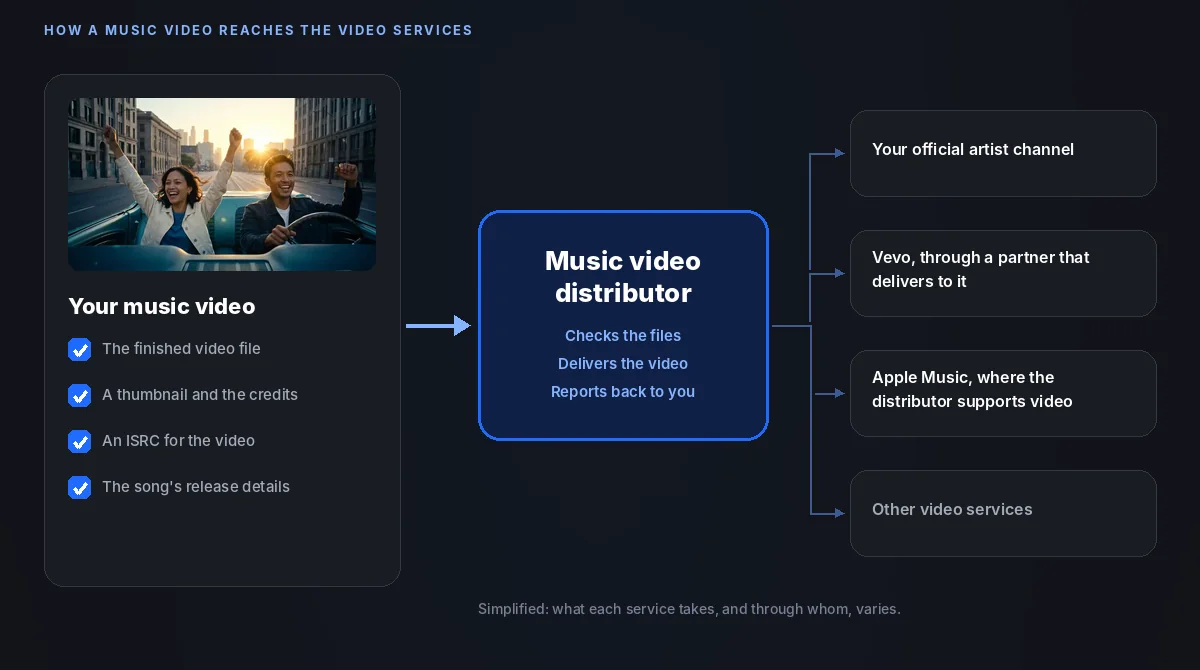
By the ISRC agency's own guidance, a music video is a different recording from the song's audio, even when the audio in it is exactly the same, so a video that gets an ISRC gets its own, never the audio's. Two music videos count as different when their picture or their sound differs, and the agency asks registrants to note in their records whether each code is for a sound recording or a music video.
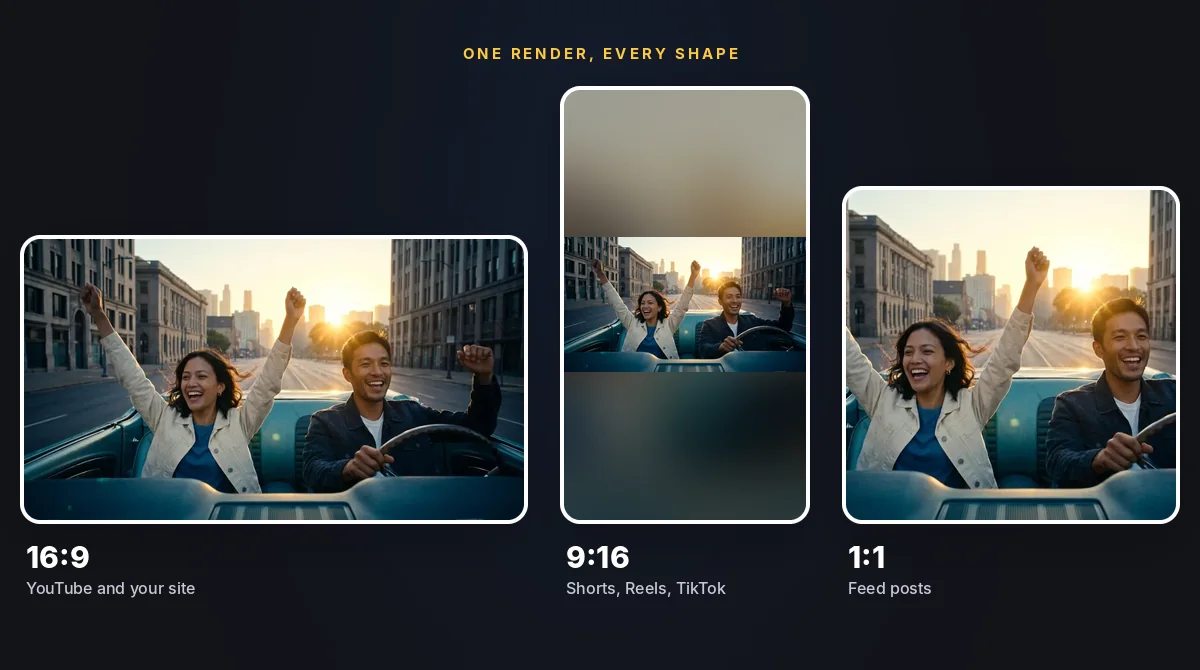
Whether you need one depends on where the video goes. If a distributor or label delivers the video to music video services, it will either assign the video an ISRC or ask you for one, so check your distributor. A video you upload yourself to your own YouTube channel goes up without one. If you deliver more than one cut, such as a widescreen video and a vertical version, ask your distributor whether each needs its own code, since their pictures differ.
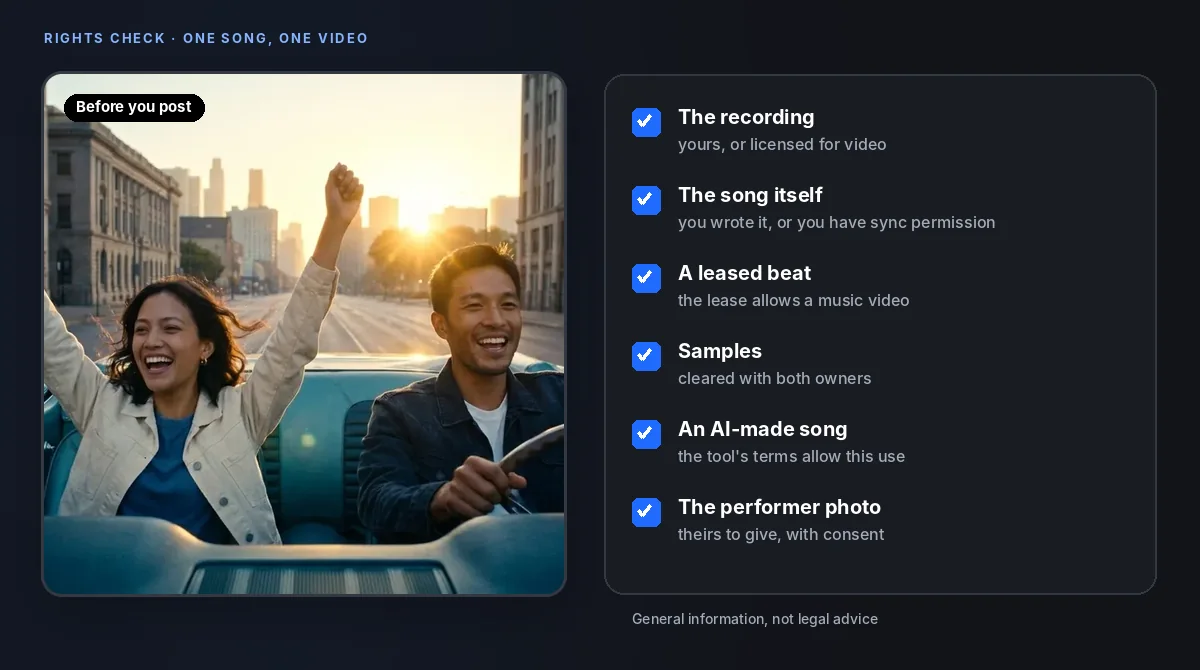
Muvora makes the video and leaves the codes to you and your distributor: the soundtrack of every render is the file you uploaded, untouched, so the video's audio is the same master the audio ISRC identifies. Owning the master isn't the whole picture for a video, though: music video copyright covers the composition, samples and beat leases that decide what you may put on screen.
Make the music video your release needs
Upload the finished master and get a free storyboard cut to its beats, then render the widescreen video, vertical cuts and an 8-second Canvas loop in one go. The soundtrack is your file, exactly as you uploaded it.
How to get ISRC codes
There are two routes. Most independent artists let their distributor assign ISRCs at upload, which costs nothing extra and needs no paperwork. Labels and artists who release often, or who want the codes under their own name, can become registrants instead and assign their own.
- 01
Find the codes you already have
Look up every recording on the release that came out before, in your distributor's dashboard or old release documents, and note its ISRC so it's reused rather than replaced.
- 02
Decide who assigns the new ones
Let your distributor assign them at upload, or apply to your country's ISRC agency for a registrant code of your own and assign them yourself.
- 03
List every recording and version
Write down each recording the release needs a code for: the main version, the radio edit, the remix, the instrumental, the music video.
- 04
Assign one code per recording
If you're the registrant, give each recording your prefix, the current year's two digits and the next unused five-digit number, and never use a number twice in the same year.
- 05
Keep a log
Record each ISRC with the title, the version, whether it's audio or video, the date it was assigned and the release's UPC, beside the song's split sheet.
- 06
Deliver them and check the store pages
Enter or confirm the codes in the distributor's upload form, then check after release that each track shows the right code in your dashboard.
To become a registrant, go through the ISRC agency for your country; the international agency's FAQ says it handles applications itself where a country has none, and that you don't need to be a member of IFPI or any other industry body. Each agency sets its own terms: some charge a one-time fee for a registrant code and some charge nothing. In the UK, for example, PPL is the national agency and allocates codes to its recording rightsholder members.
| Your distributor assigns them | You assign them as a registrant | |
|---|---|---|
| Effort | None: they're made at upload | An application, then a log you keep up |
| Whose prefix | The distributor's | Your own, the same on every release |
| Changing distributor | Give the new one the existing codes | Same: the codes stay with the recordings |
| Suits | Most independent artists | Labels and artists who release often or license their masters |
Where the ISRC goes after release
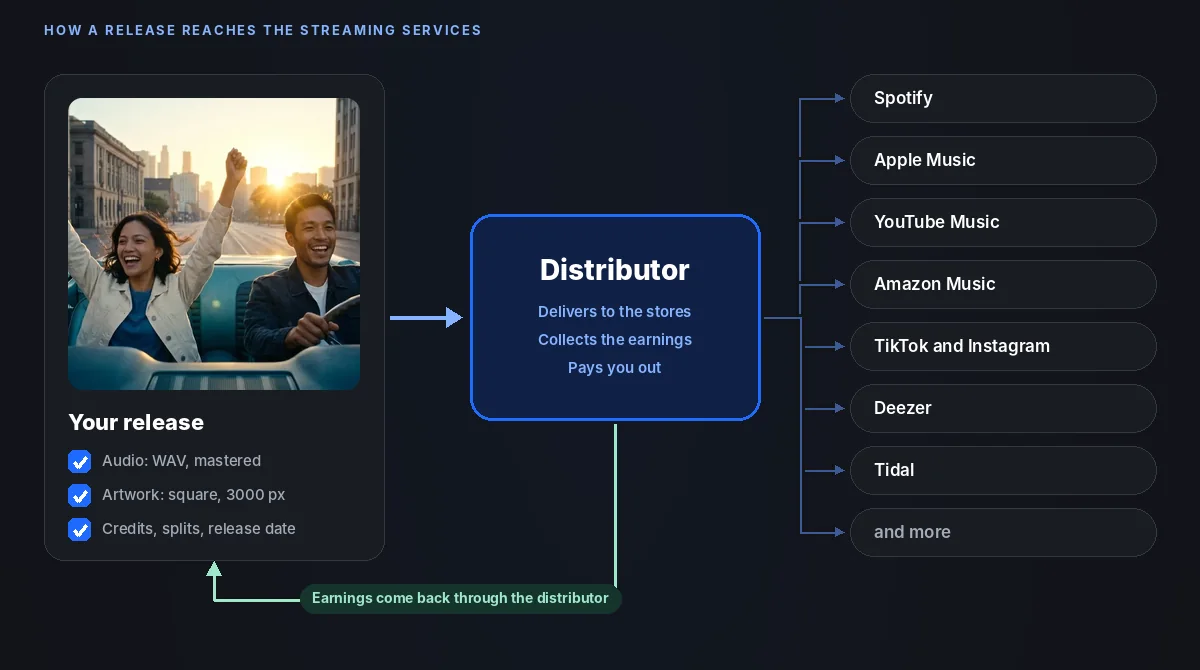
- Stores and streaming services: the distributor delivers each track with its ISRC, and plays and sales are reported against it.
- YouTube: art tracks, the automatic YouTube versions of your releases, are made one for each ISRC from what your distributor delivers, and a distributor that offers Content ID registers the same recordings for it (monetizing music on YouTube explains how that pays).
- SoundExchange (US): it collects digital performance royalties for recordings, and its page all about ISRCs says payments reach it attached to ISRCs, that the RIAA made it the authoritative source of US ISRC data in 2020, and that it runs an ISRC search.
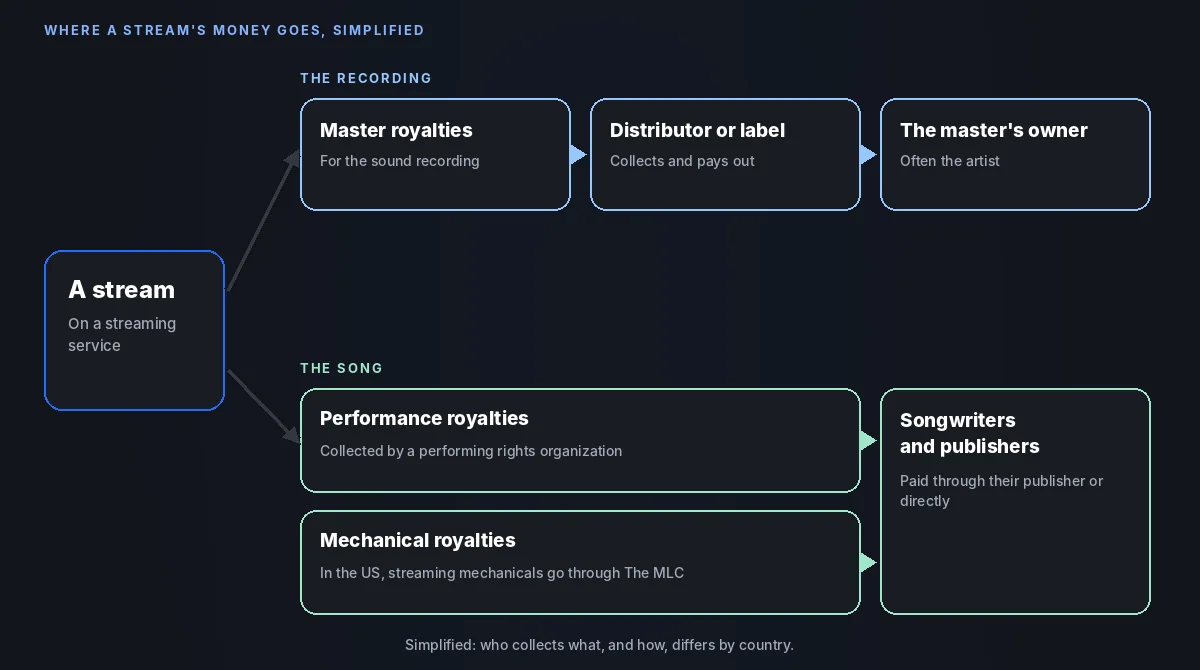
- Mechanical royalties (US): the MLC matches recordings, by their ISRCs, to the registered songs they use, by their ISWCs, so a song's writers can be paid for its streams.
- Your own records: the release's metadata document, the split sheet and the press kit's download list, so every collaborator works from the same codes.
The split sheet and the ISRC log belong together: one says who owns how much of the song, the other which recordings of it exist. What is a split sheet explains how writers agree their shares, and the split sheet generator makes a printable sheet you can keep beside the codes.
Split sheet generatorWrite down every writer's share of the song, adding up to exactly 100%, and print it for everyone to sign. File it with the release's ISRCs and UPC.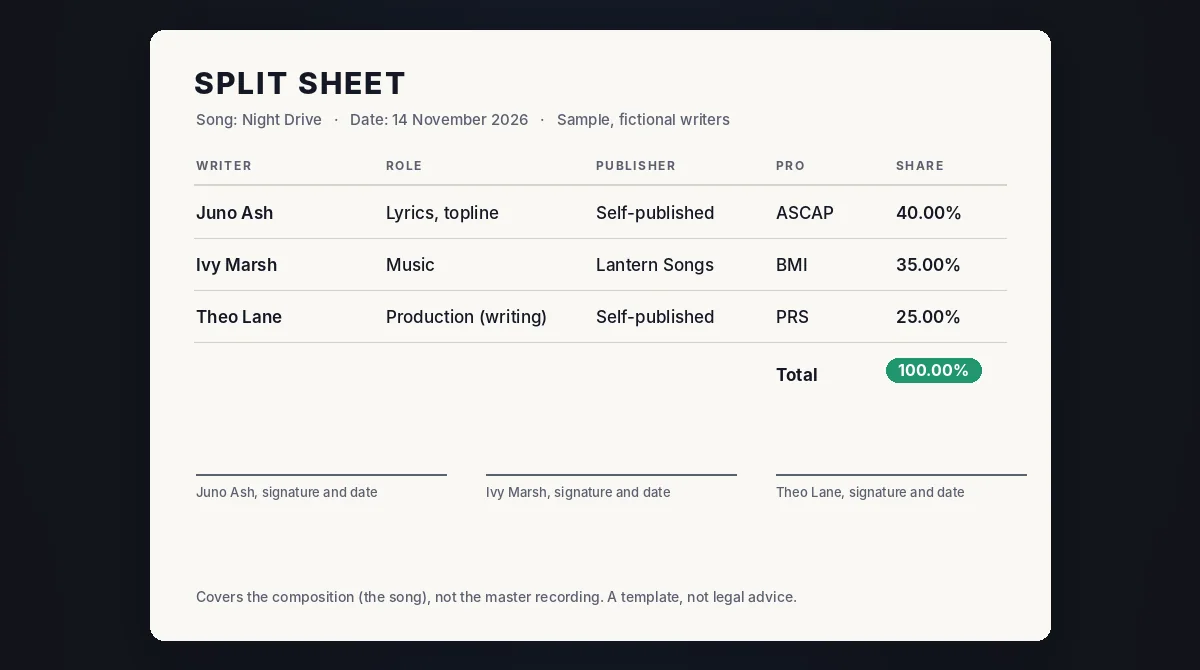
Common ISRC mistakes
- A new code for an old master: putting the single on the album under a fresh ISRC, which splits the recording's history between two codes.
- One code for two recordings: reusing the original's ISRC for the remix or the radio edit, so the two can't be told apart.
- The audio's code on the video: giving the music video the song's ISRC instead of its own.
- Two distributors, two codes: delivering the same recording twice with different ISRCs, which duplicates the listing.
- ISRC in the UPC field: the recording's code where the release's barcode belongs, or the other way round.
- Reading the year as the recording year: the two digits say when the code was assigned.
- Retyping instead of copying: an O for a zero, or a hyphen pasted into a field that wants 12 characters.
The ISRC step in a release checklist
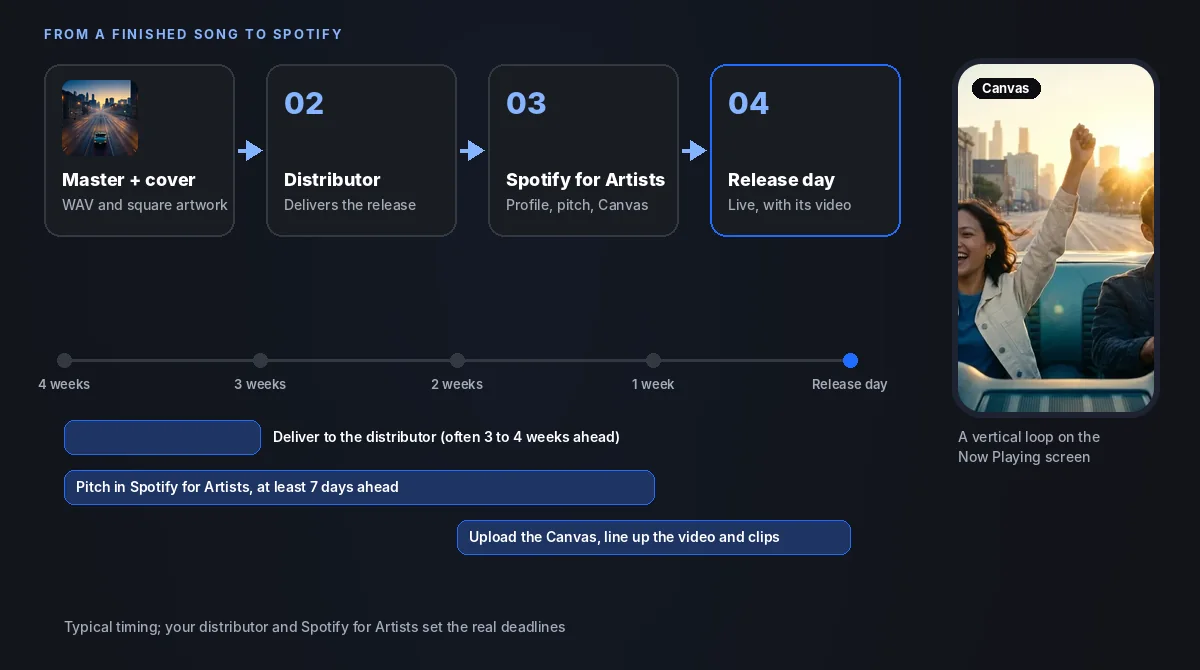
The codes take five minutes when they're done at upload and hours when they're fixed afterwards. Add these lines to the distribution part of your music release checklist, and see how to release music independently for the rest of the run from master to release day.
- Existing ISRCs found for every recording released before, and reused
- Every new recording and version listed: main, edit, remix, instrumental, video
- One ISRC per recording, from the distributor or your own registrant code
- Version names in the version field, not stuffed into the title
- The ISRC log saved with the split sheet, the UPC and the release date
- Codes checked in the distributor's dashboard after release
The press doesn't need any of these codes: a music press release lists the title, the date and the links. What writers do want is something to watch, which is where the release's music video comes in.
Codes sorted, now the video
Upload the master you delivered and Muvora plans a music video on its beats, with a storyboard you can edit for free before you render. Choose the Performance style to lip-sync yourself into it from one photo.
Written by the Muvora team. Last updated November 15, 2026. Spotted something out of date? Tell us at [email protected].