The short answer
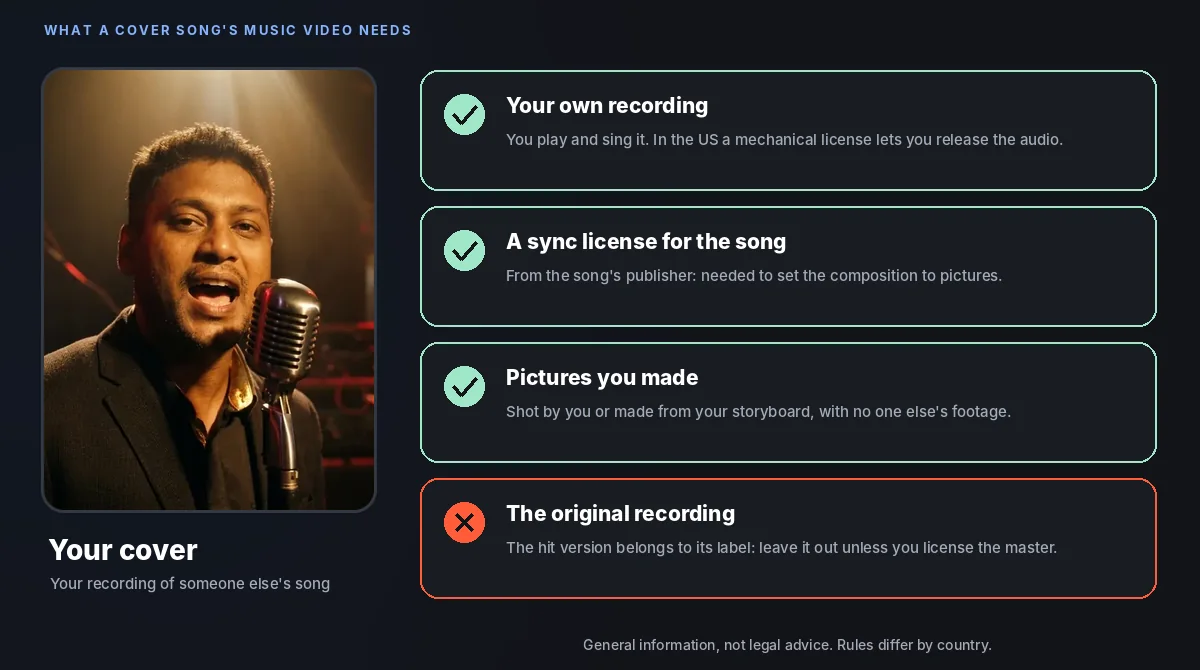
Yes, if you clear the song. In the US, the compulsory mechanical license that lets anyone release a cover is for audio only; a music video sets the song to pictures, which needs a sync license from the song's publisher, who may refuse or set a fee. Your own recording needs nothing more, but the original artist's recording needs the label's license too.
- The mechanical license that releases a cover's audio doesn't reach a video, by the law's own definitions.
- A cover's video needs a sync license from every publisher of the song, and none of them has to agree.
- Your own recording is yours; the original record or a bought backing track needs its owner's license too.
- A YouTube claim that shares ad earnings is the publisher's choice on YouTube, not a license for the video.
- In the US, songs published in 1930 or earlier are public domain in 2026, but later recordings may not be.
On this page (8 sections)ShowHide
- 1.Why a cover's video needs more than its audio
- 2.What your cover video needs, case by case
- 3.How to clear a cover for a music video
- 4.Releasing the cover's audio, and where that license stops
- 5.What YouTube does with cover videos
- 6.Public-domain songs: covers with no publisher to ask
- 7.Making a cover's music video with Muvora
- 8.A cover video checklist
- Questions
Why a cover's video needs more than its audio
A cover is your own performance of a song someone else wrote, and two quite different permissions can apply to it. Releasing your recording as audio is the easy one. In the US, section 115 of the Copyright Act gives anyone a compulsory license to make and distribute recordings of a song once it has been released with its owner's permission, provided the paperwork is filed and the royalty is paid. The publisher can't refuse it.
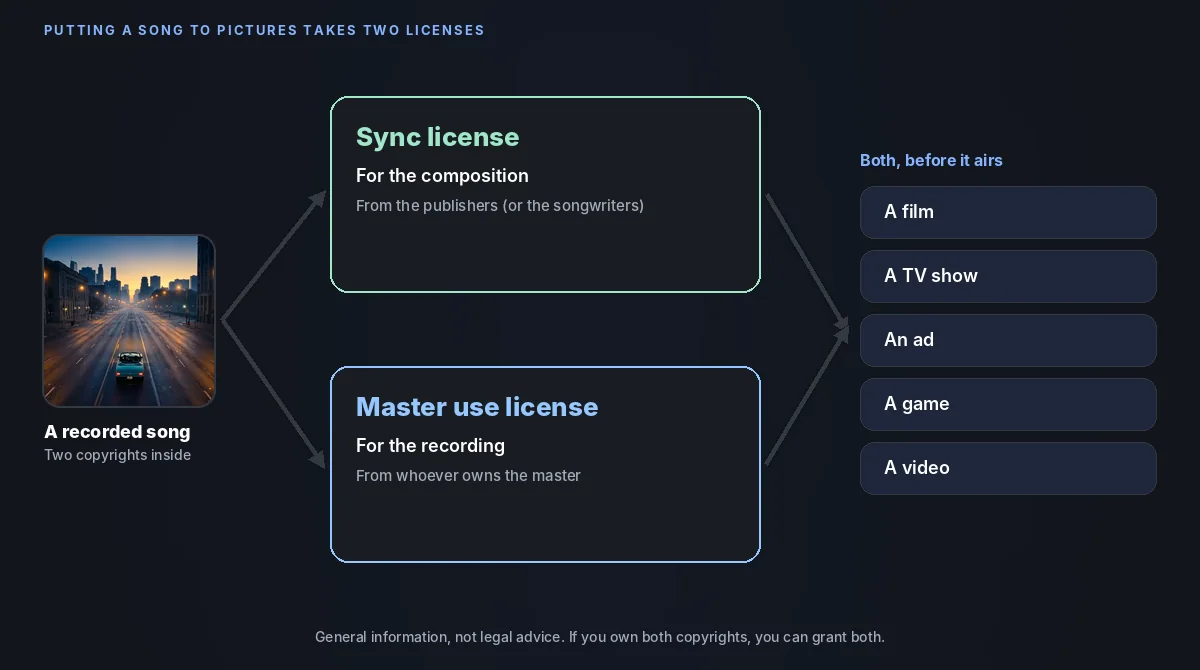
That license is written around phonorecords, and the Act's definitions in section 101 keep video out of the word: phonorecords are objects in which sounds are fixed "other than those accompanying a motion picture or other audiovisual work". A music video is an audiovisual work, so the compulsory license never reaches it. Setting a song to pictures is a synchronization use, which needs a sync license from whoever controls the composition, usually its publisher, who can say yes, ask a fee, add conditions or say no.
| Permission | What it lets you do | Who grants it | Can they refuse? |
|---|---|---|---|
| Mechanical license | Release your recording of the song as audio: streams, downloads, CDs | The publisher, or a licensing agency or distributor on its behalf | Not once the song has been released (the compulsory license) |
| Sync license | Set the song to pictures, in your music video or anyone's | Every publisher that controls a share of the song | Yes: no compulsory license covers video |
| Master use license | Use an existing recording: the original record, a karaoke or instrumental track | Whoever owns that recording, usually a label | Yes |
| Your own recording | Anything a recording's owner may do with it | You, and anyone you split the recording with | Not applicable: it's yours |
What your cover video needs, case by case
Most cover videos fall into one of six cases. The difference between them is which recording plays and how far you change the song.
| What you're making | What it needs | Watch for |
|---|---|---|
| A cover released only as audio | A mechanical license, often arranged by your distributor when you mark the song as a cover | The license covers the song as written, not a rewrite of it |
| A video of your own recording of the cover | Your recording, plus a sync license from each publisher of the song | Name every place the video will run: YouTube, Shorts, Reels, your site |
| A video over the original record or a bought backing track | A sync license, plus a master use license from the recording's owner | Buying a karaoke or instrumental track gets you a copy, not the right to publish it |
| A lyric video, or a cover with captions | The sync license, with the lyrics on screen named in the request | The words on screen are part of the composition |
| New lyrics or a reworked melody | The publisher's permission for the changed version, before any release | The compulsory license doesn't cover changing what the song is; a parody is outside it too |
| A song in the public domain | No license for the composition; your own recording is yours | A later arrangement you copy, or someone else's recording, can still be protected |
The compulsory license does let you make the song your own up to a point. Section 115 includes the privilege of arranging a song to fit the style of your performance, so a ballad played as a punk song or a club track stripped to one guitar is still a cover. What it doesn't allow is changing the basic melody or the fundamental character of the work, and your arrangement can't be protected as a work of your own without the owner's consent. New verses and swapped words need the publisher's approval before the audio comes out, let alone the video. A parody falls outside the compulsory license too; whether it's fair use is decided case by case, so treat it as needing permission until a lawyer says otherwise.
AI music tools add a newer case. Several can turn a song you upload into a new version: Suno's plan comparison lists remixing a song, including making a cover of it, among its features. If the song you upload is someone else's, the result is still their composition, so everything above applies, plus the tool's own terms; how to make a song with AI goes through those terms tool by tool.
Skip the blank page
Upload your song and Muvora's AI director plans a shot-by-shot storyboard on the beat. Edit every shot for free, and pay only if you render.
How to clear a cover for a music video
Clearing a cover takes letters, not luck, and it takes longest when a song has several writers. Start before you record the version you'll film, because the answer may decide which song you cover.
- 01
Find every publisher of the song
Look the song up in the performing rights organizations' repertories (ASCAP, BMI and SESAC in the US), the US Copyright Office's records and The MLC's public search. Write down each writer, each publisher and each one's share, since a song with three writers can have three publishers who all have to agree.
- 02
License the audio release
Mark the song as a cover when you upload it to your distributor, or license the mechanical yourself, so your recording can reach streaming services and stores. Keep the license with the release: it covers the audio and nothing else.
- 03
Record your own version
Record the song with your own playing or your own production rather than singing over the original record or a backing track you bought. Your recording is then yours, and the only owners left to ask are the song's publishers.
- 04
Write the sync request
Email each publisher's licensing contact with the song, your name, what the video shows, whether the lyrics appear on screen, where it will be posted, whether it will carry ads or promote anything, and how long it will stay up.
- 05
Get every share signed
Wait until each publisher has answered in writing and every share of the song is covered. A sync license should name the song, the video, the media, the territory and the term, and any fee or credit it asks for.
- 06
Make the video and credit the song
Upload your recording, confirm you have the rights and plan the video. In the description, say it's a cover and name the song's writers, so viewers and the publisher's systems can match it to its owners.
- 07
Keep the paperwork together
Save the mechanical license, the sync licenses and the session files of your recording in one folder, so a claim or a distributor's question can be answered in minutes.
The Harry Fox Agency, which licenses cover recordings in the US, sends people to the same places for publisher contacts: ASCAP, BMI, SESAC, the Copyright Office and The MLC (HFA). The MLC's public search shows the writers and publisher shares registered for streaming mechanicals. When a share has no owner listed or a publisher doesn't answer, you don't have the license yet: wait, keep asking, or choose another song. What moves a sync fee, and what a good request includes, is in what a sync license is.
YouTube description generatorWrite the cover's YouTube description with a credits block that names the original songwriters beside your own players, ready to paste.Licensed? Storyboard the cover free
Upload your own recording of the cover, tick the rights box, and Muvora plans every cut on its beats in a storyboard you can edit before you spend a credit.
Releasing the cover's audio, and where that license stops
For the audio, most independent artists let their distributor handle the mechanical license. DistroKid's cover song page, for one, says you choose "another artist wrote it" on the upload form, and that it then takes the legally set royalty from your earnings and sends it to the Harry Fox Agency for the songwriter. Distributors handle covers in different ways and some charge for it, so read yours before you upload (as of November 2026).
Whatever route you take, the license ends at audio. The Harry Fox Agency's cover licensing service, Songfile, says its licenses must be used on a physical product, a ringtone, a permanent download or an interactive stream, and that it can't license any other use (HFA). Its guidance on other uses adds that its mechanical license doesn't cover karaoke products, including the use of lyrics (HFA). A music video sits outside all of it.
- Streams. HFA's guidance says that when your music is streamed through a service such as Spotify, the service is responsible for the mechanical licenses for those streams (HFA).
- Downloads and CDs. These need the mechanical license for your cover, which your distributor or a licensing service arranges.
- Outside the US. Mechanical licensing works differently from country to country, often through a collecting society, so check how your distributor handles covers in the places you sell.
- The video. Always a separate request to the publisher, whatever was arranged for the audio.
What YouTube does with cover videos
Most cover videos go up on YouTube, which has an arrangement of its own for them. Its help page on monetizing eligible cover videos says creators in the YouTube Partner Program can share revenue from eligible cover videos once the publishers who own the composition claim them through Content ID, paid on a pro rata basis. An eligible video carries a "Sharing ad earnings" notice, and you then switch its monetization on in YouTube Studio.
All of that depends on what the publisher chooses. A Content ID claim follows the rights holder's settings, and YouTube's page on how Content ID works lists monetizing the video (sometimes sharing revenue with the uploader), tracking its views, or blocking it, with a choice that can differ by country. A cover whose publisher blocks it is blocked, however much work went into the video.
- A claim isn't a license. It's how YouTube lets the publisher act on an upload. It says nothing about the same video on Instagram, TikTok, your own site or in an ad.
- Your cover can't claim other uploads. Ditto Music's help page lists a cover version, a remix, a karaoke or a soundalike recording among the tracks it won't register for Content ID (Ditto), in line with YouTube's rule that a reference needs exclusive rights. Re-uploads of your cover video won't be claimed for you.
- Sharing needs the Partner Program. The revenue split on eligible covers is for creators in the program; outside it, a publisher's claim can run ads on your video for the publisher alone.
- Holding a sync license changes the conversation. Ask the publisher how it treats your channel in Content ID, so the video you cleared isn't claimed anyway.
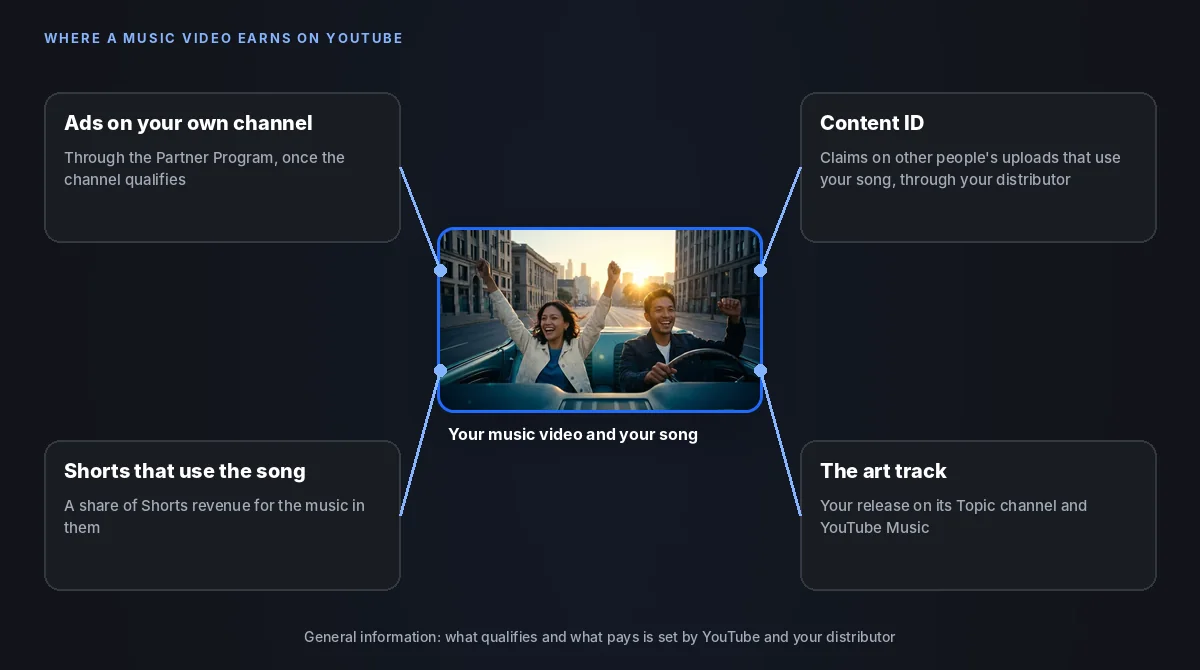
How the rest of a music video's YouTube money works, from the Partner Program's thresholds to art tracks, is in how to monetize music on YouTube.
Public-domain songs: covers with no publisher to ask
One kind of cover needs no sync license at all: a song whose copyright has run out. In the US, works published in 1930 entered the public domain on January 1, 2026, and Duke University's Public Domain Day 2026 list names songs such as "Georgia on My Mind" and "I Got Rhythm" among them. Songs published earlier are free as well, from nineteenth-century hymns and folk songs to the standards of the 1920s.
Only the composition is free, though. Recordings run on a separate clock: under the Music Modernization Act, the recordings entering the US public domain in 2026 are those from 1925, and Duke's page points out that later recordings of a 1930 song, Ray Charles's "Georgia on My Mind" for one, are still protected. A modern arrangement can be protected too, and printed sheet music may carry an editor's arrangement of its own. Record your own version from the original melody and lyrics, and check when the song itself was published, since the term counts from publication or registration rather than the first record. Other countries count differently, often from the songwriter's death.
Traditional carols are the best-known example, and Christmas music video ideas has concepts for a holiday video built on one.
A public-domain song? Give it a video
Record your own version of a song whose copyright has run out, upload it with the rights box ticked, and get a storyboard planned on its downbeats and sections for free.
Making a cover's music video with Muvora
Muvora's upload asks you to tick "I own this song or have the rights to use it in a video". For a cover, that sentence holds two things: your own recording, which you own, and a sync license from the song's publisher for a video. Muvora's terms put it the same way: you confirm you own the song, or have a license that lets you use it in a music video and do what you plan with the video, such as publish it.
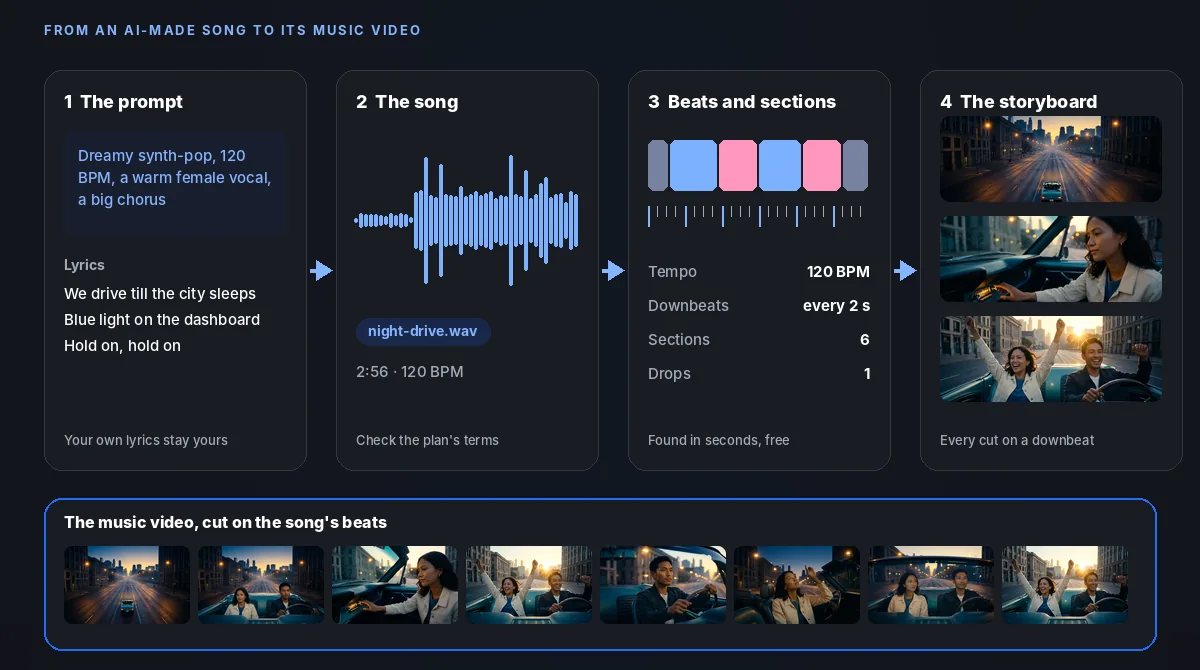
- Upload your own recording. Every Muvora video's soundtrack is the file you upload, untouched, so upload your version (MP3, WAV, M4A, AAC or FLAC, up to 8 minutes), never the original record.
- Sing it on screen. The Performance style draws you from one clear, front-facing photo and lip-syncs the shots where the song is sung to your vocal, with a consent box confirming the photo is of you or someone who agreed.
- The original artist never appears. Muvora's pictures never show real people other than a consented performer, and no logos or lettering are drawn into them, so the video can't pass for the original act's.
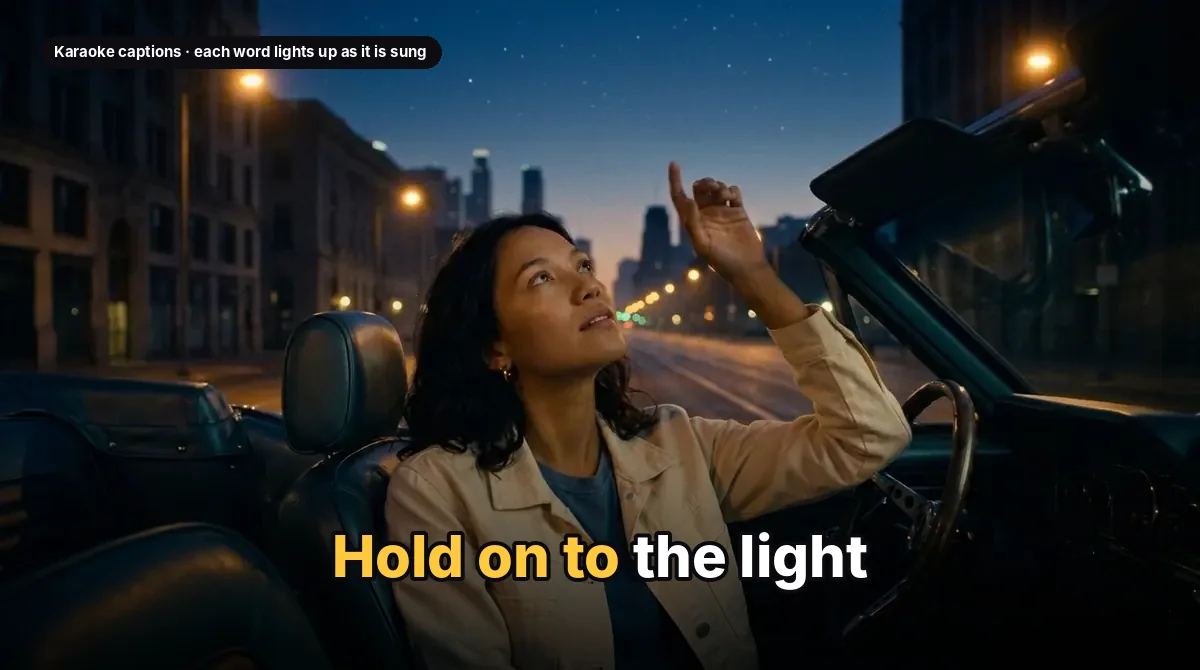
- Captions are the lyrics. Karaoke-style captions put the songwriter's words on screen, so name them in your sync request, or leave captions off.
- License every shape you'll post. One render gives a 16:9 video, 9:16 and 1:1 cuts and an 8-second Canvas loop, so list YouTube, Shorts, Reels and the rest in the request.
YouTube's rules point the same way. Its impersonation policy doesn't allow using AI to make it look as if a famous person is willingly taking part in a video, so a cover video that shows the original singer, drawn or generated, adds a policy problem to the copyright one. Make the video about your version: your face, your band, your setting.

Make the video for your licensed cover
Upload your recording, add a photo of yourself for the Performance style, and get a free storyboard and style frames with every cut on the beat. The free plan gives you 5 new storyboards a month; see photo to music video for how the sung shots are made.
A cover video checklist
Go through it before the video goes public, and again before you spend money promoting it.
- I know every writer and publisher of the song, and their shares
- The audio release has its mechanical license, through my distributor or directly
- The recording in the video is my own, not the original record or a bought backing track
- Every publisher has granted a sync license for this video, in writing
- The licenses cover every platform and shape I'll post, and the lyrics on screen
- Any change to the lyrics or melody has the publisher's written approval
- Nobody in the pictures looks like the original artist
- The description says it's a cover and names the song's writers
- The licenses and session files are saved together
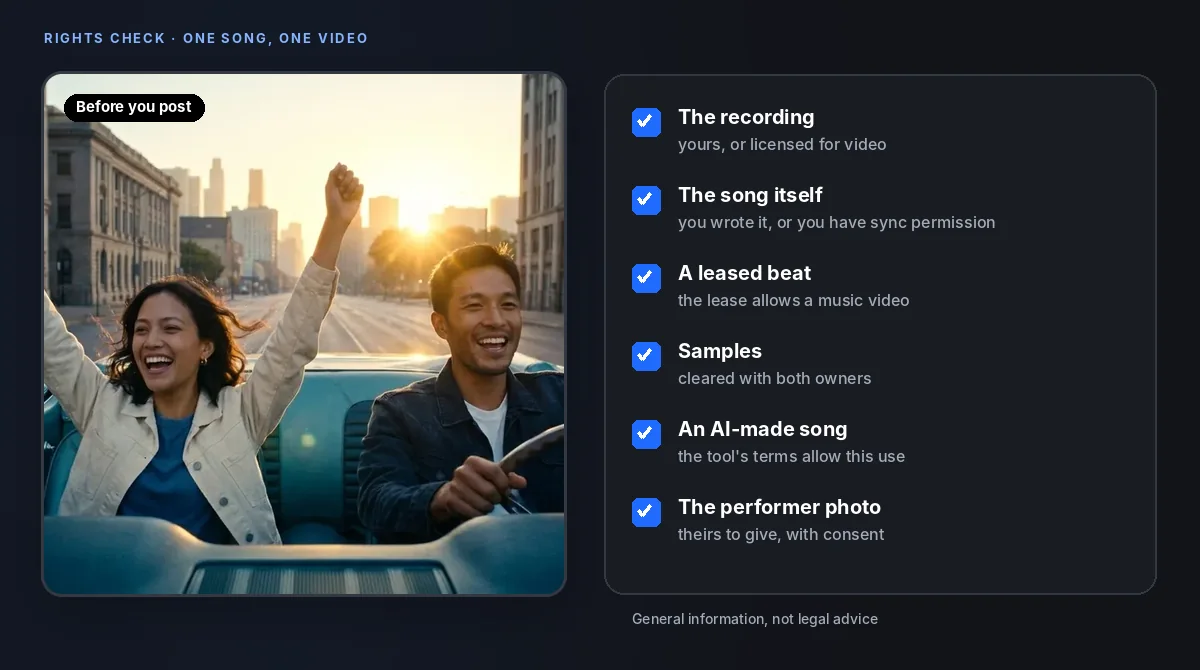
The same habits apply to everything else a video can carry, from samples to leased beats: music video copyright goes through each of them.
Written by the Muvora team. Last updated November 17, 2026. Spotted something out of date? Tell us at [email protected].