The short answer
To make a trap beat, set the tempo around 130 to 150 BPM and put the snare or clap on beat 3 of each bar, so it feels half as fast. Write a short minor-key melody, tune an 808 to its key and let it glide between notes, run 16th-note hi-hats with triplet and 32nd-note rolls, then arrange hooks and verses and balance the 808 against the kick.
- Trap runs at two speeds: hi-hats at the full tempo, the snare only once a bar.
- The 808 is the bass line, so tune it to the key and write it to the melody's roots.
- Hi-hat rolls are fills: save them for the ends of phrases and the run into a snare.
- Give the kick and the 808 a plan for every moment they meet, or the low end turns to mud.
- Count the arrangement the way the rapper will, and label the beat with both tempos.
On this page (10 sections)ShowHide
- 1.What makes a beat sound like trap
- 2.How to make a trap beat in eight steps
- 3.Tempo and the half-time feel
- 4.Write a dark melody in a minor key
- 5.Drums: the snare on 3 and hi-hats that roll
- 6.The 808: a bass line you tune
- 7.Make the kick and the 808 share the low end
- 8.Arrange the loop: intro, hooks and verses
- 9.Mix it and export it
- 10.Name it, sell it and give it a video
- Questions
What makes a beat sound like trap
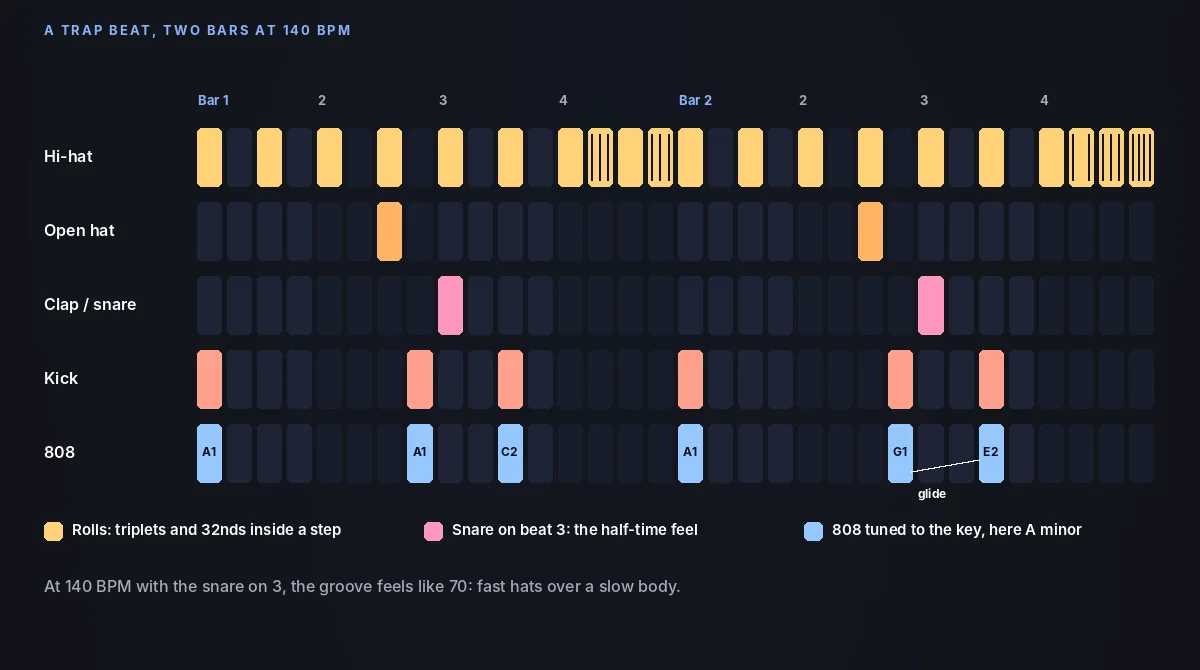
A trap beat moves at two speeds at once. On top, the hi-hats tick at the full tempo, usually in 8th or 16th notes, and break into quick rolls; underneath, the snare or clap lands once a bar, so the body of the groove feels half as fast. A long, tuned 808 fills the bottom and plays the bass line, and a loop of minor-key melody sits over all of it. Trap beats also tend to be sparse: a handful of loud, clear parts with gaps between them, because a rapper has to fit in there.
- A half-time backbeat: a snare, a clap or both on beat 3 of each bar at around 140 BPM, which the ear hears as beats 2 and 4 of a slower bar.
- Hi-hats with rolls: a steady pattern that bursts into triplets and 32nd notes at the ends of phrases, often with the pitch or the volume sweeping.
- The 808: a long bass tone with a hard start, tuned to the key, that holds notes, stops dead and slides from one pitch to the next.
- A dark melody: one or two bars in a minor key, played on bells, keys, plucks, strings, flutes, a choir or a guitar loop, repeated with small changes.
- Space and stops: gaps where the vocal goes, and moments where everything cuts out for a beat before the hook.
How to make a trap beat in eight steps
- 01
Set the tempo and the key
Start a project at about 140 BPM on a 16-step grid and choose a minor key that suits the voice the beat is for, such as A minor or F minor. Write both on the project's name now, so every bounce carries them.
- 02
Write a short, dark melody
Loop one or two bars of melody over a two- to four-chord minor progression on a bell, piano, pluck or string sound. Leave rests in it, since the vocal will need the gaps.
- 03
Put the snare on beat 3
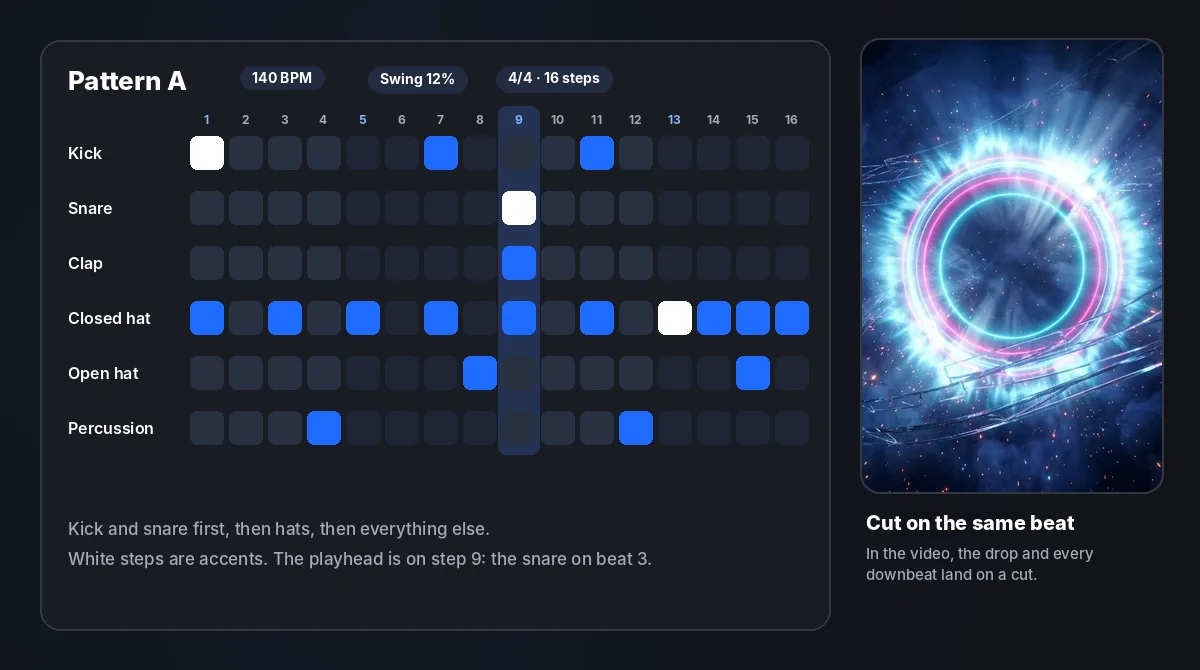
Place a snare, a clap or both on step 9 of every bar, the middle of the grid. That one hit per bar gives the beat its half-time weight.
- 04
Program the hi-hats
Run closed hats on every other step or every step, then add a roll of triplets or 32nd notes in the last beat of every second or fourth bar, leading into the next snare or downbeat.
- 05
Write the 808 to the melody
Tune the 808 to the key and play the root of each chord, in a rhythm that pushes against the snare rather than doubling it. Add a glide where one note should slide into the next.
- 06
Place the kick around the 808
Decide where a separate kick hits, if at all: on the 808's first note of a phrase, in the gaps the 808 leaves, or nowhere, letting the 808's own attack be the kick.
- 07
Arrange hooks and verses
Copy the loop out into an intro, hooks and verses, change something every 8 bars, and drop parts out before each hook so it lands harder.
- 08
Balance the low end and export
Set the 808 and the kick against each other first, check the beat in mono and on a phone speaker, then bounce a WAV labeled with the tempo, both counts and the key.
Skip the blank page
Upload your song and Muvora's AI director plans a shot-by-shot storyboard on the beat. Edit every shot for free, and pay only if you render.
Tempo and the half-time feel
Trap is often made somewhere between 130 and 150 BPM, with 140 a common place to start, and some styles push higher. What makes it feel slow is where the snare sits. At 140 BPM a bar lasts 1.71 seconds and holds one snare, on beat 3; a listener nodding along hears that snare as the backbeat of a 70 BPM groove, where one bar lasts 3.43 seconds and holds two. Both numbers describe the same beat, which is why tempo detectors and other producers may call it either.
| Grid tempo | Felt as | One grid bar | One felt bar | 16 felt bars |
|---|---|---|---|---|
| 130 BPM | 65 BPM | 1.85 s | 3.69 s | 59.1 s |
| 140 BPM | 70 BPM | 1.71 s | 3.43 s | 54.9 s |
| 150 BPM | 75 BPM | 1.60 s | 3.20 s | 51.2 s |
| 160 BPM | 80 BPM | 1.50 s | 3.00 s | 48.0 s |
The felt count matters most when you talk to the person rapping on the beat. Rappers often count bars by the groove, and then a verse they call 16 bars fills 32 bars of a 140 BPM grid. Label beats with both, for example "140 BPM (70 felt)", and arrange in pairs of grid bars so every section starts where the rapper expects it. To check a tempo by ear, tap along with tap tempo; what BPM is explains half and double time in more depth.
Write a dark melody in a minor key
Most trap melodies are short: one or two bars looped, with a small change the second or fourth time round. The minor key does a lot of the work. Natural minor sounds moody, harmonic minor's raised seventh adds tension and a V chord that pulls hard toward home, and the Phrygian mode's flat second, a half step above the root, gives the eerie, uneasy color often heard in darker beats. The examples below are in A minor, the key of the beat in the picture at the top of this guide.
| Color | Notes | Progression | What it does |
|---|---|---|---|
| Natural minor | A B C D E F G | Am–F–G–Am (i–VI–VII–i) | Moody and open; it loops without ever fully resolving |
| Harmonic minor | A B C D E F G♯ | Am–Dm–E–Am (i–iv–V–i) | The G♯ in the E chord pulls back to A, which makes the turnaround tense |
| Phrygian | A B♭ C D E F G | Am–B♭–Am–B♭ (i–♭II) | A half step rocking back and forth: uneasy, almost cinematic |
| Mixed | A B C D E F G and G♯ | Am–F–Dm–E (i–VI–iv–V) | A sad descent, then the raised seventh's pull at the end of the loop |
- Keep it in a narrow range: a melody that moves within five or six notes is easier to loop and leaves room above it for a voice.
- Repeat, then bend: play the same figure three times and change only the last note or two on the fourth, so the loop feels like a phrase.
- Rest on purpose: a melody that stops for half a bar lets the hi-hats and the 808 slide come through.
- Layer in the hook: double the melody an octave up or add a counter-line only in the hook, so the verses stay clear for the vocal.
Drums: the snare on 3 and hi-hats that roll
The snare or clap goes on beat 3 of every grid bar, step 9 of 16. Many producers stack a clap on the snare for width, and some add a quiet rimshot or a ghost snare a 16th before or after it. Then come the hi-hats, which carry most of the beat's motion. A steady line of 8th or 16th notes is the base; the rolls, two, three, four or more hits squeezed into the space of one step, are what people hear as trap. At 140 BPM those subdivisions are very fast, as the table shows.
| Note value | Gap at 140 BPM | Hits per beat | Often used for |
|---|---|---|---|
| 8th note | 214.3 ms | 2 | A sparse, laid-back verse pattern |
| 8th-note triplet | 142.9 ms | 3 | A rolling, skipping bar for contrast |
| 16th note | 107.1 ms | 4 | The steady default line |
| 16th-note triplet | 71.4 ms | 6 | Rolls that run into a snare |
| 32nd note | 53.6 ms | 8 | Short bursts at the end of a bar |
| 32nd-note triplet | 35.7 ms | 12 | A buzz or stutter, rarely longer than a beat |
- Roll into something: a roll is a fill, so aim it at the next snare or the next downbeat. Rolls on every beat stop sounding like rolls.
- Sweep the pitch: pitching each hit of a roll up or down a few semitones makes it rise or fall, which reads clearly even on small speakers.
- Ramp the volume: start a roll quiet and finish it loud, or the reverse, rather than playing every hit at full velocity.
- Use silence: dropping the hats out for half a bar is as strong a move as a roll, especially just before a hook.
- One open hat: an open hat on an offbeat, cut short by the next closed hat, gives the bar a lift without adding another sound.
- Keep the kit small: a kick, a snare or clap, closed and open hats, and one or two percussion sounds such as a rim, a shaker or a pitched tom are usually enough.
The same note values set the timing of effects. A delay on the melody at a dotted 8th (321.4 ms at 140 BPM) or an 8th (214.3 ms) repeats in time with the hats instead of smearing across them. The delay time calculator gives every note value in milliseconds at any tempo.
The 808: a bass line you tune
In trap, "the 808" means a long bass tone with a hard start, descended from the bass drum of Roland's TR-808 drum machine. It's a note, not just a thump, so it has to be in the key, and in most trap beats it is the bass line. Find the note your 808 sample plays (most samples are named with it, or a tuner will tell you), set that as its root in your sampler, then play it on the keyboard like any bass.
| Note | Fundamental | In the beat above |
|---|---|---|
| E1 | 41.2 Hz | Lower than the beat goes |
| G1 | 49.0 Hz | The note that starts the glide |
| A1 | 55.0 Hz | The root: the beat's home note |
| C2 | 65.4 Hz | The minor third above the root |
| E2 | 82.4 Hz | Where the glide lands, the fifth |
- Follow the chords: play each chord's root, and move to the next root a little before or after the chord changes for a pushed or lazy feel.
- Mono, one note at a time: set the sampler to play one voice, so a new note cuts the last one off instead of two low notes stacking and beating against each other.
- Glides: turn on glide (also called portamento) and overlap two notes, and the pitch slides from the first to the second over the glide time. Start around a 32nd or a 16th of the tempo, about 50 to 110 ms at 140 BPM, and adjust by ear. Sliding up an octave or from the fifth down to the root are common moves.
- Length: let an 808 ring through a gap and cut it short before a rest, so its long notes and its silences both become part of the rhythm.
- Saturation: distortion adds harmonics at whole multiples of the note (an A1 at 55 Hz gains 110, 165 and 220 Hz), and those are what a phone speaker can actually play, since it gives back very little at 55 Hz.
Finished a trap beat? Give it a video that cuts on it
Upload the bounce and Muvora finds its tempo, every downbeat, the sections and the drop, then writes a storyboard whose cuts land on the downbeats, with a white flash on the drop. Reading and editing it is free, with 5 new storyboards a month on the free plan.
Make the kick and the 808 share the low end
The 808 and the kick both live in the lowest octave or two, and where they hit at the same moment they add up, fight or cancel each other out. There's no single right answer, but every beat needs a decision for each place they meet. These are the common ones, often mixed within one beat.
- The 808 is the kick: no separate kick at all; the 808's hard start is the hit. Simple, and nothing can clash.
- Take turns: the kick plays where the 808 rests and the 808 plays where the kick doesn't, so they never overlap.
- Layer and tune: the kick on the 808's first note of each phrase, with the kick tuned to the same note so they reinforce each other.
- Duck the 808: sidechain compression turns the 808 down for a moment each time the kick hits, so the kick's punch comes through.
- Check the phase: if the low end gets thinner when both play, nudge one sample a few milliseconds or flip one's polarity, then listen again.
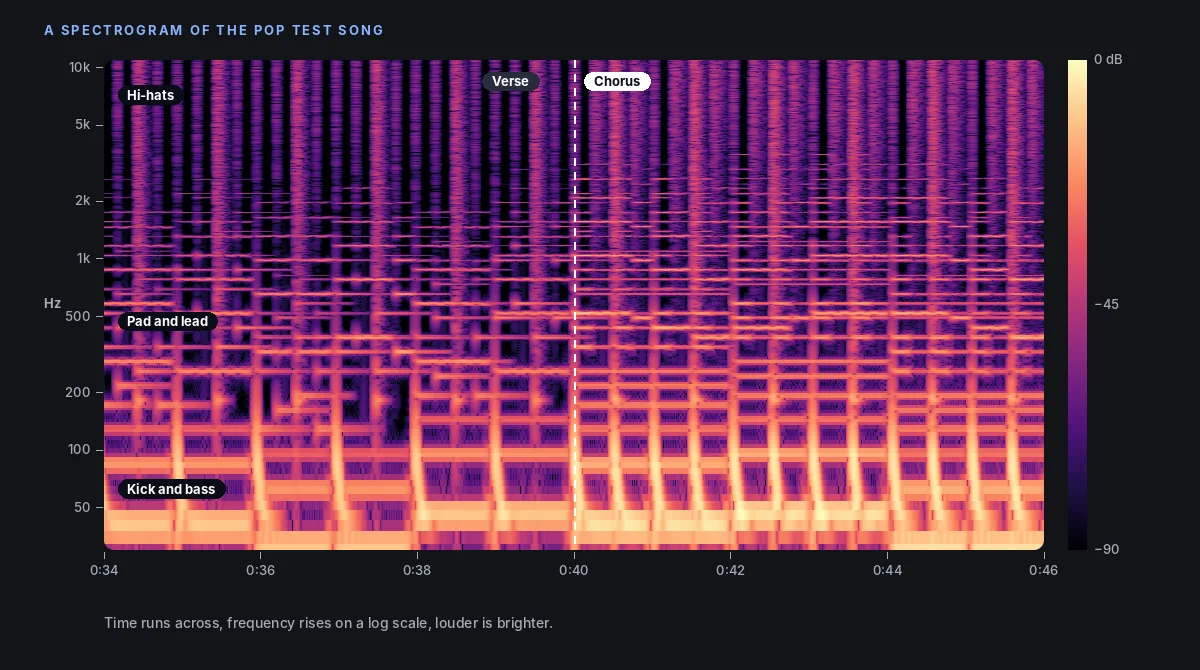
Keep both in the center and check the beat in mono: many club systems and phone and party speakers play bass in mono, and a wide 808 can lose its weight there. Cut the low frequencies out of the melody, the pads and the hats, so the bottom belongs to the 808 and the kick. The EQ frequency chart shows where each part usually sits, the spectrogram viewer shows where yours actually sit, and how to mix a song covers the rest of the mix.
Arrange the loop: intro, hooks and verses
A loop becomes a beat when it changes. The layout below is counted in felt bars at 140 BPM, the way a rapper counts, with the grid bars in brackets. It's a common starting point, not a rule: beats sent to rappers are often shorter, and a producer can loop a section on request.
| Section | Felt bars (grid bars) | Length | What plays |
|---|---|---|---|
| Intro | 4 (8) | 13.7 s | The melody alone, filtered, perhaps with a short producer tag on previews |
| Hook | 8 (16) | 27.4 s | Everything: melody doubled, full hats, 808 and kick |
| Verse 1 | 16 (32) | 54.9 s | Drums and 808; the melody thinned or an octave down |
| Hook | 8 (16) | 27.4 s | As before, after a one-beat stop |
| Verse 2 | 16 (32) | 54.9 s | One switch-up: a new hat pattern, the 808 out for 4 bars, or a new counter-melody |
| Hook | 8 (16) | 27.4 s | The fullest version |
| Outro | 4 (8) | 13.7 s | Parts drop out until the melody is alone again |
- Stop before the hook: cut everything, or everything but the melody, for the last beat or the last bar before a hook, and bring the 808 back on the downbeat.
- Switch the hats every 8 bars: a new roll position, a triplet bar, or the hats dropping to 8th notes gives a verse movement without crowding the vocal.
- Filter the intro: a low-pass filter on the melody that opens as the hook arrives makes the first hook sound bigger.
- A beat switch: a whole new section, with new drums or a new key, partway through a beat is a trap habit. It works best at a section boundary.
Bar height: how loud the section is. The strip under them: the shots, each cell one cut. Louder sections get more, shorter shots.
Mix it and export it
Start the mix with the 808 and the kick alone, at a moderate level, and get their balance right before anything else comes in. Then add the snare and clap, then the hats (usually lower than you'd guess: in a busy roll, loud hats tire the ear fast), then the melody. Put reverb and delay on the melody and the percussion rather than the 808. Check on headphones, on a phone speaker and in mono, and leave the master's loudest peaks below 0 dBFS so nothing clips; read LUFS for streaming before chasing loudness.
- The WAV: bounce the whole beat from bar 1 at the project's sample rate. A 16-bit, 44.1 kHz stereo WAV takes about 10 MB a minute; a 24-bit file half as much again.
- Stems: if a rapper's engineer will mix the song, export each part as its own WAV, all from bar 1, so they line up anywhere. What stems are covers how.
- The name: title, tempo with both counts, and key, for example "night-lot_140bpm-70felt_A-minor.wav".
- The sounds: keep a note of where every sample and loop came from and what its license allows, since a buyer's song depends on it.
Name it, sell it and give it a video
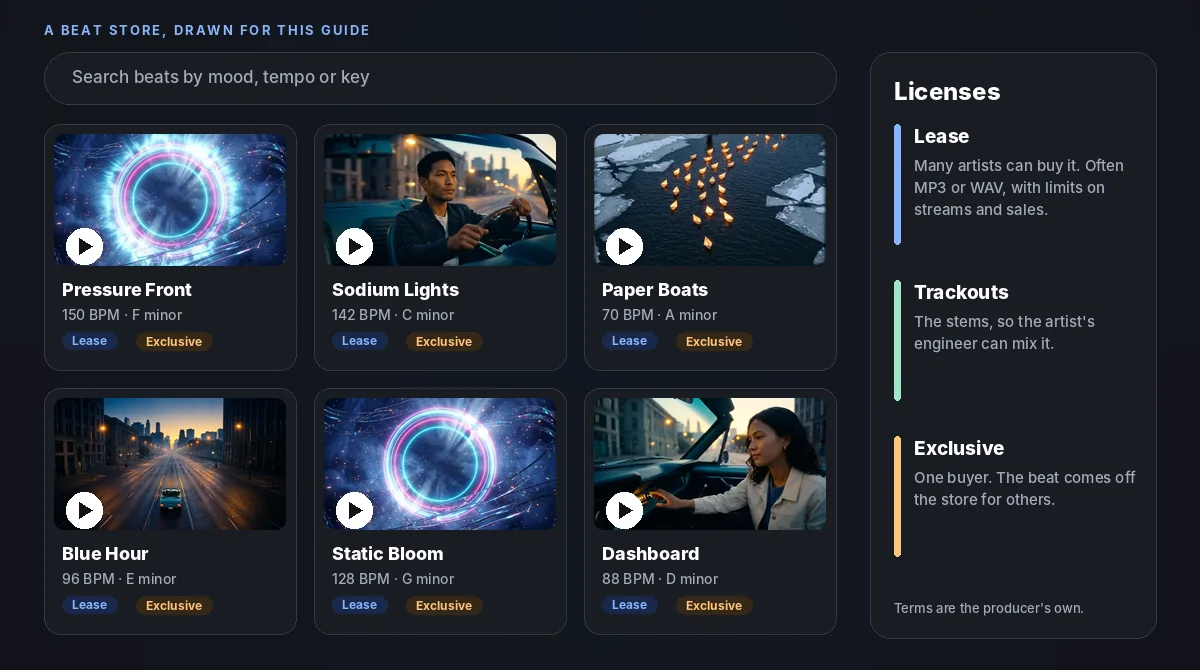
Beats are commonly posted as type beats: the title names the artist whose sound the beat suits, so people searching for that sound find it. The title is the only place that name belongs. The video, the thumbnail and the description should never use the artist's photo, likeness or logo, or suggest they made or endorse the beat. How to sell beats online covers leases, exclusives, tags and Content ID, and the type beat video maker shows how producers use Muvora for these videos.
Muvora makes the video from the audio file. Upload the WAV, MP3, M4A, AAC or FLAC, up to 8 minutes and 60 MB, and confirm you have the rights to the beat, samples included. The analysis finds the tempo (it may count your beat at 140 or at 70; on a typical arrangement the cuts come out much the same), every downbeat, the sections and the drops. Pick the hip-hop look, which trims every shot by about a fifth, and the Abstract style for light and motion or Story for a night scene you describe. Every cut lands on a downbeat and the drop gets a two-frame white flash. An instrumental gets no lip sync and no captions, and the pictures never show real people.
The soundtrack is your upload, untouched: Muvora never mixes or masters it, so upload the final bounce. If a rapper has recorded on the beat, the song can have a video of its own with the Performance style, which lip-syncs the rapper from one photo, as the trap music video maker page explains. Producers releasing instrumentals can read music videos for producers, and how to make lo-fi beats covers the slower, softer side of beatmaking.
Make a video for your trap beat
Upload the beat for a free storyboard: cuts on the downbeats, a flash on the drop, and a night, a color or a motion you describe. You see the exact price before anything renders, from 38 credits a second in Visualizer, and a widescreen render also gives you a vertical cut for Shorts and Reels.
Written by the Muvora team. Last updated November 18, 2026. Spotted something out of date? Tell us at [email protected].