The short answer
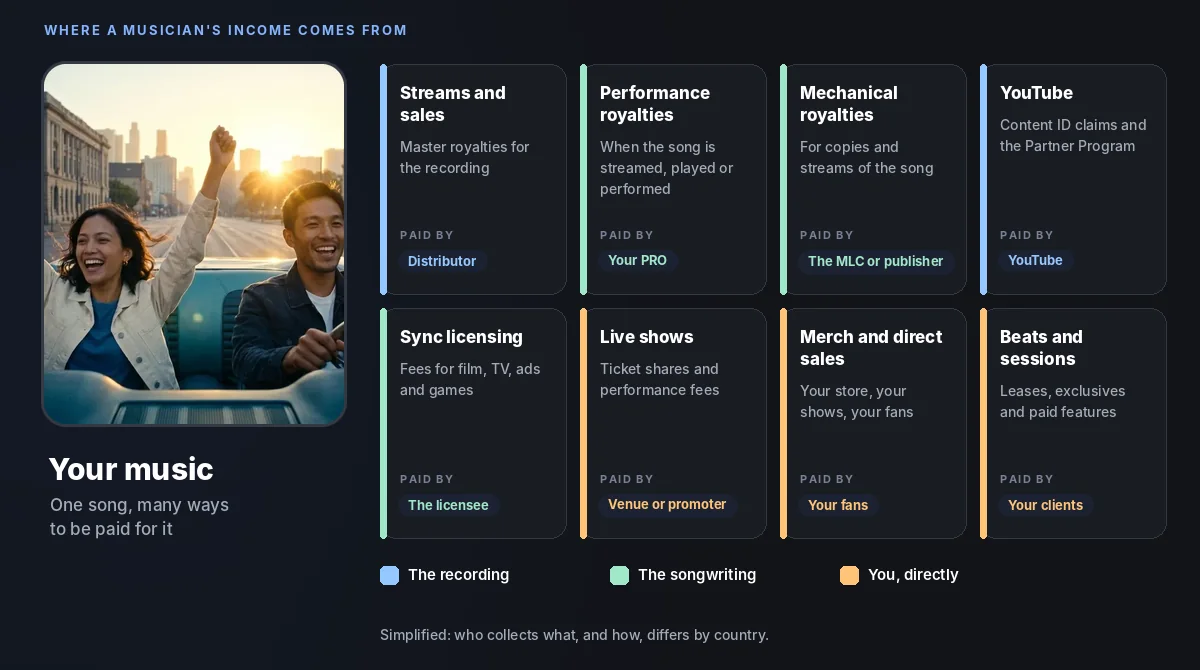
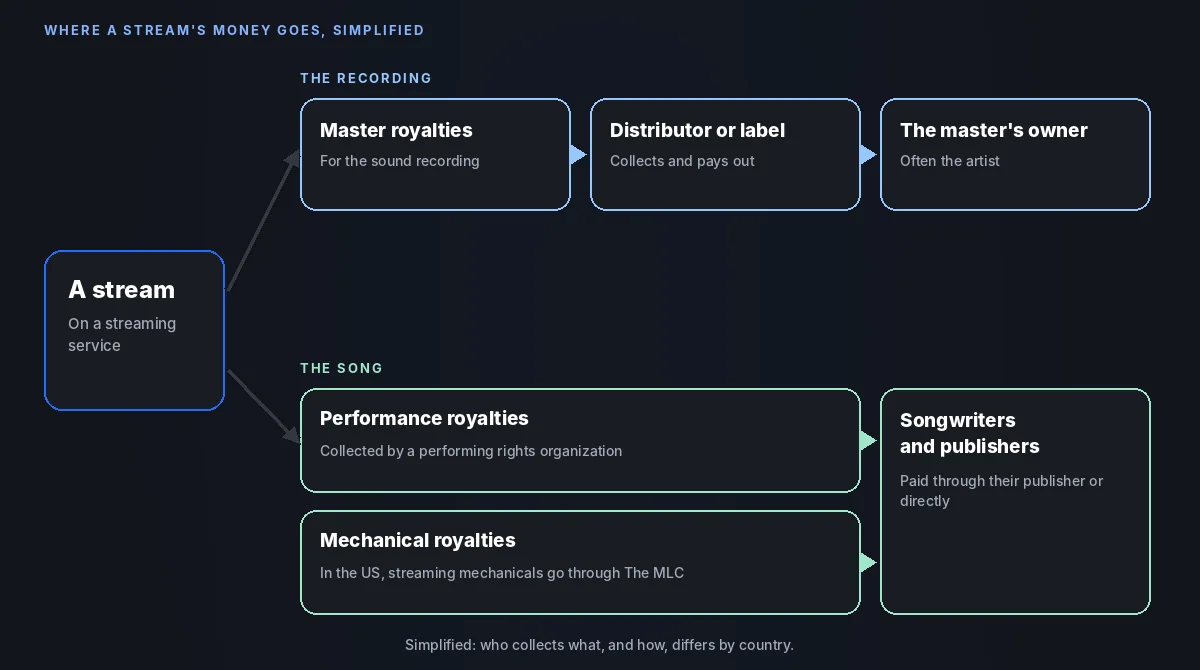
A song earns through two copyrights. The recording earns master royalties, paid by streaming services through your distributor or label, plus US digital radio royalties through SoundExchange. The composition earns performance royalties through a performing rights organization such as ASCAP, BMI or PRS, and mechanical royalties, which The MLC collects for US streams. Sync fees come from licensing the song to film, TV or ads.
- Every recorded song has two copyrights, the composition and the recording, and each earns its own royalties.
- Your distributor collects for the recording; nobody collects for the songwriting until you register it.
- In the US, a self-published writer needs a performing rights organization and The MLC.
- SoundExchange pays US digital radio royalties to featured artists, but only once they register.
- Streaming services share out revenue by share of streams; there's no fixed rate per play.
On this page (9 sections)ShowHide
- 1.Two copyrights, two sets of royalties
- 2.Every royalty at a glance
- 3.How to collect everything a song earns
- 4.Master royalties: what streaming services pay for the recording
- 5.Performance royalties: the songwriting side of every play
- 6.Mechanical royalties and The MLC
- 7.SoundExchange and neighboring rights: the recording's broadcast money
- 8.Sync fees and publishing administration
- 9.Where royalties go missing
- Questions
Two copyrights, two sets of royalties
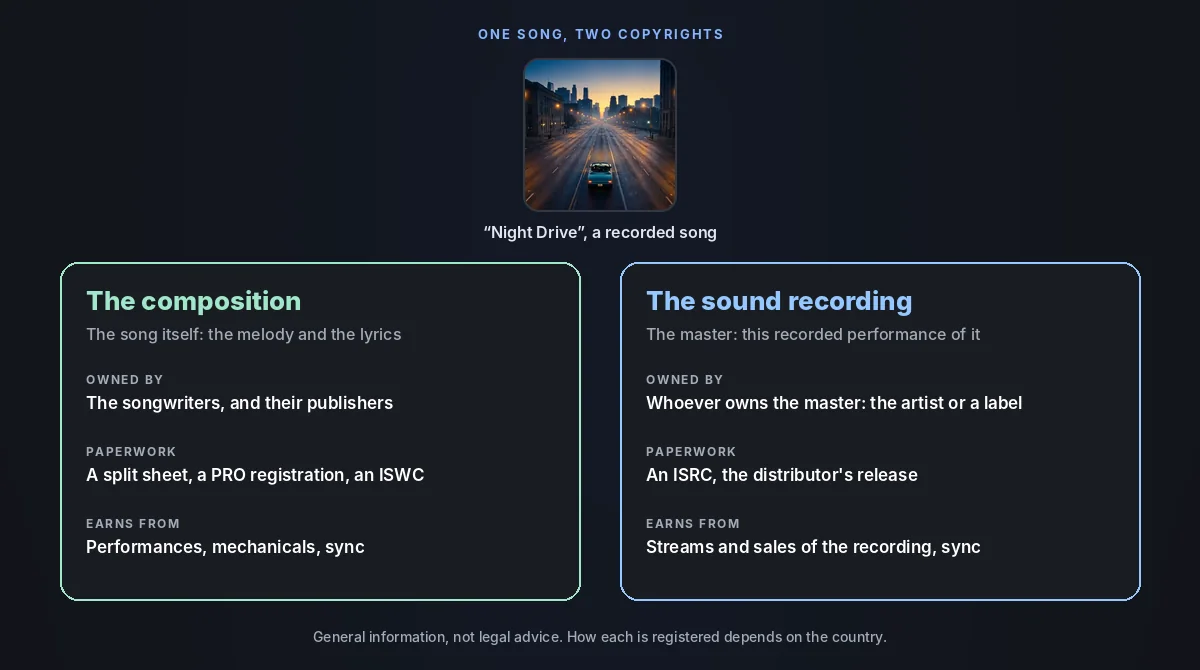
Royalties start with copyright, and a recorded song carries two. The US Copyright Office's circular on musical compositions and sound recordings puts it plainly: they "are considered two separate works for copyright purposes." The composition is the music and words as written, by the songwriters. The sound recording, usually called the master, is one fixed performance of it, by the singers, players, producers and engineers who made it.
| The composition | The recording (master) | |
|---|---|---|
| What it is | The melody, harmony and lyrics as written | One recorded performance of the song |
| Who usually owns it | The songwriters, often through a publisher | The artist, or the label that paid for the recording |
| Royalties it earns | Performance and mechanical royalties, sync fees | Master royalties, digital performance royalties and neighboring rights, master use fees |
| Who collects | Collecting societies, publishers and publishing administrators | Distributors, labels, SoundExchange and similar societies abroad |
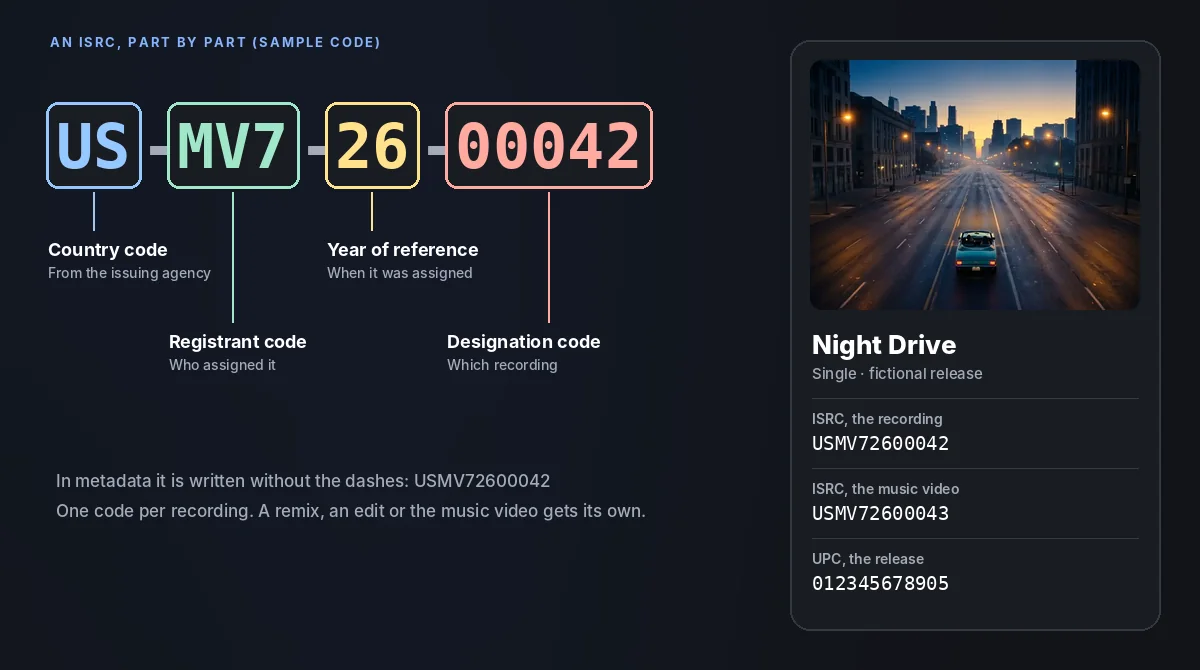
| Its identifying code | An ISWC | An ISRC |
If you wrote and recorded a song yourself and released it independently, you hold both copyrights and are owed money on both sides. Each side has its own paperwork, though, and the distributor that sends your release to streaming services collects only for the recording. How to copyright a song covers registering each work, and what is an ISRC code explains the code that follows a recording everywhere it's played.
Every royalty at a glance
Here is each kind of royalty a song can earn, what triggers it and who collects it. The bodies named are US ones unless a row says otherwise. Most countries have their own equivalents, and money earned abroad reaches you through agreements between them.
| Royalty | Copyright | Earned when | Collected by | Paid to |
|---|---|---|---|---|
| Master royalties | Recording | The recording is streamed, downloaded or sold | Your distributor or label | The master's owner, then the artist under their deal |
| Performance royalties | Composition | The song is streamed, broadcast or played in public, live or recorded | A performing rights organization: ASCAP, BMI, SESAC or GMR in the US, PRS for Music in the UK, SOCAN in Canada | Writers directly, and their publishers |
| Mechanical royalties | Composition | The song is reproduced: streamed on demand, downloaded, pressed on vinyl or CD | The MLC for US streams and downloads; MCPS in the UK; SOCAN in Canada | Publishers, administrators and self-administered writers |
| Digital performance royalties (US) | Recording | Non-interactive services play it: internet, satellite and cable radio | SoundExchange | The master's owner, featured artists and session players |
| Neighboring rights (outside the US) | Recording | The recording is broadcast or played in public | PPL in the UK, Re:Sound in Canada and similar societies | Performers and the master's owner |
| Sync and master use fees | Both | The song is licensed for a film, show, ad, game or someone else's video | Negotiated deal by deal, often by a publisher or label | Each side, for its own license |
How the money is divided after collection comes from your agreements: a label deal, a distributor's terms, a publishing contract and the split sheet you and your co-writers signed. Streaming services and societies pay rights holders; rights holders pay artists and writers according to those agreements.
Skip the blank page
Upload your song and Muvora's AI director plans a shot-by-shot storyboard on the beat. Edit every shot for free, and pay only if you render.
How to collect everything a song earns
- 01
Agree the splits in writing
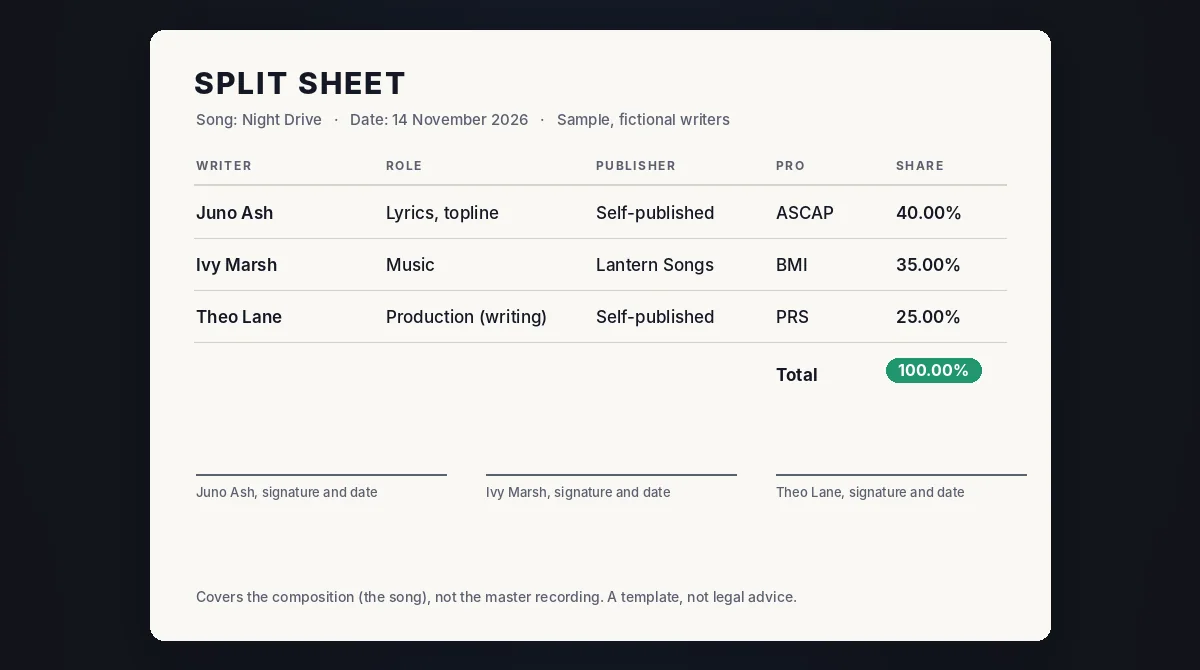
Before release, write down each writer's share of the composition and each owner's share of the master on a split sheet everyone signs, so every registration after it uses the same numbers.
- 02
Deliver the release with full credits
Release through a distributor or label with every songwriter, producer and featured artist credited, reuse the ISRC of any recording that came out before, and give writers' legal names where the form asks.
- 03
Join a performing rights organization
Join the society for songwriters where you live, such as ASCAP or BMI in the US, PRS for Music in the UK or SOCAN in Canada, and register every song with its writers and shares.
- 04
Give the publisher's share a home
Set up a publishing entity of your own with your society, sign with a publishing administrator, or sign with a publisher, so the publisher's share of your songs has someone to collect it.
- 05
Register your songs with The MLC
In the US, if you administer your own songs, become a member of The MLC and register each one for streaming and download mechanicals; if a publisher or administrator handles them, check that it has.
- 06
Register with SoundExchange
In the US, register as the featured artist, and as the rights owner too if you own your masters, so plays on internet and satellite radio reach you.
- 07
Claim your neighboring rights
Outside the US, join the society that pays performers and master owners for broadcasts and public play, such as PPL in the UK or Re:Sound in Canada.
- 08
Keep your metadata identical everywhere
Use the same titles, artist name, writer names and codes with every organization, and compare statements with your streaming stats a few times a year.
Master royalties: what streaming services pay for the recording
Most independent artists see master royalties first, because their distributor pays them. A streaming service pays the recording's share to whoever delivered it, and that company passes it on under its own terms. Spotify's page on understanding royalties describes recording royalties as "paid to artists through the licensor that delivered the music, typically their record label or distributor."
No major service promises a fixed price per play. Spotify says it divides net revenue from subscriptions and ads among rights holders by "streamshare", each one's share of the month's streams, and that it "does not pay artist royalties according to a per-play or per-stream rate." Its track monetization page adds two details: the royalty pool is "roughly two-thirds of every dollar Spotify earns from music", and since April 2024 a track needs at least 1,000 streams in the previous 12 months, plus a minimum number of unique listeners Spotify doesn't publish, before it earns recording royalties at all.
So the per-stream figures people quote are averages: listeners' countries, free and paid plans and the month all blended into one number, which is why two artists with the same stream counts can be paid different amounts. Your own statements are the truest guide. Divide what a service paid by the streams it reported, and use that rate when you plan.
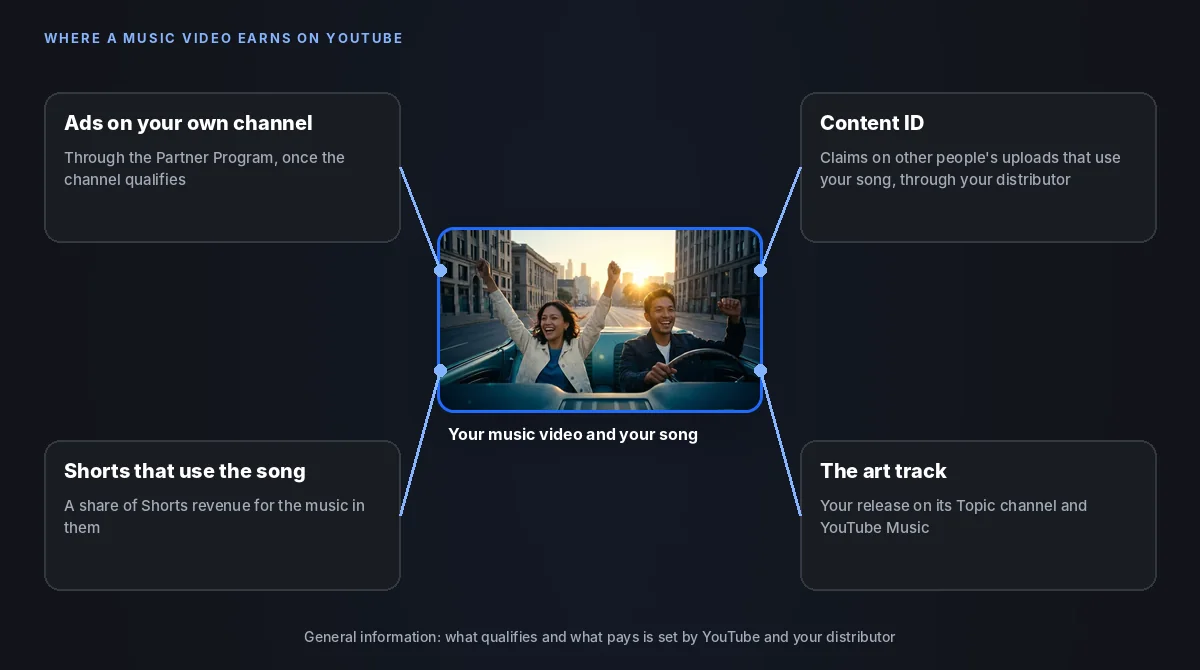
Streaming royalty calculatorTurn streams on six services into an estimate after your distributor's cut and the master's split, or see how many streams a target amount needs.Video earns on the same two sides. On YouTube the recording earns through systems your distributor or channel sets up, and how to monetize music on YouTube walks through them. Spotify's video upload page says videos longer than 30 seconds can earn royalties like audio, for artists who have access to upload them.
Royalties follow listening
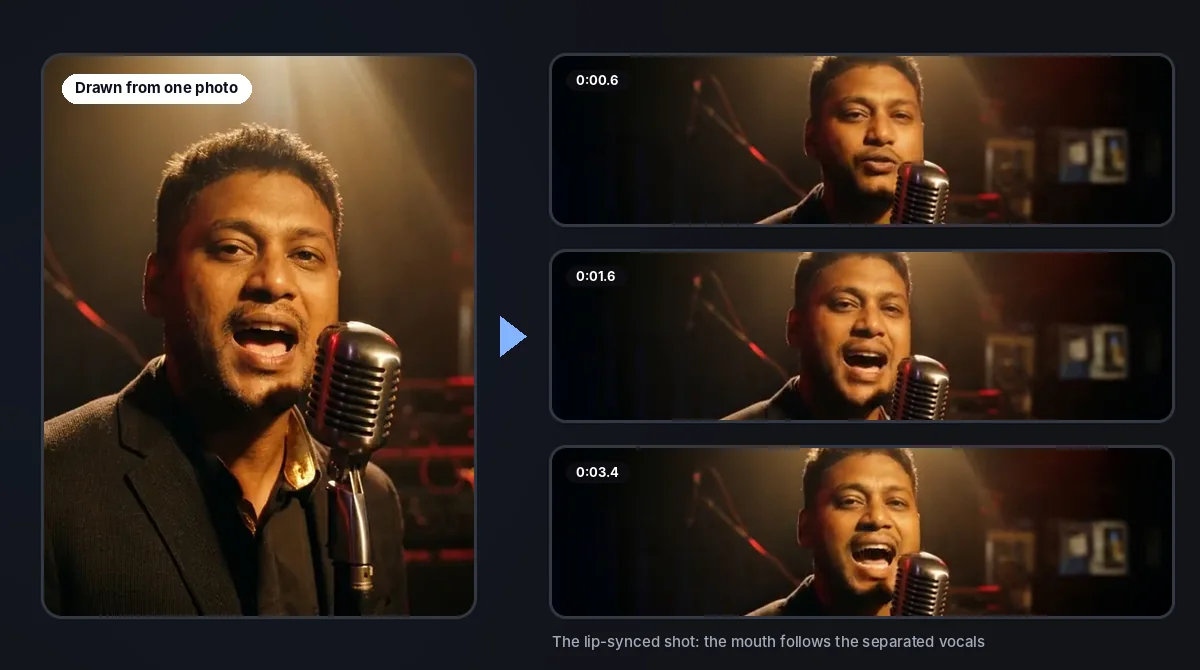
Streams start with people finding the song, and a video gives them something to find. Upload your master and Muvora writes a free storyboard on its beats, then renders the music video, a vertical cut for Reels and Shorts and a Canvas loop from one render. The soundtrack is your file, untouched.
Performance royalties: the songwriting side of every play
A performance royalty is owed to a composition's owners whenever it's performed in public, which covers far more than concerts: radio and TV, streaming, music in shops, bars and gyms, and live shows. Broadcasters and venues pay for blanket licenses, and performing rights organizations (PROs) collect that money and pay it to the writers and publishers whose songs were used. Spotify's page on collecting societies names ASCAP, BMI, SESAC and GMR as examples in the US. A Congressional Research Service overview of music licensing notes that SESAC and GMR are for-profit companies whose "membership is by invitation only", so for a songwriter starting out in the US the choice is usually between ASCAP and BMI.
Elsewhere one society usually covers a country. PRS for Music says it tracks how and where music is used, collects royalties and pays the songwriters, composers and publishers who earned them, in the UK and abroad. SOCAN issues licenses in Canada for the public performance and reproduction of music. Spotify's societies page adds that in most countries outside the US, a single collective organization handles mechanical royalties as well as performance ones.
What a society collects for a song is usually split into a writer's share and a publisher's share. Songtrust's explainer on the two shares describes them as typically equal halves of performance royalties, with the writer's share paid straight to the writer whether or not they have a publisher, and notes that many societies outside the US divide them differently. Without a publisher, the publisher's share needs somewhere to go: register a publishing entity of your own with your society, or use an administrator, and read your society's rules for songs that have no publisher.
Mechanical royalties and The MLC
A mechanical royalty is paid for reproducing a composition: pressing it on vinyl or CD, selling it as a download, or streaming it on demand. Spotify's societies page defines it as "the royalty paid to the owner of a musical composition in exchange for the mechanical license", and notes that how a stream's songwriting money divides between performance and mechanical royalties varies from country to country.
In the US, mechanicals from streaming and downloads have been collected since January 1, 2021 by the Mechanical Licensing Collective, a nonprofit set up under the Music Modernization Act. The MLC says it administers blanket mechanical licenses for eligible streaming and download services, collects their usage data and royalties every month, matches the plays to songs its members have registered, and pays members monthly. The Copyright Office's guide for songwriters settles two points people often mix up: The MLC is not a PRO, and registering with it doesn't affect what you receive from ASCAP or BMI.
So a self-published US songwriter needs both: a PRO for performance royalties and The MLC for streaming mechanicals. The MLC's site says connecting with it is free. It also says its market share distributions of the remaining unclaimed royalties it holds will begin in April 2027, and the Copyright Office's guide explains what that means: unclaimed money can be paid to the owners of matched songs according to each song's market share. Register your songs, and check every co-writer is on them, so what they earned is matched to you.
Outside the US the same societies often handle both, or work side by side. PRS for Music's page about what it does describes MCPS as representing and protecting mechanical rights for its members in the UK. In Canada, SOCAN administers reproduction rights, its name for the mechanical right, on streaming, downloads, physical copies and social media, alongside performing rights.
SoundExchange and neighboring rights: the recording's broadcast money
The recording has a performance right too, but how far it reaches depends on the country. In the US, a Congressional Research Service report on radio explains, it covers only digital audio transmissions. Over-the-air AM and FM stations pay songwriters through the PROs, but they don't need to pay the performers or the owners of the recording. Interactive services such as Spotify license recordings by negotiation, while non-interactive ones (internet radio such as Pandora, satellite radio such as SiriusXM, cable music channels) use a statutory license at rates the Copyright Royalty Board sets.
Those statutory royalties are paid to SoundExchange, and the law fixes how they're divided: the CRS report gives it as 50% to the recording's copyright owner, 45% to the featured artists, 2.5% to non-featured musicians and 2.5% to non-featured vocalists. SoundExchange's explainer says the featured artists' share is paid to them directly, so an independent artist who owns their masters should register as both the featured artist and the rights owner, or that money waits for a claim.
Most other countries go further and pay performers and producers when a recording is broadcast or played in public, rights usually called neighboring rights. The Rome Convention set the pattern: when a commercial recording is broadcast or communicated to the public, a single equitable payment goes to the performers, the producers of the recording or both, although each country may limit it. Societies collect it. PRS for Music's page describes PPL as licensing recorded music in the UK for its record company and performer members, and Re:Sound does the same job in Canada for artists and record companies.
Sync fees and publishing administration
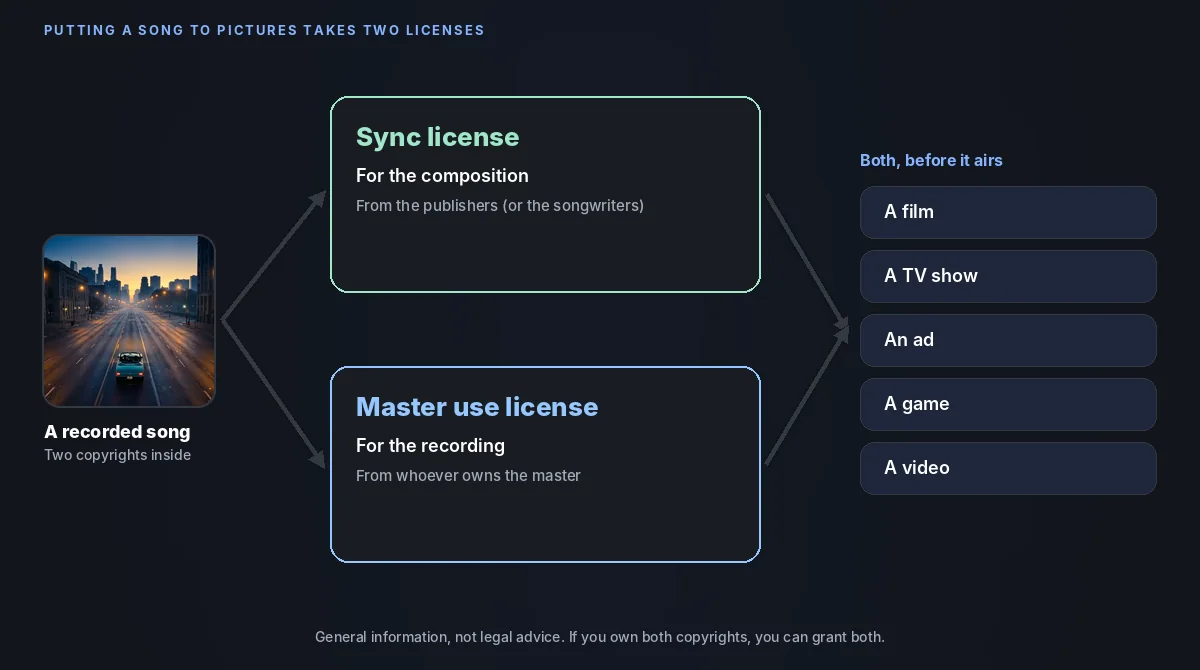
Sync money works differently from the rest: it's a fee negotiated for one use, not a royalty counted per play. Putting a recorded song in a film, a TV show, an ad, a game or a video someone else makes takes two permissions, a synchronization license for the composition from its publisher and a master use license for the recording from its owner. Owning both lets you agree to both at once, which makes your music simpler to clear. What is a sync license covers placements in both directions, and the music video copyright guide covers what you need before posting a video of a song you didn't write.
A placement can keep paying after the fee. When the show or the ad is broadcast, the TV station's blanket license with the PROs pays performance royalties to the song's writers and publishers, which is one more reason to have every song registered before you pitch it anywhere.
Publishing administration is the paperwork side of the composition. A traditional publisher usually takes a share of ownership in return for pitching and promoting your songs. An administrator, as Songtrust's introduction to publishing administration describes it, registers your songs with pay sources around the world and collects your publishing royalties while you keep complete ownership of your copyrights, in return for a fee or commission. It earns its cut once your songs are heard in several countries, since a society can only pay for a song it can match to a registered owner.
Where royalties go missing
Most missing money isn't taken by anyone. It's unmatched: plays that can't be tied to a registered song and its owners, so they sit unclaimed or end up shared out to others. These are the usual gaps, and each one is fixed with a form.
- A song released through a distributor but never registered with a performing rights organization
- A self-published writer with nobody collecting the publisher's share
- A US songwriter who joined a PRO but not The MLC
- A featured artist, or a master owner, not registered with SoundExchange
- A co-writer left off a registration, or shares that add up to more than 100%
- Titles, names or codes typed differently in different places
- Live shows never reported to the PRO
- Plays in other countries, with nobody registering the songs there
Check twice a year. Compare your distributor's statements with your streaming stats, look your songs up in your society's database and in The MLC's public search, and fix any song that is missing or split wrongly. If your catalog is growing and the forms are piling up, that's the point where an administrator starts to pay for itself.
The paperwork is done. Now get the song heard.
Upload the master you delivered and Muvora writes a storyboard on its beats for free. One render gives you the music video, a vertical clip and a Spotify Canvas loop. You confirm you own the song or have the rights to use it, and Muvora claims no ownership of the video you make.
Written by the Muvora team. Last updated November 16, 2026. Spotted something out of date? Tell us at [email protected].