The short answer
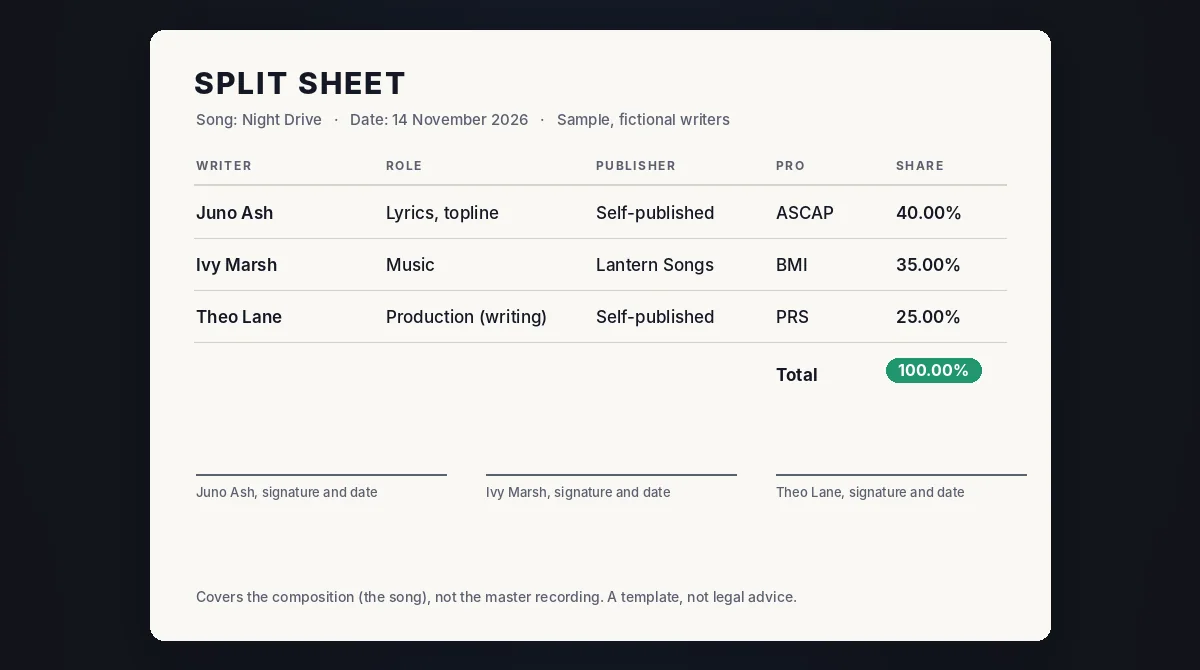
A split sheet is a short document, signed by every writer of a song, that records who wrote it and what share of the composition (the words and music) each one owns, adding up to exactly 100%. Publishers, performing rights organizations and, in the US, The MLC pay songwriting royalties by those shares, so fill it in during the session, before release.
- A split sheet covers the composition: who wrote the words and music, and each writer's percentage.
- Fill it in before everyone leaves the session, and always before the song is released.
- The shares must total exactly 100%, and every writer signs and dates the same version.
- The recording is separate: producer points and master ownership go in their own agreement.
- Register the shares exactly as signed, with each writer's PRO and, for US mechanicals, The MLC.
On this page (10 sections)ShowHide
- 1.What a split sheet is
- 2.Why it matters: the money follows the shares
- 3.What goes on a split sheet
- 4.How to make a split sheet, step by step
- 5.When to fill it in: in the session, before release
- 6.How co-writers usually split a song
- 7.Composition and master: producer points are a separate deal
- 8.Samples and interpolations change the shares
- 9.Register the splits after the session
- 10.Common split sheet mistakes
- Questions
What a split sheet is
A split sheet is a one- or two-page record of a song's songwriting ownership: the title, the date it was written, every writer's legal name, what each one contributed, their publisher and collecting society, and the percentage of the song each one owns. Everyone who wrote signs it. Songtrust's guide to how split sheets work describes it as proof of ownership for every song you create, and says it should name any sampled songs as well as each writer's publisher or administrator.
It's small on purpose. A split sheet doesn't decide who owns the recording, who gets paid for the session, or how a band shares its gig money. It answers one question that never gets easier with time: of this song's words and music, how much belongs to whom?
Why it matters: the money follows the shares
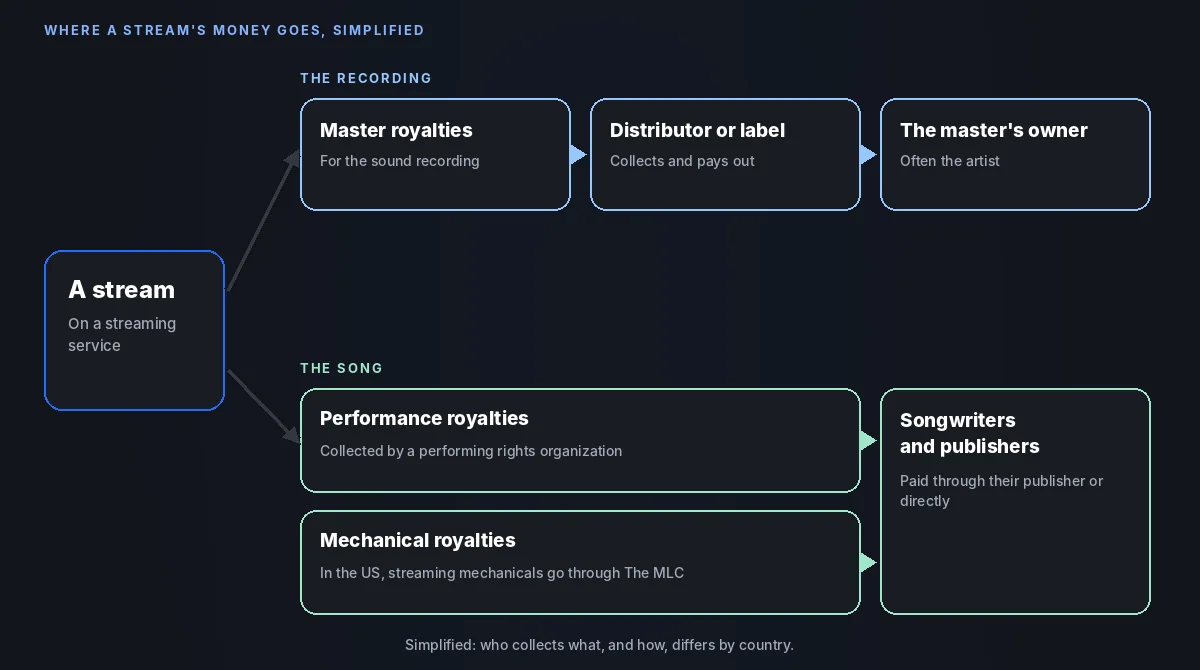
A song earns as a composition every time it is streamed, played on the radio, performed live, sold or licensed to a film or ad, and that money is divided by the shares registered for it. The organizations that collect it take those shares from the writers and their publishers, so a missing or disputed split shows up as a missing or frozen payment.
- Performance royalties are collected by a performing rights organization (PRO) such as ASCAP, BMI, PRS for Music or SOCAN, which pays each writer by the share registered for them.
- Mechanical royalties from US streaming are collected by The MLC, which calls it an overclaim when the shares registered for a song add up to more than 100% and gives its members a tool to resolve overclaims with the other claimants.
- Publishers and administrators register and collect on their writers' behalf, and they register the share the writer tells them, which is the share on the sheet.
- Licenses for films, ads, games and videos need the composition's owners to agree, and a buyer who can't work out who they are often moves on to another song.
The other reason is people. A co-write between friends can turn awkward the week a song takes off, and a page everyone signed while they still agreed settles the question before it becomes an argument. If there is no agreement at all, the law fills the gap: in the US, co-writers of a joint work are generally treated as owning equal shares however unequal their contributions were (FindLaw on joint authorship), which may not be what anyone in the room had in mind.
Skip the blank page
Upload your song and Muvora's AI director plans a shot-by-shot storyboard on the beat. Edit every shot for free, and pay only if you render.
What goes on a split sheet
Put down enough for a publisher or a collecting society to register the song without calling anyone back. Optional fields can stay blank when a writer doesn't have them yet; a missing name, share or signature can't.
- The song's title, and any working or alternate title it was known by
- The date it was written and where (a studio, a city, an online session)
- Whether it samples a recording or interpolates another song, and what
- Each writer's legal name, plus the artist or writer name they use
- What each writer contributed: lyrics, music, topline, production as writing
- Each writer's publisher or administrator, or "self-published"
- Each writer's PRO and IPI/CAE number, if they have them
- A way to reach each writer, such as an email address
- Each writer's share as a percentage, the total exactly 100%
- Every writer's signature and the date they signed
- A line saying the sheet covers the composition, not the master recording
The IPI/CAE number is the one most people don't know they have. BMI's FAQ on IPI/CAE numbers explains that IPI stands for Interested Parties Information and CAE for Composer, Author and Publisher, that it is a public international number identifying the people on a work, and that it isn't the same as a BMI account number. A writer gets one when they join a society, so a writer who hasn't joined yet simply leaves it blank.
Split sheet generatorFill in the song and every writer, split the shares equally or by hand until they reach exactly 100.00%, then print the sheet to sign or save it as text and CSV.How to make a split sheet, step by step
- 01
Open it before anyone leaves
Start the sheet at the end of the writing session, while everyone is still in the room or on the call. For a remote co-write, share it in the same thread you sent the demo in.
- 02
Write down the song
Add the title, any working title, the date and where it was written, and note anything it samples or interpolates, even if the clearance is still being worked out.
- 03
List every writer by legal name
Add each writer's legal name and the name they release under, what they contributed, their publisher (or self-published), their PRO and their IPI number if they have one.
- 04
Agree on the shares out loud
Decide whether the song is split equally or by contribution, type the percentages and check that they add up to exactly 100.00%, with no writer left at a blank.
- 05
Sign and date the same version
Every writer signs and dates one final version. If you are apart, send the PDF round and have each writer sign it and send it back, or reply in writing that they agree.
- 06
Give everyone a copy
Send each writer and their publisher the signed PDF, and keep it, with a CSV of the details, in the folder beside the song's master and stems.
- 07
Register the shares exactly as signed
Each writer, or their publisher, registers the song with their society using the same title, names and percentages, so every registration of the song agrees.
Song written and split? Plan its video
Once the mix is done, upload the master: Muvora finds the beats, sections and drops and writes a shot-by-shot storyboard you can edit for free before rendering anything.
When to fill it in: in the session, before release
The right moment is the end of the session that produced the song. Everyone remembers who found the chorus melody, nobody has a stake in remembering it differently yet, and the conversation takes five minutes. APRA AMCOS's page on co-writing splits advises getting the agreement in writing, noting that even an email chain is better than nothing, and The MLC's toolkit for lawyers tells writers to agree their splits with their co-writers and put the agreement on record before registering a song.
- Too early is fine: some writers agree the split at the start of a session ("equal, whatever happens") and only fill in the names at the end.
- At the latest, before release. Once the song is out, its registrations start collecting money, and every week without agreed shares is money waiting.
- Again whenever the song changes hands: a writer added on a second session, a verse replaced, a sample cleared. Make a new version, sign it, and mark the old one replaced.
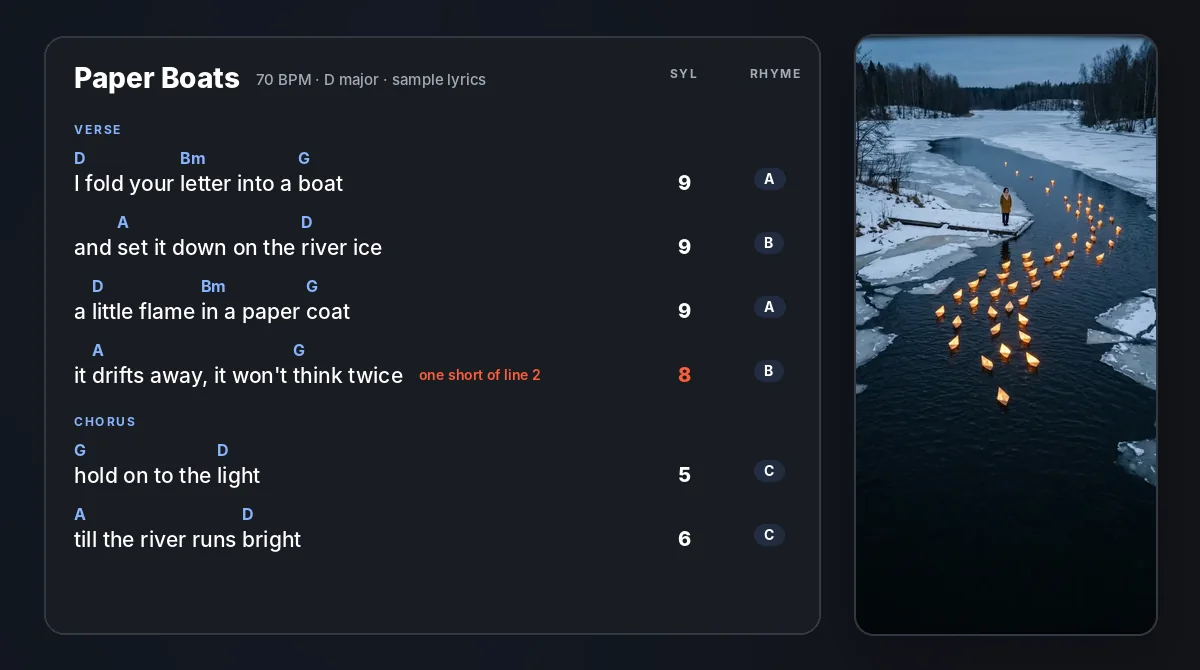
If the writing itself is still ahead of you, the guide to how to write a song covers the process from the first idea to a finished demo, and the split sheet is the last page of it. In the session itself, the chord progression generator and the syllable counter help with the chords and with lines that scan.
How co-writers usually split a song
There is no official formula. The shares are whatever the writers agree, and each common approach trades fairness to the details against how easy the conversation is.
| Approach | How it works | Where it's often used | The catch |
|---|---|---|---|
| Equal split | Every writer in the session gets the same share, whoever wrote what | Bands, writing camps, regular co-writing partners | One added line earns as much as the whole hook |
| By contribution | Shares follow who wrote what, weighed and agreed in the room | Sessions where one writer brought most of the song | It takes a frank talk, and it's hard to judge later |
| Words and music | Lyrics count for half and music for half, each half divided among its writers | Older publishing practice, lyricist and composer pairs | A topline writer works on both halves, so it rarely fits a modern session |
| Producer as writer | The track or beat counts as part of the music, and its maker takes a writer's share | Hip-hop, R&B, pop and electronic sessions built on a track | It covers the composition only; the producer's points on the recording are a separate deal |
APRA AMCOS describes an equal split as an equal percentage for everyone who was in the room during the writing, regardless of how much each person contributed. Many writers prefer it for exactly that reason: it rewards being in the session and avoids weighing a chorus against a bridge. A contribution split suits a song one writer arrived with nearly finished. Three writers might settle on 45% for the one who wrote the lyrics and topline, 40% for the one who built the chords and track, and 15% for the one who wrote one verse's melody.
Whatever you choose, write it in hundredths of a percent. Three equal writers can't each have 33.33%, because that adds up to 99.99%: one of them takes 33.34%. Bands that write together often agree one rule for every song in advance, which saves the conversation each time; the music videos for bands page covers the visual side of a band's release.
Composition and master: producer points are a separate deal
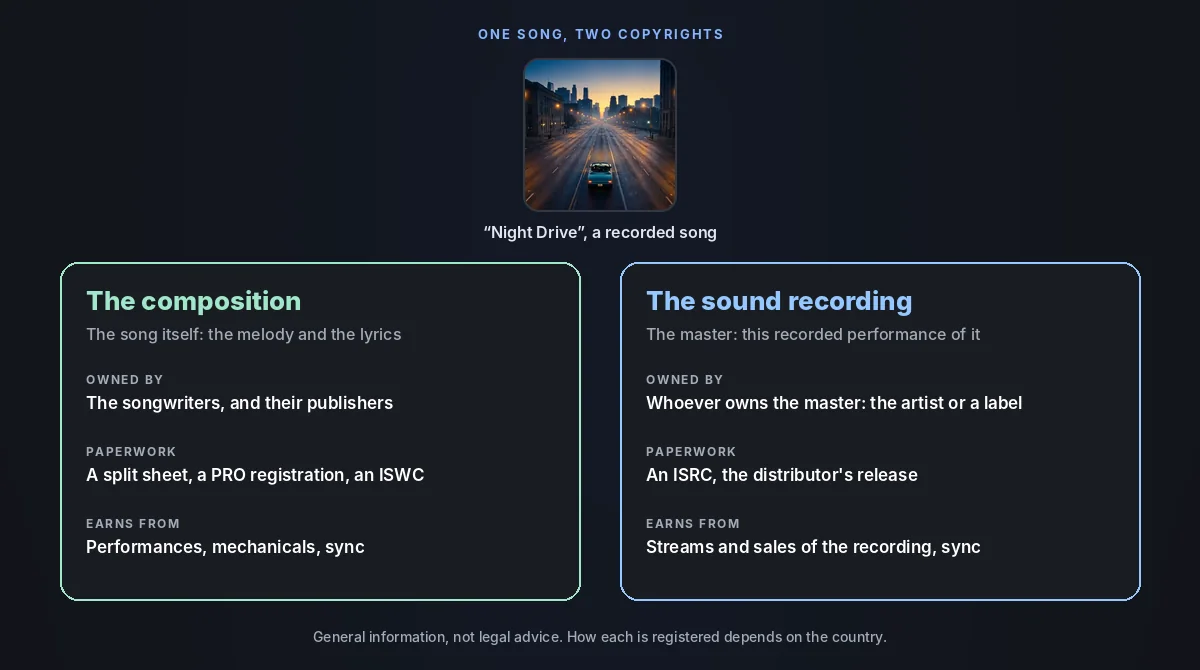
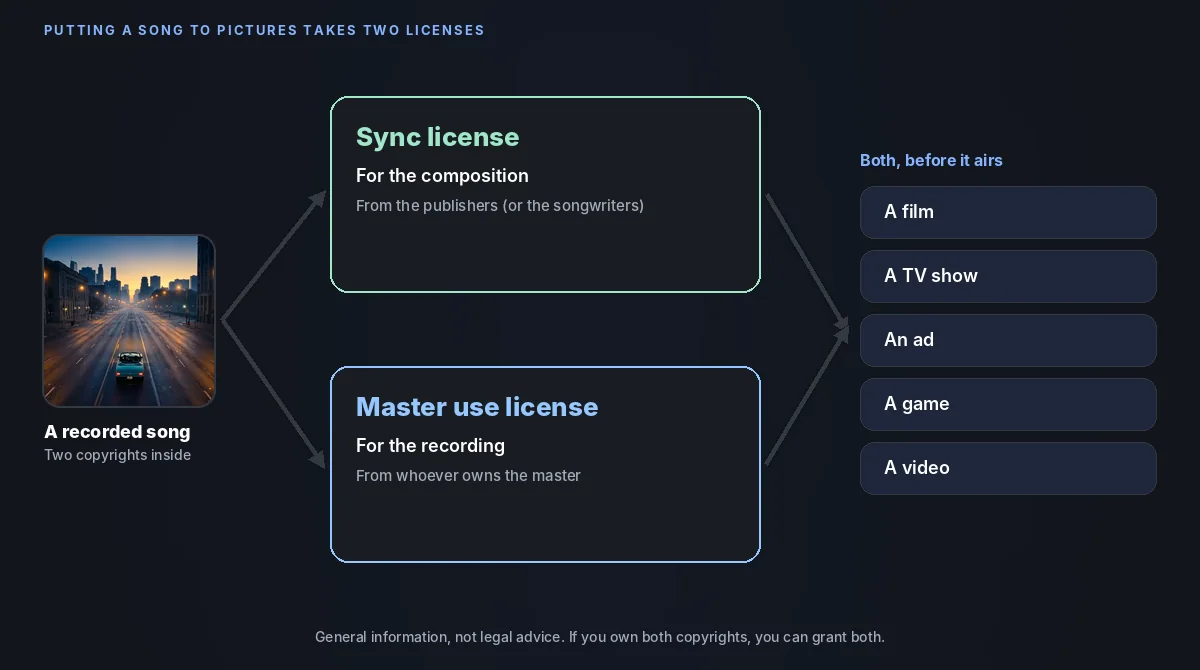
A released song is two things: the composition (the words and music, owned by its writers and their publishers) and the master (the recording, owned by whoever made and paid for it, often the artist or a label). A split sheet divides the composition. The master's money, which your distributor collects from the streaming services, is divided under different agreements, and the two don't have to match.
- On the split sheet: each writer's share of the words and music, including a producer who wrote part of them.
- Not on the split sheet: who owns the recording, a producer's points (a percentage of the recording's royalties, set in a producer agreement), a featured artist's royalty on the record, and fees for the session, the mix or the master.
- Both, separately: a producer can have points and no writer share, a writer share and no points, or both, so agree the two in two places.
Many distributors can also pay a share of a release's earnings straight to collaborators (RouteNote on how distributor splits work). That money comes from the recording, so it's the place for a producer's points or a band's share of the master, not for the writers' shares. To see roughly what the recording side earns from streams after a distributor and a master split, use the streaming royalty calculator.
Samples and interpolations change the shares
When a song uses part of another song, the other song's owners come into the split. An interpolation (replaying or re-singing a melody or lyric yourself) uses their composition, so its writers and publishers usually take a share of yours, agreed with their publisher before you release. A sample (lifting part of their recording) uses both their composition and their master, and Spotify for Artists' guide to sample clearance explains the two permissions that takes.
- Mark it on the sheet at once, with the original song's title and writers, even before you know whether it will be cleared.
- Treat the shares as provisional until the clearance is agreed: the original writers' share comes off the top, and the new writers divide what's left, in the same proportions or as they agree.
- Sign a new version once the clearance is settled, listing the original writers with the share their publisher agreed.
- Don't release before it's cleared. A song pulled for an uncleared sample takes its video, its playlists and its registrations with it.
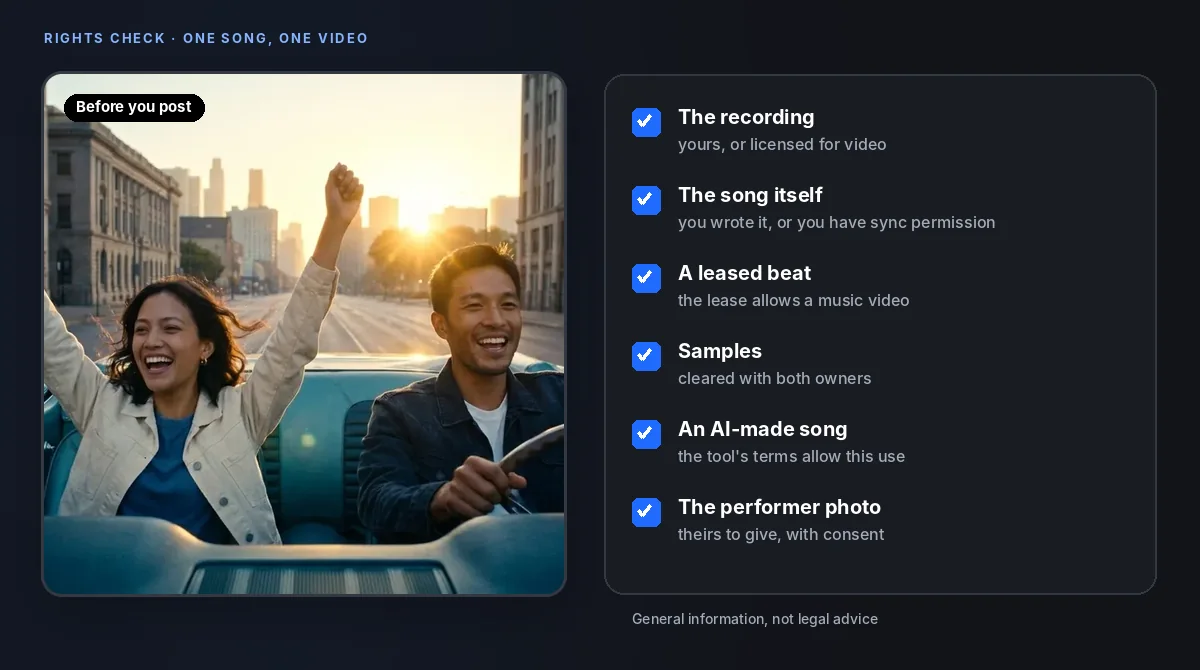
Covers, beat leases, AI-made songs and Content ID claims each raise their own permissions; the music video copyright guide goes through every situation and what to clear before you post a video.
Register the splits after the session
A signed split sheet collects nothing by itself. The shares start earning only once they are registered with the organizations that pay, and every registration should use the same title, names and percentages as the sheet.
- Your PRO. Each writer registers the song with their own society (or their publisher does), listing the co-writers and the agreed shares. Writers in different societies usually each register it with their own; check your society's help pages for how it wants co-writes entered.
- The MLC, for US streaming mechanicals. Its guidance on co-written songs is that each co-writer who keeps the right to register and collect their own share registers that share; a writer with a publisher or administrator leaves it to them. Belonging to a PRO doesn't collect these, as Spotify's explainer on The MLC points out.
- Outside the US, one organization often collects both kinds: PRS for Music (for PRS and MCPS) in the UK, APRA AMCOS in Australia and New Zealand.
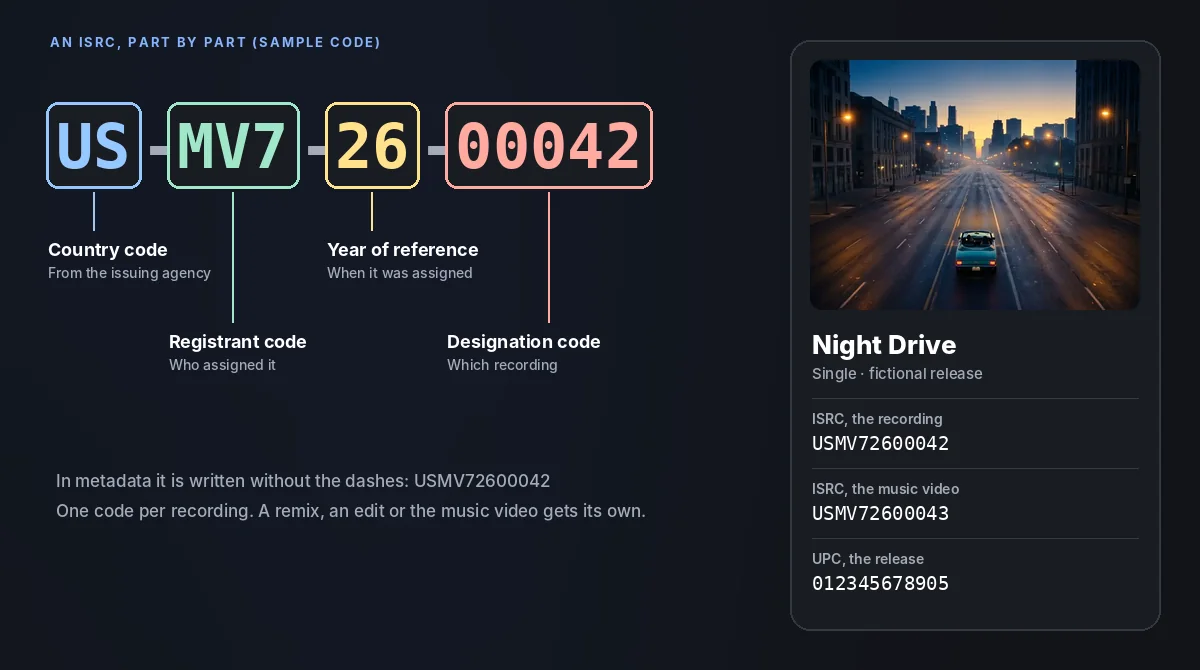
- Your distributor asks for writer credits with the release. Spell the names as on the sheet, so the credits on streaming services match the registrations.
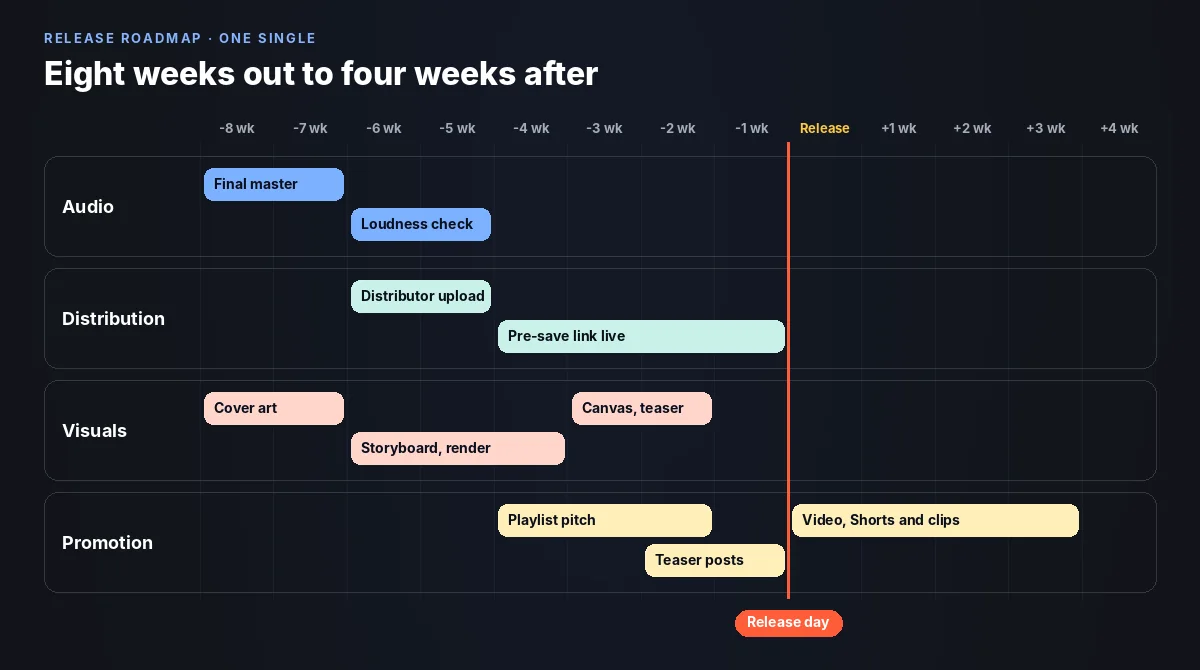
The rest of the release, from the master to the month after, is in how to release music independently, and the music release checklist turns it into boxes to tick. What a released song can earn on YouTube, as a composition and as a recording, is in how to monetize music on YouTube.
Mixed, cleared and split: now the video
The visuals are the last part of a release. Upload the song, pick a style and get a storyboard timed to its beats, with every cut on a downbeat. The free plan includes 5 new storyboards a month.
Common split sheet mistakes
- Waiting until the song makes money. By then memories differ and everyone has a reason to remember generously.
- Shares that almost add up. 33.33% three times is 99.99%; a society or publisher may question a total that isn't exactly 100%.
- Stage names only. Registrations and contracts use legal names; add the artist name beside it, not instead of it.
- Mixing in the master. Points, fees and the band's recording split belong in their own agreements.
- Forgetting the late writer. Someone who sent a lyric fix by voice note a week later may be a writer too; agree it and sign a new version.
- Several versions in circulation. Date each one, mark the old one replaced, and make sure every writer signed the same final version.
- Registering something different. A society entry that doesn't match the sheet creates the conflict the sheet was meant to prevent.
Once the sheet is signed and filed, the song's credits belong in public too: in the streaming metadata, in the video's description, and in the press kit. The YouTube description generator writes a credits block with the writers and producer, one line each.
Written by the Muvora team. Last updated November 14, 2026. Spotted something out of date? Tell us at [email protected].