The short answer
To make a lo-fi beat, set a slow tempo, often 70 to 90 BPM, and swing the drums so they lean back: a soft kick, a snare or rimshot on 2 and 4, loose hi-hats. Loop two to four jazz chords with 7ths and 9ths on a mellow keys sound, add a round bass, then wear it in with a low-pass filter, tape wobble and quiet vinyl crackle.
- Slow and swung: the drums sit a little behind the beat, never perfectly on the grid.
- Seventh and ninth chords give lo-fi its soft, unresolved color; move each note as little as possible.
- Sample only what you have the rights to: your own playing, licensed packs or cleared material.
- Texture is a set of effects on clean parts: filter the highs, add wobble and crackle, then turn them down.
- Keep it short and make the end lead back to the start, because lo-fi is heard in long playlists.
On this page (9 sections)ShowHide
- 1.What makes a beat sound lo-fi
- 2.How to make a lo-fi beat in seven steps
- 3.Tempo, swing and drums that lean back
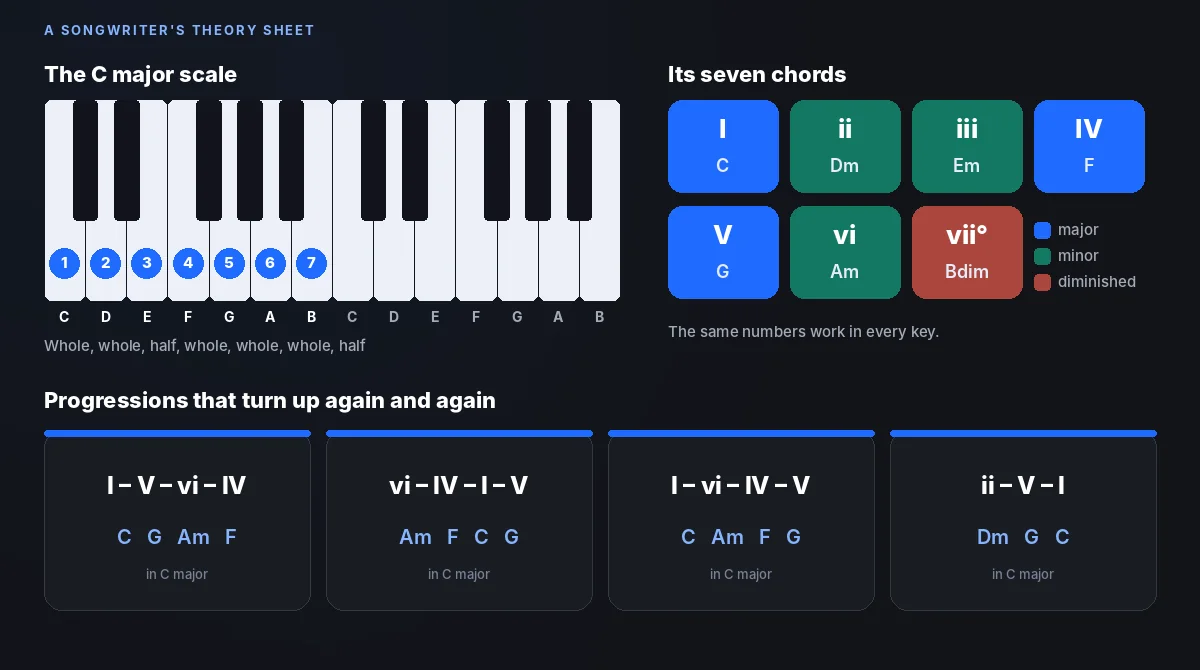
- 4.Jazz chords: sevenths, ninths and smooth voicings
- 5.A round bass and a melody that leaves room
- 6.Samples: only what you have the rights to
- 7.Texture: filters, tape and vinyl as effects
- 8.Arrange it short and loopable
- 9.Give the beat a video it can loop to
- Questions
What makes a beat sound lo-fi
Lo-fi hip-hop, the beats behind study streams and late-night playlists, takes its name from low fidelity: the sound of old equipment, worn tape and dusty records. Underneath that surface it's a hip-hop beat slowed down and softened, with jazz harmony on top. The surface is almost always added on purpose to clean recordings, which means you control how much of it there is.
- A slow, swung groove: drums that lean behind the beat, with soft hits and a backbeat on 2 and 4.
- Jazz harmony: two to four seventh and ninth chords looped, on electric piano, piano, guitar or soft pads.
- Rounded sound: the highs filtered off, so even the hi-hats are soft.
- Movement in the noise: tape wobble, crackle, hiss and room sound that keep a short loop from sounding frozen.
- Few words, if any: most lo-fi is instrumental, sometimes with a hummed line or a short sung phrase.
- A short, loopable form: a track that changes every 8 bars or so and ends where it began.
How to make a lo-fi beat in seven steps
- 01
Set a slow tempo and a swing amount
Start the project at 75 to 85 BPM with the grid's swing at about 58 to 62% (in MPC-style terms), and write the tempo and key into the project's name.
- 02
Find the chord loop
Play two to four seventh or ninth chords on an electric piano, a piano or a guitar, one chord a bar or two, and record yourself playing them rather than drawing them in, so the timing breathes.
- 03
Play the drums in loosely
Lay down a soft kick, a snare or rimshot on beats 2 and 4 and swung 16th-note hats, then move the snare and some hats slightly late and vary every hit's volume.
- 04
Add a round bass
Play the root of each chord on a soft, short bass sound, adding a passing note into the next chord, and keep it in the center of the mix.
- 05
Add one melody or texture layer
Put a short melody, a hummed phrase you recorded or a field recording of your own on top, and leave plenty of empty bars around it.
- 06
Make it warm and worn
Low-pass the drums or the whole loop, add gentle tape saturation and wobble to the chords, and lay a quiet crackle or hiss under everything.
- 07
Arrange a short track and export
Build an intro, two or three 8-bar sections and a break from the loop, end on the intro's chords so it loops, and bounce a WAV named with the tempo and key.
Skip the blank page
Upload your song and Muvora's AI director plans a shot-by-shot storyboard on the beat. Edit every shot for free, and pay only if you render.
Tempo, swing and drums that lean back
Lo-fi beats often sit between 70 and 90 BPM, slow enough that a bar lasts three seconds or more. The groove comes from swing: each pair of 16th notes is played long-short instead of even. Drum machines in the MPC tradition measure swing as the share of each 8th note the first 16th takes, so 50% is straight and about 66% is a triplet feel; many DAWs use their own scales, so match by ear. The table shows what those settings do at 80 BPM, where an 8th note lasts 375 ms.
| Swing | First 16th lasts | Second 16th lasts | How it feels |
|---|---|---|---|
| 50% | 187.5 ms | 187.5 ms | Straight: tidy, a little stiff for lo-fi |
| 54% | 202.5 ms | 172.5 ms | A light lean, felt more than heard |
| 58% | 217.5 ms | 157.5 ms | Relaxed: a common lo-fi starting point |
| 62% | 232.5 ms | 142.5 ms | Heavy, head-nodding swing |
| 66% | 247.5 ms | 127.5 ms | Close to triplets (250 and 125 ms): almost a shuffle |
- Drag the backbeat: move the snare or rimshot a little late, often somewhere around 10 to 30 ms at these tempos, so it drags behind the kick without sounding like a mistake. Trust your ears over the number.
- Soft sounds: a round, short kick, a snare with some room in it or a rimshot, brushed or quiet hats and a shaker. Hard, bright samples fight the filter later.
- Uneven hats: no two hats at the same volume. Accent the first of each pair and let the swung one fall back.
- Fewer kicks: one on beat 1 and one somewhere around beat 3 is often enough; a lazy kick pattern leaves space for the bass.
- Partial quantize: if you play the drums in, many DAWs let you quantize at less than full strength, which tightens the worst slips and keeps the feel.
Jazz chords: sevenths, ninths and smooth voicings
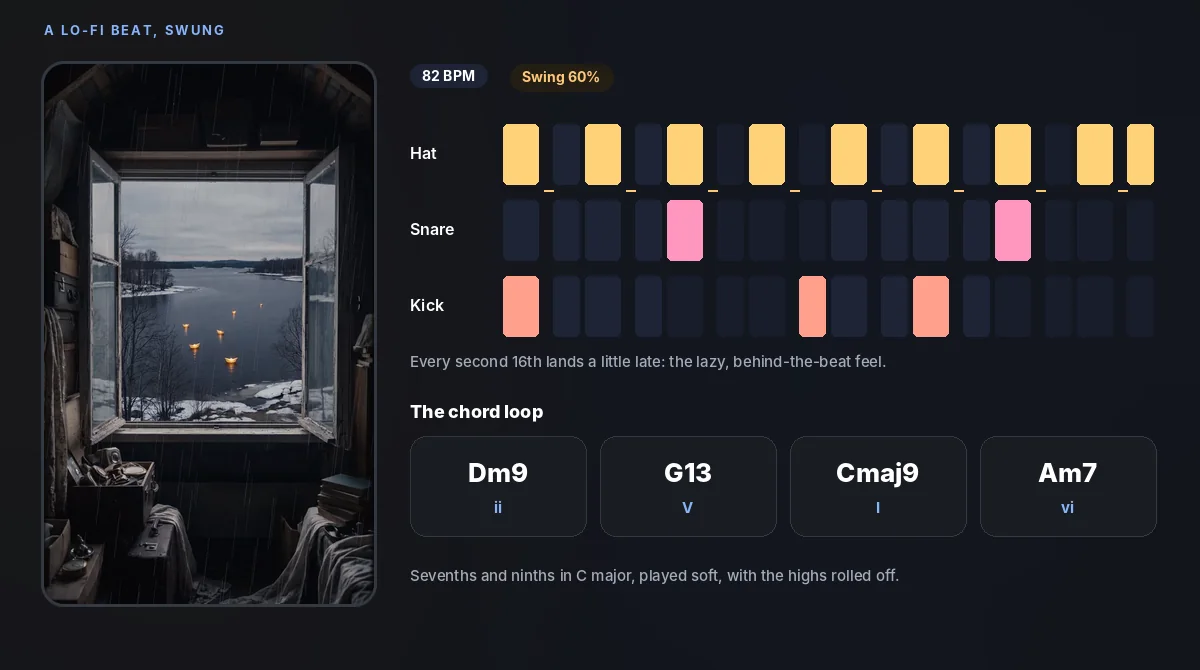
Most of lo-fi's mood comes from its chords. A plain triad (three notes) sounds settled; stack one more third on top for a seventh chord and another for a ninth, and the chord gets softer and less final, which is what lets a loop of two to four chords play for two minutes without wearing out. Major sevenths sound warm and a little wistful, minor sevenths and ninths mellow, dominant chords with added 13ths lean forward. The loops below were written for this guide; the first is the one in the picture at the top.
| Loop | Chords and notes | Numerals | What it does |
|---|---|---|---|
| ii–V–I–vi in C | Dm9 (D F A C E), G13 (G B D F A E), Cmaj9 (C E G B D), Am7 (A C E G) | ii9–V13–Imaj9–vi7 | Jazz's favorite cadence, then the vi to turn the loop around |
| Stepping down in C | Fmaj7 (F A C E), Em7 (E G B D), Dm7 (D F A C), Cmaj7 (C E G B) | IVmaj7–iii7–ii7–Imaj7 | One step down per chord: calm, easy to voice |
| Two-chord minor vamp | Am9 (A C E G B), Dm9 (D F A C E) | i9–iv9 in A minor | Two chords for a whole track; the ninths keep it moving |
| Turnaround in E♭ | E♭maj7 (E♭ G B♭ D), Cm9 (C E♭ G B♭ D), Fm9 (F A♭ C E♭ G), B♭13 (B♭ D F A♭ C G) | Imaj7–vi9–ii9–V13 | A warm I–vi–ii–V cycle in a flat key |
How you voice the chords matters as much as which ones you pick. Let the bass play the root and keep the right hand's notes close together, moving each as little as it can. In the first loop: over a D in the bass, play F, A, C and E for Dm9. For G13, over a G bass, keep F, A and E and move only the C down to B. For Cmaj9 over C, move three notes down a step and keep the B: E, G, B, D. For Am7 over A, keep E and G, move the B up to C and let the D go. Four chords, and the hand barely moves, which is why the loop sounds like one gentle line.
Got a finished loop? See it as a video
Upload the beat and Muvora reads its tempo, every downbeat and its sections, then writes a calm storyboard on the lo-fi look, whose shots run longer than in any other genre look. Reading and editing it is free, with 5 new storyboards a month on the free plan.
A round bass and a melody that leaves room
The bass in lo-fi is soft and short: a muted electric or upright bass, or a sine-like synth with its edge filtered off. It plays the root of each chord and, now and then, one passing note into the next. A classic jazz move is approaching the next root from a half step below, so before the Cmaj9 in the first loop the bass plays B, then C. Keep it in the center and well below the chords, and don't let it ring into the next note.
- Melody from the chord tones: a few notes taken from the chord under them, or from the key's pentatonic scale, almost always sit right.
- One idea per section: a two-bar phrase repeated with a change at the end is plenty; leave whole bars empty.
- Mellow sounds: an electric piano, a muted guitar, a soft synth lead, a flute or a vibraphone, filtered like the rest.
- Your own voice: a hummed or whistled line, recorded on a phone and filtered, gives a beat a melody nobody else has.
- Chop your own playing: record yourself improvising for a minute, cut the best moments into pieces and play them back in a new order, the way producers chop samples.
Samples: only what you have the rights to
Lo-fi grew up on samples: a few bars of an old record, chopped, pitched and looped. That's also where many beats run into trouble. A sample of a recording uses two copyrights at once, the recording's and the song's, and both owners have to agree before anything built on it is released or sold. Recording the record yourself, slowing it down or filtering it doesn't change who owns it, and using only a second or two doesn't make it safe. Old doesn't mean free either: recordings and songs stay protected for decades, for different lengths in different countries.
- Play it yourself: a few bars of keys, guitar or bass that you recorded, then chopped like a sample, are yours from the start.
- Sample packs: packs sold for music production usually come with a license to release music made from them. Read it: royalty-free means no fee per use, not no rules, and some licenses limit things such as reselling the sounds or registering them for Content ID.
- Your own field recordings: rain on a window, a kettle, footsteps, a train. Keep other people's music, playing in a café or a car, out of the recording.
- Musicians you hire: a session player's part, recorded for your beat, with a written note of who owns it.
- A cleared sample: written permission from both the recording's owner and the song's publisher, before release.
Texture: filters, tape and vinyl as effects
The worn sound people hear as lo-fi is mostly made with effects on clean parts. Each of these is a common move; the usual mistake is using all of them at full strength, on everything. Put most of them on the chords and the drums, keep the bass clean, and check the result against a beat you like at the same volume.
- A low-pass filter: rolls off the highs, so hats go soft and keys go round. Set it by ear on the drums or on the whole loop until the brightness goes but the hats still tick, and open it a little for a later section.
- Tape saturation: gentle distortion that rounds off the peaks and adds warmth, on the chords and the drum bus.
- Wow and flutter: wow is a slow drift in pitch and flutter a faster waver. A little detunes the chords pleasantly; too much puts them out of tune with a clean bass, so keep it off the bass.
- Bit and sample-rate reduction: fewer bits or a lower sample rate adds grit. A small amount on the drums goes a long way.
- Crackle and hiss: a layer of noise from a licensed pack or your DAW's noise generator. Filter the lows out of it and set it so you notice when it stops rather than while it plays.
- Room: a short room reverb on the drums and a longer one on the keys make parts recorded apart sound like one place. Time a delay to the tempo with the delay time calculator.
- A gentle pump: sidechain the chords to the kick so they dip slightly on each hit and swell back, a slow breathing motion.
Arrange it short and loopable
Lo-fi tracks are often short, many around two minutes, and they're heard one after another in long playlists, so the arrangement does two jobs: keep a simple loop interesting for its length, and end in a way that flows into whatever plays next. Change something every 8 bars, and let the ending lead back to the beginning.
| Section | Bars | Length | What plays |
|---|---|---|---|
| Intro | 4 | 12 s | The chords alone, filtered, over the crackle |
| A | 8 | 24 s | Drums and bass come in and the filter opens a little |
| B | 8 | 24 s | The melody, or a second chord loop |
| Break | 4 | 12 s | Drums out: keys, texture and perhaps your own field recording |
| A again | 8 | 24 s | Everything back, with one change: a new hat pattern or a counter-melody |
| Outro | 4 | 12 s | The intro's chords again as the filter closes, or a slow tape stop |
- End where you began: the outro's chords and crackle match the intro's, so the track loops on repeat and sits well beside the next one.
- Don't crush it: lo-fi's soft edges are the point, and streaming services turn loud masters down toward their own reference level anyway. LUFS for streaming shows how far.
- Bounce clean files: a WAV of the whole track from bar 1, named with the tempo and key, and the stems if anyone will remix or mix it.
Give the beat a video it can loop to
Lo-fi is one of the genres people listen to with a picture: a looping scene behind a stream, a channel's visual identity, a Canvas on Spotify. The picture's job is to set a mood and then stay calm, which the lo-fi music video ideas guide turns into concepts. Muvora makes that video from the beat file itself.

Upload the beat (MP3, WAV, M4A, AAC or FLAC, up to 8 minutes and 60 MB) and confirm you have the rights to it, samples included. The analysis finds the tempo, every downbeat and the sections. Pick the lo-fi look, which lets every shot run about a third longer than the default pace, and the Abstract style for a moving painting with no cast, or Story for a character in a room or on a night train. The storyboard puts every cut on a downbeat and is free to read and change before you render. An instrumental gets no lip-synced shots or captions; a lo-fi song with words can use the Lyric style, with each word lighting up as it is sung.
The soundtrack is your upload, untouched, so bounce the final version first. One widescreen render also gives you a 9:16 version for Shorts and Reels, a square cut and an 8-second Canvas loop. The lo-fi music video page shows the look, music videos for producers covers releasing instrumentals with a video, and how to make a trap beat is the same walk-through for the faster, darker side of beatmaking.
Make a calm video for your lo-fi beat
Upload the beat for a free storyboard on the lo-fi look: long shots, slow camera moves and a cut on every downbeat, set in the room, the weather or the drawn style you describe. The exact price shows before you render, from 38 credits a second in Visualizer, and shots that fail cost nothing.
Written by the Muvora team. Last updated November 18, 2026. Spotted something out of date? Tell us at [email protected].